One vocabulary, three study modes: read, listen and practice
Do more with the list you already have. Reading, MP3 listening and active matching train different parts of recall.

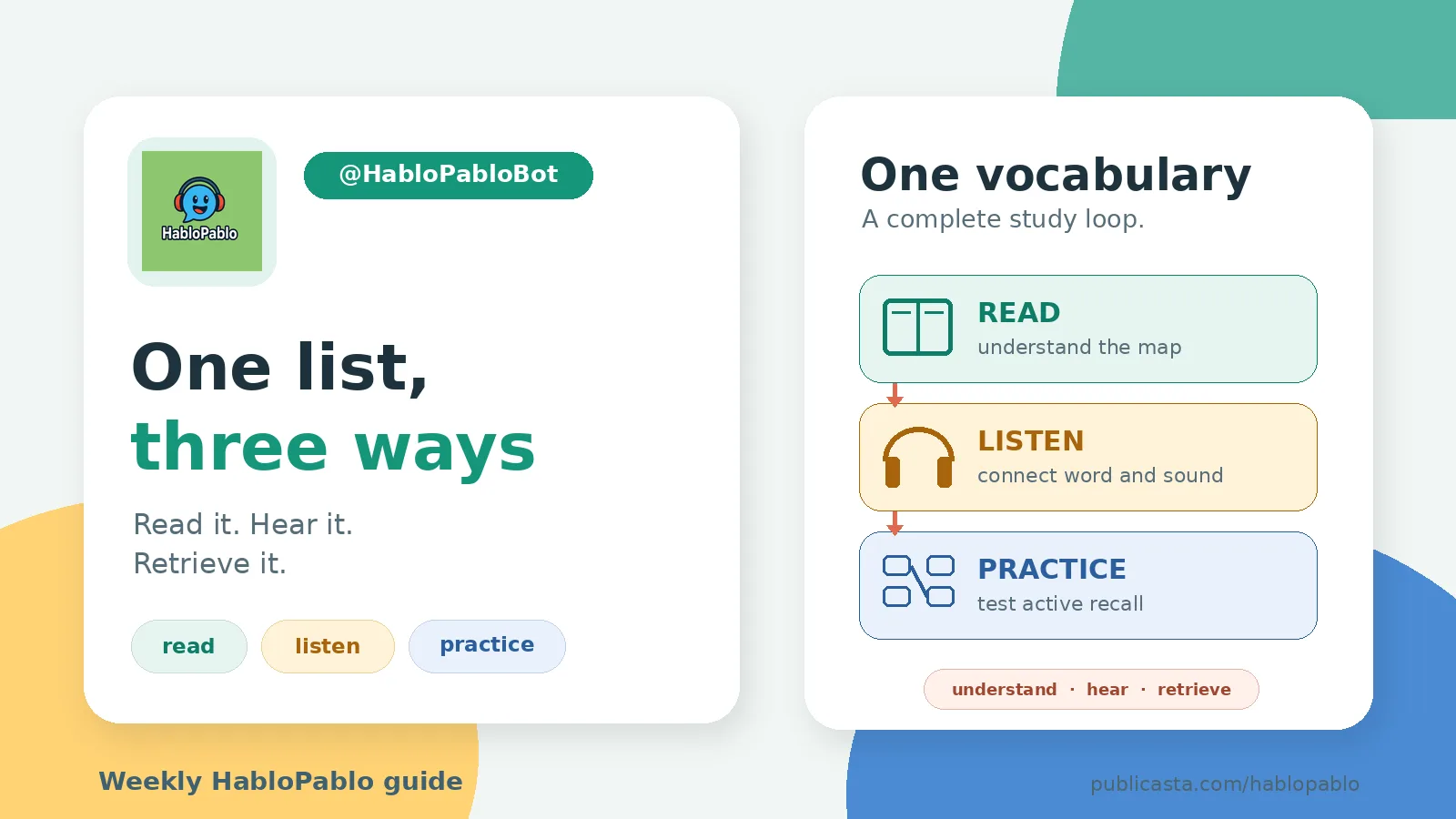
Creating a vocabulary is only the beginning. The useful work happens when you meet the same words in more than one way. Reading helps you understand the list, listening connects it to sound, and active practice reveals what you can recall without looking.
You do not need three different vocabularies for these steps. One focused list can support all three.
1. Read to understand the map
Start by reading the vocabulary without trying to memorize every line. Check the direction of translation, notice familiar words and mark the items that look similar or easy to confuse.
This first pass answers basic questions: Does the list match the topic you wanted? Are the translations clear? Are there phrases that would work better as individual words for practice? Fixing the material now is easier than repeating an awkward pair many times later.
Read difficult words aloud once or twice. The goal is not a perfect score; it is to give every item a clear meaning before sound and recall enter the routine.
2. Listen to connect spelling and sound
An MP3 vocabulary changes the context. You can listen while walking, doing routine work or preparing for the next practice session. Hearing both sides of a pair helps connect the written word with pronunciation and rhythm.
Do not turn audio into background noise for hours. A short, attentive listen is more useful: pause when a word feels unfamiliar, predict the translation before it is spoken, or repeat the word aloud.
Our guide to MP3 vocabularies explains when audio is especially helpful. Creating MP3 is a separate action in the bot, so use it when listening fits your goal rather than as a mandatory step for every list.
3. Practice to test recall
Reading and listening both provide the answer. Practice removes that support for a moment: you see one side and have to choose its match. That small effort is what shows the difference between “this looks familiar” and “I can retrieve it”.
Open /train, choose the vocabulary and complete a matching round. The result shows correct attempts, mistakes and difficult pairs. If a few words caused trouble, use Practice mistakes instead of restarting the whole list.
The word-pair practice guide describes the matching flow, while the practice-results guide shows how mistakes become a focused follow-up round.
A simple 15-minute routine
Try this compact sequence with a vocabulary you already own:
- Read for three minutes and identify the difficult words.
- Listen for five minutes and predict several translations.
- Practice for seven minutes, then repeat only the mistakes.
The exact minutes do not matter. The sequence does: understand, hear, retrieve. On a busy day, choose just one step. On another day, continue with the same vocabulary rather than generating a replacement.
Open HabloPablo, choose a ready list and use it in the mode that fits today. When you return tomorrow, another mode can make the same words feel new without throwing away the progress you already made. Start with HabloPablo when you are ready to turn one list into several useful sessions.
Related articles
What your word-practice statistics actually tell you
Sessions, matched words, accuracy and a streak mean different things. Use each number to choose a small, useful next step.

Gemini 3.8 Live Makes Voice Agents More Useful—and More Operationally Demanding
Google’s Gemini 3.8 Live brings background tool calls, live visual input and native speech-to-speech interaction to voice agents. The practical question is no longer whether it can talk, but whether a team can control latency, permissions, data retention and failure recovery.

How to share a vocabulary with a friend and get a bonus
HabloPablo sharing lets a friend add your ready vocabulary from Telegram, and a bonus coupon appears when sharing actually helps a new user start.

Preschool Shared Reading Is Still Recoverable: A Practical Plan for Bringing Books Back Into Family Life
A recent national study found that shared book reading with preschoolers remained below pre-pandemic levels through 2024. The useful response is not a stricter reading quota, but a low-friction routine built around access, choice and conversation.

Comments
Sign in to comment.
No comments yet.