HAARP’s October 23 Transmission Window: A Practical SDR Listening and Reporting Plan
HAARP’s research transmissions supporting the INFUSE-II and DUST-III sounding rockets run through October 24. Here is how operators and shortwave listeners can monitor the 2.8–10 MHz range without mistaking a variable research signal for a normal amateur-band opening.
What HAARP Is Transmitting and Why the October Window Matters
The High-frequency Active Auroral Research Program, or HAARP, is a University of Alaska Fairbanks research facility used to study the ionosphere. That distinction matters before any receiver is switched on: HAARP is not an amateur repeater, and it is not an ordinary broadcast station with a fixed program that listeners can expect to hear continuously. Its transmissions are part of controlled research activity, so the signal may appear, change, stop, or remain absent even while an announced operating window is in progress.
The official notice schedules a research campaign for October 20–24 UTC. During that period, HAARP transmissions in the 2.8–10 MHz range are intended to support the INFUSE-II and DUST-III sounding-rocket missions. For listeners, the important point is that the radio activity and the rocket missions are related parts of the same research effort, but they should not be treated as one uninterrupted event. A rocket mission does not by itself guarantee a signal on the air, and a signal heard during the campaign should not automatically be interpreted as a launch transmission or as proof that a particular mission phase is underway.
That uncertainty is central to making useful observations. The published frequency span is broad enough that a listener should approach the campaign as a search across a portion of the HF spectrum rather than as a hunt for one permanent channel. The notice identifies the range in which transmissions may occur, but it does not turn every frequency inside that range into a dedicated HAARP frequency. Conditions, research requirements, and coordination with the sounding-rocket work can affect what is transmitted and when. In practical terms, the announcement defines an opportunity for monitoring, not a promise that a receiver will find a stable carrier at a predictable spot.
This also changes how an observation should be described. A new sound in the 2.8–10 MHz range may be worth recording, but frequency alone is not enough to establish its identity. The same part of the spectrum can contain ordinary amateur, shortwave, utility, or other signals, and a receiver can also produce misleading effects through overload or intermodulation. A responsible listening log therefore begins with context: the UTC time, the frequency or observed frequency range, the receiver and antenna used, and the behavior of the signal. Notes about whether it appeared briefly, shifted, widened, or disappeared are more useful than a confident label based only on where it was heard.
For operators and shortwave listeners, the October window is therefore best understood as a structured listening opportunity. The goal is not to force a match between an interesting sound and the HAARP name, but to observe carefully within the announced campaign period and preserve enough evidence for later comparison with official information. A receiver can monitor the stated range while the listener remains aware that the transmitter may not be active continuously. That combination—broad searching, disciplined timing, and modest claims—provides the right foundation for the more detailed schedule and identification work that follows.
The Schedule Is Useful, but the Frequency Is Deliberately Unfixed
The published listening window for the HAARP campaign is 0530–0930 UTC on each of October 20, 21, 22, 23, and 24. That four-hour block is the most useful starting point for planning a receiving session, especially for listeners who need to arrange an antenna, record a waterfall, or leave an SDR running unattended. It should be treated as a period in which transmissions may be scheduled, however, rather than as a promise that the transmitter will be active continuously from the opening minute to the closing one. A planned window gives observers a common reference; it does not turn the event into a conventional broadcast with a fixed programme and uninterrupted carrier.
The practical implication is that a listener should be ready before 0530 UTC and continue monitoring through the end of the listed period, while allowing for gaps or changes. The operating timetable can move in response to ionospheric and geomagnetic conditions, as well as coordination with the sounding-rocket work associated with the campaign. Those factors make the schedule valuable without making it rigid. A quiet first part of the window is therefore not enough to conclude that nothing will happen, just as a signal heard briefly is not evidence that the entire session has begun or that it will remain on the air.
Frequency planning requires the same caution. The notice identifies a broad range of 2.8–10 MHz, but it does not establish one authoritative channel for the whole campaign. HAARP research transmissions can use different parts of that range as the work requires, and a receiver parked on a single frequency may simply miss an emission that has moved elsewhere. For that reason, the 2.8–10 MHz range should be treated as a search area rather than a list of guaranteed channels. The absence of a signal at one frequency says little about what may be occurring elsewhere in the band.
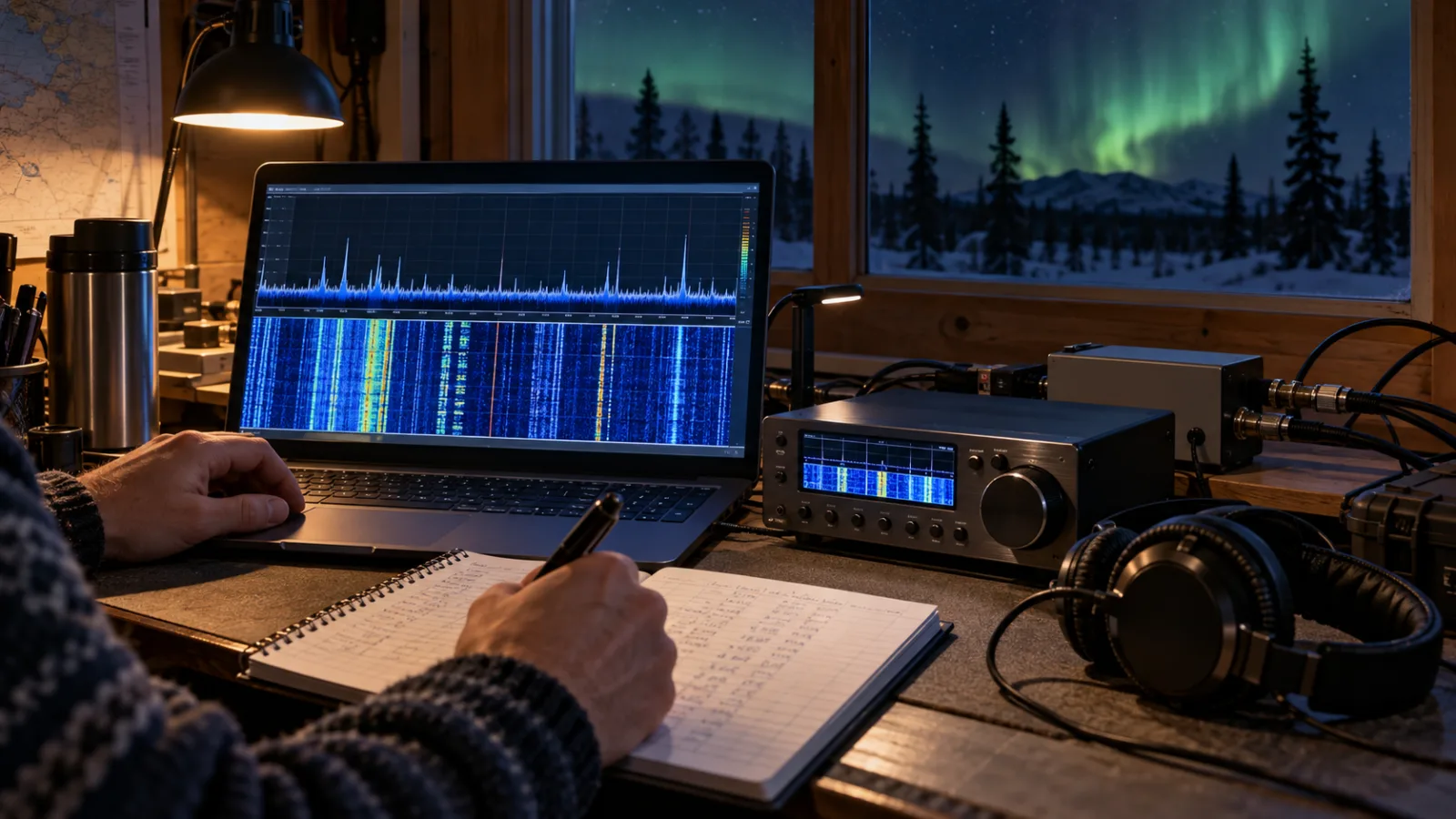
When the receiver or SDR can display the span, a wideband view is the most efficient first step. A waterfall covering as much of 2.8–10 MHz as the hardware and sample-rate limits allow can reveal a new trace, a carrier that appears and disappears, or a wider block of energy that would be easy to overlook while tuning manually. If the equipment cannot show the full range at once, divide the monitoring task into smaller segments and revisit them during the window. The objective is not to predict a frequency from the calendar, but to detect activity and then document where it appeared.
The official HAARP transmission notice should remain the primary reference for schedule changes and operational information. Its diagnostic suite is also important because it can provide current indications that are more useful than assumptions based on an earlier timetable. Check those official resources before the session and again while monitoring if the status changes. Reports from listeners and amateur-radio discussion can help indicate what others are observing, but they should not replace the official notice when deciding whether a time or frequency is current.
It is also useful to separate three different statements: a transmission is planned for a stated window; the transmitter is operating at a particular moment; and a listener has received a signal that may be associated with the experiment. These are not interchangeable. The first comes from the schedule, the second requires an operational indication or direct observation, and the third requires evidence from the receiver. Keeping those distinctions clear prevents a published time range from being mistaken for proof that a signal must be present at every location and on every receiver.
A disciplined log can make the uncertainty productive. Record the UTC start and stop times of each observation, the frequency or frequency range examined, and whether the receiver was scanning or parked. If a trace appears, note how long it lasts and whether it remains in place or shifts. Preserve a waterfall image that includes the time scale and frequency markings, and retain an audio recording when practical. These details allow the observation to be compared with the official window and with later reports without overstating what the schedule alone can establish.
For October 23, the same rule applies as for the other listed dates: use 0530–0930 UTC as the published window, monitor broadly across 2.8–10 MHz, and expect the actual operating pattern to be variable. A successful listening plan is therefore built around readiness and documentation rather than a single frequency prediction. The schedule tells you when to pay attention; the live notice, diagnostic information, and receiver evidence determine what can responsibly be said about what was heard.
A Receiver Workflow for Finding and Identifying the Signal
Treat the observation as a receive-only exercise from the outset. An SDR or HF receiver should be used to watch the published 2.8–10 MHz range, rather than to search for one supposedly fixed HAARP frequency. If the receiver and software can display the full span at once, begin with a wide waterfall view covering that range. If the hardware cannot provide that bandwidth in a single view, step through the range in manageable sections and keep the same UTC clock and recording practice throughout. The purpose of the first pass is to notice a signal that changes the normal pattern of the band: a new carrier, a broader block of energy, or a transmission that appears and disappears while the rest of the spectrum remains familiar.
A waterfall is especially useful because it preserves the signal’s behavior over time. A conventional audio check can miss a short transmission or make an unfamiliar emission sound like noise, while a waterfall can show when energy begins, how long it remains present, whether it moves in frequency, and whether its width changes. Once a possible signal is visible, narrow the displayed or recorded passband around it for closer inspection. Do not assume that the first visible trace is the complete emission. The transmission notice allows for different forms of emission, including a carrier, single sideband, or wider modulation extending to about 46 kHz. That means the appropriate receiver setting may vary: a narrow mode can help inspect a carrier or one sideband, while a wider view is needed to understand the structure of a broad signal. If a narrow demodulator produces only an odd tone or partial audio, return to the waterfall and examine the occupied bandwidth before drawing conclusions.
The same caution applies to frequency. The signal may change frequency during the planned operating window, and its on/off cycles may not follow a simple continuous pattern. A receiver should therefore remain capable of revisiting the full range instead of locking permanently to the first frequency where activity is seen. Record the center frequency and, where possible, the approximate lower and upper edges of the visible emission. Note the mode selected for listening, but distinguish that software setting from the physical character of the signal: selecting USB, LSB, AM, or another demodulation mode does not establish what the transmitter was using. It only describes how the receiver presented the observation.
For every potentially relevant event, preserve a UTC timestamp. A useful log should include the date, start and end time, observed frequency, approximate bandwidth, receiver mode, and a brief description of the signal’s behavior. Add the receiver location and antenna information, since those details help place the observation in context and make later comparison possible. If the receiver software provides a spectrum or waterfall capture, save an image or export that record with a filename tied to the UTC time. An audio recording can supplement the visual evidence, particularly when the signal has a recognizable carrier, sideband structure, or changing modulation. Keep the original capture when possible rather than relying only on a processed clip.
A practical log entry might look like this:
| Field | What to record |
|---|---|
| UTC time | First appearance, last appearance, and any significant interruptions |
| Frequency | Center or carrier frequency, plus the observed range if visible |
| Bandwidth | Approximate occupied width and whether it changed |
| Mode | Receiver demodulator setting used for the audio check |
| Signal behavior | Carrier, sideband-like, wider emission, frequency movement, or on/off cycling |
| Station setup | Receiver location, antenna, and relevant SDR settings |
| Evidence | Waterfall or spectrum capture and an audio recording, if available |
This level of detail also helps prevent a common mistake: treating a clear signal as self-identifying. The 2.8–10 MHz span contains many ordinary users of the HF spectrum, including amateur, shortwave, utility, and other signals. A carrier that happens to appear during the expected period, or that falls somewhere inside the published range, is not by itself proof of HAARP activity. Identification should come from the combination of timing, observed behavior, bandwidth, frequency changes, and a record that another listener can examine. When possible, compare the same event with a second receiver or antenna. Agreement between independent receiving arrangements is more informative than a single unexplained trace, although it still does not turn frequency alone into confirmation.
The safest workflow is therefore iterative: scan the range, mark unusual activity, zoom in, observe its shape and timing, capture the evidence, and return to the wider view when the signal stops or moves. Keep the receiver passive throughout. The campaign is an opportunity to document a variable research transmission, not a reason to transmit into the band or to alter the receiver’s findings to fit an expected pattern.
How to Report a Reception Without Overclaiming
A reception during the published October 20–24 UTC campaign window can be worth documenting, but timing alone does not identify a signal as HAARP. The 2.8–10 MHz range is shared by amateur, shortwave, utility, and other services, and a receiver can also produce apparent signals through intermodulation or other unwanted responses. A carrier heard at a convenient frequency is therefore an observation, not proof of origin. The useful question is whether several independent details fit the transmission notice and the signal’s recorded behavior.
Begin by placing the report in context. Record the observation in UTC and compare it with the relevant daily operating window, while remembering that a planned window is not a guarantee that the transmitter will be active continuously. Note when the signal first appeared, when it disappeared, and whether it changed frequency, mode, bandwidth, or amplitude during the observation. A signal that switches on and off, moves within the announced range, or changes from a narrow carrier to a wider emission may be consistent with the notice’s description of possible operating modes. Those features still do not establish an identification by themselves, but they are more informative than a frequency written down without a time or recording.
The strongest report is built from material that another listener can examine. Include the exact UTC start and end times, the frequency or frequencies observed, the receiver’s mode and passband, and an estimate of the occupied bandwidth when it is visible on the waterfall. State the receiver location, antenna, and any relevant orientation or setup information. Attach a waterfall capture that shows the signal in relation to nearby spectrum, and preserve an audio recording when the signal is audible. If the receiver software provides a tuning or center-frequency reference, keep that information with the image so the display is not detached from its scale. A short written description should explain what changed over time rather than simply labeling the signal.
Cross-checking can make the evidence more useful. If possible, listen with a second receiver or compare a separate antenna. A signal that appears only on one front end may reflect the receiver, antenna system, local electronics, or intermodulation rather than a transmission arriving over the air. A signal that appears at the corresponding time on independent receiving setups is more persuasive, particularly when its frequency movement or on/off pattern is also recorded. This comparison does not require identical equipment; the point is to distinguish a shared radio event from an artifact of one listening chain. Do not fill gaps in the record with assumptions, and do not claim that a signal is HAARP solely because it falls somewhere between 2.8 and 10 MHz.
Use HAARP’s official reception-report form to submit the observation. The form is most helpful when the report preserves the distinction between what was heard and what is inferred: provide the time, location, frequency, receiver and antenna details, mode or bandwidth information, and supporting waterfall or audio evidence, then describe why the event appears to correlate with the announced campaign. If the identification remains uncertain, say so. A careful report that calls a signal “possibly related” and supplies verifiable measurements is more useful than a confident attribution with no record of how it was reached.
The practical operator takeaway is simple: treat this as a controlled ionospheric listening experiment, not as a normal amateur-band opening or an invitation to transmit. Monitor receive-only, follow the official notices for updates, and respect all local transmitting rules. Never transmit on an unassigned or unauthorized frequency. The value of the observation lies in a disciplined record—UTC timing, spectrum evidence, signal behavior, and clear limits on the conclusion—not in forcing a definitive label onto every signal heard during the window.
Related articles

Lohnt sich ein Saug- und Wischroboter 2026?
Eine nüchterne Kaufhilfe: Wann ein Wischroboter Arbeit spart und wann er nur ein weiteres Gerät wird.


Helfen Kollagenpräparate Haut oder Gelenken? Was die neuesten Studien zeigen – und was nicht
Kollagenpulver und Trinkpräparate werden für glattere Haut und beweglichere Gelenke beworben. Aktuelle Übersichten zeichnen ein vorsichtigeres Bild: Manche Sammelergebnisse wirken positiv, doch Studienqualität, Finanzierung und uneinheitliche Gelenkresultate begrenzen die Aussagekraft.


Herbstduft und parfümierte Körperpflege günstig ausprobieren, ohne die Haut zu reizen
Herbstliche Düfte wandern in Duschgel, Bodylotion und günstige Bodysprays. Die kluge Budgetstrategie besteht nicht darin, jeden Duft zu kaufen, sondern gezielt zu entscheiden, wo Duft Freude macht und wo parfümfreie Pflege die bessere Wahl bleibt.

Solltest du das Valve Steam Frame kaufen? Nur wenn kabelloses PC-VR bereits dein wichtigster Einsatzzweck ist
Das Steam Frame ist kein günstiger VR-Einstieg, sondern ein teures Steam-Gerät mit starkem Streaming-Versprechen, junger Standalone-Bibliothek, begrenzter Akkulaufzeit und einem Reservierungssystem, das Geduld belohnt.

Comments
Sign in to comment.
No comments yet.