UNNE-1B Is Transmitting: A Practical Guide to Listening, Decoding, and Reporting Its 70 cm Telemetry
Nebrija University’s UNNE-1B satellite is now sending telemetry from orbit. Here is what the mission transmits, which frequencies and modes matter, how to build a receive-only station, and how to turn one pass into useful data.
The newly launched UNNE-1B satellite has moved from launch coverage into the more interesting phase for radio amateurs: routine reception. The Nebrija University and AMSAT-EA mission is transmitting telemetry on 436.888 MHz, and receiving stations have already reported power, temperature, status, antenna, ephemeris, time-series, and game packets. The first shared reception came from Greece on October 4, followed by additional game packets on October 10 and 11.
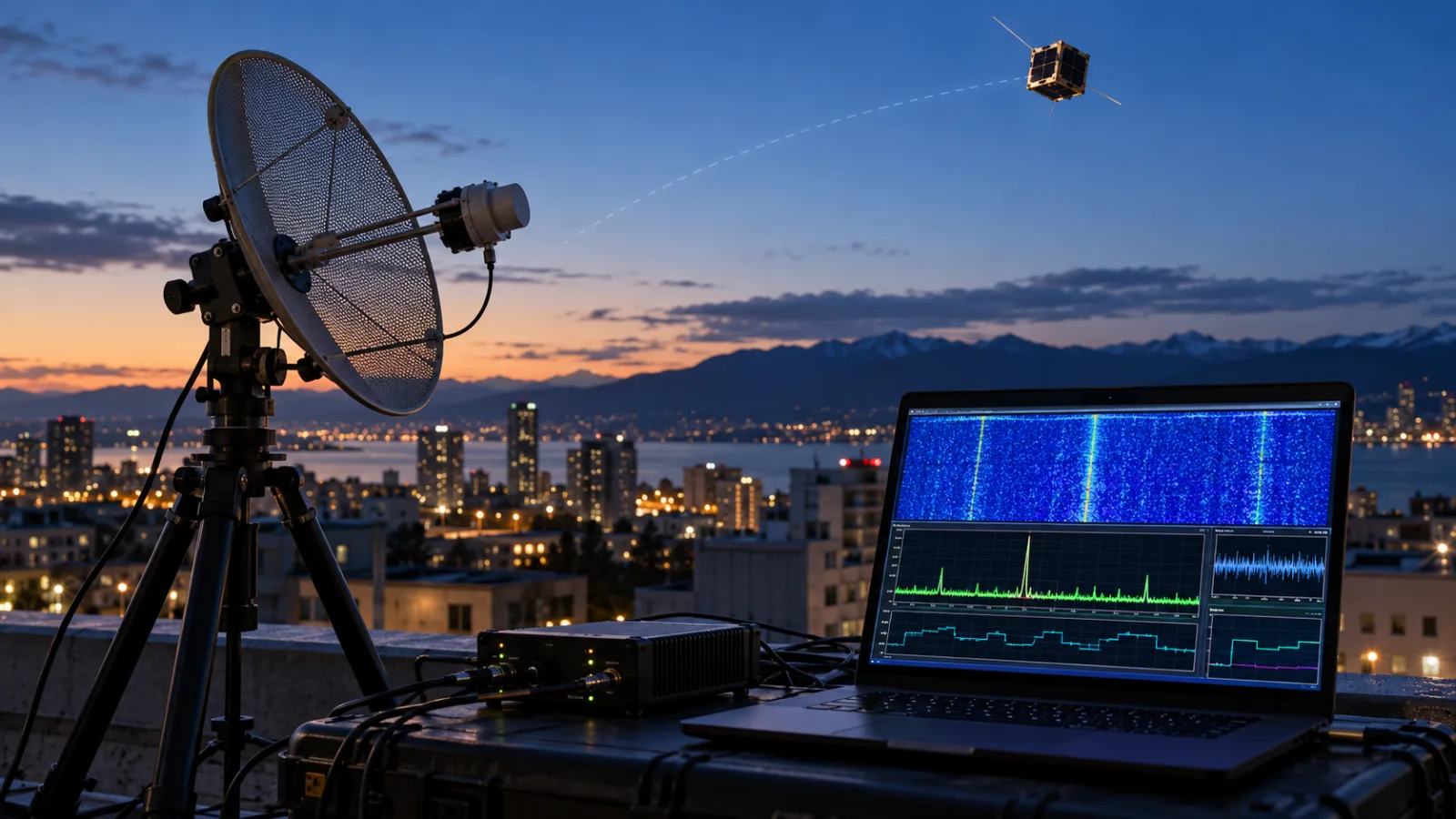
That makes UNNE-1B a useful small-satellite project for an operator who wants a concrete result without starting with a transmit setup. A modest 70 cm antenna and an SDR can be enough on a high pass. The objective is not simply to hear a burst of noise or identify a moving carrier. Capture a clean recording, decode what is possible, attach the result to a time and pass, and submit it so the reception becomes part of the mission record.
This article is based on the mission’s English documentation, its October 13 reception report, AMSAT’s satellite coverage, and the technical material published by the Nebrija University project. Frequencies and operating status can change during commissioning, so check the mission pages before treating any setting as permanent.
What UNNE-1B is, and why it is worth monitoring
UNNE-1B is an amateur-radio satellite operated by AMSAT-EA with a payload developed at Nebrija University in Madrid. It launched on October 1, 2026, as part of SpaceX’s Transporter-18 mission from Vandenberg, California. The satellite initially traveled inside OSSIE-D, an orbital transfer vehicle built by UARX Space. After deployment, UNNE-1B released from the vehicle, deployed its antenna, and began sending its own telemetry.
The launch arrangement explains why early reports referred to both OSSIE-D and UNNE-1B. A reception near 401.5 MHz shortly after launch confirmed that the transfer vehicle was active, but it was not the satellite’s normal amateur downlink. The mission’s current receive target is 436.888 MHz.
UNNE-1B is designed as more than a voice repeater. Its payload includes an Arduino-based deduction game programmed by the ARIES group at Nebrija University. Telemetry includes a recurring game packet, identified by the mission team as type 10, and the project’s Space Cowboy II challenge uses the received fragments as an educational exercise. The packet is one additional data product embedded in a broader mission about signal processing, orbital radio, and decoding.
The project separates listening from transmitting. Anyone may receive the downlink, subject to local radio rules and the practical limits of a satellite pass. Transmitting through the satellite requires an appropriate amateur-radio licence and compliance with the rules in the operator’s jurisdiction. A receive-only demonstration can begin with an SDR, while an uplink experiment requires licensed operation, correct current instructions, and a station configured for satellite work.
The current radio configuration
The mission documentation lists these principal frequencies and modes:
| Function | Frequency | Band | Mode or data |
|---|---|---|---|
| Satellite downlink | 436.888 MHz | 70 cm UHF | FM voice and FSK telemetry |
| Satellite uplink | 145.925 MHz | 2 m VHF | FM voice, FSK, AFSK, and AX.25 options |
The downlink is the sensible starting point. The mission identifies 436.888 MHz as the frequency received at home, with narrow-FM voice and FSK telemetry. Its technical material describes the telemetry as 200-baud FSK and says the wider radio design can support higher-rate telemetry up to 2400 baud. Do not assume every signal on the frequency uses the same decoder or data rate; establish what the current mission documentation and software expect.
The uplink is listed at 145.925 MHz with no subtone. That is useful for licensed operators studying the system, but it is not an invitation to transmit casually. Satellite uplinks are shared resources. Before transmitting, confirm that the repeater is enabled, check the current operating instructions, observe the applicable band plan, and use only the power needed for a reliable contact. The repeater’s commissioning state may change independently of the telemetry downlink.
At 436.888 MHz the free-space wavelength is about 68.6 centimetres. That is why a purpose-built 70 cm antenna is usually more helpful than a general-purpose HF wire. A quarter-wave element is roughly 17 centimetres before practical corrections; a half-wave dipole is roughly 34 centimetres end to end. The exact dimensions depend on construction, feed point, surrounding materials, and the desired impedance, but the wavelength gives a useful scale when deciding whether an antenna is plausible.
What the October reception report tells us
The mission’s October 13 update is more useful than a generic claim that the satellite is active. It gives a reproducible reception example. Station SV2HWM in Greece heard UNNE-1B on a pass reaching 59 degrees maximum elevation, using a turnstile antenna and an Airspy receiver. The station decoded packets containing power, temperature, satellite status, antenna deployment, ephemeris, and time-series information, then recovered the first game packet.
The report says ten packet types had been received and three game packets had been logged at that point. It also notes that the signal was strong on high passes and that a turnstile or small Yagi was sufficient. Those details do not guarantee identical results at every location. Pass elevation, local noise, coax loss, antenna polarization, receiver gain, Doppler correction, and satellite attitude all affect the result. They do show that the project is accessible to a technically modest ground station.
The first reception was reported at 20:27 UTC on October 4. The mission later reported the game packet again on October 10 and 11, with the game advancing from week 0 to week 1. These dates are evidence of what had already been received, not a promise of a fixed future pass schedule. Use a current tracker and the mission data pages for the next attempt.
A receive-only station that can produce useful data
Build the station in layers. Start with the receiver and a known-good recording path, then improve the antenna and tracking workflow only after you know what the noise floor and local interference look like. This avoids confusing a software problem with an antenna problem.
Receiver
An inexpensive RTL-SDR-class receiver can cover 436.888 MHz. A better SDR may offer a cleaner front end, more stable frequency control, and easier recording, but price alone does not determine success. The important questions are whether the receiver is stable enough for the pass, whether it can record the required bandwidth, and whether the computer can process the data without overruns.
Use a short, good-quality USB connection and keep the receiver away from noisy switching supplies where possible. If the antenna is outdoors, use suitable feed line and protect equipment against static and weather. A low-noise amplifier can help when feed-line loss is significant, but adding gain to a station already suffering from strong local interference can make decoding worse. Begin without an amplifier and inspect the waterfall.
Antenna
A vertical antenna can receive a high pass, but a satellite is not a fixed terrestrial repeater. A turnstile, crossed dipole, eggbeater, or small 70 cm directional antenna offers a more deliberate approach. Circular polarization can reduce deep fades caused by the satellite’s changing orientation and path geometry. A small Yagi can provide useful gain, but it needs to be aimed and its polarization may still need attention.
The first station should favour repeatability over complexity. A temporary antenna in the clear, mounted away from metal objects and mains wiring, may outperform a theoretically better antenna installed beside a wall, roof hardware, or a dense bundle of cables. Record the antenna type, height, orientation, and feed-line length in the reception log.
Software
For a basic listening test, SDR++ or another SDR application can tune the receiver and display the pass in a waterfall. Set the demodulator to narrow FM for voice or for a first look at the downlink. For telemetry, use the decoder supplied or referenced by the mission project when available. The Nebrija material identifies 200-baud FSK telemetry and explains the signal structure.
Keep an unprocessed baseband or audio recording with UTC time, centre frequency, sample rate, receiver, antenna, and pass information. A later decoder update may recover packets that were not understood during the pass. Do not overwrite the original with aggressive filtering or audio compression. Keep a processed copy for experiments and the raw file for verification.
Tracking
A satellite is visible only during a pass. The project’s radio module describes a typical useful window of roughly 10 to 15 minutes, although the exact duration depends on location, elevation mask, and the tracking software. Obtain current orbital elements from a reputable tracker or the mission’s linked resources, then calculate passes for the actual station location.
The most productive first attempt is usually a high-elevation pass. A pass that rises only a few degrees above the horizon spends more time behind local obstructions and through a thicker part of the atmosphere. It can still work, but it is a poor test if the goal is to decide whether the station is functioning. Log the pass start, maximum elevation, end time, and local azimuth path.
Doppler is not optional at 70 cm
At UHF, the satellite’s apparent frequency changes as it approaches and recedes. The size of the shift depends on pass geometry and the receiver’s frequency reference, but it is large enough to matter for a narrow signal. A fixed 436.888 MHz setting may show the carrier at the beginning of a pass and miss it later, especially with a narrow decoder filter.
There are three practical ways to handle this:
- Use a tracking application that controls the SDR and applies Doppler correction during the pass.
- Record a wider bandwidth and correct the signal during playback.
- Tune manually while watching the waterfall, using the mission frequency as the nominal reference.
The first method is convenient once the station works. The second is valuable for experiments and complete records. Manual tuning is valid for a first reception, but it demands attention and can make a short packet disappear while the operator adjusts the dial.
Do not confuse Doppler drift with an unstable oscillator. If the signal moves smoothly in one direction during approach and reverses after the closest part of the pass, that is expected orbital geometry. If the entire receiver moves unpredictably when no satellite is present, investigate the SDR clock, USB power, temperature, and computer load.
A disciplined pass workflow
Before the pass, check the current UNNE-1B mission page and confirm that the downlink remains 436.888 MHz. Load current orbital elements into the tracker. Start the SDR several minutes early and inspect the local noise floor across the expected bandwidth. Remove unnecessary software-defined gain and avoid clipping the receiver input. If possible, record a short sample of the empty band before acquisition of signal.
During the pass, watch for a signal that follows the predicted path rather than assuming every trace is the satellite. Listen briefly in narrow FM, but keep the recording running if telemetry is the goal. If the decoder needs a particular audio level or filter bandwidth, follow its instructions and note the settings. Do not repeatedly change gain, bandwidth, sample rate, and frequency at the same time; make one change, observe the result, and write it down.
After the pass, inspect the recording and decoder output. A valid packet should be associated with a plausible time and pass, not merely a line of characters that looks technical. Check whether the packet type, satellite identifier, sequence information, or telemetry fields are consistent with other receptions. If the project provides a data registry, submit the reception with station location, UTC time, antenna, receiver, software, and any uncertainty.
A useful reception report can be short:
Satellite: UNNE-1B
Date and time: use UTC
Location: grid locator or approximate region
Pass: maximum elevation and azimuth, if known
Downlink: 436.888 MHz nominal
Receiver: SDR model and sample rate
Antenna: type, height, and polarization
Result: packet types decoded and confidence notes
Use the actual date and time in the report. The mission’s published first reception at 20:27 UTC on October 4 is an example of reporting detail, not a prediction for every station.
What to do when you hear a carrier but decode nothing
The failure modes are ordinary, and they can be separated with a few tests. First, confirm that the signal is actually on the predicted pass. Terrestrial interference, local oscillators, and unrelated satellite signals can all produce convincing traces. Second, confirm the demodulation mode and audio path. A decoder receiving the wrong channel, a muted virtual audio cable, or an over-wide filter can look like a radio problem.
Next, check frequency movement. If the carrier is present but slides through the filter, Doppler correction is probably inadequate. If the signal is strong but distorted, reduce gain and check for front-end overload. If it appears only at the horizon, compare the antenna path with a higher pass before rebuilding anything. If the signal fades rapidly when the satellite changes direction, polarization or antenna pattern may be the limiting factor.
For data, verify the expected baud rate and framing assumptions. The project describes FSK telemetry at 200 baud, while general amateur-satellite software often defaults to AX.25 or 1200-baud AFSK. A decoder configured for the wrong protocol may display nothing even when the receiver and antenna are working.
Preserve the recording. A failed decode is still useful if frequency, timing, and station configuration are known. It can be compared with a successful pass, shared with the project team, or tested against a revised decoder. Deleting the evidence and immediately changing five variables makes the next attempt harder to interpret.
The Space Cowboy II challenge and the value of reporting
The educational game gives UNNE-1B a clear reason for individual stations to submit data. The satellite sends a recurring telemetry packet containing game status and the number of weeks since release. The project describes the challenge as a sequence of fragments that can be collected and interpreted over time. That structure rewards repeated reception rather than one dramatic first contact.
For a club or classroom, the challenge can become a compact experiment in the complete radio chain. One group can predict the pass, another can monitor the waterfall, a third can maintain the recording and time log, and a fourth can inspect packet fields. The work does not require everyone to transmit. It also creates a useful discussion about what telemetry can reveal: battery state, temperature, time, orbital information, deployment status, and mission-specific payload data.
The project’s educational pages explain frequency, wavelength, modulation, FSK, and satellite geometry in accessible terms. Those explanations are useful for newcomers, but experienced operators should still verify live radio settings against the current mission page. Educational material can remain online after a commissioning parameter changes.
What this mission teaches about small-satellite reception
UNNE-1B is part of a broader pattern in amateur space communications: small educational payloads are becoming practical ground-station projects rather than distant engineering demonstrations. The satellite combines a conventional amateur-radio link with a mission-specific data payload, and it uses a commercial rideshare plus an orbital transfer vehicle to reach its deployment sequence. That arrangement lowers the barrier to putting experimental hardware into orbit, but it also adds stages that ground observers must understand when interpreting early signals.
The companion HADES-L satellite illustrates another design trade-off. The Nebrija mission page says HADES-L carries an HF-to-UHF voice repeater and a materials experiment, while its repeater is constrained by power and operates only during limited intervals. UNNE-1B is described as having a repeater intended to remain on once enabled. The comparison is a reminder that the phrase satellite is transmitting does not answer which payload, mode, or service is active.
AMSAT’s October 18 bulletin places UNNE-1B in a wider satellite-radio context that includes student-built CubeSats, changes to TLE distribution, meteor-scatter work on 6 metres, and new CubeSatSim features. The common thread is the relationship between an orbital object, a documented signal, a predictable pass, and a ground station capable of producing evidence.
A sensible first attempt
If UNNE-1B is new to your station, choose one high pass and keep the goal narrow: receive the downlink and produce a time-stamped recording. Do not begin by trying to build an automated Doppler-corrected transmit station, decode every packet type, and solve the weekly game at the same time. A clean recording with honest notes is already a successful technical result.
Once the receive path is reliable, add Doppler correction, compare antenna types, and test the mission decoder. Then submit the reception to the project registry. Repeated reports from different locations help distinguish a local station problem from a satellite or software issue, while the game packets give those reports a shared purpose.
UNNE-1B is therefore best approached as a measurement project with an operating component, not merely as another satellite to chase. The 436.888 MHz downlink, the 200-baud telemetry, the changing pass geometry, and the mission’s public data registry provide enough structure to learn something on every attempt—even when the decoder does not yet produce a complete packet.
Sources and current-status notes
- UNNE-1B mission overview and radio configuration — launch sequence, frequencies, payload, and operating description.
- UNNE-1B mission news — October 13 reception report, packet types, Greek station example, and current telemetry status.
- UNNE-1B signal fundamentals — wavelength, modulation, and the project’s 200-baud FSK description.
- UNNE-1B radio and satellite guide — pass duration, satellite geometry, and receive-station context.
- AMSAT News Service, October 18, 2026 — current amateur-satellite context and the weekly bulletin.
- AMSAT 2026 Space Symposium archive — recent satellite-operation and CubeSatSim context.
- SpaceX Transporter-18 mission page — launch-provider context for the rideshare mission.
The live status of the repeater, current orbital elements, and any revised operating instructions take precedence over this article. Frequency and licensing requirements are jurisdiction-dependent; receive-only monitoring does not grant permission to transmit.
Related articles
Les failles du noyau SAP de septembre 2026 imposent un inventaire et une mise à jour immédiate
Deux vulnérabilités critiques de SAP, publiées le 8 septembre, touchent des voies centrales de communication et peuvent menacer tout un environnement ERP. Voici ce qui est établi, ce qui reste incertain et comment vérifier l’exposition.

Quand une HOA traite les plantes natives de mauvaises herbes, le design protège le jardin
Un jardin de plantes natives peut économiser l’eau et aider les pollinisateurs, mais il doit paraître entretenu. Voici comment le préparer avant l’amende.

Contrôle des rappels d’aliments pour animaux de septembre 2026 : vérifier les compléments, le cru et les habitudes en cuisine
Les rappels récents de compléments Fi et d’aliments crus Northwest Naturals montrent qu’un contrôle sérieux doit inclure les lots, le congélateur, les accessoires et l’hygiène du foyer.
La recherche sur la longévité des chiens progresse : ce que les propriétaires peuvent utiliser dès maintenant et ce qui reste à prouver
Une étude majeure sur le vieillissement des chiens bénéficie d’un nouveau financement, tandis qu’un essai clinique évalue si la rapamycine peut favoriser une vie en bonne santé plus longue. Voici ce que cela change pour les propriétaires et quelles promesses restent à prendre avec prudence.

Comments
Sign in to comment.
No comments yet.