A Global Refugee and War Victims Healing Center An Expansion of the Universal Healing Library of Virtual Reality
Imagine a world where a child displaced by war can access education, health information, emotional support, creative activities, and new opportunities through a single phone.
A Universal Libr
My idea for the Universal Healing Library of Virtual Reality (VR) is based on a simple theory: one day, the world may increasingly use virtual reality, AI, and digital resources to help address problems that affect humanity, including depression, abuse, fear, grief, trauma, and loss.
Rather than building isolated projects, we could bring together healing resources from around the world into one growing library of knowledge, applications, code, science, and VR experiences.
I propose adding a dedicated Global Refugee and War Victims Healing Center as a new wing of that library.
Imagine a child in Syria or another conflict zone receiving a simple phone with an application that opens the door to helpful information. Imagine a parent discovering educational materials, survival lessons, local aid organizations, health resources, and opportunities to build a small business.
The center could include:
Instant AI resources: Government-supported programs delivered through phones, providing accessible information and assistance.
Instant schools: Multilingual lessons, digital books, and educational activities for children whose schools have been destroyed or become inaccessible.
Survival lessons: Practical, professionally reviewed information about shelter, warmth, safe water, food, and other essential needs.
WhatsApp-based support: Potential channels for educational resources, emotional support, community connection, business learning, and access to appropriate services.
Poppies and humanitarian fundraising: Selling poppies or other meaningful products to help fund hospitals while creating income opportunities for war survivors.
VR healing: Accessible experiences intended to support relaxation, education, and emotional well-being.
VR medical training: Simulations that help healthcare professionals practice emergency scenarios in a controlled environment.
Business schools and nonprofit building: Helping survivors learn digital skills, explore employment, create small businesses, and establish community organizations.
Connections to people who help: Linking refugees to aid organizations, medical services, legal assistance, educational opportunities, employment resources, mentors, and supportive communities.
A continually growing library: New applications, books, codes, translations, and VR experiences contributed by people around the world.
These are proposed directions, not claims that every service or technology is already available or proven effective.
Surgical Training and the Future of VR
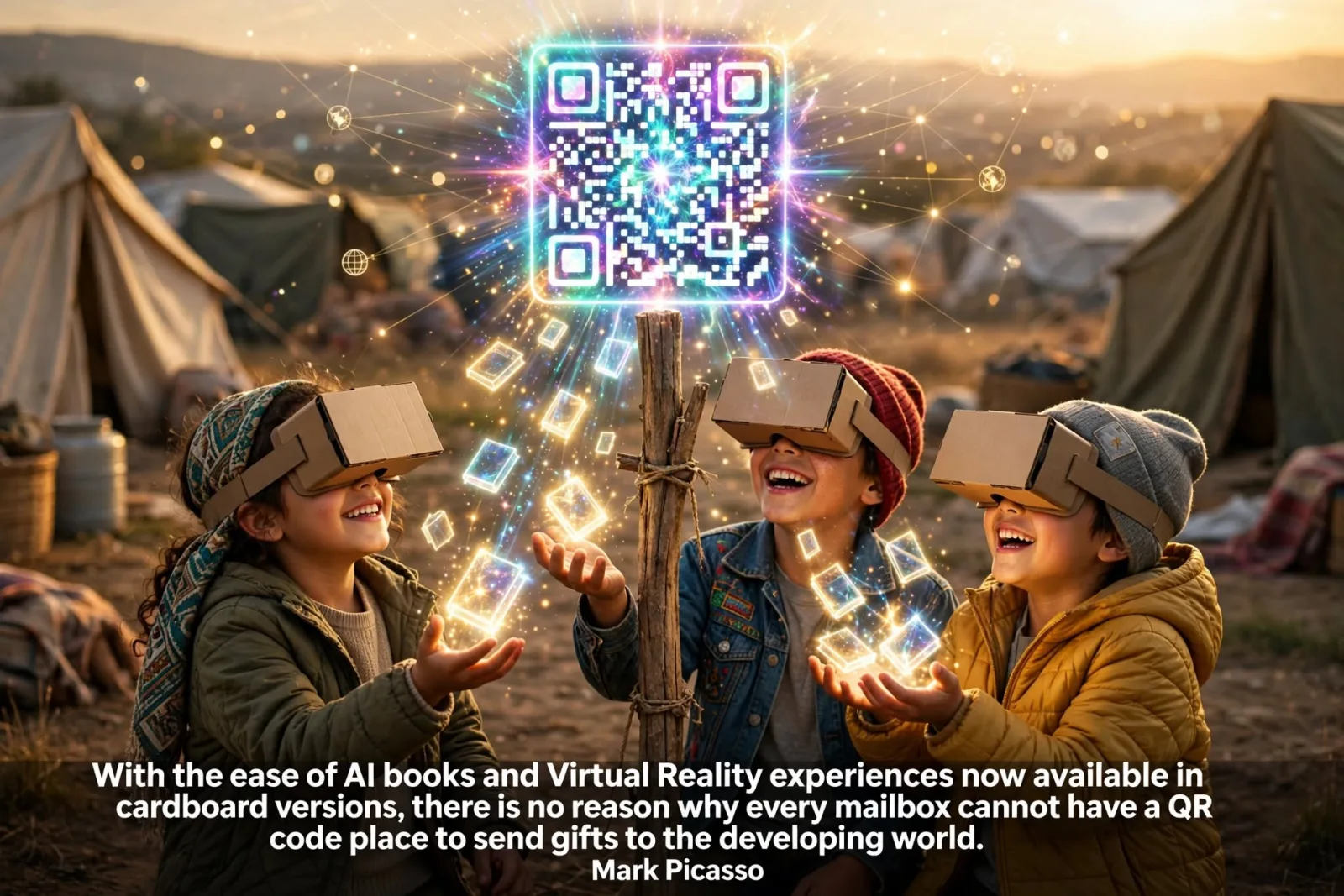
In areas affected by war, access to trained doctors and hospitals can be severely limited. This has inspired me to explore whether affordable VR equipment—including simple headsets made from cardboard, lenses, and plastic—could make medical education more accessible.
My proposal includes a shared, multilingual VR training library where medical scenarios could be explored and practiced. AI could help create educational materials and translate them into different languages.
The vision also includes children and young people exploring medical learning through engaging simulations, while more advanced surgical scenarios would be designed for qualified healthcare professionals and supervised trainees.
The original concept imagines a future in which a doctor in another country could guide a surgical robot remotely through a VR interface, potentially progressing toward more autonomous robotic surgery. Those possibilities require substantial research, reliable communications, medical-device validation, and professional oversight. VR practice is not authorization to perform real surgery, and children or untrained people must not attempt surgical procedures on actual patients.
The purpose is to investigate how technology might expand training and medical support—not replace qualified medical professionals with untested systems.
Digital Stockings: A Gift That Keeps Growing
Think about the small donations people make at a store checkout to support a good cause. What if technology could turn that generosity into a personalized digital gift for a child affected by war?
Imagine receiving a digital stocking on your phone. Inside are colorful, personalized books, digital art to color, puzzles, games, educational activities, and new experiences to discover.
There could even be reviewed lessons about warmth and other practical life skills, alongside opportunities to learn digital business skills and explore a print-on-demand business.
A child who once had little access to books or entertainment could discover an expanding world of learning and creativity. Families could explore business opportunities, educational resources, and eventually VR experiences where suitable equipment is available.
The digital stocking would not replace food, shelter, healthcare, or human care. It would be an additional gift of knowledge, creativity, and possibility.
A Global Link to Help, Community, and Hope
War can leave people isolated from the resources they need. Families become displaced, communities are fragmented, and even finding reliable information can be overwhelming.
The healing center could include a Global Community Link connecting refugees and war victims with:
Organizations providing food, shelter, medical assistance, and other essential resources.
Communities where people can share experiences, ask questions, and encourage one another.
Guidance on local and international legal services, education, and employment.
Mentorship, counseling resources, and emotional support networks.
Optional spiritual support, guided prayer, prayer circles, and communities of people who want to stand together in compassion.
Prayer is personally important to me. I know that wanting to pray for hours during a crisis does not always mean knowing what to say or how to sustain that time. Guided prayers could provide structure for people who want it, while virtual prayer companions could help people gather around a shared hope for peace.
Whether someone seeks practical assistance, professional support, spiritual connection, or simply a community that listens, the aim is to reduce isolation and make help easier to find.
A Downloadable Health-Information App
Imagine a mother in a conflict zone experiencing a painful, swollen cheek when no doctor is nearby. Or a parent worried about a child with an unusual symptom.
A proposed health-information app could allow someone to describe a problem, ask a question aloud, or submit a photograph where appropriate. The app could provide plain-language information about possible common conditions, explain basic safety measures, identify warning signs, and direct the family toward qualified medical help.
Information could be adapted to local languages and reviewed for the needs of specific regions, including communities of Syrian refugees.
This might help people understand their options and avoid spending scarce resources on random, potentially unsafe remedies. However, a photograph cannot reliably establish every diagnosis, and an AI application should not claim certainty or prescribe treatment without appropriate clinical oversight. When a condition may be serious, the app must direct users toward qualified healthcare professionals or emergency services.
The principle is that people without nearby doctors still deserve accessible information, dignity, and a path toward appropriate care.
How Can We Build This Together?
You do not have to wait for one government, company, or organization to build the entire center.
If you can write, create art, translate, develop code, use AI tools, or build VR experiences, you can contribute to a small part of the vision. Someone could create a multilingual children's book; another person could develop an educational application, translate survival resources, build a community directory, or create a professionally reviewed VR learning experience.
AI can help make coding and translation more accessible, while qualified professionals and local communities check accuracy, cultural suitability, privacy, and safety.
Each contribution could become part of a shared, growing library. We can begin with individual projects and bring them together over time, rather than attempting to build everything at once.
In my book, War and Peace AI: The Future of Peaceful Artificial Intelligence, I discuss related possibilities in greater depth. I encourage readers interested in the wider vision to explore it; I have shared the book through WhatsApp.
Those of us who live in peace have an opportunity to contribute now. And should our own communities ever experience war, the resources we help build might support us, too.
Imagine being part of a project that helps children learn, connects families with assistance, creates opportunities for survivors, and gives people another way to contribute to healing.
Let's build a global library of compassion, knowledge, and practical help—together, in every language, for people who need it today and generations who may need it tomorrow.
Mark Picasso, MPANote: This article presents a humanitarian vision and proposed projects, not a claim that these systems already exist or are proven effective. Medical, psychological, surgical, and emergency-related tools require appropriate professional review and testing before real-world use.
Related articles
War and Peace AI: The Future of Peaceful Artificial Intelligence
What if we created a healing architecture to deploy prior to, during, or after a war? Could we do this with AI and Virtual Reality?
Preparing For Emergencies/War. Even though there's no current threat, what do we leave our children's children?
This is not a message of fear, but one of preparation, which leads to peace and hope.
Will AI Chatbots Heal Refugees and People in War?
From Pesky Chatbots to Lifelines: AI That Helps Humanity Rebuild
Happy "Hump" Day!
The Actual Potential of OnlyFans: Could It Bring Back a Country From the Brink? This is for 18+ Over

Comments
Sign in to comment.
No comments yet.