Cultivated Meat for Cats: What a 40-Cat Treat Trial Shows—and What It Doesn’t
A new 40-cat comparison found no clear taste preference between a cultivated-meat treat and a conventional chicken lickable. For owners, the useful question is not whether cats will eat it, but how to judge labels, nutrition, regulation and safety.

A cultivated-meat cat treat has passed an early test that matters to manufacturers: cats were willing to eat it. In a home trial involving 40 cats, first bites were split evenly between a treat made with BioCraft’s cell-cultured mouse ingredient and Applaws Chicken Creamy Lickable Treats. The trial reported no statistically significant preference between the two products.
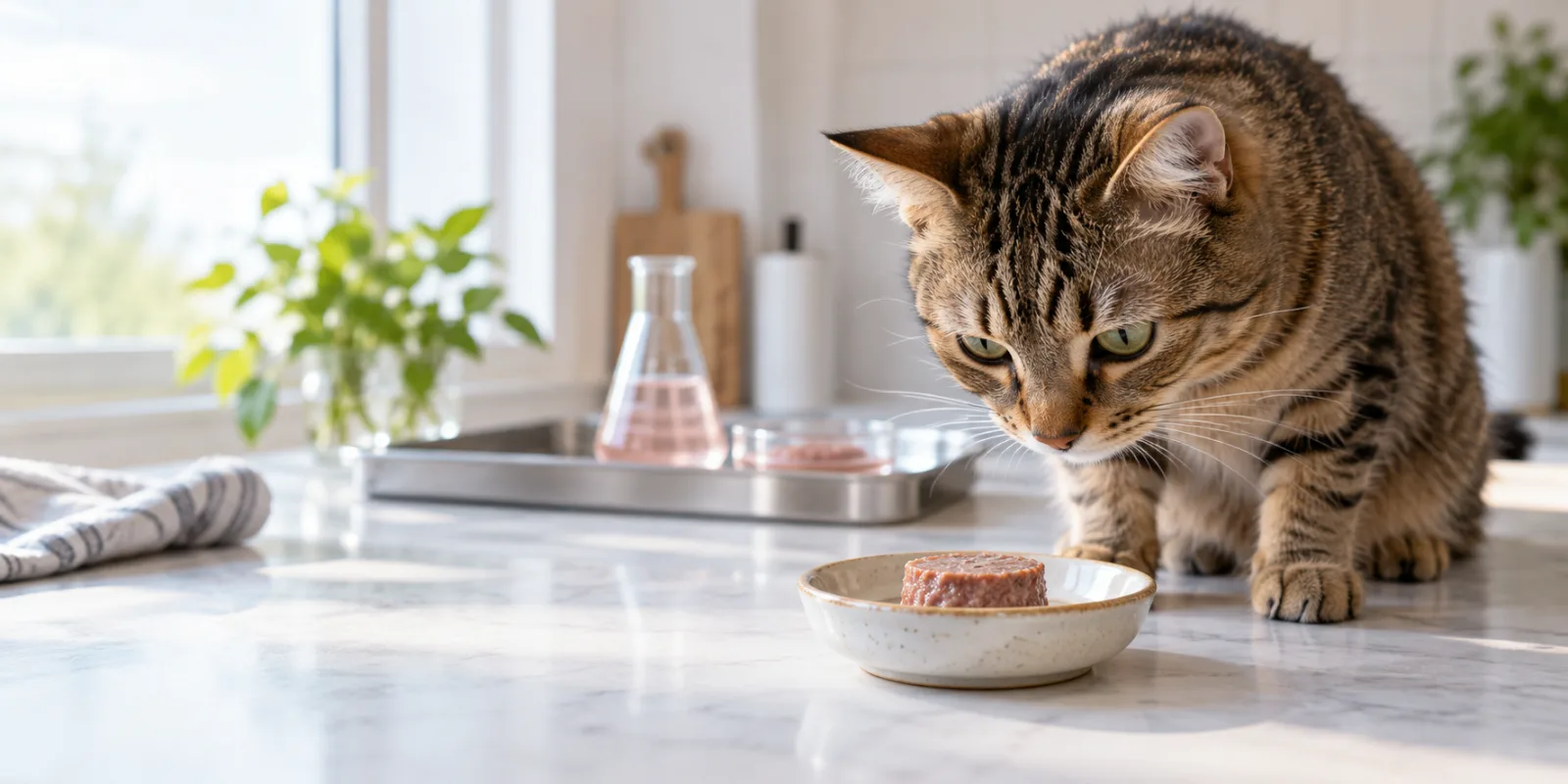
That is interesting news, but it is a much narrower result than some headlines may suggest. The test measured palatability—whether cats accepted one treat over another during a short side-by-side comparison. It did not establish that cultivated meat is nutritionally superior, safer than conventional ingredients, suitable as a complete diet, or ready to replace ordinary cat food.
For cat owners, the practical lesson is simple: treat this as an early product-development result, not as a dietary recommendation. If cultivated-meat treats become available where you live, the same checks used for any unfamiliar pet product will matter more than the novelty of the ingredient.
What the new trial actually tested
The trial was conducted by Regionales-Produkt-Panel, a German market-research company, in cats’ homes. Each cat received 30-gram portions of the BioCraft product and the conventional chicken treat in neutral bowls, with bowl positions rotated between households. According to the published report, 20 cats took the BioCraft treat first and 20 took the Applaws treat first. The reported result was no statistically significant difference in overall preference.
That design answers a useful but limited question: can a cultivated ingredient be formulated into something that cats will accept? Palatability is a real hurdle for any new pet food. A nutritionally sound product that animals refuse to eat cannot be useful in daily feeding. The side-by-side format also gives developers a more meaningful benchmark than asking whether cats will eat a product at all.
The comparison does not answer several other questions owners may reasonably have:
- How many calories did each product provide per gram or serving?
- What were the protein, fat, taurine, mineral and vitamin levels?
- Was the product intended only as a treat, or was it formulated as complete and balanced food?
- How did cats respond after repeated feeding over weeks or months?
- Were there differences in stool quality, body weight, vomiting, itching or other signs that would matter in everyday use?
- What production controls were used to prevent contamination or unintended ingredients?
None of those questions can be answered by a first-bite result. The trial is best understood as evidence of short-term acceptance, not evidence of long-term nutritional adequacy or medical benefit.
“Cultivated” does not mean “complete”
Cultivated meat is produced by growing animal cells in a controlled environment rather than obtaining the meat through conventional slaughter. The ingredient may resemble animal tissue in some respects, but the production method alone does not tell an owner whether a finished treat supplies what a cat needs.
Cats have specific nutritional requirements. A food designed to be the sole diet must provide the right nutrients in the right amounts and ratios for the relevant life stage. That includes more than a headline protein percentage. Moisture, energy density, amino acids, fatty acids, vitamins and minerals all matter. Processing and formulation can change what is available to the animal, and a single novel protein ingredient will not automatically create a balanced food.
A treat is a different category. The Association of American Feed Control Officials explains that products labeled as snacks or treats are generally not required to meet the nutritional-adequacy standards used for complete and balanced cat food. That is not a defect: treats are normally meant to be occasional rewards, not the nutritional foundation of a cat’s day. It does mean that a striking ingredient claim on the front of a packet should not be mistaken for a complete feeding claim.
When reading a future cultivated-meat product, first decide what it is meant to do. If the label says “treat,” “snack” or “supplement,” assume it is an addition to the main diet unless the package clearly says otherwise. If it claims to be complete and balanced, look for the nutritional-adequacy statement, the intended life stage and feeding directions. If those details are missing or difficult to interpret, ask the manufacturer or your veterinary team before making it a regular part of the diet.
The label matters more than the production story
A cultivated ingredient may appeal to owners who want to reduce conventional meat use, avoid certain sourcing practices or try a newer form of pet food. Those are personal choices. They do not remove the need to assess the finished product on ordinary pet-care grounds.
A sensible label check includes the following:
- Product purpose: Is it a treat, a complementary food, a supplement or a complete diet?
- Calorie information: Can you see calories per treat, tube, pouch or gram?
- Ingredient list: Is the cultivated ingredient identified clearly, and are other proteins, fats, flavorings or binders also present?
- Nutritional adequacy: If the product is meant to replace meals, does it state that it is complete and balanced for a defined life stage?
- Feeding directions: Does the package explain how much to feed and what to do with the cat’s ordinary food?
- Manufacturer information: Is there a named company, contact information, batch or lot identification and storage guidance?
- Claims: Are the claims about taste and sustainability separated from claims about health?
The word “natural,” an image of a mouse, a sustainability comparison or a claim about a cat’s instinctive preferences does not replace this information. A product can be innovative and still be poorly suited to a particular cat.
Owners should also remember that the ingredient list does not always tell the whole story about a food’s practical effect. A moist lickable treat may be useful for training or for making a routine more pleasant, but it can also add calories quickly because cats often receive it in addition to meals. A cat that gets several small treats from different family members may receive much more than the owner who bought the packet realizes.
Treat calories are still calories
The World Small Animal Veterinary Association advises keeping treats to no more than about 10% of a cat’s daily calorie intake. Its cat guidance gives approximate treat-calorie limits based on body weight and warns that the suitable amount depends on the individual animal. The recommendation is especially relevant to lickable treats, because a single serving can be easy to offer quickly and difficult to judge by eye.
For an average healthy adult cat, WSAVA’s examples put the daily treat allowance in the general range of roughly 18 to 28 kilocalories for cats weighing 2.5 to 7 kilograms. Those figures are not a prescription for an individual cat. Energy needs vary with age, body condition, activity, health and the calorie density of the main food. A cat on a veterinary-prescribed diet may need a different plan, and some treats may not fit that plan at all.
If a new treat does not list calories per serving, do not assume that a small-looking portion is insignificant. Ask the manufacturer for the calorie content, or use a different product with clearer information. The same principle applies whether the treat is cultivated, conventional, plant-based, freeze-dried or made in a kitchen marketed as artisanal.
A practical household system is to set aside the day’s treat allowance in the morning. Everyone can then offer from the same amount instead of opening a new portion each time the cat asks. For cats that gain weight easily, replacing part of the ordinary food with an appropriately measured reward may be more sensible than adding treats on top of every meal, but any meaningful feeding change should be discussed with a veterinary professional if the cat has a medical condition or a history of weight problems.
Why a taste test cannot prove safety
A cat eating a product is not evidence that the product is safe for every cat. Animals may accept foods that are too rich, unsuitable for a chronic condition or poorly stored. Palatability trials also tend to be short and relatively small. They can identify whether a product is rejected, but they are not designed to detect every possible adverse effect or manufacturing hazard.
In the United States, the Food and Drug Administration regulates pet food under the Federal Food, Drug, and Cosmetic Act. The agency says animal food must be safe to eat, produced under sanitary conditions, free of harmful substances and truthfully labeled. FDA and state partners use risk-based inspections and require manufacturers to address food-safety hazards. The existence of this framework is important, but it does not mean that every new product has been tested in the same way or that one country’s rules apply everywhere.
Regulatory treatment can also depend on what a product claims to be and where it is sold. Food, feed ingredients, supplements and animal drugs are not interchangeable categories. A product marketed as a food treat should not make unsupported claims to cure, prevent or treat disease. If a company suggests that its ingredient can manage kidney disease, allergies, urinary problems or another medical condition, that is no longer an ordinary “my cat likes this” question. Owners should seek veterinary advice rather than treating a marketing claim as medical guidance.
The UK government’s recent material on cell-cultivated products illustrates another important point: authorities may examine cell identity, production, hygiene and traceability as part of a product’s regulatory pathway. Those controls are about how the product is made and documented. They still do not turn a short palatability study into proof of long-term nutritional adequacy.
Novel ingredients and cats with health problems
A healthy cat with no dietary restrictions may be able to try a new treat in a small amount if the product is legally sold, clearly labeled and introduced carefully. That does not make the same product appropriate for every cat.
Extra caution is warranted when a cat has a history of food reactions, recurring digestive upset, kidney disease, urinary disease, diabetes, obesity, chronic medication use or a veterinary-prescribed diet. In those situations, the problem is not whether the cat will eat the treat. The problem is whether its nutrients, calories, minerals, additives and interaction with the prescribed plan are appropriate.
The WSAVA guidance specifically notes that conventional treats may not be suitable for cats with medical conditions, dietary sensitivities or prescription diets. A novel ingredient can make the label harder to interpret rather than automatically making it safer. If a veterinary team has asked you to avoid particular proteins, phosphorus levels, calories or other nutrients, show them the full label before offering the product.
Do not use a new treat to test whether a cat’s symptoms are food-related. If a cat develops repeated vomiting, diarrhea, marked itching, swelling, breathing difficulty, weakness, pain, sudden behavior change, stops eating or drinking, or may have swallowed packaging, contact a veterinarian promptly. Those signs need an assessment of the individual animal; they should not be explained away as normal adjustment to a fashionable ingredient.
How to introduce any unfamiliar treat
If your veterinarian has no objection and the product is appropriate for your cat, start with a small amount rather than a full serving. Keep the rest of the diet unchanged for several days so that you can tell what might be associated with a change. Do not introduce a new treat at the same time as a new food, supplement or litter if you are trying to observe your cat’s routine.
Store the product exactly as the label directs. Moist treats may require refrigeration after opening and may have a shorter safe-use period than dry biscuits. Use clean hands or utensils, avoid leaving opened food warm for long periods and discard anything that smells abnormal, changes texture unexpectedly or has passed its use-by guidance. A new production method does not make ordinary food-handling rules unnecessary.
Watch the cat without turning the experiment into a clinical test. A normal appetite, ordinary stool and unchanged behavior are reassuring observations, but they do not prove long-term suitability. If the cat refuses the treat, that is also useful information: there is no reason to keep offering it because the ingredient is technologically interesting.
What the trial means for the future of pet food
The most meaningful result from the 40-cat comparison is that cultivated ingredients may be able to clear one practical barrier: cats may accept the taste and texture of a product made with them. That could give manufacturers room to investigate new sources of animal protein, production systems with different land-use profiles, and products designed for owners who want alternatives to conventional meat.
The harder questions come next. Developers will need to show that the finished products can be manufactured consistently, labeled accurately, stored safely and formulated to meet the nutritional purpose claimed on the package. They will also need to explain the production medium, processing aids, flavor systems and quality controls in language ordinary owners can understand. If the product is intended to be more than a treat, evidence of nutritional adequacy and suitable feeding protocols becomes central.
The environmental case also requires care. A cultivated product may have potential advantages, but its overall impact depends on the energy used, the growth medium, facility design, transport, waste and scale. One taste trial says nothing about those factors. Owners should be wary of treating a palatability result as proof of sustainability.
There is a similar risk in the opposite direction. Some people will reject the product because “lab-grown” sounds unfamiliar, while others will assume that a newer method is automatically cleaner or more ethical. Both reactions skip the information that matters. The relevant questions are concrete: what is in the finished food, how was it produced, what claims are supported, how is it regulated, and is it appropriate for this animal?
A short checklist for owners
When cultivated-meat treats reach a shop or an online store, use this checklist before buying:
- Confirm the product category. Treats are not automatically complete food.
- Read the nutritional-adequacy statement. If the product is not labeled complete and balanced, keep it as an occasional addition.
- Find the calorie count. Count every treat alongside the main diet.
- Check the full ingredient and manufacturer information. Look for a clear identity, contact details, lot information and storage instructions.
- Ignore medical promises unless your veterinarian confirms them. Food marketing is not a diagnosis or treatment plan.
- Introduce one change at a time. A small trial makes it easier to notice intolerance or a routine change.
- Stop and seek advice for worrying signs. Breathing trouble, swelling, repeated vomiting or diarrhea, pain, injury, poisoning, refusal to eat or drink, and sudden behavior changes need veterinary attention.
The current result is a promising taste test, not a reason to replace a cat’s food. For now, the sensible position is to remain curious and exacting: judge the finished product by its label, evidence, regulatory status and fit for the individual cat—not by the novelty of how one ingredient was made.
Related articles

September Lawn Care: Seed Thin Turf or Prevent Winter Weeds?
Early autumn can favor both cool-season lawn repair and winter-weed prevention, but the two jobs may conflict. Use turf type, weed identity, local timing and the product label to choose the priority before spending seed, water or treatment.

The Free Universal Healing Library of Virtual Reality
What if every wound — physical, emotional, ancestral — could find its medicine inside a world we build together?

Free General Psychological Help at All Ages.
In the age of AI, there is no reason why we cannot have free general psychological help for the public.

Before Freezing Weather: A Safe Autumn Storage Plan for Garden Tools, Batteries and Hoses
A late-October storage plan for the equipment that fails quietly over winter: drain hoses, protect batteries, clean cutting tools and avoid the shortcuts that turn spring maintenance into repair work.

Comments
Sign in to comment.
No comments yet.