Late-Fall Lilac Blooms Are a Clue, Not a Crisis: What to Check Before Winter
An unexpected November bloom on a lilac or other shrub can reflect stress, cultivar traits, or an unusually long season. Here is how to investigate without pruning, feeding, or spraying at the wrong time.

What an unexpected November bloom can—and cannot—tell you
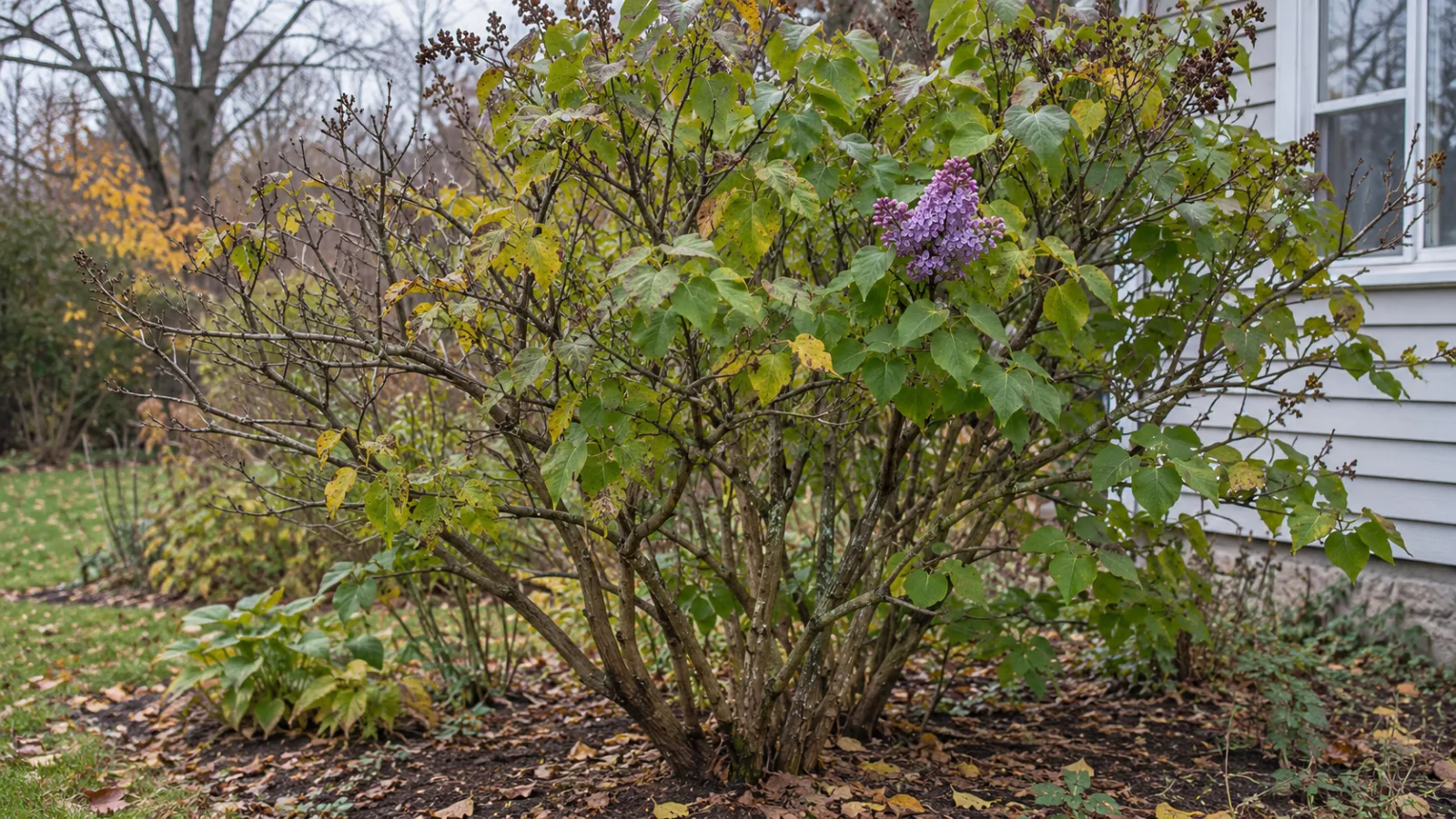
A lilac opening a few flowers in November can look like a warning that something has gone badly wrong. In most cases, it is better treated as a clue. An out-of-season bloom may follow a stressful growing season, including drought, excessive heat, or the loss of leaves caused by pests or disease. It can also reflect the plant’s natural tendency to flower again: some lilac cultivars are bred or selected for reblooming, so an autumn flush is not automatically evidence of damage.
The first useful distinction is between an isolated late cluster and a plant that is visibly struggling. A few flowers on an otherwise sturdy shrub tell a different story from late flowers accompanied by widespread leaf loss, spotted foliage, wilt, dieback, or weak new growth. The bloom itself is only one observation. Its meaning depends on what happened to the whole plant during the season and on whether the shrub is a cultivar known to rebloom.
That is why a November flower should not trigger an immediate round of pruning, feeding, or spraying. Those actions address specific problems, and an unexpected bloom alone does not identify one. A lilac can flower late after stress has altered its normal rhythm, yet still retain enough healthy buds for the following spring. University of Minnesota Extension notes that a small autumn flush typically involves less than 20% of the next spring’s flowers. In practical terms, seeing a modest number of November blossoms does not usually mean that the shrub has sacrificed its entire spring display.
The timing also needs a regional qualifier. “November bloom” describes a northern-hemisphere calendar moment, not a universal plant response. Autumn temperatures, the length of the growing season, local moisture patterns, and the cultivar itself all affect when a lilac sets and opens flowers. A late-season bloom in one climate may not carry the same significance in another. Readers should therefore use the calendar as a prompt to inspect the plant, not as a diagnosis that can be transferred unchanged from one region to the next.
Start with the simplest record: photograph the flowers, the nearby leaves, and the shrub as a whole. Note whether the bloom is scattered or concentrated on one branch, whether the foliage remains broadly healthy, and whether leaves disappeared earlier than expected. If the cultivar is known, record its name; if it is not, the plant’s history and overall condition are still useful. A photograph taken now can make it easier to compare the same branches in spring and to show a local Extension service or qualified arborist if the symptoms continue.
Next, reconstruct the season without trying to force a conclusion. Was the shrub exposed to an unusually hot or dry period? Did it lose leaves early? Were there visible insects, spots, or damaged shoots? Is the soil around the root zone currently very dry or compacted? These observations help separate a one-off response to stress from a recurring pattern or a possible disease issue. They also prevent a common mistake: treating the most noticeable feature—the flowers—as though it explains every other symptom.
A healthy-looking shrub with a small autumn flush may simply need observation. A plant that flowered late after obvious summer stress deserves attention to recovery and moisture, where local conditions allow. Repeated late flowering, especially when paired with leaf spots, dieback, or weak growth, is a reason to seek a more precise diagnosis before applying a treatment. The aim for now is not to eliminate the flowers, but to understand what the rest of the plant is saying before winter care decisions are made.
A simple inspection that separates stress from a normal rebloomer
Start with identification rather than treatment. Confirm that the plant is actually a lilac, and note its cultivar if the label or planting records are still available. This matters because some lilacs are bred to rebloom, so a small flush of flowers in late fall can be part of the plant’s known habit rather than evidence of a new problem. If the cultivar is unknown, record the shrub’s size, flower color, location, and whether it has shown this behavior before. A few minutes of observation can prevent an autumn bloom from turning into an unnecessary round of pruning, feeding, or spraying.
Photograph the flowers and the surrounding foliage before removing anything. Take one close image of the flower cluster and several wider images that show the entire shrub, its canopy, and the ground beneath it. The whole-plant view is important: one late flower cluster does not tell the same story as a shrub that has lost much of its foliage, developed widespread spots, or begun to die back. Keeping a dated image also gives you something to compare with the plant’s condition in spring and with any later recurrence.
Next, inspect the leaves and stems systematically. Look for premature leaf loss, spots, wilt, dead or dying twigs, and areas where growth appears weaker than the rest of the plant. Do not treat every mark as proof of a serious disease. University of Minnesota Extension guidance notes that some lilac leaf spots are primarily cosmetic, although leaf damage can add stress to the shrub. The useful question is not simply whether a spot is present, but how extensive the damage is and whether it appears alongside other symptoms.
A practical inspection can follow this order:
- Identify the plant and its history. Record the species or cultivar when known, and note whether late flowering has happened before.
- Photograph before disturbing the shrub. Capture both the unusual bloom and the overall canopy, including any bare or thinning sections.
- Check foliage and branches. Look for early leaf loss, leaf spots, wilt, dieback, or a clear difference between healthy and declining sections.
- Examine the root-zone conditions. Notice whether the soil is very dry or compacted, and consider whether the plant recently experienced heat or drought.
- Compare the whole plant. Decide whether the bloom is an isolated autumn flush or part of a broader pattern of stress.
The soil check should be observational, not an invitation to make a major correction immediately. Very dry or compacted soil can help explain why a shrub deserves closer monitoring, but the inspection should also account for recent weather and the plant’s general condition. A shrub that flowered unexpectedly after heat or drought may need recovery-focused care, while a known reblooming cultivar with healthy foliage may simply be showing a characteristic flush. The same flower can therefore point to different next steps depending on what the leaves, stems, and root zone reveal.
Also note the pattern of any leaf symptoms. Isolated spots on otherwise vigorous foliage present a different picture from extensive spotting combined with premature defoliation or dieback. Look at whether symptoms are scattered across the canopy or concentrated in one section, and whether new growth appears affected. These observations do not replace a diagnosis, but they make the decision about further help more informed. They also reduce the risk of choosing a treatment based on the flower alone or on a single ambiguous mark.
Avoid cutting out branches or applying a product simply because the shrub bloomed at the wrong-looking time. The purpose of this inspection is to gather evidence while preserving the plant’s condition for later comparison. If symptoms are limited and the shrub otherwise looks healthy, document the event and continue watching it. If flowering is accompanied by visible decline, repeated leaf problems, or dieback, treat the combination of signs—not the late bloom in isolation—as the reason to seek a more precise diagnosis before deciding on corrective action.
What to do before winter—and what to postpone
A late-season flower cluster is not, by itself, a reason to start cutting, feeding, or spraying. The safest response is a short inspection followed by low-risk care that supports the shrub without trying to force a correction while winter is approaching. Begin with the root zone: if the soil is dry where the shrub’s roots are active, water deeply when local conditions allow. The aim is to moisten the root area rather than wetting the surface repeatedly. If the soil is already damp, drainage is poor, or freezing conditions are imminent, adding more water is not a useful reaction to the flowers.
Watering should be guided by the plant and the soil, not by the calendar alone. A shrub that experienced drought or heat earlier in the season may benefit from recovery care, but an isolated autumn bloom does not prove that the plant is currently thirsty. Check several spots beneath the canopy instead of judging from one exposed patch. Avoid turning a single observation into a routine of frequent shallow watering, which can leave the surface alternately wet and dry while the deeper root zone remains difficult to assess. Local weather, soil type, drainage, and the plant’s established care pattern all matter.
Sanitation is another sensible step when the foliage shows disease symptoms. Remove fallen leaves that are clearly affected and dispose of them according to local guidance rather than leaving a heavy layer around the base. This is a housekeeping measure, not a promise that every spot will disappear. University of Minnesota Extension notes that many lilac leaf spots are primarily cosmetic, although damaged or prematurely lost foliage can add stress. That distinction matters: sanitation can reduce lingering plant debris, but it does not replace diagnosis when symptoms are spreading, the shrub is losing vigor, or branches are declining.
Keep mulch moderate and away from direct contact with the stems. A clear, even area around the base makes it easier to check moisture and notice changes in the trunk or lower branches. The purpose of mulch at this point is to maintain a stable root-zone environment, not to create a deep, wet pile against the plant. If existing mulch has been pushed tightly around the stems, pull it back carefully. Do not bury the crown or use fresh amendments as an emergency response to an unexpected flower.
Late-season corrective pruning is the main task to postpone. Cutting off the flower clusters may make the shrub look tidier, but it does not explain why they appeared, and extensive pruning can remove growth that would otherwise contribute to the next flowering cycle. Spring-flowering lilacs are generally pruned after flowering, so a November reaction can interfere with the more appropriate timing. For now, photograph the plant, note which branches carried flowers, and mark any branch that appears weak, dead, or suspicious. That record will be more useful in spring than hurried cuts made without a clear diagnosis.
Fertilizer is also not the default answer. An unexpected bloom does not establish a nutrient deficiency, and applying a corrective product without knowing the cause can add another variable at the least useful time of year. The same caution applies to fungicide. Disease sprays are preventive tools in situations where a specific disease and timing are known; they are often of little value once symptoms are advanced. Spraying simply because leaves have spots can therefore miss the actual problem while exposing the plant and surrounding area to an unnecessary treatment.
Before winter, the practical sequence is simple: inspect the whole shrub, check the soil, water only when the root zone is dry and conditions permit, remove clearly diseased fallen leaves, keep mulch moderate, and record branches or symptoms that need a closer look later. Leave major pruning, fertilizer decisions, and disease treatment for a time when the plant’s pattern can be evaluated with better evidence. That restraint protects next season’s growth while still addressing the immediate risks that can be corrected safely.
The regional decision guide for spring follow-up
The most useful question is not whether a lilac has produced a few late flowers, but what the rest of the plant is doing. A known reblooming cultivar with healthy foliage, firm stems, and no obvious dieback usually belongs in the observation category. Photograph the flowers and the whole shrub, make a note of where the blooms appeared, and revisit the plant in spring. A small, isolated autumn flush is information to keep, not a reason to begin corrective treatment.
A one-off display following a difficult growing season calls for a different kind of follow-up: recovery care and monitoring. If the shrub experienced heat, drought, premature leaf loss, or another visible stress, check the root-zone soil when conditions permit and water deeply only if it is dry and local weather allows. Keep the area around the base reasonably clean, maintain a clear, moderate layer of mulch rather than piling it against the stems, and avoid turning one unusual bloom into a sequence of late-season interventions. The aim is to help the plant enter winter in stable condition while preserving the growth that will support the next flowering cycle.
Use this decision guide when you review your notes:
- Healthy foliage and a cultivar known to rebloom: observe, photograph, and compare the plant’s spring growth with its normal pattern. No immediate pruning or spraying is indicated by flowers alone.
- A single late flush after heat or drought: provide recovery care when needed, then monitor for renewed leaf loss, wilt, weak growth, or branch dieback. Mark any questionable branch so it can be assessed later rather than cutting first and diagnosing afterward.
- Repeated late flowering together with leaf spots, dieback, or weak growth: seek a diagnosis from a county Extension service or a qualified arborist. The combination matters more than the flowers themselves, and a correct diagnosis should come before choosing a treatment.
Spring is the point at which the late-fall clue becomes easier to interpret. Begin by looking at the whole shrub: whether new growth is developing evenly, whether damaged or dead portions are becoming clearer, and whether the canopy has enough airflow. During dry conditions, continue to pay attention to the root zone and water according to local guidance rather than following a fixed schedule. If diseased leaves remain in the planting area, sanitation can reduce the material available for problems to continue, but leaf spots should still be assessed in context because their importance varies with the plant’s overall vigor.
For spring-flowering lilacs, reserve routine shaping and corrective pruning for the period after flowering. That timing protects the season’s display and avoids treating an autumn bloom as proof that branches need to be shortened immediately. Likewise, do not assume that a fungicide is the right answer simply because leaves show spots: disease sprays are preventive, and they may provide little value once symptoms are advanced. If symptoms return, spread, or occur alongside dieback and weak growth, document them clearly and take the evidence to a local expert.
Regional judgment is essential. Frost exposure, disease pressure, irrigation needs, soil conditions, and the timing of flowering differ by climate and cultivar, so advice that is appropriate in one area may be poorly suited to another. The safest conclusion is therefore modest but practical: a healthy reblooming lilac can be watched; a stressed plant should be supported and monitored; and a plant with recurring flowers plus decline deserves diagnosis. By carrying photographs and observations into spring, you can respond to the pattern that develops instead of reacting to one unexpected cluster of November blooms.
Related articles
Late-October Fertilizer Check: When to Feed the Lawn, When to Stop, and What to Do Instead
Late October is not a universal “winterizer” window. The right decision depends on grass type, active growth, soil temperature, recent feeding, and local rules. Here is a practical way to avoid wasted fertilizer and winter-sensitive growth.
Empty Vegetable Beds in September Need a Cover Crop, Not Bare Soil
A practical September guide to choosing oats, rye, clover, radish or a simple mulch for empty vegetable beds, with timing, rates, watering and spring termination caveats.

Fall Garlic Needs a Reserved Bed Before It Needs a Planting Day
Gardeners are buying seed garlic now, but the useful move is not always planting immediately. Match the bed, mulch and spacing to your first hard freeze so next summer’s bulbs are worth the space.
Fall Planting After a Hot Summer: How to Establish Trees and Shrubs Without Wasting Water
Early fall can be a better planting window than spring, but only if the soil, root ball and watering plan are ready. This practical checklist covers what to plant, what to postpone, how to water, and which common shortcuts quietly kill new plants.

Comments
Sign in to comment.
No comments yet.