October Tree-Decay Check: How to Decide What Needs an Arborist Before Winter
A cavity, mushroom, dead limb, or buried trunk flare does not automatically mean a tree must come down. This practical October check helps you separate routine monitoring from urgent risk, protect targets, and hire the right help.

October is a useful month to look at mature trees with a safety question in mind. Leaves are thinning or falling, the canopy is easier to see, and the ground has not usually frozen yet. That makes it possible to notice dead limbs, cracks, old storm wounds, mushrooms at the base, or a trunk that disappears into a deep ring of soil and mulch. It is also late enough in the season to see whether a tree has been declining all summer.
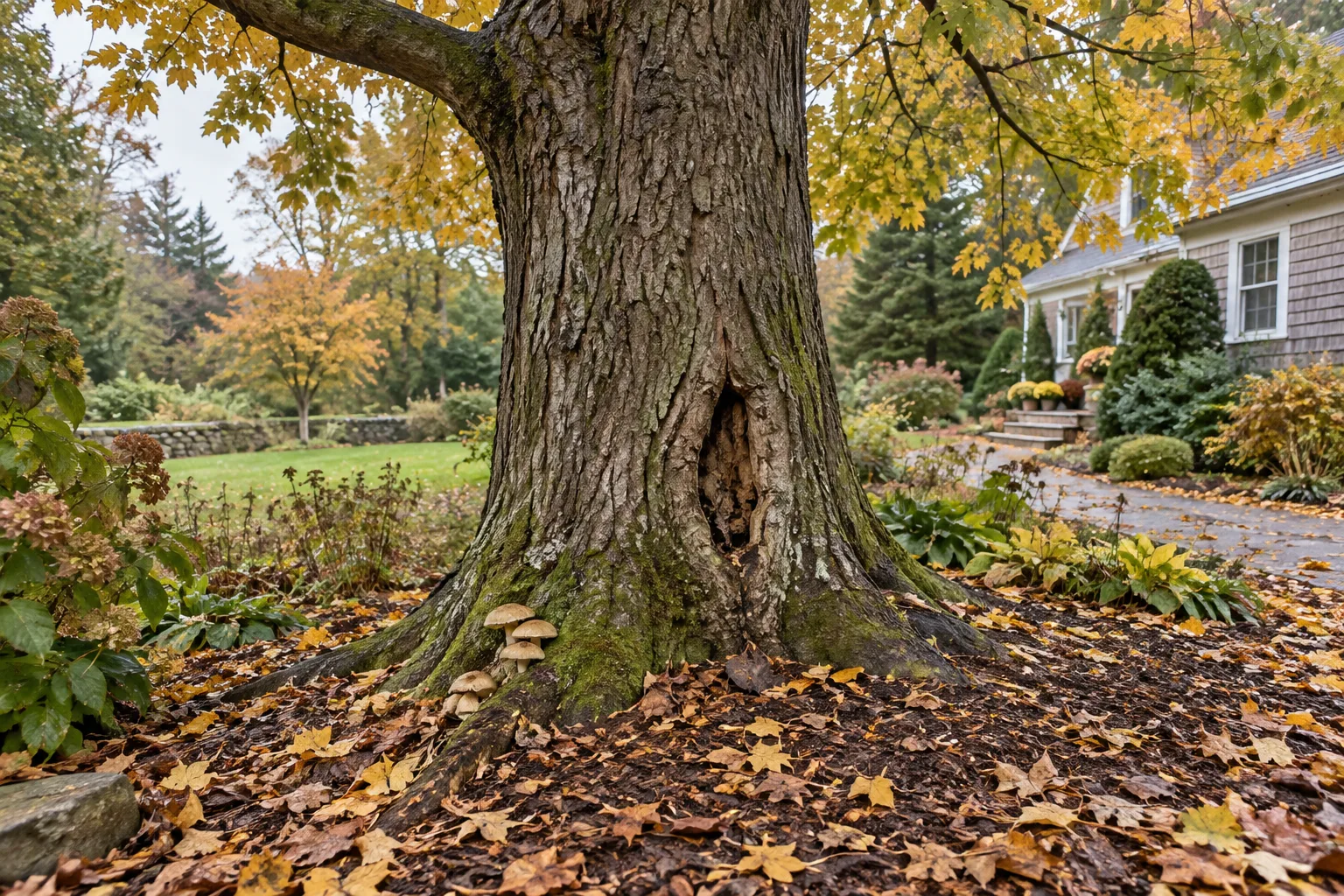
The aim is not to diagnose a tree from a photograph or declare every hollow trunk dangerous. Decay is common in older trees, and a tree can contain internal rot while remaining stable. Risk depends on three things together: the defect, the likelihood that a part will fail, and what that part would hit. A decayed branch over an empty woodland edge is a different problem from the same branch over a roof, play area, driveway, path, or power line.
This is a homeowner’s screening guide for the October garden. It can help you decide what to photograph, what to keep people away from, what to monitor, and when to book a qualified arborist. It is not a substitute for climbing, probing, cutting, or making a removal decision yourself.
Start with the target, not the tree’s age
A large old tree is not automatically a hazard, and a young tree is not automatically safe. Begin by walking around the tree and listing the places that could be struck if a branch or the whole tree failed. Include the house, garage, shed, greenhouse, fence, parked vehicles, frequently used seats, children’s equipment, livestock areas, and paths used in storms. Include utility lines and neighboring property where relevant.
Move portable targets if you can. A bench, bird feeder, stack of firewood, or seldom-used vehicle may be relocated without touching the tree. This is one of the simplest risk-reduction measures and often costs nothing. It does not solve a defect over the house or a public footpath, but it can reduce the consequences while you arrange an inspection.
Do not treat a tree as safe merely because it survived the last storm. Trees add new wood in response to the forces they have already experienced; an unusually wet, windy, icy, or saturated-soil event can expose a weakness that ordinary weather did not. The question is not whether failure is possible. It is whether the current level of risk is acceptable for the site and whether a practical measure can reduce it.
The October walk-around
Choose a dry, calm day. Take a phone, notebook, binoculars, and a tape measure for approximate trunk diameter if useful. Stay on the ground. Do not climb, use a ladder, cut into bark, drill the trunk, hit it with a hammer, or push a probe into a cavity. Those actions can injure you or create a new wound, and a casual test cannot establish how much sound wood remains.
Walk around the entire tree rather than inspecting only the side facing the house. Look at the trunk base, the main unions, the larger limbs, and the crown. Photograph the whole tree first, then close-ups with a ruler or another familiar object for scale. Record the date, recent weather, and whether the symptom is new or has been present for years.
The following observations do not provide a pass-or-fail score. They are clues that help an arborist understand what has changed and where to look more closely.
- Dead or hanging branches: Large dead limbs, branches caught in the crown, and broken pieces that remain attached deserve attention. Small dead twigs are normal in many trees; a heavy limb over a target is a different category.
- Cracks and splits: Look for vertical cracks in the trunk, cracks running from a branch union, separated bark, or a fresh split after wind. A crack at a major union can be more significant than a superficial scar, especially when the union has included bark or two stems press against each other.
- Cavities and soft wood: An opening, loose bark, crumbling wood, or a hollow sound is evidence of a wound or decay process, not a measurement of remaining strength. Note its height, approximate width, position, and whether water drains from it.
- Fungal brackets or mushrooms: Fruiting bodies on the trunk, roots, or root flare can indicate decay. Their absence does not prove that no decay exists, and their presence does not by itself tell you that the whole tree must be removed. The location matters: decay at a root flare or major union can raise a different structural question from a small old wound in a branch.
- Root and soil changes: Look for exposed or severed roots, soil added around the trunk, a buried root flare, recent trenching, paving, grade changes, or persistent standing water. Construction can damage roots and compact soil even when the crown still looks green.
- Lean and movement: A long-standing lean may be normal for that tree and site. A new lean, lifted soil, a cracked root plate, or movement after a storm is urgent. Do not stand beneath the tree to test movement in wind.
- Crown decline: Smaller leaves, sparse foliage, dead branch tips, premature color change, or dieback in the upper crown can point to stress. These signs may have causes unrelated to structural failure, but they are worth recording and discussing.
What decay actually means
Wood decay begins after a wound or, in some cases, through roots. Fungi break down parts of the wood, reducing its strength as the process advances. A living tree does not simply spread rot through itself like water through a pipe. It responds to injury by compartmentalizing damaged tissue with chemical and structural barriers. That response can slow decay, but it does not restore wood that has already lost strength.
Species differ in how effectively they compartmentalize decay. Some can wall off a column of decay and continue adding sound wood around it. Others are poorer compartmentalizers and may outgrow an internal column while the center becomes hollow. The species, age, growth rate, wound history, moisture, location of decay, and loading from wind all matter. This is why a rule such as “a hollow tree is always dangerous” is too simple.
A cavity is also not a reason to fill the trunk with concrete, expanding foam, tar, or paint. Extension guidance explains that these materials do not restore structural strength. They can interfere with drainage and air movement, conceal the condition from later inspections, and create hazards for a removal crew. Old repairs should be reported to an arborist rather than covered with a new material.
Mushrooms deserve the same measured response. A bracket at the base or on a major root may be a sign that decay is active in a load-bearing area, so it should prompt an assessment when there is a target nearby. But the mushroom’s common name, color, or size is not enough to estimate risk. Do not eat or handle unknown fungi, and do not spray a fungicide on a trunk in the hope of reversing structural decay.
The root flare is a frequent blind spot
At ground level, the trunk should usually widen into visible buttress roots or a root flare. Soil, turf, mulch, or a raised bed piled against the trunk can hide this transition. A buried flare keeps the lower trunk damp, reduces oxygen around roots, and can contribute to decline and decay. It also makes it harder to see cracks, decay, girdling roots, or a change in the soil around the base.
Remove only loose surface mulch that you can move safely by hand. Do not excavate around a mature tree with a shovel, mattock, or machine to expose roots. Cutting roots can create a new failure pathway, and digging may damage buried utilities. If the trunk flare is buried under soil or construction fill, ask an arborist whether a professional root-collar excavation is appropriate. Air excavation may be used in some cases because it can remove soil with less root damage than digging.
For routine care, keep mulch a few inches away from the trunk and spread it in a broad, shallow layer rather than building a volcano against the bark. Mulch should improve soil conditions, not hide the base. Avoid adding fertilizer simply because the tree looks stressed; excess nitrogen can stimulate top growth when roots are already compromised, and the correct response depends on the diagnosis.
Triage: what can wait and what cannot
A tree with a small old cavity in a low-target area may be suitable for routine monitoring. Photograph it, mark its location on a simple property sketch, and inspect it again after major storms and during the next annual review. Monitoring is not neglect when the target is low and the defect is stable; it is a deliberate way to notice change.
Book a qualified arborist promptly when you see a large dead limb over a target, a new crack or split, a hanging branch, a rapidly changing lean, a root plate lifting from the soil, extensive decay at the base, a large cavity at a major union, or a tree that has suffered recent construction damage. A tree that looks healthy can still have internal decay or root defects, so green leaves alone should not settle the question.
Keep people and animals away from the area if a limb is suspended, a trunk has split, the soil is lifting, or failure appears possible. Do not work beneath it while waiting for help. After a storm, do not approach a tree or branch touching a power line. Treat every line as energized, keep away from the area, and call the utility provider or emergency service according to local procedure.
An urgent situation is not the same as an urgent removal. The first priority is separation from the target and a professional assessment. Depending on the defect, risk may be reduced by pruning a particular limb, shortening or reducing weight under professional direction, installing support hardware, improving root-zone conditions, moving a target, or removing the tree. Support cables and braces are not guarantees and require follow-up inspections.
How to choose the right professional
For a tree where safety or structural integrity is the concern, look for an arborist with recognized professional credentials and specific experience in tree-risk assessment. In the United States, the International Society of Arboriculture provides a directory for ISA Certified Arborists and professionals with the Tree Risk Assessment Qualification. Other countries have their own professional registers and local standards.
Ask for a written assessment or proposal that identifies the tree, the observed defects, the targets, the recommended action, and the reason for the recommendation. If removal is suggested, ask whether the risk is limited to one limb or union, whether pruning or target protection is a realistic alternative, and what follow-up is needed. A second opinion is reasonable when a large, healthy-looking tree is being recommended for removal without a clear explanation.
Separate assessment from sales where possible. A company that only offers removal may be competent at tree work, but a consultant or arborist who can explain retention and mitigation options may give you a more balanced decision. Check insurance, local licensing requirements, references, and whether permits are needed. Never pay someone to top a tree as a shortcut to safety; indiscriminate heading cuts create large wounds and weakly attached regrowth.
A useful request includes the tree’s species if known, approximate height, location, photographs of the whole tree and defect, distance from the nearest structure, and any recent storm, excavation, trenching, or grade change. Tell the arborist whether the area is used by children, pets, vehicles, or pedestrians. Risk is site-specific, so those details matter as much as the tree’s appearance.
Cost planning without false precision
There are several possible costs, and they should not be confused. A self-guided visual check costs time. A written risk assessment costs professional labor. Pruning, cabling, root-zone work, removal, stump treatment, hauling, utility coordination, and follow-up inspections are separate services. Prices vary substantially with tree size, access, species, region, equipment, distance from structures, and whether emergency work is required.
Ask for itemized estimates rather than a single number. The quote should say whether cleanup, wood removal, stump grinding, traffic control, permit fees, and disposal are included. Emergency storm work usually costs more because access is difficult and crews must manage unstable material. Delaying every decision can also increase cost if a defect worsens, but removing every mature tree at the first sign of decay wastes shade, habitat, and money. A clear assessment helps compare the cost of mitigation with the cost and consequences of removal.
Do not spend money on decorative treatments that claim to seal or strengthen a decayed trunk. Concrete filling, foam filling, wound paint, and unlabelled injections cannot substitute for an evaluation of the load-bearing structure. Spend first on accurate identification of the problem, safe access, and the measure that addresses the actual risk.
October maintenance that helps without creating new damage
Keep lawn mowers, string trimmers, vehicles, and stored materials away from the trunk and surface roots. Repeated bark injury opens wounds and removes the living tissues that help a tree respond to damage. If construction is planned, protect the root zone before equipment arrives; soil compaction, trenching, grade changes, and fill can cause decline that becomes visible years later.
Water a stressed tree deeply and infrequently when local conditions require it, applying water across the root zone rather than against the trunk. Do not keep poorly drained soil saturated. Mulch can moderate moisture and temperature, but it cannot correct a drainage problem or compensate for severed roots. Local extension guidance should take priority because watering needs differ by species, soil, rainfall, and regional climate.
Prune only small branches that you can reach safely and identify clearly, using proper cuts near the branch collar. Leave large limbs, overhead work, chainsaw work, storm-hung branches, and anything near utility lines to trained professionals. Autumn is not a universal permission slip for heavy pruning. The best timing depends on the species, objective, disease pressure, local climate, and the condition of the tree.
Leave some healthy stems and leaf litter where they do not create a disease or access problem. A tidy garden is not the same as a safe garden, and removing every piece of habitat can harm beneficial insects. Diseased foliage and plant debris that is known to harbor a serious local problem should be handled according to extension or plant-health guidance. The tree-risk inspection is separate from general fall cleanup: do not cut sound habitat simply because it looks untidy, and do not leave a hazardous hanging limb because wildlife may use it.
A simple record for winter and spring
Create one page for each mature tree that concerns you. Write down the species if known, trunk location, approximate size, nearest targets, visible defects, recent work nearby, and photographs from the same viewpoints. Note whether the defect changes after wind or heavy rain. If an arborist visits, add the date, qualifications, findings, recommended action, and the date for follow-up.
Recheck after a major storm, construction project, drought, flooding event, or sudden change in the canopy. A mature tree does not need a daily inspection, but annual review is sensible, especially for trees near buildings and paths. If the tree is on a boundary, coordinate with the neighbor before arranging work. If it is in a public right-of-way or near utility infrastructure, contact the responsible authority rather than cutting it yourself.
The useful decision at the end of an October inspection is specific: monitor this tree, protect this target, arrange a professional assessment, or restrict access until the hazard is addressed. “It is old” and “it has a hole” are observations, not conclusions. A careful site check turns them into better questions, and better questions make it more likely that a valuable tree will be retained when it can be retained—and dealt with safely when it cannot.
Related articles
A Low-Maintenance Landscape Starts With the Site, Not the Plant Label
“Low maintenance” is not a promise that a plant can be ignored. It is a design result: match the plant to the light, soil, moisture, mature size and wildlife pressure already present in your yard.

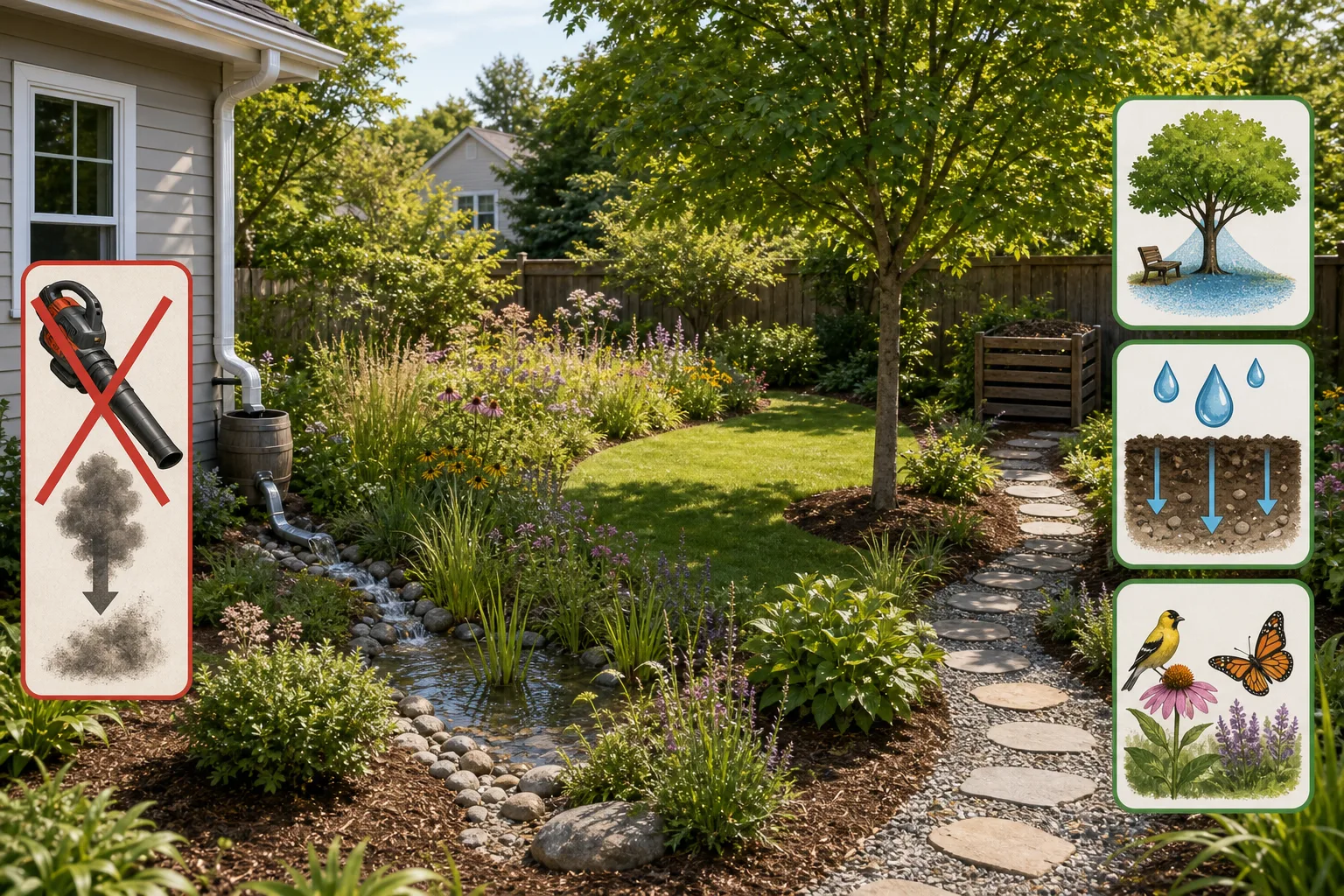
Your garden is not a carbon vacuum, but it can still fight heat, drought and wasted work
The useful climate yard is not sold as an offset. It is designed for shade, water, soil, habitat and less maintenance.
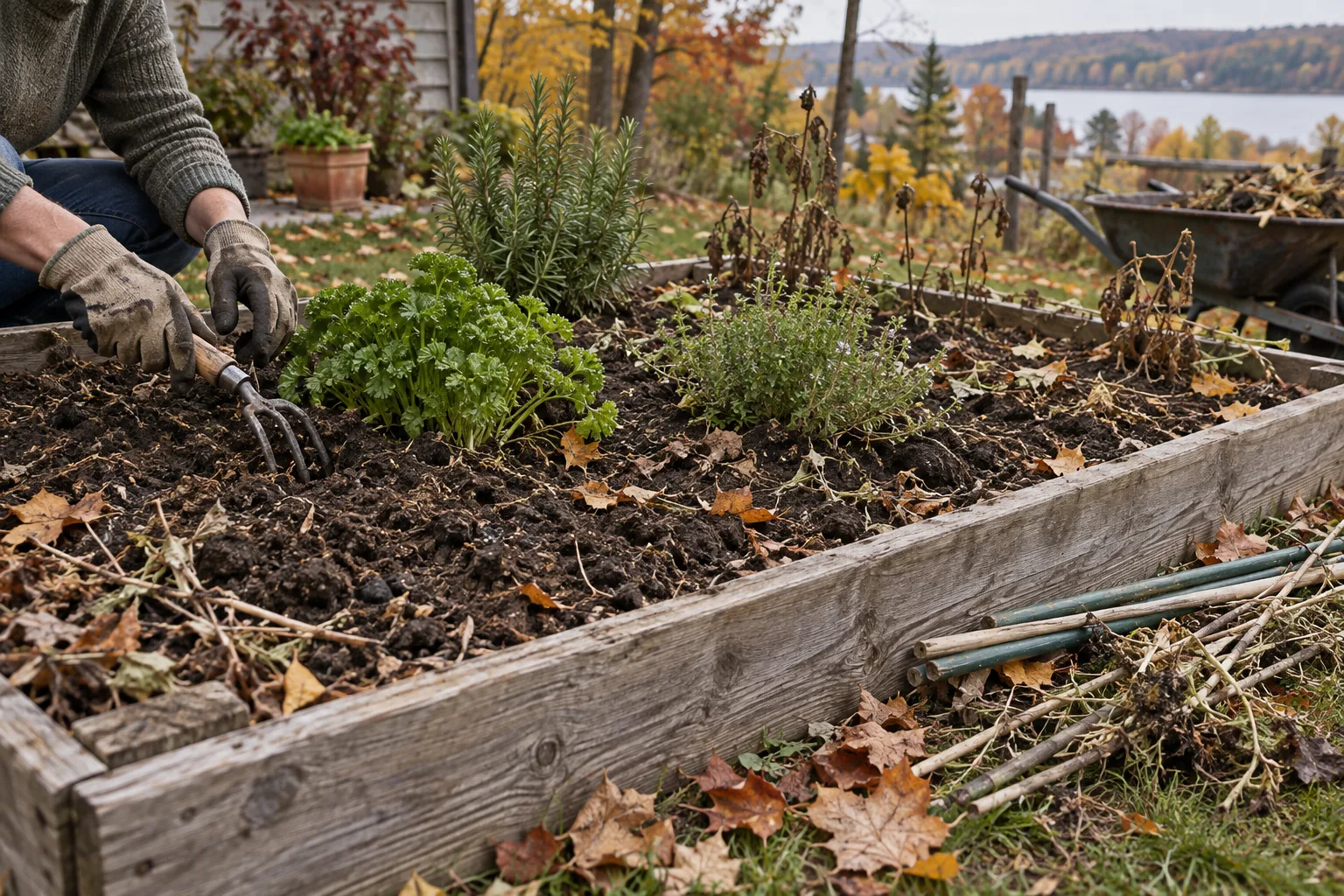
A Late-September Reset for a Raised Bed That Produced Almost Nothing
A poor raised-bed harvest does not automatically mean you need more compost. Use this late-season checklist to separate compaction, drainage, excess organic matter, timing, and crop-choice problems before spending money on a rebuild.

Italy After the September 30 Airport Strike: A Budget Traveler’s Plan for Rebooking, Trains and Missed Connections
Italy’s September 30 air-traffic-control strike has ended, but its cancellations can still affect October itineraries. Here is how to check a booking, choose between rerouting and refunding, use rail alternatives, and protect a low-cost trip from extra costs.

Comments
Sign in to comment.
No comments yet.