Could Potassium-Enriched Salt Prevent Millions of Deaths? What the New Global Estimate Shows—and Misses
A new global model estimates that replacing ordinary salt with potassium-enriched salt could prevent millions of cardiovascular and kidney-disease events. The striking number is plausible as a scenario, but it is not a prediction that every household can safely act on.

A new study has put an unusually large number on a familiar dietary idea: replacing some ordinary table salt with potassium-enriched salt could, under a worldwide implementation scenario, prevent about 2.96 million deaths and 10.17 million new cases of cardiovascular disease or chronic kidney disease each year.
That headline is easy to misread. The paper did not follow billions of people, and it did not show that buying a particular salt product will prevent a person’s heart attack or kidney disease. It built a comparative-risk model using existing evidence about sodium, potassium, blood pressure and disease burden. The result is best understood as an estimate of potential population benefit, not a clinical guarantee.
The idea is also not entirely new. In potassium-enriched salt, some sodium chloride is replaced with potassium chloride. That can lower sodium exposure while increasing potassium exposure, addressing two dietary factors that influence blood pressure. Randomized trials and systematic reviews support a blood-pressure benefit, but the evidence for mortality and cardiovascular events is less evenly distributed across countries and populations than the new global figure might suggest.
What the new study actually estimated
The research, published in Nature Health in November 2026, examined 193 countries and modeled five possible implementation scenarios. The broadest scenario assumed that all salt added to food would be replaced with potassium-enriched salt. Under that hypothetical change, the model estimated 2.96 million fewer deaths, 10.17 million fewer new cases of cardiovascular disease and chronic kidney disease, and about 69.4 million fewer disability-adjusted life years each year.
Those numbers are not measurements of events that have already been prevented. They are outputs from a model. The researchers combined estimates of salt consumption, population disease burden, the relationship between sodium and potassium exposure and blood pressure, and the relationship between blood pressure and disease outcomes. They then asked what would happen if those relationships held across countries and if the proposed salt replacement could be implemented at scale.
The more limited scenarios are more informative for understanding the model’s assumptions. Replacing only ordinary salt used at home was estimated to prevent about 1.85 million deaths and 6.19 million new cardiovascular or kidney-disease cases annually. Replacing salt used in processed and restaurant foods was estimated to prevent about 1.56 million deaths and 5.46 million cases. The model therefore did not assume that a complete reformulation of the global food supply was the only route to benefit.
The distinction matters because the main source of dietary sodium differs by region. In some countries, much of the salt is added during cooking or at the table. In others, processed foods, restaurant meals and packaged sauces account for a larger share. A salt substitute used at home cannot directly change the sodium content of foods that are already manufactured or served outside the home.
The model also considered a more targeted scenario in people with diagnosed or treated hypertension. Limiting the switch to household salt used by people with diagnosed hypertension produced a smaller estimate—about 0.59 million deaths prevented each year—but it may be easier to target and monitor than a universal change. Even that estimate remains a model result, not the outcome of a trial involving every person with hypertension.
Why potassium-enriched salt could help
Ordinary table salt is mostly sodium chloride. Sodium is essential, but high sodium intake can raise blood pressure in many people. Blood pressure is one of the most important modifiable risk factors for stroke, heart disease and kidney disease. Potassium, a mineral found naturally in foods such as beans, vegetables, fruit and dairy products, can influence blood pressure and sodium handling in the opposite direction.
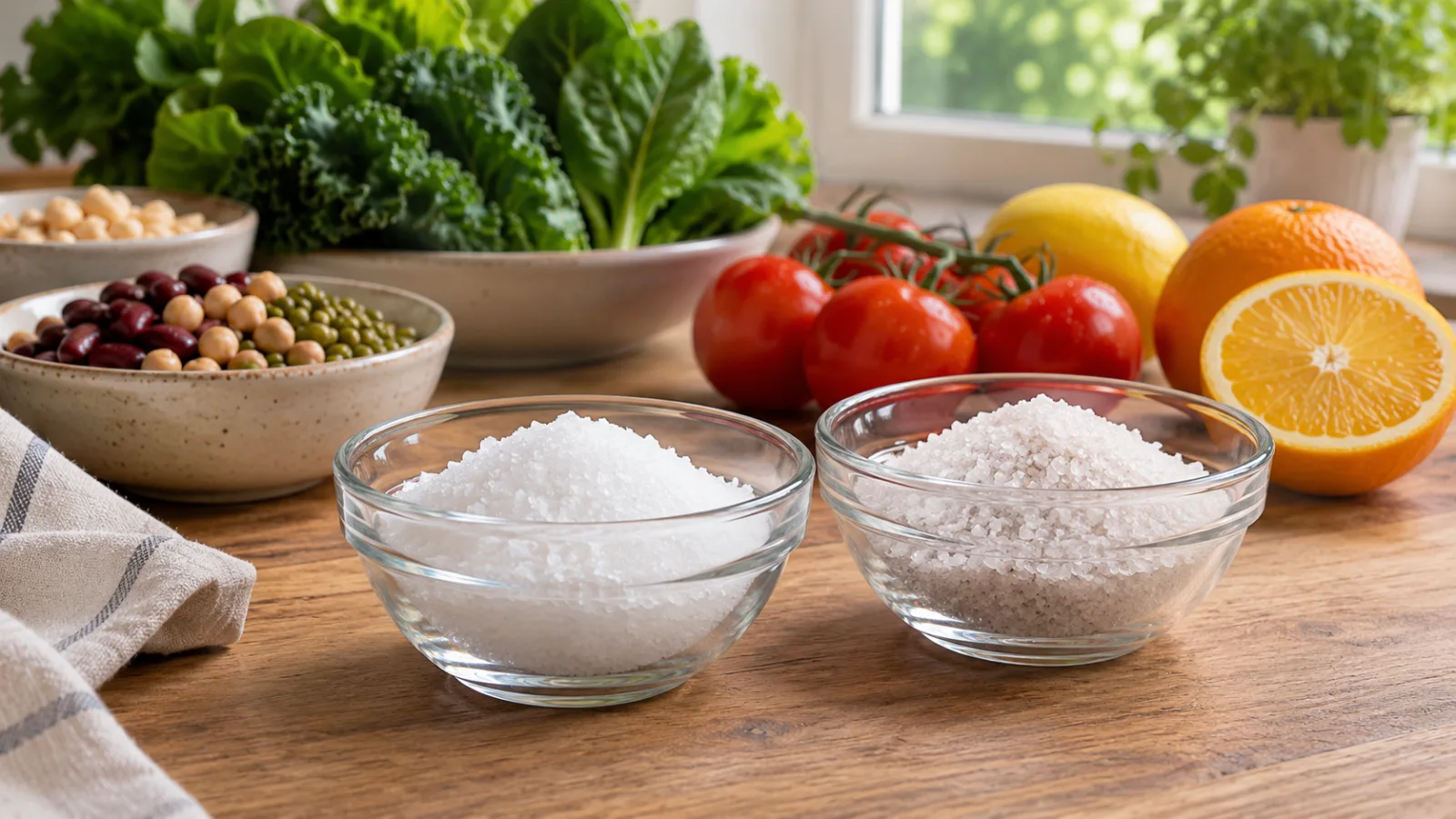
Potassium-enriched salt usually replaces part of the sodium chloride with potassium chloride. The product is still salty because it contains sodium chloride, but it contains less sodium per amount of salt and more potassium than standard salt. The expected effect is not a mysterious detoxification process or a special cleansing action. It is a change in the balance of two electrolytes that affect blood pressure regulation.
The evidence is strongest for an average reduction in blood pressure. A 2026 systematic review and network meta-analysis included 34 randomized controlled trials with 37,063 participants in 15 countries. The review concluded that moderate-potassium, lower-sodium substitutes—roughly formulations containing 25–40% potassium chloride and 60–79% sodium chloride—probably reduce systolic blood pressure by around 4.4 to 4.6 mmHg compared with ordinary salt. The authors judged the evidence for some cardiovascular outcomes to be moderate to high certainty, but the mortality findings require more careful interpretation.
A reduction in average blood pressure can matter at population level even when the change for one person is modest. Small shifts across millions of people can produce meaningful differences in strokes and heart attacks. That is the logic behind many public-health interventions, including reductions in smoking, trans fats and lead exposure. But it does not mean that the same numerical benefit will occur in every individual or that a salt substitute is equivalent to treatment for diagnosed hypertension.
The strongest trial evidence is not evenly global
The new review found an important limitation: the apparent reductions in mortality and cardiovascular events were driven largely by one very large Chinese trial, the Salt Substitute and Stroke Study, or SSaSS. That cluster-randomized trial included about 21,000 participants in rural Chinese communities. Villages were assigned to use either regular salt or a substitute containing less sodium and more potassium.
Over several years, the salt-substitute group had fewer major cardiovascular events and strokes, along with lower blood pressure. The trial is valuable because it tested a real-world intervention rather than simply asking participants to remember what they ate. It also reflects a setting where people commonly add salt during household cooking, making a household salt replacement a direct intervention.
But a trial in rural Chinese villages does not automatically predict the same effect in North America, Europe, Africa or urban populations elsewhere. Diets differ. The amount of salt added at home differs. Processed food consumption differs. Baseline potassium intake, access to health care, rates of kidney disease and medication use also differ. The 2026 meta-analysis reported that when the large Chinese trial was excluded, statistical significance for all-cause mortality disappeared because the remaining studies did not provide comparable mortality data.
That does not prove that the benefit is absent outside China. It means that the evidence is thinner than the global headline implies. Blood-pressure reductions appear more consistent across studies than reductions in deaths. The model therefore extends evidence beyond the populations in which the most decisive outcome data were collected.
This is a normal challenge in nutrition research. Dietary interventions are difficult to standardize, and outcomes such as stroke or death require large numbers of participants and long follow-up. Researchers often have to combine trials, observational data and disease models. That can be useful for policy planning, but the uncertainty should remain visible when the results are communicated.
What the estimate can—and cannot—say
The model can show the approximate scale of benefit that might be possible if several assumptions are correct. It can help policymakers compare a salt-substitution strategy with other approaches to lowering sodium or improving blood pressure. It can also show why the source of salt matters: switching household salt and reformulating processed foods produce different benefits in different places.
The model cannot tell an individual that a particular product will prevent a particular illness. It cannot establish that every person will respond in the same way. It cannot guarantee that people will use the substitute consistently, that food manufacturers will reformulate products without changing total consumption, or that taste differences will not affect adherence.
It also cannot fully capture implementation problems. Potassium chloride can taste bitter or metallic at higher concentrations. Food manufacturers may use mixtures, flavor enhancers or other ingredients to compensate. Products sold under similar labels may not have the same composition. A population-wide policy would need testing, labeling, quality control, affordability measures and monitoring of potassium exposure.
The headline also combines cardiovascular disease and chronic kidney disease into a single total. That is useful for estimating overall burden, but it can blur the fact that the intervention has different implications for different groups. Lower blood pressure may reduce cardiovascular risk, while excess potassium can be dangerous when the kidneys cannot excrete it adequately or when certain medicines affect potassium handling.
The researchers estimated that, even among people with advanced chronic kidney disease, the modeled cardiovascular benefits could exceed the modeled deaths associated with high potassium. That is a population-level comparison. It should not be read as evidence that people with kidney disease can safely use potassium-enriched salt without individual assessment. A favorable average balance does not remove the possibility of serious harm in a susceptible person.
The safety boundary is central, not a footnote
The World Health Organization’s 2025 guideline supports the use of lower-sodium salt substitutes containing potassium chloride for adults in general populations, but its scope is deliberately limited. It excludes people with kidney impairment or other circumstances that may compromise potassium excretion, including some people taking potassium-sparing diuretics or potassium supplements. The guideline also says the evidence is insufficient to extend the recommendation to children or pregnant women.
That boundary is easy to lose in social-media posts that turn a public-health intervention into a universal wellness tip. “More potassium” is not automatically better. The body normally keeps blood potassium within a narrow range, and the kidneys play a major role in maintaining that balance. Kidney disease, heart failure and some medicines can alter the way potassium is handled. The risk may be invisible to someone who feels well.
For that reason, a person with kidney disease, heart disease, diabetes, a history of abnormal potassium tests, or a prescription that affects potassium should not treat a salt substitute as an ordinary seasoning change without discussing it with a clinician. The same caution applies during pregnancy and for children because the evidence base and dietary context are different. This is not a recommendation to stop or change any medicine.
The safety question is also relevant to processed foods. If manufacturers add potassium-based ingredients to lower sodium, people who need to limit potassium may encounter the ingredient in products marketed as “lower sodium.” Clear ingredient lists and nutrition labeling can help, but labels do not replace individualized medical advice. The 2026 U.S. Federal Register rulemaking on standardized foods emphasized that any permitted salt substitutes must be safe and suitable ingredients and that potassium-containing ingredients must be declared under existing labeling requirements. It did not establish that every reformulated product is appropriate for every consumer.
“Salt substitute” does not mean “less salty food” in every situation
A potassium-enriched product can reduce sodium per amount of salt, but the amount of food seasoning used still matters. A person could compensate for a weaker salty taste by adding more of the substitute, reducing or eliminating the intended sodium benefit. The global model assumes specific changes in exposure, not simply that a new package appears in a kitchen.
There is another practical limit: replacing table salt does not remove sodium from all dietary sources. Bread, cheese, cured foods, sauces, snacks and restaurant meals can contribute substantial amounts. In countries where most sodium comes from manufactured foods, changing household salt alone will have a smaller effect. Conversely, in settings where people add salt during cooking, a household substitution may reach more of the relevant exposure.
This is why the study’s two broad intervention categories should not be collapsed into a single consumer instruction. A policy that changes food manufacturing, a program that distributes household salt substitutes, and a clinician discussing sodium intake with a patient are different interventions with different safeguards.
The study also does not argue that potassium-enriched salt should replace potassium-rich foods. Foods provide fiber, protein and other nutrients that salt substitutes do not. The research concerns the composition of salt, not a general case for potassium pills, electrolyte powders or high-dose supplements. The evidence for a salt substitute cannot be transferred to unrelated products marketed as ways to increase potassium.
How to read the “millions of deaths” headline
A useful way to translate the headline is: if the modeled changes in sodium and potassium exposure could be achieved across large populations, the resulting reduction in blood pressure and disease risk might prevent millions of events. That is a plausible public-health scenario supported by a mixture of randomized evidence and established risk relationships.
A less accurate translation would be: “Potassium salt prevents millions of deaths, so everyone should switch today.” The latter skips the assumptions, the geographic differences and the safety exclusions. It also converts a population estimate into personal medical advice.
The most defensible verdict is therefore promising for population health, but conditional for individuals. The evidence supports further implementation research and carefully designed policy. It supports the idea that reducing sodium while increasing potassium can lower average blood pressure. It does not justify universal use by people with kidney impairment or by those taking medicines that can raise potassium. It does not show that the full modeled global benefit will occur in practice.
Future research should answer questions that the current evidence leaves open: how well the approach works in regions where processed food is the dominant sodium source; how it performs in Africa and other underrepresented populations; whether food reformulation changes purchasing and eating behavior; how often unsafe potassium levels occur outside trial settings; and which labeling and clinical safeguards protect people at risk.
For readers, the main lesson is about evidence scale. A large number in a model can identify an important policy opportunity without becoming a personal prescription. Potassium-enriched salt may be a useful tool in some public-health strategies, but its safety and relevance depend on a person’s health, medicines, usual diet and the actual product involved.
This article explains research evidence and does not provide a diagnosis, treatment plan or individualized dietary recommendation. It does not replace consultation with a qualified healthcare professional, particularly for people with kidney disease, heart disease, pregnancy, chronic conditions or medicines that affect potassium levels.
Related articles

A Late-September Reset for a Raised Bed That Produced Almost Nothing
A poor raised-bed harvest does not automatically mean you need more compost. Use this late-season checklist to separate compaction, drainage, excess organic matter, timing, and crop-choice problems before spending money on a rebuild.

Late-October Fertilizer Check: When to Feed the Lawn, When to Stop, and What to Do Instead
Late October is not a universal “winterizer” window. The right decision depends on grass type, active growth, soil temperature, recent feeding, and local rules. Here is a practical way to avoid wasted fertilizer and winter-sensitive growth.


Could AI Help Protect Bomb-Squad Officers? Exploring a Safer Approach to Chemical Hazard Detection
How a simple day at the Oregon Ducks game in Eugene inspired the possibility of protecting our Officers.

Could AI and Doctors Develop Psilocybin and LSD Blockers to Stop Bad Trips?
The Future of Psychedelic Emergency Medicine

Comments
Sign in to comment.
No comments yet.