Hyundai’s Atlas strike is really about who writes the rules for humanoid robots
The Ulsan walkouts are formally about wages, but Atlas turns them into an early test of how factories should negotiate humanoid automation before it is fully mature.
The first important factory argument about humanoid robots may have arrived before humanoid robots are truly ready for factory scale. That is exactly why it matters. In Ulsan, South Korea, Hyundai Motor workers have already staged partial walkouts after wage talks failed, and the union announced longer four-hour strikes for July 20 through July 22. The formal dispute includes pay, bonuses, retirement age and job security. But the detail that made the story travel around the robotics world is Atlas: Boston Dynamics’ humanoid robot, owned inside Hyundai’s orbit, and a demand that deployment should not happen without labor-management rules.
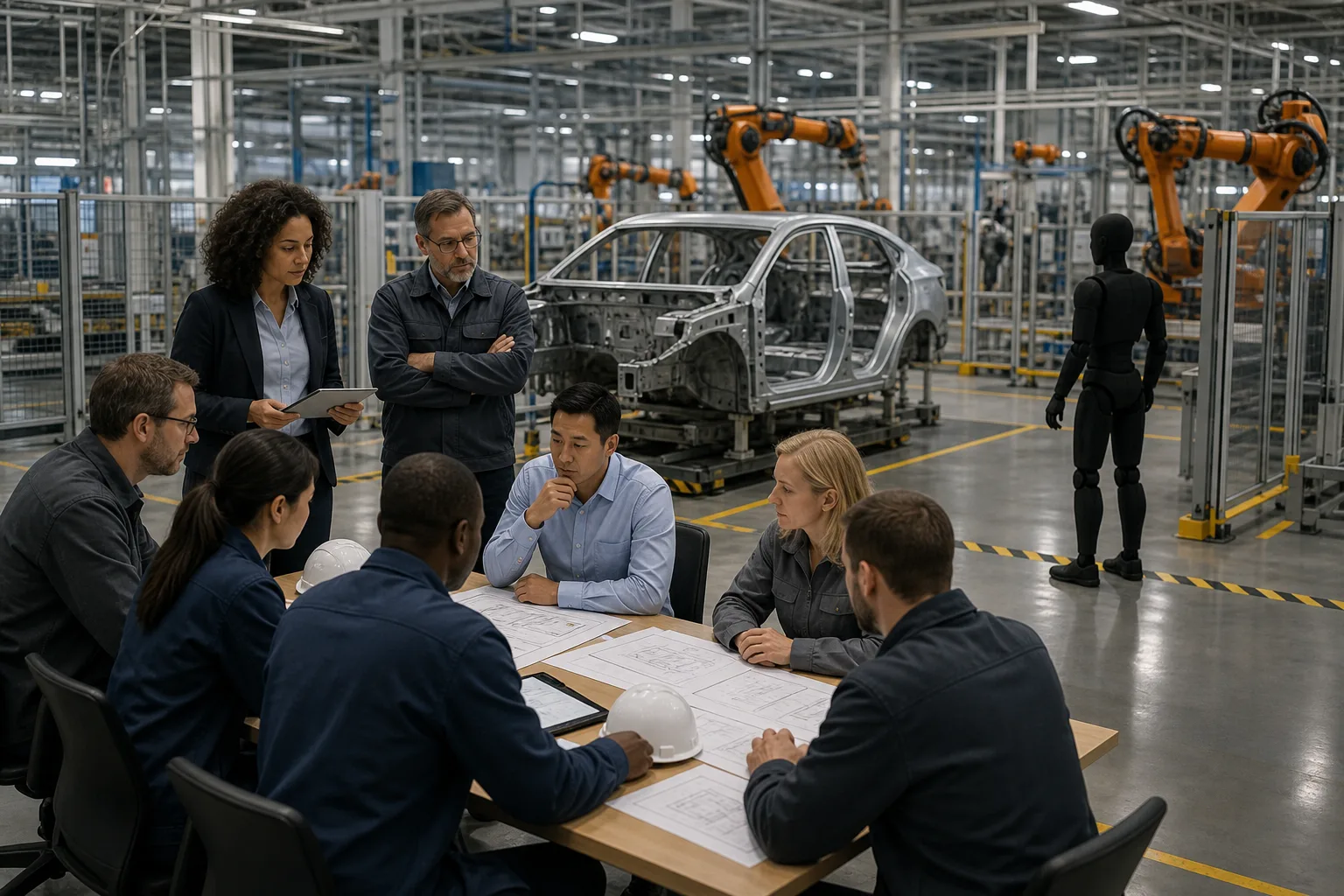
This is not a simple “robots versus workers” fable. Hyundai has rational reasons to study humanoid automation: labor shortages, aging populations, dangerous tasks, global competition, electric-vehicle production pressure and the constant search for flexible manufacturing. The union also has rational reasons to move early. If workers wait until a robot is certified, purchased, integrated and already performing useful work, the practical negotiation may be over. The leverage exists before deployment, not after.
That makes the Hyundai dispute a template for robotics, not a local curiosity. The question is not whether robots will enter factories. They already have, in enormous numbers. The International Federation of Robotics has reported about one million industrial robots operating in the automotive industry worldwide, roughly a third of all installed industrial robots. The new question is who writes the rules when the robot stops being a fixed arm behind a fence and starts being marketed as a general-purpose worker for human spaces.
What happened in Ulsan
The Korea Times, citing Yonhap, reported that Hyundai Motor workers left shifts two hours early from Monday through Wednesday and that the 39,668-member union planned four-hour strikes during shifts from July 20 to July 22. The two sides had held 15 rounds of wage negotiations without narrowing the gap. The union demanded a 149,600 won increase in monthly base pay and performance-based pay equivalent to 30 percent of Hyundai’s net profit for the previous year. Hyundai’s offer included an 80,000 won monthly base-pay increase, a performance bonus equal to 350 percent of monthly salary plus 10 million won, and 15 company shares.
Those numbers matter because they keep the story grounded. This is not only a science-fiction panic about a walking machine. It is an ordinary industrial negotiation in a very important factory system. Pay structure, retirement age and bonuses are central. The robot issue adds a new layer: if humanoids eventually reduce hours, replace retiring workers, change task assignments or shift bargaining power, then wage talks and automation talks cannot be separated cleanly.
Ars Technica framed the stoppage, citing the Wall Street Journal, as the car industry’s first factory stoppage addressing humanoid robots. That “first” should be read cautiously because labor history is messy and definitions matter. But even if another smaller dispute could be found somewhere, this is still one of the clearest early cases where a major automaker, a major union and a named humanoid robotics program are colliding in public.
Why Atlas changes the emotional temperature
Automotive factories have been automated for decades. Welding cells, painting robots, transfer lines, CNC systems, gantries, automated guided vehicles and collaborative arms are not new. Workers have long lived beside machines that do one job faster, more precisely or more safely than a person. So why does a humanoid robot generate a different reaction?
The answer is symbolism and flexibility. A classic industrial arm is usually a tool assigned to a cell. A humanoid is sold, at least rhetorically, as a flexible worker. It has legs, arms, hands, cameras, balance, perception and software. It is meant to operate in spaces originally built for people. Boston Dynamics describes Atlas as a humanoid platform for real-world applications, and the company’s public image has always been tied to dynamic mobility. Whether the current commercial value is proven or not, the shape says something to workers: this machine is not merely automating a weld; it is being imagined as a substitute body inside the workplace.
That does not mean the humanoid form factor is always the best engineering answer. Hacker News commenters immediately raised the obvious technical challenge: on a smooth factory floor, when is a walking Atlas better than one to three robot arms on a pedestal, gantry or mobile base? In many tasks, the boring answer may win. Fixed automation can be cheaper, stronger, safer, easier to certify and easier to maintain. AMRs can move bins without needing knees. Cobots can assist in constrained workstations. A humanoid has to justify its flexibility against battery life, uptime, maintenance, supervision, safety cases and integration cost.
But this is exactly why the labor fight is not premature. The technology may still be economically uncertain, yet management strategy can be decided before the machine is mature. If a company secures the right to deploy broadly without consultation, the eventual technical details become implementation questions. The union is trying to move the decision back into negotiation.
Hyundai is not just a customer of humanoid robotics
Hyundai is unusually exposed to this story because it is not merely buying robots from the market. Boston Dynamics is part of Hyundai’s strategic robotics identity, and Reuters reported that Hyundai Motor Group moved to make Boston Dynamics wholly owned by buying SoftBank’s remaining stake. Ars, citing Korea Herald reporting, said Hyundai aims to deploy more than 25,000 Atlas robots across Hyundai and Kia manufacturing plants, starting with U.S. factories in 2028. The Strait Times also reported Hyundai plans to deploy humanoid robots such as Atlas at U.S. plants from 2028, while saying the company had not disclosed Korean deployment plans.
That distinction matters. If robots first appear at nonunionized U.S. facilities, Korean workers can still reasonably ask what the global plan implies for them. A factory workforce does not need a published Korean deployment date to see the direction of travel. Automakers learn across sites. If a process works in Georgia or elsewhere, it can become a benchmark, a cost target, a boardroom argument and eventually a pressure point at home.
Hyundai can argue that Atlas would assist rather than replace workers. That may be true for many early tasks. Humanoids may start with ergonomic lifting, parts movement, repetitive handling, night-shift inspection, hazardous zones or flexible work that is too variable for fixed machinery. But “assist, not replace” is not a governance system. Workers want to know which tasks, which lines, which metrics, which safety rules, which retraining paths and which protections apply when assistance becomes substitution.
The economics are tempting but not settled
The case for humanoids is built on a powerful idea: factories are already designed around the human body, so a general-purpose robot body could reuse existing tools, stairs, carts, doors, shelves and work cells. If one platform can learn many tasks, the capital expense might spread across the plant. If software improves, the same robot could become more useful over time.
Analyst estimates cited by Ars are striking: Atlas cost around $130,000 in one estimate and might pay for itself in about two years; another analyst suggested that if costs fall toward $100,000, operational cost could eventually undercut low-wage labor benchmarks. These figures are useful signals, not settled facts. Real factory economics depend on uptime, cycle time, safety stops, maintenance, spare parts, software licensing, integration engineering, supervision, insurance, training, battery management and the number of tasks the robot can actually perform at production quality.
Robotics history is full of machines that looked cheaper in spreadsheets than in real deployments. A robot that works 80 percent of the time in a demo may be impressive research and unacceptable production equipment. A robot that needs a specialist standing nearby may not save the expected labor. A robot that damages parts or slows a line can destroy its own business case quickly. Humanoids will have to clear the same boring tests as every other factory technology: reliability, repeatability, serviceability, safety and measurable throughput.
That uncertainty cuts both ways. Companies should be cautious about promising near-term replacement. Workers should also be cautious about dismissing the threat because today’s robot is imperfect. Manufacturing technology improves through pilots, iteration and process redesign. The first deployment may be clumsy; the fifth generation may not be.
Safety is not a press-release problem
A humanoid robot in a factory is not the same risk category as a chatbot in an office. It has mass, moving limbs, grippers, batteries, perception systems and software decisions that can intersect with people, vehicles, tools and expensive work-in-progress. If it falls, misidentifies an object, moves unexpectedly, blocks a path or applies force in the wrong direction, the result is physical.
Industrial robotics already has safety standards, guarded cells, collaborative robot rules, emergency stops, speed and separation monitoring, lockout procedures and risk assessments. Humanoids do not escape that world because they look friendly or because their software is called AI. They may make the safety case more complicated because their whole promise is mobility in human environments.
Before deployment, a factory needs task-level risk assessments, mapped operating zones, speed and force limits, emergency-stop access, incident reporting, maintenance procedures, data logging, worker training and clear authority to stop a robot when behavior looks unsafe. The union demand for consultation can be read not only as job protection, but as a safety demand: people who work beside the machine want a voice in defining safe work.
What a serious robot agreement could include
The most useful outcome would not be a blanket ban on humanoids. It would be a deployment agreement detailed enough to make automation governable.
First, notice and consultation rights. Workers should know before a robot is piloted on a line, not after the purchase order is signed. Consultation should include task lists, affected roles, expected staffing changes, training requirements and safety documentation.
Second, task transparency. “Atlas will assist workers” is too vague. A factory should identify whether the robot is expected to move totes, handle parts, inspect, pick, fasten, clean, load machines, carry tools, work near people or replace a shift task. Different tasks carry different job and safety implications.
Third, retraining and internal transfer paths. If robots remove repetitive strain work, that can be good. But the workers whose bodies were spared need credible routes into robot supervision, maintenance, quality control, logistics, safety auditing or other roles. Training should happen before displacement, not as a farewell benefit.
Fourth, hour and wage protections. Automation can reduce overtime, compress teams or replace retiring workers without headline layoffs. Those changes still affect income and bargaining power. A serious agreement should address not only layoffs, but attrition, reduced hours, reassignment and pay structure.
Fifth, independent safety review. A vendor demonstration and a management sign-off are not enough. Worker representatives, safety engineers and external experts should be able to review risk assessments, incident data and near misses.
Sixth, productivity sharing. If humanoids create major gains, the people who help integrate them should not only absorb the disruption. Profit-sharing, bonuses, shorter hours, safer tasks or career upgrades can turn a robot program from a threat into a negotiated modernization plan.
The global race is already moving
Hyundai is only one front. Tesla continues to position Optimus as part of its future factory and AI strategy. BMW has publicized work with Figure humanoid robots in Spartanburg under the language of “Physical AI.” Chinese automakers and robotics companies are moving quickly, with BYD and others linked to humanoid experiments or development. Logistics companies are watching humanoids alongside mobile manipulation, warehouse AMRs and existing systems such as Agility Robotics’ Digit.
Each sector will face a different version of the Hyundai question. In warehouses, the issue may be pace, injury, surveillance and attrition. In construction, it may be safety, subcontracting and liability. In elder care, it may be dignity, staffing and trust. In factories, it is the combination of cycle time, union power, skill transfer, safety certification and capital investment.
The first agreements will travel. If Hyundai grants formal consultation over humanoid deployment, unions elsewhere will cite it. If Hyundai wins broad freedom to deploy without meaningful labor rules, other companies will cite that too. Robotics governance often lags deployment, but labor contracts can become a faster regulatory layer than government law.
The technical argument workers are forcing engineers to answer
The strongest part of the current debate is that it forces robotics teams to answer a question that demo videos often avoid: why humanoid here?
A humanoid is plausible when the environment is too variable for fixed automation, when the task uses human tools, when the robot must move through existing spaces, when volumes do not justify a custom cell, or when one mobile platform can perform many small jobs across shifts. It is less plausible when the task is high-speed, heavy, perfectly repetitive, spatially constrained or easily solved by a conventional arm, gantry, conveyor, AMR or fixture.
That distinction should be part of worker consultation. A deployment plan that cannot explain why a humanoid is better than simpler automation may be a technology showcase rather than good industrial engineering. A union that asks for this explanation is not necessarily anti-robot. It may be asking for disciplined robotics.
What the Hyundai strike means for robotics
For years, humanoid robotics has been measured by demos: can it walk, jump, recover, carry, pick, fold, sort, place, learn and navigate? The Hyundai dispute adds another benchmark: can it be introduced into a real workplace without turning the social system into a hazard?
A factory is not only machines and software. It is workers, supervisors, maintenance crews, quality engineers, safety committees, suppliers, insurance, law, union contracts, tacit knowledge and daily routines. A robot that fits the geometry of a human workplace still has to fit the politics and responsibility structure of that workplace. Physical AI does not become industrial automation until it has a safety case, a business case and a social contract.
The most likely future is not total victory for either side. Robots will keep coming because the economic and demographic pressures are real. Workers will keep resisting silent deployment because the risks are also real. The winning factories will be the ones that treat negotiation as part of system design, not as a public-relations obstacle.
That is the lesson from Ulsan. Humanoid robots do not only need better actuators, batteries and perception. They need rules. If the machine is meant to work in a human-shaped environment, the deployment process also has to be human-shaped: negotiated, legible, safe, and honest about who gains and who bears the cost.
Related articles
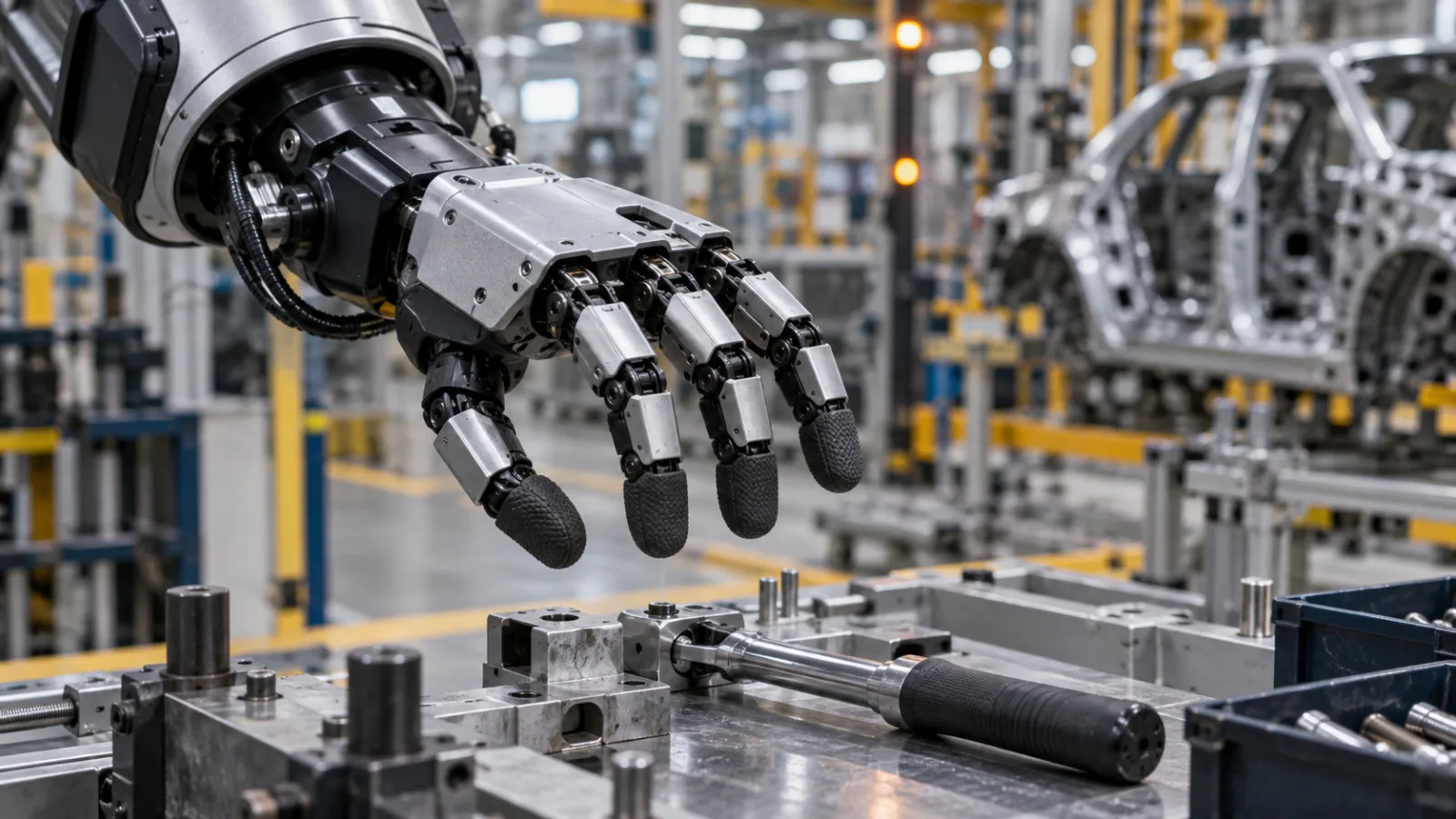
Atlas’s New Hand Makes Humanoid Robotics a Factory Product Problem
Boston Dynamics’ four-finger Atlas hand is less about looking human and more about surviving tools, shifts, repairs and safety audits. That makes it a useful signal for where humanoid robots are actually headed.
يد أطلس الجديدة تحوّل الروبوتات الشبيهة بالبشر إلى اختبار لمنتج صناعي
تكشف يد أطلس ذات الأصابع الأربعة أن مستقبل الروبوتات الشبيهة بالبشر لن يُحسم بحركات استعراضية، بل بقدرتها على استخدام الأدوات، تحمّل الورديات، اجتياز اختبارات السلامة، وإصلاح الأعطال داخل المصنع.
Новая кисть Atlas превращает гуманоидную робототехнику в задачу промышленного продукта
Четырёхпалая кисть Atlas от Boston Dynamics важна не сходством с человеческой рукой, а способностью переживать инструменты, смены, ремонт и проверки безопасности. Это показательный сигнал о реальном направлении гуманоидной робототехники.
La nouvelle main d’Atlas transforme la robotique humanoïde en problème de produit industriel
Avec quatre doigts, 13 degrés de liberté et une détection tactile dense, la nouvelle main d’Atlas montre que la robotique humanoïde se joue désormais sur la manipulation, la maintenance, la sécurité et la fabrication à grande échelle.
Comments
Sign in to comment.
No comments yet.