Bonsai 27B shows what local AI can do before the cloud call
PrismML’s compressed 27B model is less about replacing the cloud than about moving private, routine AI work closer to the user’s device.

A 27-billion-parameter model running on a phone sounds like a headline from the wrong year. That is why Bonsai 27B is worth paying attention to, and also why it needs a careful read.
PrismML released Bonsai 27B on July 14, describing it as the first 27B-class multimodal model that can fit on a phone. The claim is not that phones have suddenly become frontier-model machines. The more useful claim is narrower: aggressive 1-bit and ternary compression may be pushing a useful class of reasoning, vision and agent workflows close enough to the user's data that product architecture starts to change.
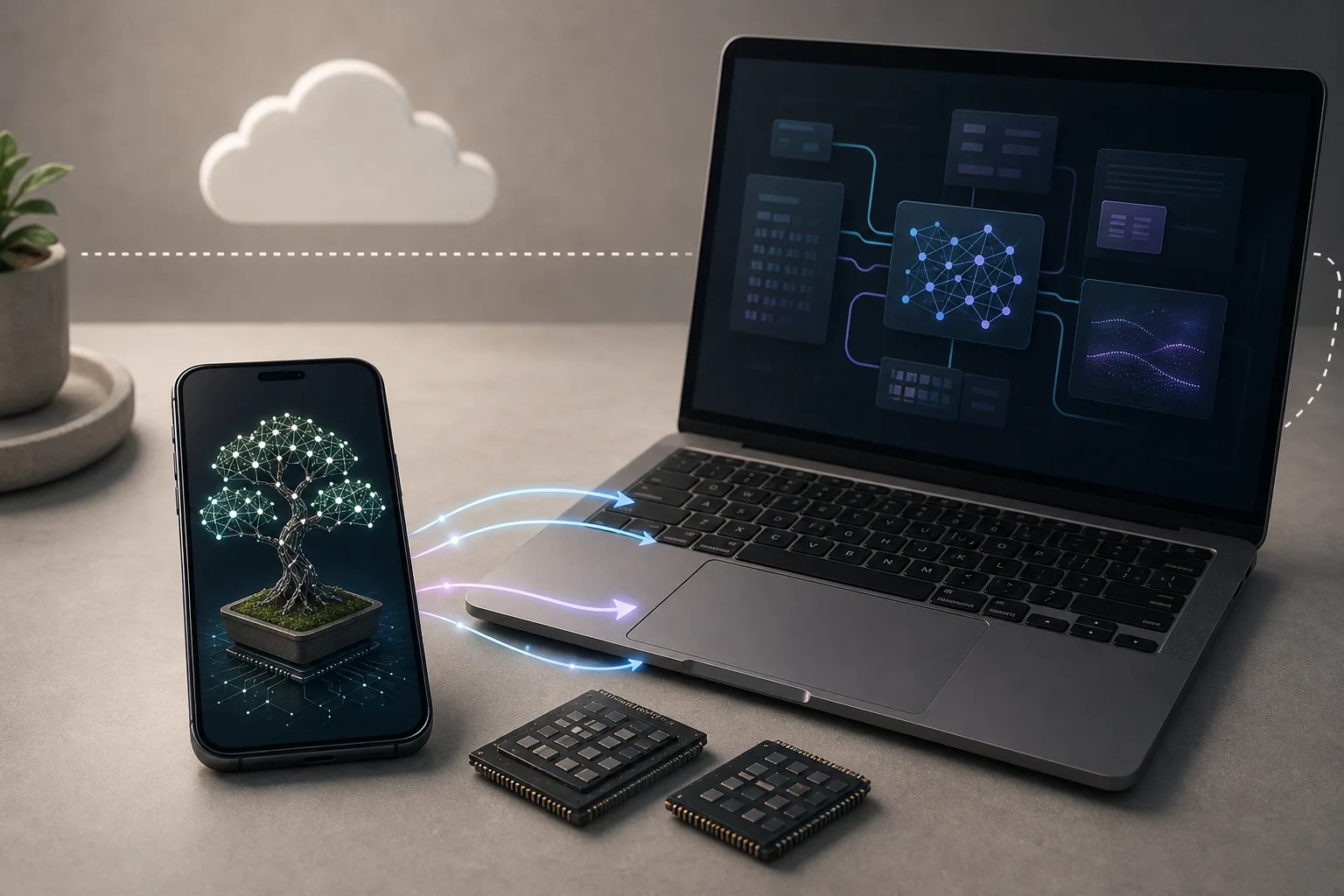
That matters for anyone building AI into real software. Cloud APIs remain the best answer for many hard tasks. But if a local model is good enough for routine private steps, the economics and privacy assumptions shift. A customer-support app could summarize local logs before sending a smaller problem to the cloud. A field worker could query documents offline. A personal agent could inspect screenshots and files without every intermediate step leaving the device.
Bonsai 27B does not prove all of that is ready. It makes the question harder to ignore.
What PrismML actually released
Bonsai 27B is based on Qwen3.6 27B, according to PrismML's announcement and Hugging Face metadata. That detail matters. This is not a new foundation model trained from scratch. It is a low-bit Bonsai build of a Qwen-family 27B model, packaged for unusually small memory footprints.
PrismML lists two main variants. Ternary Bonsai 27B uses weights constrained to {-1, 0, +1} with FP16 group-wise scaling, for a claimed 1.71 effective bits per weight. The company positions it as the quality-oriented build at 5.9 GB. The 1-bit Bonsai 27B variant uses binary {-1, +1} weights with group-wise scaling, for a claimed 1.125 effective bits per weight and a 3.9 GB footprint.
The official announcement says a conventional 27B model would need roughly 54 GB in 16-bit precision and that even a strong 4-bit build, at about 18 GB, is too large for phones and many laptops. On that comparison, 3.9 GB and 5.9 GB are not minor optimizations. They move a model class from server memory into consumer-device territory.
PrismML also claims multimodal input through a compact 4-bit vision tower, a 262K-token context window and speculative decoding. Platform support is framed around MLX for Apple devices and CUDA for NVIDIA GPUs, with custom low-bit kernels. Hugging Face currently shows Bonsai 27B GGUF and MLX repositories, including prism-ml/Bonsai-27B-gguf, prism-ml/Ternary-Bonsai-27B-gguf, prism-ml/Bonsai-27B-mlx-1bit and prism-ml/Ternary-Bonsai-27B-mlx-2bit, tagged with Apache-2.0 licensing and Qwen3.6 27B as the base model.
The vendor's benchmark framing is ambitious. PrismML says Ternary Bonsai 27B retains about 95% of the full-precision baseline across a 15-benchmark suite, while the 1-bit version retains about 90%. A press variant of the announcement says the 1-bit model reaches 11 tokens per second on an iPhone 17 Pro, while a table for M5 Max lists 87 tokens per second for the 1-bit build and 58 for the ternary build. Those numbers are useful as starting points, not as deployment guarantees.
Why local 27B changes the product discussion
The phrase "runs on a phone" can be misleading if it is read as "replaces the cloud." That is not the practical takeaway.
The practical takeaway is that more AI work can happen before the cloud call, after the cloud call or without a cloud call at all. That opens a different design space.
A local assistant can preprocess sensitive context. It can classify documents, draft structured notes, extract fields from screenshots, summarize a folder, propose a command plan or decide whether a cloud model is needed. It can do repeated low-stakes steps without turning every loop into a billable API chain. For agents, that matters. Autonomous workflows burn tokens through planning, reflection, retries, tool calls and error handling. If the cheap local model can handle half of that loop, cloud cost changes.
Privacy changes too. Sending one final redacted request to a frontier model is a different risk from streaming every file, screenshot and intermediate tool output to a remote service. Local inference gives product teams a way to keep raw context near the user while still using cloud models for the steps that need the most intelligence.
Offline capability is the third piece. Many AI demos assume perfect connectivity. Real work often happens on trains, factory floors, clinics, construction sites, warehouses, ships, classrooms and homes with unreliable networks. A local model that is merely adequate can beat a better cloud model when the connection is absent or when data policy blocks upload.
This is why Bonsai 27B belongs in AI Practice rather than only in model-release news. The interesting question is not whether it tops every benchmark. The question is whether "good enough and local" starts to beat "best available but remote" for enough routine jobs.
The quality question is the whole story
Low-bit models are easy to over-sell because the headline metric is so visual. A 27B model in 3.9 GB feels like a breakthrough even before anyone checks whether it behaves well.
That behavior is the deciding factor. A compressed model can retain benchmark averages while losing exactly the qualities that make an agent useful: stable instruction following, tool-call formatting, refusal to hallucinate APIs, robust vision grounding, long-loop coherence and boring reliability after the fifth retry. An assistant that is 90% of a baseline on a table may still be wrong in the places where a product cannot tolerate improvisation.
The Hacker News thread around the release showed that split clearly. The post reached 684 points and 242 comments in the Algolia item I checked. Some readers focused on the engineering jump and the possibility of local agents with near-zero marginal token cost. Others dug into the meaning of "1-bit," ternary packing, runtime support and whether the model's real answers matched the claim.
Those community comments are not a substitute for evaluation, but they are a useful signal. People were not only cheering. They were asking whether LM Studio, MLX, llama.cpp, Android and CPU paths work cleanly; whether a smaller 4-bit model might be better in practice; whether coding quality survives the compression; and whether vendor benchmarks are measuring the right failure modes.
That is the right skepticism. Local AI is not valuable because the model fits in memory. It is valuable if it fits in memory, responds fast enough, stays cool enough, and does the task correctly enough to remove cloud dependency for that use case.
Phone memory is not the same as phone usability
"Fits on a phone" is an important milestone, but it is not a product spec.
A real mobile deployment has to pay for more than weights. There is runtime overhead, KV-cache memory, vision inputs, long context, tokenizer and app memory, OS pressure, battery drain, thermal throttling and user patience. A one-off demo can run differently from a daily assistant that keeps state, watches the screen, calls tools and answers several times in a row.
PrismML's own positioning gives two clues. The 1-bit build is the footprint-oriented option. The ternary build is the quality-oriented option. That already tells product teams not to treat "smallest" as automatically "best." If the task needs better tool calling or fewer hallucinations, 5.9 GB on a laptop may be more useful than 3.9 GB on a phone.
The iPhone throughput claim also needs the usual deployment caution. Eleven tokens per second can be workable for short interactions. It may feel slow for long answers, code generation or multi-step agents. It may also vary with prompt length, cache size, thermal state, background load and whether the app uses the exact runtime path PrismML optimized.
For mobile developers, the first question should not be "can it run?" It should be "what can it run without making the product feel worse?" A private local summarizer that works for 20 seconds after a meeting is different from a constantly active agent that drains a battery by lunch.
Where Bonsai-like models make sense first
The best early uses are likely not giant autonomous agents living entirely on a phone. They are smaller, sharper pieces of a hybrid system.
One good target is privacy filtering. A local model can inspect raw notes, messages, files or screenshots and produce a reduced representation before anything leaves the device. It can remove names, isolate the task, classify urgency or decide that no cloud call is needed.
Another is repetitive automation. Many workflows contain dozens of routine reasoning steps around a few genuinely hard decisions. A local model can handle the routine steps: parse, label, summarize, route, prepare a patch, draft a plan, check a policy, compare two versions. The cloud model then handles the harder step or audits the local output.
A third is offline work. A smaller local model that answers adequately can be the default assistant for travel, field work, classrooms or regulated settings. It may not beat frontier models, but it does not need to. It only needs to be available, private and good enough for the job.
The fourth is cost control. Agent loops are expensive when every thought, tool result and retry hits a paid API. If a local 27B-class model can take over planning, local file reasoning or first-pass transformation, teams can reserve cloud calls for the moments that actually require frontier capability.
This is also where local AI could change procurement. Companies may stop asking only which model is smartest and start asking which tasks can be moved closer to the data with acceptable accuracy, latency and governance.
Where the cloud still wins
Bonsai 27B does not remove the need for cloud frontier models.
Complex reasoning, high-stakes writing, difficult code review, sophisticated vision, long autonomous tasks and situations where tool-call correctness matters more than privacy will still favor stronger remote models. A model that is local but unreliable can create more work than it saves. In regulated environments, local inference also does not remove governance. It changes what has to be governed.
Teams should also compare Bonsai-like models against smaller specialists, not only against big cloud APIs. A 12B or 8B model tuned for one task may outperform a heavily compressed 27B model in a phone product, especially when battery, heat and latency matter. OCR, classification, routing, embeddings and small command grammars often do not need a general 27B-class model.
The important decision is therefore not local versus cloud. It is routing. Which model handles which step, under which data policy, with what fallback when confidence drops?
A good hybrid stack might use a tiny classifier, a local 27B-class assistant for private context and routine planning, and a cloud frontier model for hard reasoning. That is more realistic than imagining a single model replacing everything.
What teams should evaluate before adoption
The first evaluation should be on your own tasks. Vendor benchmark retention is not enough.
Test tool-call correctness, not only chat quality. If the model has to emit JSON, call functions, choose tools or operate a local agent loop, measure invalid outputs, missing fields, wrong tool selection and recovery after errors. A model that chats well but breaks schemas is not ready for automation.
Measure context cost. A 262K-token context window sounds generous, but long context consumes memory through KV cache and can slow a device. Check what happens with the actual prompt sizes your app needs, not the maximum advertised window.
Measure thermal and battery behavior on the target hardware. A benchmark on an M5 Max or an iPhone 17 Pro says little about an older phone, an Android device, a fanless laptop, or a product that must run alongside camera, GPS and network activity.
Check runtime maturity. Hugging Face availability is good, but a product team needs reliable loading, quant format support, predictable performance, clean packaging, update paths and fallback behavior. Early HN comments mentioned successes and failures across MLX, LM Studio, llama.cpp-style paths, CPU and Android attempts. That kind of rough edge is normal for a fresh release, but it affects shipping decisions.
Finally, run adversarial practical tests. Ask the model to use tools, refuse bad assumptions, handle ambiguous instructions, recover from a failed command, reason over an image, summarize private context and say when it does not know. Low-bit degradation often shows up in these messy edges before it shows up in a neat average.
The enterprise angle: local does not mean unmanaged
Local inference sounds like a compliance win, and it can be. But "local" is not automatically safe.
A local model can still read sensitive files. It can still generate bad output. It can still call tools. It can still leak data if the surrounding app logs prompts, syncs traces, uploads telemetry or falls back to a cloud model without a clear policy. If the product uses hybrid routing, the boundary between local and remote must be explicit.
Security teams should ask familiar questions. What data can the local model see? What leaves the device? When does fallback happen? Are prompts, images, tool results or generated files logged? Can admins disable cloud escalation for certain repositories, folders or document classes? Is the model license compatible with the use case? Are updates controlled? Can users bring their own model file? How is output audited when an agent takes an action?
Local AI shifts risk from model provider to product architecture. That is good if the architecture is disciplined. It is bad if "on-device" becomes a marketing label pasted over a system that still uploads the interesting parts.
The practical line
Bonsai 27B is not the moment phones replace cloud AI. It is a sign that the middle layer is getting serious.
The most important AI products over the next few years may not be pure cloud chatbots or pure offline assistants. They may be hybrids that keep sensitive context local, spend cloud tokens only when needed, and choose models by task instead of brand. In that world, intelligence per gigabyte, per watt and per private workflow becomes as important as leaderboard rank.
PrismML's release gives builders a concrete reason to start designing for that world. It also gives them a reason to be strict. Do not accept "runs on a phone" as proof of product readiness. Ask what runs, how fast, for how long, with what quality, and under whose control.
That is the real boundary Bonsai 27B moves. Not from cloud to phone in one jump, but from "local AI is a hobbyist compromise" toward "local AI is a design option serious teams have to evaluate."
Comments
Sign in to comment.
No comments yet.