When basic AI becomes free: what ChatGPT’s new Luna and Sol split changes in practice
OpenAI’s wider free text access changes the buying question from model access to control, trust and workflow reliability.
OpenAI's August ChatGPT change is easy to read as a consumer perk: Free and Go users get GPT-5.6 Luna as the default text model, and text conversations are described as unlimited, subject to abuse guardrails. But the practical meaning is bigger than a nicer free plan. It moves the market from a scarcity story — who can reach a capable model — toward a control story: who can make the model predictable enough for study, work, customer operations, and budget planning.
What changed in ChatGPT
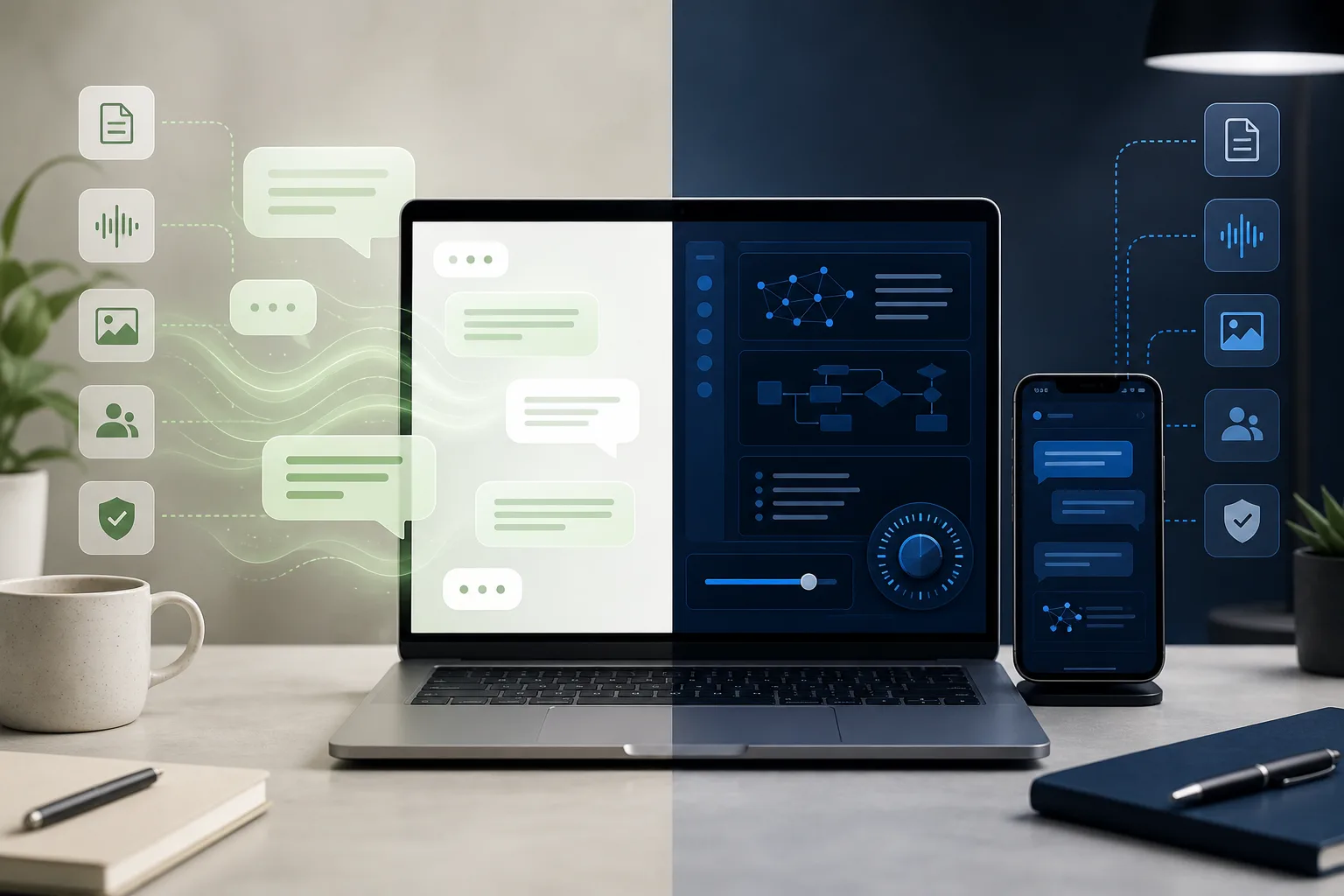
The public outline is now consistent across OpenAI's announcement, TechCrunch's report and consumer coverage by MacRumors and 9to5Mac. GPT-5.6 Luna becomes the everyday ChatGPT model for Free and Go users. OpenAI says ordinary text chats are no longer counted as a scarce allowance, while separate limits remain for files, image work, voice and image generation. Free users also receive a Think button for questions that need more deliberate analysis rather than a fast reply.
Paid tiers are not simply left with the same product and a smaller advantage. Plus and Pro users get an updated GPT-5.6 Sol in ChatGPT, positioned for more focused responses and fewer factual mistakes in OpenAI's own tests. The visible product lesson is the new thinking-depth control: instead of only choosing a named model, the user can ask the system to spend more or less effort on an answer. Work and Codex variants are a separate line in this rollout, so teams should not assume every OpenAI surface changed at the same time.
The timing matters because ChatGPT is no longer an experimental destination for enthusiasts. OpenAI has described weekly ChatGPT use at about a billion people. At that scale, changing the free default changes the daily habits of students, teachers, freelancers, support teams and small businesses that do not run formal model procurement. It also forces paid plans to justify themselves with something more concrete than access to the newest name.
Free text is not free everything
The most important operational sentence is the least glamorous one: unlimited text chats do not mean unlimited AI work. A user who only drafts emails, summarizes short notes, asks coding questions or checks a translation may find the free layer newly sufficient. A user who relies on large file uploads, image analysis, generated visuals, voice workflows, long project memory, shared team spaces or administrative controls will still hit product boundaries.
That distinction is where many AI budgets should be rebuilt. If a task is short, non-confidential and easy to verify, the free text layer can be a useful first pass. If a task involves contracts, medical or financial implications, customer data, regulated records, complex code changes or repeated business workflows, the subscription is paying for repeatability and governance, not just for a clever answer. A cheap answer that must be rechecked three times may be more expensive than a paid workflow with logs, permissions and stable settings.
Free access also changes training behavior. New users can build intuition without watching a message counter. They can compare prompts, ask for alternatives and learn when the model is overconfident. That is good for AI literacy. It also means organizations will see more unsanctioned use, because the tool becomes easier to adopt before procurement notices it. The practical response is not to ban every free account; it is to define which data may be used there and which work must stay inside managed systems.
What the reaction tells teams
The Hacker News thread around the announcement was unusually useful because the argument was not only fan enthusiasm. Commenters compared Luna with Claude and Gemini free tiers, asked whether ChatGPT's real competitor is a separate chatbot or Google's AI Overview, and debated whether low-cost models are already good enough for routine work. The thread had more than three hundred points and hundreds of comments when checked for this article, which is a signal of practical concern rather than a small product-news ripple.
One side of the discussion sees Luna as the normal evolution of the fast default model: capable enough for daily questions, cheap enough to offer widely, and not necessarily a sign of panic. Another side says the free benchmark is no longer set by OpenAI alone. If Gemini, Claude or search-integrated AI answers are already convenient, a free ChatGPT message has to be noticeably more helpful to earn a separate tab. That is a harsh but useful standard for product teams choosing assistants for employees.
There is also a trust argument. OpenAI says its internal evaluations found fewer factual-error cases for the updated models versus GPT-5.5 Instant: 62% fewer for Luna and 68% fewer for Sol in the cited comparison. Those figures are meaningful as vendor evidence, not as a substitute for your own tests. A sales team, school, newsroom or engineering group should build a small evaluation set from real tasks and measure whether the new default actually improves answers that matter to them.
Why control became the paid feature
The history behind this update matters. The backlash around earlier ChatGPT model changes showed that users care about more than benchmark scores. They notice tone, latency, refusals, continuity of workflows, model choice and whether a familiar assistant suddenly behaves differently. A system can be objectively stronger in a vendor chart and still feel worse if it changes the style of answers that people built routines around.
The Think button and the Sol depth slider look like a product answer to that lesson. They make effort visible. For a quick recipe conversion or a one-line Excel formula, fast mode is enough. For a contract clause, debugging plan, hiring rubric or incident report, the user wants the model to slow down, expose assumptions and check edge cases. The control is not magic, but it gives people a language for matching model effort to risk.
That is especially relevant in business adoption. Teams do not only ask, "Which model is smartest?" They ask which setting they can standardize, which logs they can audit, which outputs they can reproduce and which limits they can explain to managers. A paid plan has to package those answers. If it merely says "better model," the free layer will eat more of its perceived value each month.
A practical buying framework
Individuals should start by separating everyday drafting from consequential work. Use the free Luna layer for brainstorming, language polishing, study questions, harmless code examples and quick comparisons. Move to paid Sol or another managed tool when the answer changes a decision, consumes staff time, touches private data or must be reused by others. The moment you need a stable routine rather than an occasional answer, control becomes part of the price.
Small businesses can run a two-week audit. List the ten AI tasks employees actually perform: customer replies, product descriptions, meeting notes, spreadsheet formulas, bug triage, policy drafts, image ideas, file summaries, translations and competitor research. For each task, record whether the free text layer is enough, whether attachments or images are required, how often answers need correction, and what a mistake would cost. The result is usually more useful than arguing about model rankings in the abstract.
Larger teams should avoid one-vendor autopilot. Compare ChatGPT, Claude, Gemini, API calls and open-weight models on the same internal examples. Track factual misses, refusal behavior, latency, cost per finished task, data-handling requirements and administrator overhead. Some work belongs in a consumer assistant, some in a managed workspace, some in a custom API pipeline and some in local or private inference. The new free layer makes that routing question more important, not less.
Risk and safety are part of the price
A stronger free default also raises safety stakes. OpenAI's system-card material for the August models discusses higher-capability domains, child and teen protections, health and emotional-reliance evaluations, and restrictions around sexual content, self-harm and dangerous activities for users understood to be under 18. These are vendor evaluations and policies, not independent proof that every use is safe. Still, they show why a frontier lab cannot treat free access as a simple giveaway.
For organizations, guardrails should be translated into policy. Do not allow sensitive personal data in unmanaged accounts. Tell employees when AI output requires human review. Keep logs for business-critical uses. Do not use a general assistant as a therapist, compliance officer, doctor, lawyer or final security reviewer. Decide who may upload files, who may connect tools, and who is accountable when an automated workflow sends something outside the company.
The best practical interpretation of the rollout is therefore not "AI is free now." It is "basic text help is becoming abundant." Scarcity moves to verified context, trust, permissions, safety settings, workflow integration and accountability. That is where paid AI products will have to prove value, and it is where users should focus their decisions.
What to do this week
First, test the free layer on real low-risk tasks before paying for habit. Second, keep a short failure log: wrong facts, missing context, bad tone, slow answers, hidden limits and tasks that required attachments. Third, define an escalation rule for deeper reasoning or paid work. Fourth, compare against at least one competitor, because the free assistant market is now genuinely competitive. Fifth, remember that a model upgrade is not the same as an operating procedure.
The August ChatGPT update lowers the entrance fee for everyday AI use. It does not remove the need to choose tools carefully. The mature question is no longer whether people can access a capable model. It is whether they can control it, verify it and fit it into work without turning convenience into hidden risk.
Sources
OpenAI announcement and release material; OpenAI GPT-5.6 August Updates system card; TechCrunch; Axios; MacRumors; 9to5Mac; Hacker News discussion of the OpenAI announcement.
Related articles
AI crawlers can no longer be trusted by name
Spoofed crawler names turn AI traffic governance into a security, analytics and operations problem for sites and SaaS teams.
OpenAI’s Agents API: What Changes for Teams Building Long-Running AI Workflows
OpenAI’s public-beta Agents API packages the Codex harness, persistent sessions, tool orchestration, subagents, and managed or self-hosted sandboxes. The practical question is not whether it can run an agent, but whether its boundaries fit your workflow, budget, and data controls.


Should you wait for a screenless AI speaker? Only if it proves a daily job
Reported OpenAI and Jony Ive hardware makes the category tempting, but a smart buyer should wait for independent reviews, data rules and a proven use case.
School AI tools for children: what parents should ask before the classroom chatbot arrives
New school AI rules are arriving faster than parent handbooks can explain them. Here is a practical way to judge classroom AI by age, privacy, supervision and real learning value.
Comments
Sign in to comment.
No comments yet.