20,000 mAh power banks with a built-in USB-C cable: handy travel find or cable trap?
A practical marketplace buyer guide to integrated-cable power banks: capacity math, charging protocols, seller signals, safety caveats and when a replaceable cable is the better value.

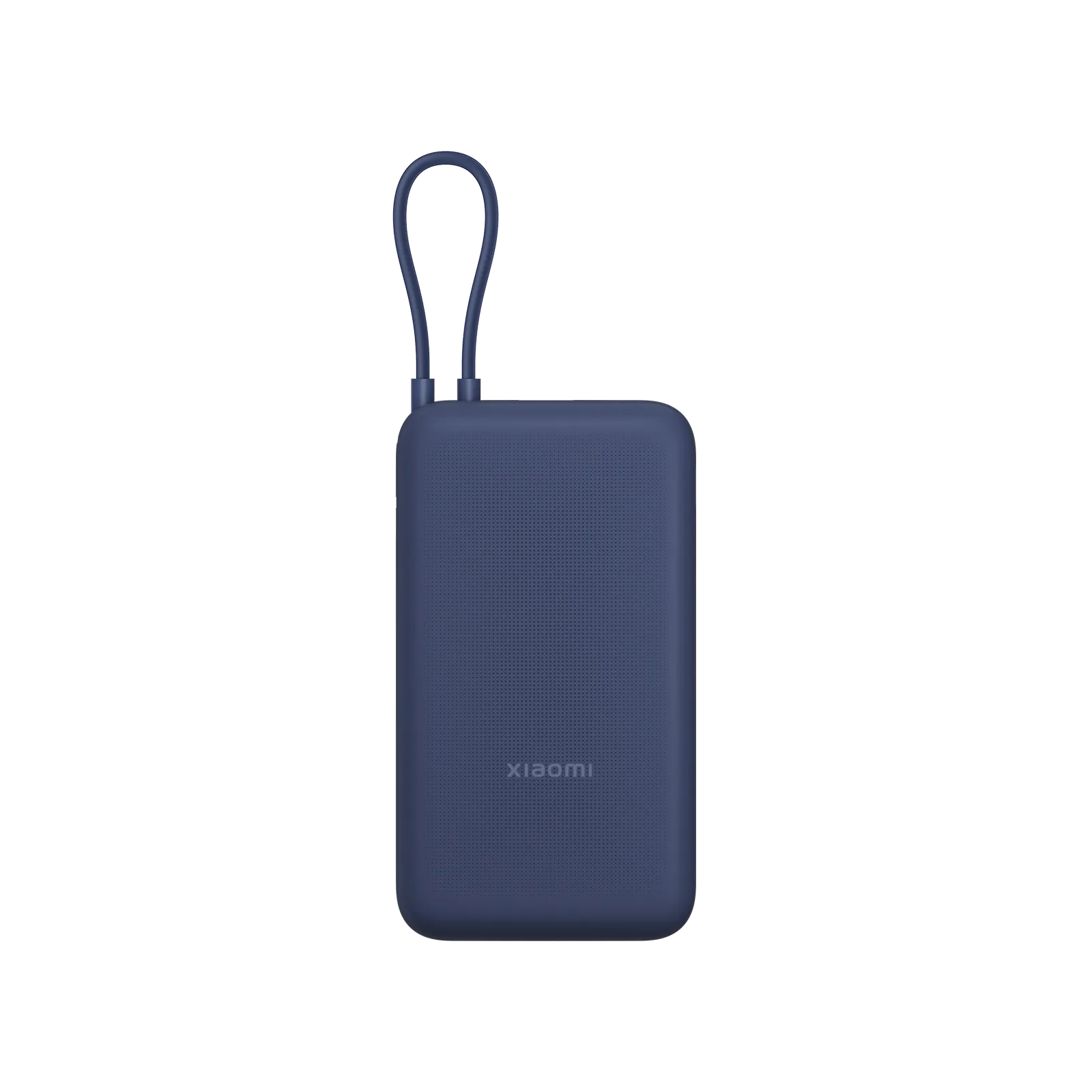
A 20,000 mAh power bank with its own USB-C cable looks like the tidy version of a travel charger: one brick, one cable folded into the body, no rummaging through a backpack at the airport gate or in a taxi. That convenience is real. The problem is that the same built-in cable can become the least replaceable part of the whole purchase. If it bends badly, loses fast-charging support, or is simply not the protocol your phone expects, the headline capacity and the glossy listing photos stop mattering.
This guide treats Xiaomi's 33W Power Bank 20000mAh (Integrated Cable) as a clean specification anchor, not as a blanket endorsement of every marketplace listing that borrows the same design language. Xiaomi's global page lists a 20,000 mAh nominal class, 12,000 mAh rated capacity at 5V/3A, 75.48 Wh typical battery energy, an integrated USB-C cable, a USB-C port and a USB-A port, up to 33W output for compatible devices, and up to 30W two-way fast charging for recharging the bank. Those official numbers are useful because they show what a documented product can disclose. On AliExpress, Ozon, Wildberries and similar marketplaces, many cheaper integrated-cable models show similar badges but do not always show the same rated-capacity, Wh, output-table and certification detail.
What the built-in cable really solves
The best reason to buy this product class is not extra power. It is less friction. A built-in USB-C lead means you can top up a phone while standing, walking between trains or sharing a charger at a table without opening a pouch of accessories. It is also helpful for people who regularly forget cables, because the minimum charging kit is physically attached to the power bank.
There is a second practical advantage: the power bank body often doubles as cable storage. A short integrated lead is less likely to tangle, and it does not hang like a one-metre cable from a pocket. For commuters, students and short trips, that may be more valuable than another port or a slightly lower price. Some models, including Xiaomi's official example, also combine the built-in cable with separate USB-C and USB-A outputs, so the bank can be used with more than one device when total power demand allows it.
But the feature does not remove the normal checks. It adds a new one. With a conventional power bank, a poor or worn cable can be replaced cheaply. With a captive cable, the buyer has to judge strain relief, hinge shape, how the cable nests into the body, whether review photos show fraying, and whether the cable supports the fast-charging mode promised by the listing. A built-in cable is a convenience feature; it is not a proof of better cells, safer electronics or honest capacity.
Capacity: why 20,000 mAh is not what reaches the phone
The large number on the listing is usually the cell-side nominal capacity, often measured around the battery-cell voltage, not the exact energy delivered to a phone over USB. Voltage conversion and heat losses reduce usable output. That is why Xiaomi's official specification is a good reality check: the product is marketed as 20,000 mAh, but the rated capacity is listed as 12,000 mAh at 5V/3A, and the typical battery energy is listed as 75.48 Wh.
For shopping, watt-hours are often more useful than the largest mAh number. Wh lets you compare energy across different battery voltages and is the number that matters for many airline spare-lithium-battery rules. A power bank that hides Wh, rated capacity, weight and output profiles while shouting an enormous mAh figure deserves skepticism. Very high capacities in a suspiciously small, light and cheap body are a classic marketplace warning sign.
A practical expectation is this: a documented 20,000 mAh class power bank should charge a modern phone more than once, but not as if the full printed mAh were poured directly into the handset. Screen-on use, phone battery size, cable quality, protocol negotiation and ambient temperature all change the result. If review comments complain that a unit behaves like a much smaller bank, compare those comments with photos of the printed label and the seller's output table, not just with the star rating.
Fast charging badges need protocol matching
A '33W' label is not a universal promise. Xiaomi says its 33W maximum is available with compatible Xiaomi phones and that actual results vary. Other marketplace listings may mix PD, QC, SCP, PPS, VOOC or brand-specific terms in the same image. These labels are not interchangeable. Your phone, tablet or earbuds will negotiate a mode with the power bank; if the matching protocol is missing, charging may fall back to a slower profile.
The USB-IF's USB Power Delivery material is the standards context behind many USB-C charging claims, but a listing saying 'PD' is not the same as proof of USB-IF certification. For this product class, look for an output table rather than a badge wall: 5V/3A, 9V profiles, PPS ranges if your phone needs them, total multi-port output, and separate behavior for the integrated cable, USB-C port and USB-A port. If the seller shows only 'super fast charge' without voltages and currents, treat the wattage claim as marketing until proven otherwise.
Multi-device charging also deserves a careful read. Xiaomi's official page says the integrated cable, USB-C port and USB-A port can work together, but it also warns that if combined demand exceeds total output capacity, all three may not charge simultaneously or at the expected speed. That caveat is exactly what many marketplace listings hide. Thirty-three watts maximum for one compatible path does not mean thirty-three watts per port while three devices are connected.
Four buying routes to compare
1. A documented integrated-cable 20,000 mAh model
This is the cleanest version of the idea. It suits buyers who want the built-in cable but still want a recognizable product page, a rated capacity, Wh, port list, dimensions and safety claims. Xiaomi's 33W model is an example of the amount of disclosure to look for: 127 × 70.5 × 30.5 mm dimensions, lithium-ion cells, USB-C cable plus USB-C and USB-A outputs, 75.48 Wh typical energy and multiple protection claims. The advantage is a neater everyday kit. The trade-off is that the integrated cable still has to survive normal bending, bags and pockets.
2. A cheaper marketplace lookalike with similar badges
This is where AliExpress, Ozon and Wildberries searching gets tempting. Many listings copy the travel-friendly photograph: cable tucked into the side, phone charging in one hand, fast-charge icon in the corner. Some may be perfectly usable budget products, but the burden of proof is higher. Check seller age, review photos, negative comments about heat or capacity, and whether the printed label in buyer photos matches the hero image. A no-review duplicate store is a poor place to buy lithium charging gear, even if the price is attractive.
3. A normal 20,000 mAh USB-C PD power bank plus a short replaceable cable
This is the boring alternative and often the better long-term value. You lose the built-in-cable neatness, but you gain replaceability. If the cable fails or a new phone needs a different cable, the power bank is not automatically e-waste. This route is also easier if you need a specific certified USB-C cable, a longer lead for a desk, or a cable with a known current rating. For people who keep accessories for years, the replaceable-cable option is often safer than a captive lead.
4. A smaller 10,000 mAh integrated-cable bank
A smaller model can make more sense for pockets and city use. It will not have the reserve of a 20,000 mAh bank, but it may be lighter, less bulky and more likely to be carried every day. The same checks apply: Wh, rated capacity, output profile, cable strain relief and real review photos. A 20,000 mAh brick that stays at home is less useful than a smaller bank that is actually in the bag.
Photo-review signals that matter
For this category, review photos are more useful than many written one-liners. Look for the printed specification label on the back or bottom. It should show something close to the listing's model name, capacity, Wh and input/output ratings. Look at the integrated cable in buyer photos: is the strain-relief area thick enough, does the cable sit flush, are there complaints about looseness, and do the photos show the same port layout as the listing?
Also read the negative reviews first. Heat while charging, swelling, sudden shutdown, a cable that stops fast-charging, or a unit that arrives with different markings are more important than vague praise. For power banks, 'works' on day one is not enough evidence. A good listing has repeated photos of the same casing and printed specs over time, not a mixture of different bodies under one product page.
Social discussion is useful as a risk signal, not as final proof. A fresh r/AliExpress thread about a suspicious duplicate store with no reviews is not evidence that every integrated-cable power bank is unsafe. It is evidence that marketplace seller identity and review history matter, especially for products with lithium cells and charging electronics. Treat forum and social comments as a prompt to inspect the listing harder, then rely on official specs, platform records and real buyer photos for the decision.
Safety and travel caveats
Power banks are spare lithium batteries. The FAA's PackSafe guidance explains that lithium batteries can overheat and that spare lithium batteries and power banks are subject to air-travel rules. Many common consumer power banks under 100 Wh are generally within the familiar threshold, and Xiaomi's official example lists 75.48 Wh, but do not turn that into a universal travel promise. Airlines, routes and regulators can differ; check the current rule before flying.
At home, avoid damaged, swollen or unusually hot units. Do not open the pack, replace cells, bypass protection circuits or keep using a cable that sparks, exposes conductors or disconnects under light movement. Use a charger suitable for the input profile, and avoid piling the bank under bedding while fast charging. Marketplace convenience is not worth ignoring basic lithium-battery caution.
Certifications and warranty claims also need precise wording. Do not assume authenticity or certification because a listing uses a familiar brand name or a 'global version' phrase. If local warranty, compliance marks, reliable returns or invoice documentation matter to you, a local retail channel may be worth paying for. Marketplace dispute outcomes, customs treatment and delivery dates are never guaranteed by the product photos.
Buyer fit: who should consider it
Consider an integrated-cable 20,000 mAh power bank if you mainly charge phones, earbuds and small tablets; if you often forget cables; if a compact travel kit matters more than maximum flexibility; and if the listing shows a real rated capacity, Wh, output table, model name and consistent photo reviews. It is especially reasonable for commuters, short trips and people who want one emergency phone charger in a bag.
Be more cautious if you charge several devices at once. Verify total output and port priority, because multi-port use can reduce speed. If your phone needs PPS or a brand-specific fast-charge mode, confirm the exact profile rather than assuming the built-in cable will deliver the advertised maximum. If you plan to charge a laptop, this product class is usually the wrong starting point; look for a higher-power USB-C PD bank with clear laptop support instead.
Skip it if you want one power bank to last for years and dislike captive cables. Skip it if the listing hides Wh and rated capacity, uses impossible capacity claims, has no credible review photos, shows different casings in reviews, or comes from a suspicious new store. Also skip it when you need clear local certification, warranty and support. In those cases, a conventional PD power bank plus a short, known cable is the calmer choice.
Quick checklist before buying
Check the Wh number, not only mAh. Check rated capacity at 5V. Check the output table for the integrated cable and each port. Check whether '33W' is a total maximum or a compatible-device peak. Match PD, PPS, QC or brand-specific protocols to your own device. Inspect review photos for the printed label, cable strain relief and matching port layout. Read negative reviews for heat, swelling, fake capacity and cable failure. Prefer sellers with history and consistent buyer photos. Treat dramatic discounts and no-review duplicate stores as red flags. And remember the main trade-off: the built-in cable is useful convenience, but if it is the part that fails first, a normal power bank with a replaceable cable may be better value.
Related articles

The travel gadget worth buying in 2026 is a better USB-C charging kit
A practical buyer guide to chargers, cables, power banks and adapters that keep the rest of your devices alive.
Power banks are useful, but recent recalls show why you should check the battery in your bag
Repeated recalls involving Casely, Anker and lithium-ion travel batteries turn the humble power bank into a practical safety check for 2026.
The USB-C travel charging kit that actually makes sense in 2026
A practical guide to choosing one charger, the right cables, a safe power bank and a plug adapter without packing a drawer full of electronics.
充电宝仍然有用,但召回事件提醒你检查包里的那块电池
Casely、Anker 相关召回和锂电飞行规则,让普通充电宝变成 2026 年必须做的安全检查。
Comments
Sign in to comment.
No comments yet.