After AliExpress’s €550 Million Fine: How to Check a Marketplace Gadget Before You Buy
A marketplace listing can look polished and still leave the important safety questions unanswered. Here is a practical pre-purchase check for chargers, batteries, lights and other electronics, using recent regulator findings as context.

A low price is not the only thing that makes a marketplace gadget tempting. The listing may have thousands of reviews, a long specification table and photographs that look almost identical to those used by a known brand. Yet the details that matter most for safety—who made the product, which exact model was tested, what the charger is compatible with and who is responsible for it in your country—can remain unclear.
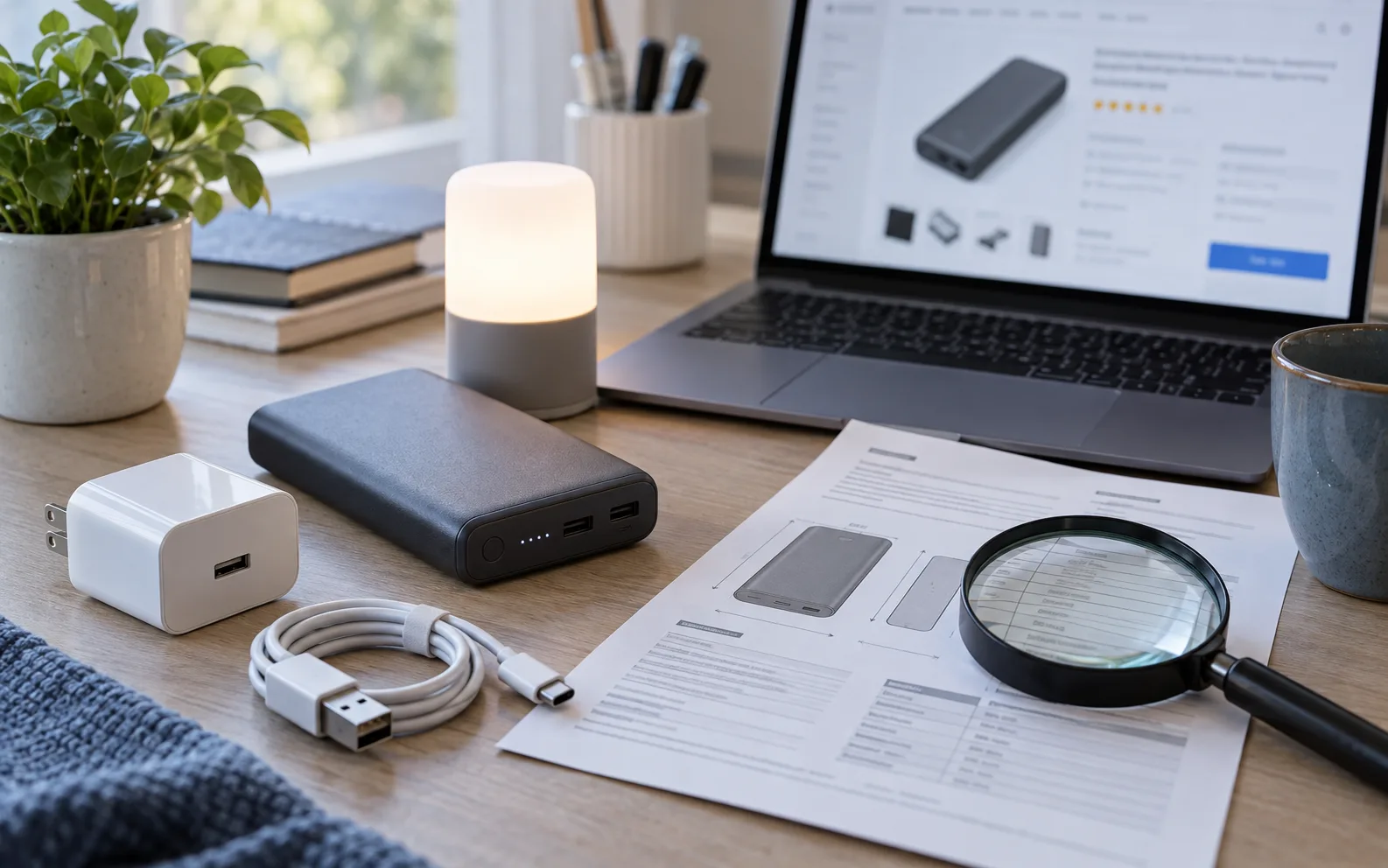
That gap matters more now than it did when marketplace shopping was mostly about inexpensive phone cases and desk accessories. Chargers, battery packs, e-bikes, lights, heaters and small appliances are sold through the same search systems as cable organizers and decorative items. They do not all carry the same level of risk. A missing label on a phone stand is irritating; an unclear battery or charger can create a fire or electric-shock hazard.
The European Commission’s July 2026 decision to fine AliExpress €550 million under the Digital Services Act has put that distinction back in the news. The Commission said AliExpress had not adequately assessed or reduced risks connected with illegal, unsafe and counterfeit products, and gave the platform until 20 October 2026 to submit an action plan. That is a finding about the platform’s systems, not proof that every listing or every seller is unsafe. It is also not a reason to assume that a product is safe merely because it appears high in search results.
The useful response for a buyer is not panic and not blind trust. It is a repeatable check that separates a good bargain from a product whose important claims cannot be verified.
What the recent enforcement actually changes for a shopper
The €550 million figure is easy to remember, but the practical point is more specific. According to the Commission, its investigation examined how AliExpress assessed the risk of illegal products, how it identified and removed them, how repeat violations were handled, and whether its advertising and recommendation systems could amplify the problem. The decision also concerned the traceability of traders and the effectiveness of controls that were supposed to stop illegal offers from returning.
This does not mean a marketplace has no useful sellers or that an inexpensive electronic device cannot work well. It means the platform’s search and review layer should not be treated as a complete product-safety certification system. A product can rank well because it is cheap, heavily promoted or widely purchased, while still having weak documentation.
The Digital Services Act is also not a substitute for the product rules that apply to the item itself. In the European Union, online marketplaces have obligations to display traceability and safety information supplied by traders. The General Product Safety Regulation sets out information such as the manufacturer’s identity and contact details, the responsible person in the EU when the manufacturer is outside the Union, and information that identifies the product. A listing that hides or omits these basics deserves more scrutiny, even when a platform allows it to remain visible.
For shoppers outside the EU, the legal details differ, but the buying logic is similar. A seller should be able to identify the product, explain its electrical limits and provide a route to contact the responsible business. A generic promise such as “high quality” tells you almost nothing.
Start with the exact model, not the headline specification
Marketplace electronics often use a family name across several physically similar products. The photographs may show one version while the options menu contains several others. A title may mention a large capacity, high wattage or fast charging speed that applies only to the most expensive variant. Before comparing prices, write down the exact model number, voltage, connector type, rated input and output, and battery chemistry if it is supplied.
Then check whether those details agree in four places: the main specification table, the photographs of the label, the user manual and the seller’s answers to questions. Small discrepancies are not automatically evidence of a dangerous product; listings are often translated badly. But a 20 V tool battery that becomes a “24 V” battery in another section, or a charger described as suitable for several unrelated voltages, is a reason to stop.
The word “universal” deserves special caution. In September 2024, the U.S. Consumer Product Safety Commission warned about SafPow and AMPOWSURE chargers marketed for 36-volt lithium batteries used in micromobility products. The agency said the chargers were not universal and could be incompatible with some products for which they were advertised. It reported 47 fire or thermal incidents, including burn and smoke-inhalation injuries and property damage. That warning concerned named chargers sold on Amazon and eBay, not AliExpress, so it should not be presented as evidence against every marketplace charger. It is a useful example of why compatibility must be checked by model and electrical specification rather than by a broad word in a title.
For a charger, compare at least these values:
- input voltage and frequency;
- output voltage;
- maximum current or wattage;
- connector dimensions and polarity;
- charging protocol, where relevant;
- the battery or device models explicitly supported.
For a power bank or battery pack, also look for the nominal voltage, energy in watt-hours, protection information and a clear manufacturer or importer. Capacity expressed only as a large milliamp-hour number can be misleading because mAh depends on voltage. For travel, airline limits and marking requirements may also matter; a seller’s claim that an item is “airline safe” is not a substitute for checking the carrier’s current rules.
Treat markings as clues, not proof
A familiar conformity mark, a printed safety icon or a sentence saying “CE certified” can be reassuring, but a photograph of a mark does not establish that the exact item was tested. The relevant question is whether the documentation connects the test or declaration to the exact model, manufacturer and electrical configuration being sold.
The European Commission’s product-safety guidance says marketplace interfaces should make key traceability information accessible. That gives a buyer a practical checklist: look for the manufacturer’s name and address, an EU responsible person where required, a product identifier, and safety information in a language you can understand. If the listing provides only a trading name, a warehouse address and a stock photograph, the product may still arrive and work, but you have less evidence about who stands behind it.
Be particularly careful with claims that sound like independent approval but are not explained. “Tested,” “approved,” “EU standard,” “FCC,” “RoHS” and similar terms can refer to different things. Some concern electromagnetic compatibility or restricted substances rather than protection from overheating. None should be read as a blanket guarantee that a charger is correctly designed for your particular battery.
A genuine document should identify the product and the issuing laboratory or responsible organization. If a seller uploads a certificate for a different model, a different company or a product category rather than the item in the cart, treat the document as irrelevant. Do not assume that a PDF with a logo is stronger evidence than a clear label and a traceable manufacturer.
Read reviews for failure patterns, not star averages
The review score answers a narrow question: how many buyers chose to rate the item positively, often shortly after delivery. It does not tell you how a battery behaves after six months, whether a charger becomes hot under load or whether the seller sends the same product shown in the listing.
Start with the lowest ratings and search within reviews for words connected with the product’s risk. For electronics, useful terms include “hot,” “smell,” “smoke,” “sparks,” “swollen,” “cuts out,” “wrong voltage,” “noise,” “melted,” “manual” and “different model.” For lighting, look for overheating and flicker. For power supplies, look for buzzing, resets and whether the advertised output was measured under load. For e-bike and scooter parts, look for connector fit, battery compatibility and charger temperature.
Photos are helpful but not conclusive. A review may show the packaging, a label or a test meter, but a single measurement made with an inexpensive USB meter cannot validate the internal design. Conversely, a pattern of several independent buyers reporting the same failure is meaningful even if the listing has a high overall score. Pay attention to dates and variants: reviews can be attached to a product family after the seller changes the hardware.
Questions under a listing can reveal uncertainty too. If buyers repeatedly ask for the model number, plug type or safety documentation and receive vague answers, that is information. A seller who answers a technical question with a coupon code has not answered it.
Use the price as a reason to investigate, not a reason to hurry
A large discount can be real, but the comparison price shown on a marketplace is not automatically a reliable historical price. Sellers may change variants, bundle accessories, raise the base price before a promotion or display a price that applies only to the least capable option. The total cost may also depend on shipping, taxes and the exact destination.
For a safety-sensitive product, compare the landed price with several alternatives: a recognized brand sold by an established local retailer, a manufacturer’s own store, a used genuine accessory, or a simpler product with fewer claims. The marketplace item does not need to be the cheapest option to be worthwhile. If a locally available charger costs only a little more and provides a traceable warranty route and clear compatibility information, the lower-risk choice may be better value.
There is another form of false economy: buying a cheap power supply for an expensive battery or device. If the accessory fails, it can damage the item it was meant to support. Savings should be judged against the replacement cost, not only against the price on the product page.
Avoid stacking uncertainty. A poorly documented battery, an unknown charger, a travel adapter and an unattended overnight charging routine create a much worse situation than any single questionable purchase. When one part is safety-critical, make that part the most traceable component of the setup.
A practical check for common marketplace categories
USB chargers and power supplies
Confirm the exact output profile, plug standard and supported charging protocol. A USB-C connector does not by itself mean USB Power Delivery, and a device that accepts 100 W does not require a 100 W charger. Look for clear electrical ratings on the unit itself, not only in the title. Stop using a charger that develops an unusual smell, visible discoloration, crackling noise or excessive heat.
Do not cover a power supply while it is operating, and do not use a travel plug adapter to compensate for an incompatible voltage. A cheap adapter can solve a mechanical plug mismatch; it cannot fix an electrical mismatch.
Power banks and loose lithium batteries
Check whether the capacity is stated in watt-hours or can be calculated from a credible nominal voltage. Look for a model identifier, protection information and an enclosure that does not flex or rattle. A swollen, dented, leaking or unusually hot battery should not be charged or placed in household waste.
For batteries used in scooters, bikes, tools or cameras, compatibility includes more than voltage. The battery-management system, connector, charging current, physical fit and communication protocol may all matter. Never assume that a connector that fits is proof of compatibility.
E-bikes, scooters and high-power accessories
The risk rises when a product combines a large battery with a high-current charger, a motor or a device that may be used on public roads. In the United Kingdom’s product-safety database, recent reports have included electric bikes and scooters with serious risk classifications, including products rejected at the border. One report described the absence of evidence that the bike, battery and charger had been assessed under relevant conformity procedures; the stated concern was that the charger or battery could overheat and cause a fire.
That does not mean every imported bike is defective. It does mean that a price comparison should include assembly quality, replacement batteries, charger availability, local repair support and the legality of using the vehicle where you live. A listing with no identifiable importer or parts route is a poor choice for a device that may need service.
Heaters, lamps and small appliances
For anything that produces heat, check the rated power, plug and voltage before considering appearance or smart features. Look for ventilation instructions, a thermal cut-off and clear information about indoor use. Do not rely on a seller’s “energy saving” claim as evidence of safe operation. A heater or high-power lamp should not be left unattended simply because it has a timer or an app.
Children’s products and cosmetics
The Commission specifically mentioned unsafe toys and dangerous cosmetics in its AliExpress decision. These categories deserve a higher threshold because the user may be a child or because ingredients and skin contact are difficult to assess from a translated listing. For cosmetics, check a complete ingredient list, responsible business information, batch information and local regulatory requirements. For toys, look for age grading, small-part warnings and battery-compartment security. If the listing makes medical or developmental promises without credible documentation, skip it.
What to do after the parcel arrives
Keep the product page, order confirmation, photographs and seller messages until you have tested the item. Listings can change after purchase, and screenshots preserve the version you relied on. Photograph the model label and the packaging before discarding anything.
Check the physical product against the listing: model, plug, connector, markings, accessories and manual. Do not connect an unfamiliar charger to an expensive battery just to see whether it fits. For low-voltage USB accessories, a basic test may be reasonable if you understand the equipment and can monitor temperature. For mains-voltage products, high-current batteries and heating appliances, improvised testing is not a substitute for professional inspection.
On first use, stay nearby. Watch for heat, smell, noise, swelling, repeated resets or a cable and plug that become hot. Stop immediately if something behaves abnormally. A normal first session does not prove long-term safety, so avoid charging lithium batteries on a bed, sofa or other combustible surface and do not leave questionable products operating while you sleep or leave home.
If a product appears unsafe, stop using it and preserve evidence. Check your national product-safety authority, the manufacturer’s recall page and the marketplace’s safety or recall notices. A dispute process may help with a transaction, but it is not a safety control and should not be treated as a guaranteed remedy.
Who should consider marketplace electronics, and who should skip them
A marketplace gadget is easier to justify when the consequences of failure are minor, the product is simple, the electrical demands are low and the exact model is clearly identified. Examples might include a passive cable-management accessory, a non-powered mount or a basic low-voltage light used under supervision. Even then, the item should match the description and arrive without damage.
Be more conservative when the product stores significant energy, connects directly to mains electricity, produces heat, carries a person, protects a child or makes a health-related claim. Skip a listing when the seller cannot provide a model number, the safety information conflicts across the page, the photos show a different product, the reviews report repeated overheating or the price is low only because essential accessories are missing.
The same rule applies to replacement parts. A genuine-looking battery, charger or brake component is not necessarily interchangeable with the original. When a failure could cause a fire, injury or loss of control, traceability is worth paying for.
The short decision rule
Before ordering, ask five questions: Can I identify the exact model? Can I identify the manufacturer or responsible business? Do the electrical specifications agree everywhere? Do independent reviews reveal a recurring failure pattern? Would I still buy it if the promotional price disappeared?
If the answer to any of the first four questions is no, the product has not earned a place in your cart. If only the last answer is no, wait. A deal is useful only when it lowers the price of a product you already understand; it should not pressure you into accepting uncertainty that you would otherwise reject.
The recent enforcement action against AliExpress is a reminder that marketplace scale does not remove the buyer’s need to check. It is also a reminder that responsibility does not belong only to the buyer: platforms and sellers have obligations to identify traders, provide safety information and reduce the circulation of illegal products. Until those systems are consistently reliable, the most valuable marketplace skill is not finding the biggest discount. It is knowing when the listing has not given you enough information to make a safe decision.
Related articles
AliExpress’s EU Fall Sale after the €3 duty: how to check whether a small bargain is still a bargain
The September Fall Sale is ending just as a new EU customs charge changes the maths of cheap imports. Here is how to read the checkout total, compare bundle offers, and decide when a local alternative is the better buy.

Cheap Folding Walking Pads From AliExpress: What to Check Before the Fall Sale Price Looks Like a Bargain
A sub-$100 walking pad can solve a real space problem, but the lowest price often hides compromises in belt size, stability, noise, support and safety. Here is how to judge the listing before buying.

Tiny electric bike pumps from AliExpress: useful ride backup or rechargeable gimmick?
A practical buyer check for 120–150 PSI mini inflators, with valve, battery, heat and backup-plan caveats before you trust one on a ride.
Cheap earbuds with a case display: useful AliExpress find or shiny TWS gimmick?
A practical buyer check for low-cost TWS earbuds that advertise a bright battery screen, ANC labels and long playtime.
Comments
Sign in to comment.
No comments yet.