Marketplace Heated Vests: How to Check Battery Compatibility, Heat Claims and Safety Before Buying
Heated vests are appearing in October marketplace winter promotions, but the useful question is not how many heating zones a listing claims. Check the power system, runtime math, construction and safety evidence before trusting the price.

A heated vest can be a sensible layer for a cold commute, outdoor work, fishing, winter photography or a long wait at a sports field. It can also be a poor marketplace purchase: a thin garment with vague sizing, a power bank that does not match the connector, heating zones concentrated in one patch, or a battery whose safety information is impossible to verify.
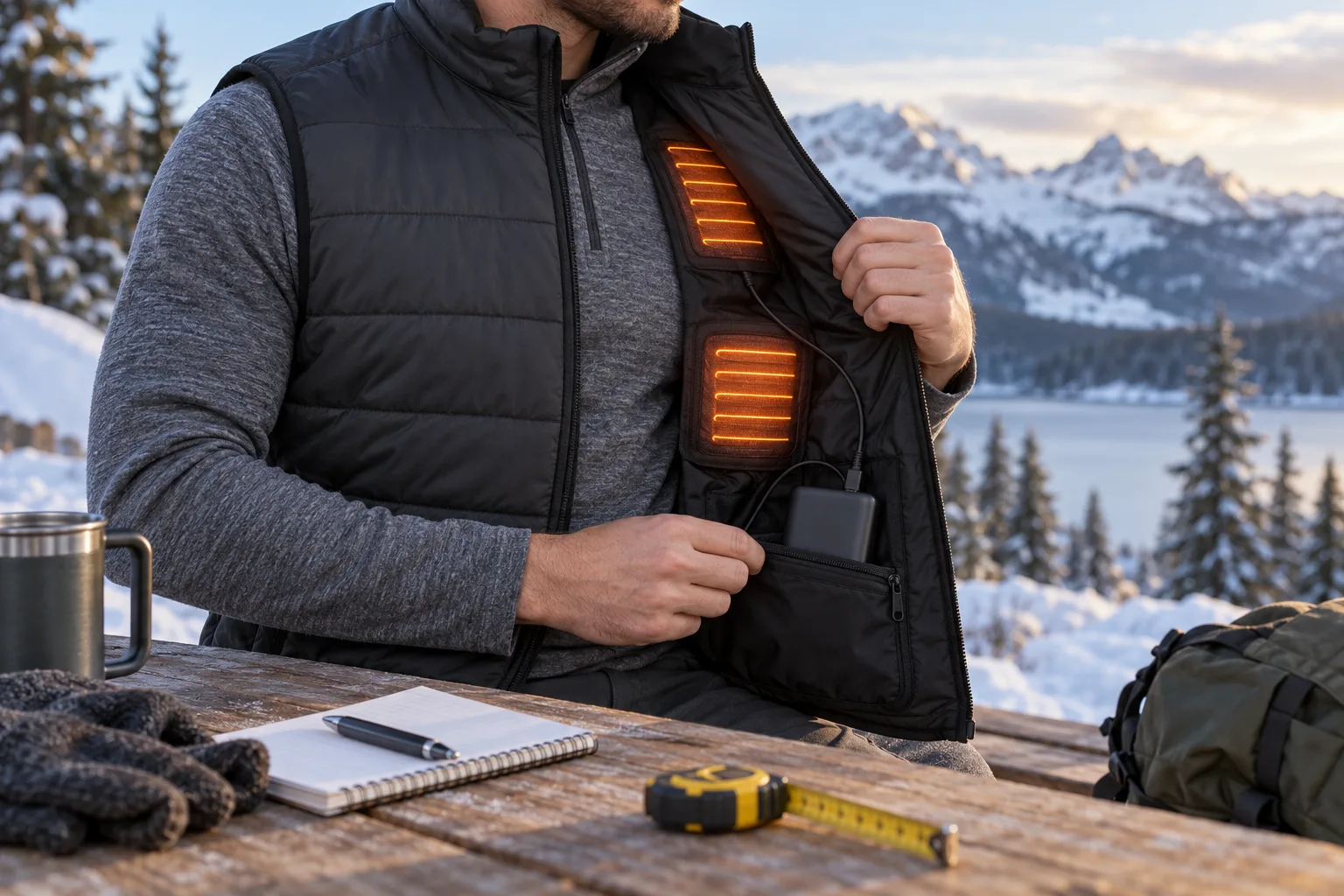
The timing matters because winter-themed AliExpress campaigns are active around October 17, 2026. A marketplace campaign tracker lists a Winter Offers event running from October 14 to October 17, alongside other regional promotions. That is useful context for why heated clothing is suddenly easier to find, but a sale label does not establish that a product is safe, durable or cheaper than its alternatives.
The right way to assess these listings is to treat the vest as two products: clothing and a small electrical system worn directly against the body. The garment has to fit, insulate and survive washing. The electrical system has to deliver the required voltage and current, manage heat, protect the battery and remain accessible if something goes wrong. A good listing explains both parts. A weak listing spends most of its space on phrases such as 17 heating zones, graphene, infrared or a large milliamp-hour number.
What the current marketplace listings are actually selling
Search results and price-history pages show a familiar pattern: low-cost heated vests are offered with names such as USB infrared heated vest, 17 heating areas or 21 heating zones. One archived AliExpress listing for a vest marketed with 17 heating areas was recorded at about $23 in September 2026, while another listing marketed with 21 heating zones was recorded at about $25 in May. Those are historical observations from third-party price archives, not a current price guarantee, and they may represent a garment without a battery or a particular size and colour option.
That distinction matters. A listing may show a battery in the photographs while the selected variation says vest only. Another may include a small battery but charge separately for a higher-capacity pack. The displayed price can also change when the destination, size, colour, seller or shipping method changes. Before comparing a marketplace vest with a local product, record the final price for the exact variation, including the battery if you need one.
The product category is not automatically bad. A simple USB-powered vest can be easier to maintain than a proprietary system: if the vest accepts a standard, good-quality power bank, you may already own a compatible replacement. The trade-off is that the seller may provide little information about current draw, temperature control, wash procedure or battery protection. The electrical specification is part of the purchase decision, not an accessory detail.
Heating-zone counts are a poor shortcut
17 zones sounds more precise than heats your back and chest, but the number tells you very little on its own. A zone can be a small resistive element, a section of a larger panel or merely a marketing description for several wired areas. The listing may not say how many watts the system uses at each setting, whether all zones are active together, or whether the controller cycles them on and off.
What you want to know is where the heat is placed and how evenly it is distributed. A vest with one strong panel on the upper back may feel useful when sitting still, yet leave the sides and lower torso cold. A vest with chest and back elements can be more practical for walking, but only if the garment fits closely enough for the panels to remain in contact with the insulating layers. Loose sizing reduces the benefit even when the heating element itself works.
Look for a diagram or clear product photographs showing the actual element positions. Treat language such as full body heat or 360-degree heating as a claim that needs evidence. Review photographs are more useful when buyers show the inside of the garment, the cable pocket, the controller and the heating panels rather than only a mirror selfie. Text reviews that mention the temperature setting, ambient conditions and battery used are also more informative than a five-star comment that only says works.
A useful test for a listing is to ask whether you could explain the heat pattern to another person without repeating the seller’s adjectives. If you cannot tell whether the vest heats the kidneys, shoulder blades, chest, collar or pockets, you do not yet know what you are buying.
The battery number needs a unit and a voltage
Marketplace battery claims often highlight capacity in milliamp-hours, but milliamp-hours alone do not tell you how long a vest will run. The meaningful quantity is energy, usually expressed in watt-hours. The basic calculation is:
energy in watt-hours = capacity in amp-hours × nominal voltage
A nominal 3.7-volt, 10,000 mAh lithium-ion pack contains roughly 37 Wh before conversion losses. If a vest consumes 10 W continuously, the theoretical runtime is less than four hours after allowing for the converter, controller, battery cutoff and the fact that 10 W may not be constant. A 5-volt USB output also involves conversion from the cell voltage, so the number printed on the pack is not the energy delivered to the heating elements.
This is why up to 12 hours is not a useful promise without conditions. Ask: at which heat setting, at what ambient temperature, with what battery, and with the heating elements continuously on or pulsing? Low settings may cycle the element and produce a much longer number than high settings. Cold weather also reduces available battery performance, especially when the pack is carried in an exposed outer pocket.
The listing should identify the required input. A 5 V USB vest is not the same as a vest requiring 7.4 V or 12 V through a special adapter. A USB-C connector does not automatically mean USB Power Delivery or a higher-voltage mode; sometimes it is only a physical connector used for 5 V input. Do not assume that a phone charger, laptop power bank or tool-battery adapter is compatible because the plug fits.
A practical buyer should record four values before ordering:
- the vest’s required voltage and maximum current;
- whether the included cable is USB-A, USB-C, barrel or proprietary;
- whether the battery is included in the selected variation;
- the seller’s stated runtime at each heat level.
If the listing does not provide the voltage or current, the runtime claim cannot be checked. That is a reason to skip the item or contact the seller before buying, not a reason to fill in the missing specification from another listing that merely looks similar.
Connector compatibility is where many cheap systems fail
A standard USB power bank is convenient, but the vest still needs a suitable cable and enough output. Some low-cost garments use a USB lead inside a pocket and expect a 5 V supply. Others use a round connector, an inline controller or an adapter designed for a particular battery. The connectors may look similar while having different voltage requirements or polarity.
Power banks also behave differently under a small or pulsed load. Some switch off when the current falls below their minimum threshold. A vest whose controller rapidly cycles the heating element may therefore work with one power bank and repeatedly shut down with another. That is not necessarily evidence that the vest is defective, but it is a compatibility problem the listing should explain.
Do not modify the cable, reverse the plug or use a step-up adapter simply because the original battery is unavailable. A regulator that raises voltage can also raise risk if the vest’s wiring, controller and thermal protection were designed for a different input. Japan’s Consumer Affairs Agency specifically advises using the charger and lithium-ion battery recommended for the product and avoiding modified equipment.
The most defensible low-cost configuration is a vest that clearly states its input voltage and uses a reputable, replaceable power bank with appropriate protection. Even then, the power bank should not be compressed under a tight belt, folded inside the garment or exposed to water. The pocket should hold it without sharp bends in the cable, and the cable should not be pulled when you sit down or remove the vest.
Safety is not a theoretical footnote
A heated vest places a battery, wiring and heat-producing elements close to skin. That makes battery quality and temperature control more important than they are for an ordinary decorative LED accessory. The UK Office for Product Safety and Standards published a product safety report for a heated jacket whose lithium-ion battery pack was judged poorly constructed and lacking sufficient protection against thermal runaway. The report classified the fire risk as serious and also identified a noncompliant plug exposing users to live parts. The report concerns a specific product, not every marketplace vest, but it shows why a generic battery claim should not be treated as evidence of safety.
Japan’s Consumer Affairs Agency gives a broader warning about lithium-ion products used for warmth. Its accident database contained 68 reports involving products such as heated clothing, heated gloves, electric blankets and rechargeable warmers from April 2014 through September 2024. Heated clothing accounted for 35 of those reports. Among 32 incidents considered likely to involve the lithium-ion battery, overheating, smoke or fire were the most common outcomes. The agency also describes incidents involving a melted vest battery, a heated-glove battery catching fire during charging and a heated insole that became hot enough to damage footwear and cause burns.
These figures do not mean that a heated vest is inherently unsafe. They do mean that it uses a power bank is not a complete safety explanation. Before buying, look for a named manufacturer, a traceable manual, a clearly identified battery model, charging instructions and a return or recall path. A listing that gives only a capacity number and a set of lifestyle photographs leaves too many important questions unanswered.
At minimum, reject a unit with a swollen, cracked, dented, leaking or unusually hot battery. Stop using it if the vest smells of chemicals, shows scorch marks, heats in one sharply abnormal spot, turns on by itself or gets hotter when switched off. Do not continue wearing it to see whether the problem disappears. Disconnect the battery when the manufacturer instructs you to do so, and charge it where you can see it, away from bedding, clothing piles and other combustible materials.
Do not sleep in a marketplace heated vest unless the manufacturer explicitly designs and approves it for that use. A temperature setting that feels comfortable at first can become dangerous when the user is asleep or when a heating element is pressed against the body. People with reduced heat sensitivity, circulation problems or certain medical conditions should ask a clinician whether heated clothing is appropriate; a marketplace listing cannot make that decision safely.
Washing and weather resistance are separate questions
Water-resistant in a product title does not tell you whether the electrical system is safe in rain, snow or a washing machine. Check whether the battery must be removed, whether the cable pocket has a cover, whether the controller is sealed and whether the instructions specify a wash cycle. If the instructions are missing or contradictory, treat the vest as hand-wash only with the battery and controller removed, and do not immerse the electrical parts. That is a cautious handling choice, not a certification claim.
The fabric also has to dry completely before the battery is reconnected. Moisture around a connector can create corrosion or an electrical fault, while a folded wet garment can hold heat in unexpected places. If you need a vest for motorcycle riding, heavy rain or snow, choose a product with clear environmental limits and documented instructions rather than inferring protection from a studio photograph.
A washable garment should explain how the heating elements are routed and protected. Look for flat, strain-relieved wiring and a controller that can be removed without cutting stitches. Thin wires emerging from a poorly finished seam are a durability warning. The cheapest vest may be economical for occasional use, but it is a poor fit for daily work if replacing the garment every season costs more than buying a better-supported one at the start.
How to read reviews without being misled
Marketplace reviews are most useful when treated as field notes, not a vote count. Sort for recent reviews with photographs, then look for recurring details:
- Does the buyer identify the size and body measurements?
- Is the battery included, and what model was actually used?
- Does the vest heat after washing or only during the first test?
- Are the front and back zones warm, or is one area doing all the work?
- Does the controller remain accessible while wearing a jacket over the vest?
- Does the battery last for the claimed duration on medium or high?
- Do buyers mention a smell, hot connector, intermittent cable or unexpected shutoff?
Ignore reviews that appear to describe a different variation. Marketplace pages frequently combine several colours, sizes, batteries and even related products under one review group. A review for vest only may be attached to the same page as a review for a battery bundle. Product photographs can also be reused across sellers, so a highly polished image is not proof that the garment shown will be shipped by the store you selected.
Reddit discussions about heated clothing show why battery and interface details matter in daily use. Owners often prefer vests that accept a standard battery bank because replacement is easier, while others report that a proprietary battery adds cost or creates a second charging ecosystem. These discussions are useful for identifying questions to ask, but they are anecdotal and cannot verify the safety of a particular marketplace listing.
Marketplace vest versus a better-supported alternative
There are three reasonable ways to approach the category. A low-cost USB vest can make sense when you need occasional extra warmth, already own a compatible power bank and are willing to inspect the garment carefully. The low entry price is its main advantage. Its weaknesses are uncertain documentation, variable quality control, difficult sizing and limited confidence in long-term battery performance.
A branded vest with a documented battery system costs more, but the value is not only the heating element. You are paying for an identifiable manual, replacement batteries or adapters, clearer washing instructions, a support channel and a better chance of finding recall information. If the vest will be used for outdoor work every day, those details can matter more than the number of zones printed in the title.
A third option is a conventional insulated vest combined with a reputable power bank only for accessories that are designed for it, such as a separate rechargeable hand warmer. This avoids putting heating elements inside clothing, although it does not automatically remove battery risks. It may be the simpler choice if you mainly need insulation and only occasionally want active heat.
Do not compare a marketplace vest with a local alternative using sticker price alone. Include the battery, a replacement cable, shipping, possible return friction, and the cost of buying another layer if the fit is wrong. A product that is only slightly cheaper but has no clear battery specification may not be the better deal.
Who should consider one
A marketplace heated vest is worth considering for a buyer who:
- needs occasional supplemental warmth rather than a primary protective garment;
- can check voltage, connector and battery inclusion before ordering;
- is comfortable using a reputable compatible power bank;
- can inspect the wiring, seams and battery on arrival;
- will remove the battery before washing and stop using the vest at the first sign of overheating or damage.
It is a poor choice for someone who needs certified protective workwear, guaranteed all-day operation, dependable rain protection or a product for unsupervised overnight use. It is also a poor choice when the buyer cannot verify the battery, cannot return an unsafe item or is buying for a person who may not notice excessive heat. In those cases, a better-supported product or a non-heated insulating layer is the more sensible route.
A pre-checklist before pressing Buy
Save the product page and selected variation before checkout. Confirm that the listing states the garment size, the battery arrangement, input voltage, connector type, heat settings, washing method and whether the battery must be removed. Check photographs from the exact variation rather than the first image in the carousel.
Then compare the claimed capacity with the claimed runtime. The numbers do not have to be perfect, but they should be internally plausible. A tiny pack claiming a full day on high power needs a clear explanation. If the seller changes the capacity, connector or runtime answer when asked a basic question, walk away.
After delivery, inspect the vest before connecting power. Check for crushed cells, a damaged connector, exposed conductors, loose wiring, sharp edges, burned fabric and a battery that smells unusual. Test it while awake and nearby, first on the lowest setting. Keep the battery and cable visible during the first charge. Do not leave a new or unfamiliar lithium-ion pack charging unattended simply because the listing says it has fast charging.
Finally, keep the packaging, order details and product instructions until you have tested the garment. If the product differs from the listing, document the discrepancy with photographs. That evidence is useful for a return or marketplace complaint, but it is not a substitute for checking the item before use.
Bottom line
The best marketplace heated vest is not necessarily the one with the lowest price or the largest heating-zone count. It is the one whose power requirements, battery arrangement, heat layout, washing instructions and safety information can be understood before money changes hands.
For occasional use, a clearly specified USB vest paired with a reputable compatible power bank may be reasonable. For daily outdoor work, wet conditions, motorcycle use or anyone who cannot easily detect overheating, the extra cost of a better-supported product is easier to justify. If a listing cannot explain its battery and runtime in plain technical terms, treat that omission as the central product fact.
The October winter promotion may make the category more visible, but it does not change the buying test: inspect the electrical system, verify the garment fit, question unsupported runtime claims and stop using the product at the first sign of battery or heat failure.
Related articles
Fast multicolor 3D printers on marketplaces: what the 600 mm/s promise leaves out
Fast multicolor 3D printers are appearing in marketplace hot lists, but speed is only one part of the purchase. Here is how to check the bundle, feeder, purge waste, software, safety and real ownership cost before treating one as a bargain.

Car mounts for action cameras: when a suction cup, magnet or clamp makes sense
A car mount is only as good as the surface, the load and the route. Here is how suction cups, magnetic mounts and clamps differ before an action camera ends up on the road.

Phone thermal cameras from marketplaces: what a $300 plug-in imager can actually diagnose
USB-C thermal cameras are becoming a tempting marketplace buy for electronics, HVAC and home checks. Here is what the category can reveal, where temperature readings mislead, and which buyers should skip the gadget.
SONOFF TRV Gen2 on AliExpress: Check the Radiator Valve Before You Buy the Smart Upgrade
The SONOFF TRV Gen2 is showing up in current AliExpress marketplace rankings, but the real buying question is not the color display. It is whether your radiator, hub and room-control setup can use it properly.
Comments
Sign in to comment.
No comments yet.