A Budget Beauty Safety Check After the Lead-Contaminated Kohl Recall
A specific Canadian kohl recall offers a practical lesson for budget beauty shoppers: verify the product, label and seller before trusting a low price, and do not confuse a patch test with contamination testing.

A recall is not a reason to panic about every inexpensive cosmetic. It is a reason to change how you shop. Health Canada has recalled two traditional kohl products after testing found lead above the impurity limits in its guidance for cosmetics. The affected products were sold in Canada between January and August 2026, and the notice names the brands, importer and return instructions. That is a specific safety alert, not proof that every kohl, kajal or low-priced imported product is contaminated.
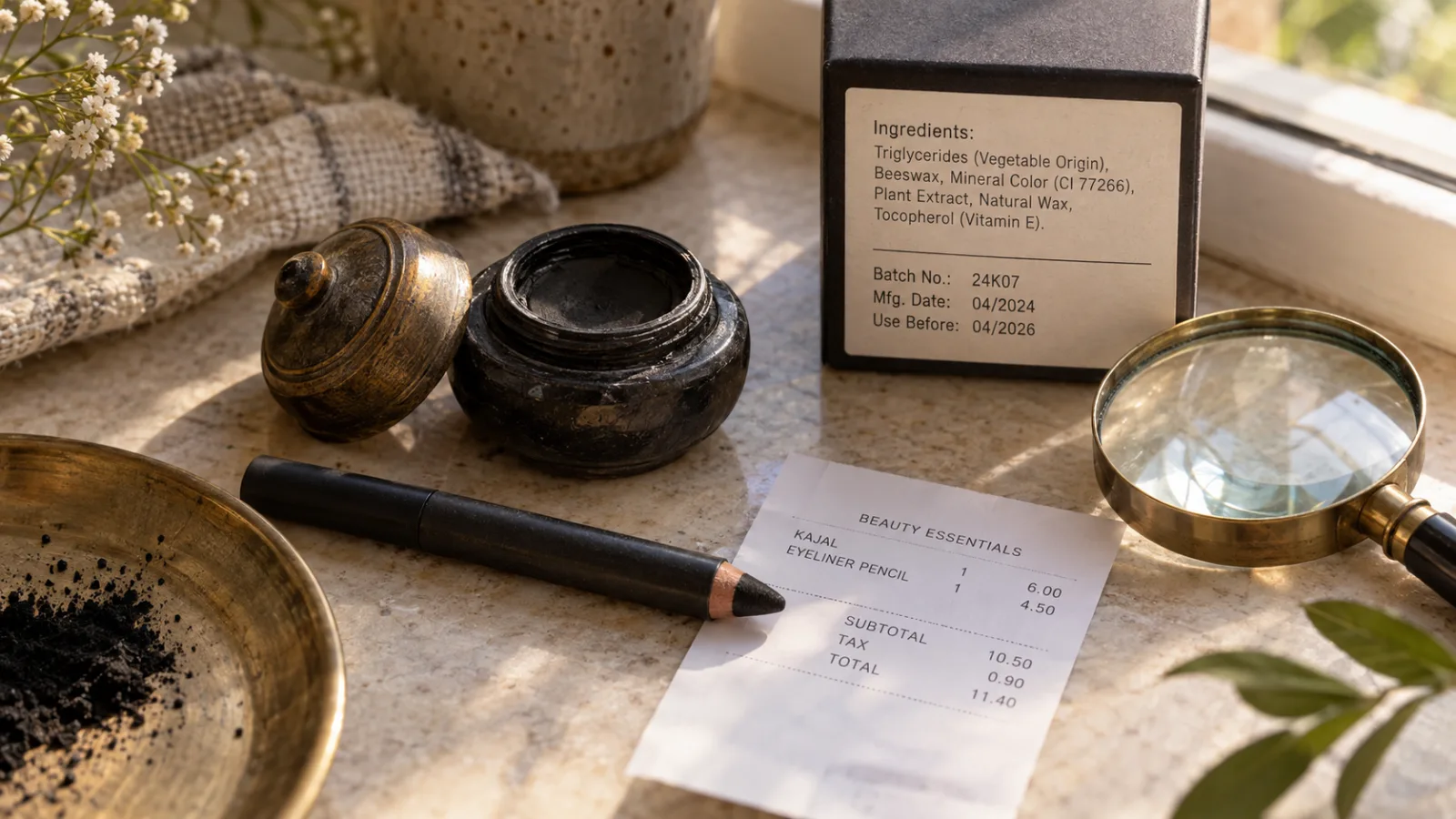
For budget beauty shoppers, the useful lesson is broader: price is a poor safety filter, and a familiar product category is not a guarantee of a reliable supply chain. A ten-dollar product with a complete label, traceable seller and responsive manufacturer can be a more sensible purchase than a twenty-five-dollar item with a vague listing and no ingredient information. The task is to separate a verified recall from internet fear, then build a repeatable check that costs little or nothing.
What the current recall actually says
Health Canada’s September 4, 2026 notice covers Mumtaz Herbal Kajal With Almond Oil for Sensitive Eyes and Al-Asmad Alharmain Zam Zam & Rose Water. The products were imported by Sara Islamic Store and sold in Canada from January through August 2026. The agency says the products contained lead above the impurity limits outlined in its Guidance on Heavy Metal Impurities in Cosmetics. Consumers were told to stop using them and return them to the store for a refund. The notice reported 576 units of each affected product sold in Canada and said there were no reported incidents or injuries in Canada as of August 28.
Those details matter. A recall identifies a product and a defined action. It does not establish that every item with the word “kohl,” every product made in the same country, or every product sold through a marketplace has the same problem. Nor does a product being absent from a recall database prove that it has been independently tested. The responsible conclusion is narrower: do not use the named products, check whether a product in your home matches the name and packaging, and treat unclear sourcing as a reason not to buy.
Lead is not an ingredient to seek out for cosmetic benefit. Health Canada describes it as toxic, particularly to children, and notes that it can build up in the body. The practical consumer response is therefore simple: stop using a recalled item, keep the packaging or purchase record if you need to identify it, follow the named retailer’s refund process, and ask a healthcare professional what to do if you are concerned about exposure. Do not try to make a recalled cosmetic “safe” by wiping the tip, mixing it with another product or using it less often.
Why kohl and kajal need a more careful label check
Kohl is used as an umbrella term for several traditional eye cosmetics, and the same word can describe products with different formulas, manufacturers and regulatory histories. Some are modern eyeliners made for a regulated retail market; others are imported powders or pastes sold through small shops, social-media accounts, informal resellers or marketplace listings. The name alone cannot tell you whether the product has been tested, correctly labelled or made for use around the eye.
Eye-area products also have less room for error than a body lotion. A loose powder can migrate into the eye. A pencil can transfer bacteria if shared or used on irritated tissue. A homemade or decanted product may have no dependable batch information, storage history or preservative system. These are separate concerns from lead, but they all point to the same low-cost habit: buy a product whose identity and instructions are clear.
Look for the full product name, manufacturer or responsible company, ingredient list, warnings, net quantity, batch or lot information and a seller that can answer basic questions. The exact label requirements vary by country, so this is not a promise that one checklist makes a product legal everywhere. It is a screening tool. If the listing shows only a decorative front image, calls the product “natural” or “herbal,” and provides no usable back-label information, you have less evidence to work with.
The word “natural” does not settle the safety question. The U.S. Food and Drug Administration says that the source of a cosmetic ingredient does not determine whether it is safe, and that “natural” has no formal FDA definition for cosmetics. FDA also notes that cosmetic products and ingredients generally do not receive premarket approval, apart from rules for color additives and certain exceptions. Responsibility for product safety remains with the companies and individuals marketing the cosmetics. That makes traceability and label quality more important, not less.
The five-minute budget buying check
Before purchasing a low-priced cosmetic, especially one used near the eyes or lips, pause at the product page or store shelf and run five checks.
1. Match the product to an official notice
Search the regulator’s recall database for the product name, brand, importer and category. In Canada, Health Canada’s recall pages identify the product, issue, seller and action. In the United States, FDA maintains recall and safety-alert pages and a cosmetics compliance section. Other countries have their own consumer-safety databases.
Search by the exact name rather than a broad phrase such as “kohl recall.” Compare spelling, size, packaging, importer and date range. Marketplace listings often reuse images or shorten names, so a visual resemblance is not enough. If a notice tells you to stop using the product, follow it even if the item looks normal and you have had no obvious reaction.
2. Read the back label, not just the marketing story
A product description that talks about tradition, purity, bright eyes or “ancient beauty” is not a substitute for an ingredient declaration and responsible-company information. If the package is sealed, inspect the label before opening it. If the online listing does not show the back, ask the seller for a clear photograph or choose a different item.
Do not assume a long ingredient list is automatically better. The useful question is whether the list is present, legible and consistent across the package, listing and manufacturer’s page. A typo does not by itself prove contamination, but a label that changes between photos, omits the company or makes impossible claims should lower your confidence.
3. Identify who is accountable
A cheap item can be perfectly reasonable when a real company stands behind it. Check whether the manufacturer, importer or distributor has a physical contact route and whether the seller provides a return policy. A marketplace may host a listing without being the maker. Record the seller name and lot number for products you use regularly, particularly eye products and sunscreens.
Do not confuse a platform badge, high review count or influencer mention with laboratory verification. Reviews can tell you about texture, color and comfort; they usually cannot establish that a product is free from a contaminant that requires testing. The more serious the claim, the more you should ask for a credible source.
4. Treat “tested” as an incomplete sentence
A brand may say “lab tested,” “clean,” “non-toxic” or “approved,” but those phrases do not tell you what was tested, by whom, when, or against which standard. A useful answer names the product and batch, the type of test and the responsible organization. If a seller refuses to explain, you do not need to debate them; you can simply skip the purchase.
This is especially important with heavy metals. Lead and other contaminants are not reliably identified by smell, color, texture or a home patch test. A cosmetic that feels comfortable can still be a poor purchase if its source is unclear. Conversely, a plain package is not automatically dangerous. Confidence comes from evidence and traceability, not from aesthetic cues.
5. Calculate the cost of a bad bargain
The sticker price is only one part of value. Add the cost of shipping, a difficult return, replacing a contaminated or irritating item, and the time spent trying to identify an unknown seller. A slightly more expensive product from a transparent retailer may be the cheaper choice over its useful life.
For a budget routine, spend first on products where performance and safe use matter most: a gentle cleanser if you need one, a moisturizer you tolerate, and a broad-spectrum sunscreen for daytime exposure. You do not need a ten-step routine to get value from personal care. A trend product with a dramatic story is optional; a clear label and reliable storage are not.
What to do with a product already at home
Start with the recall notice, not with social-media speculation. Compare the brand, full name, size, packaging and purchase location. If the item is named in an official alert, stop using it and follow the listed return or disposal instructions. Do not donate it, resell it or pass it to a child.
If the product is not named but the label is missing, the seller cannot be identified, or the packaging has been decanted, replacing it is a sensible choice. That is a shopping decision, not a diagnosis. Keep a photo of the package and purchase details if you want to ask the seller or regulator a question.
For any cosmetic that causes burning, swelling, a rash or another unexpected reaction, stop using it. The FDA advises consumers to stop a problematic product, contact a healthcare provider about how to care for the reaction and report the problem through the appropriate system. Urgent symptoms such as trouble breathing or marked swelling require immediate medical attention. This article cannot determine whether a reaction is an allergy, irritation or another condition.
Do not use a home “detox,” scrub, acid or essential oil to correct a suspected cosmetic problem. Adding more products can make it harder to work out what happened. If symptoms persist, recur, involve the eyes, or concern you because of a child’s exposure, seek professional advice rather than attempting an internet treatment plan.
Patch testing helps with irritation, not contamination
The American Academy of Dermatology recommends testing new skin-care products on a small area before applying them more widely. Its consumer guidance describes applying the normal amount to a quarter-sized area, often on the inner arm or elbow, twice daily for seven to ten days, while following the product’s directions. If redness, itching or swelling appears, wash the product off and do not continue using it. A severe or persistent reaction deserves professional attention.
That advice is useful for fragrance, preservatives, botanical extracts and other ingredients that may irritate or trigger an allergic skin reaction. It cannot tell you whether an eyeliner contains lead or whether a product was manufactured under reliable conditions. A patch test is not a substitute for a recall check, a complete label or legitimate sourcing.
“Fragrance-free” and “unscented” also mean different things. The AAD notes that unscented products may still contain fragrance-related ingredients used to mask odor. If you know that fragrance bothers your skin, read the ingredient list and do not rely on the front label alone. People with a history of significant reactions, ongoing skin problems, eye sensitivity or pregnancy-related questions should ask a qualified clinician for individualized guidance rather than trying to solve the issue by stacking products.
Affordable substitutes without the viral markup
If you bought a traditional eye cosmetic because you wanted definition, the budget alternative is not necessarily another product marketed as a miracle. A basic eyeliner from a retailer with a clear ingredient list, intact packaging and an easy return route may meet the same cosmetic goal. Choose the format you can use cleanly, keep it personal rather than sharing, and replace it according to the manufacturer’s guidance or sooner if the smell, color, texture or packaging changes.
If the attraction was the “herbal” or almond-oil story, remember that a botanical label describes an ingredient theme, not a safety guarantee. A simple, fragrance-free moisturizer from a transparent brand may be a better value than an elaborate product whose claims you cannot verify. If the attraction was cultural or traditional use, you can preserve that meaning while buying from a seller that provides the product identity and safety information required in your market.
If the attraction was a bargain marketplace price, compare unit cost with a mainstream retailer and look for the same product from an authorized seller. Do not assume a listing is genuine because its photographs match a brand’s website; counterfeit or diverted goods can use copied images. When the listing offers a branded product at an implausibly low price, the risk is not only the ingredient list. It may have been stored in heat, opened, diluted, relabeled or handled outside the manufacturer’s intended supply chain.
For skin care more generally, composition still matters more than prestige. A moisturizer does not become more effective because its jar is heavy. A serum does not earn a better evidence base from a celebrity endorsement. The useful comparison is formula, concentration when disclosed, packaging stability, instructions, tolerance and price per use. Marketing language can be entertaining; it should not be the only thing you are buying.
A calmer way to read viral safety posts
A Reddit warning can be valuable when it points people toward an official notice, but the post itself is not the notice. Check its date, location and link. Ask whether it names a specific lot or makes a sweeping claim about an entire category. Look for corroboration from a government consumer-safety agency or a manufacturer’s formal recall statement.
The opposite error is dismissing every warning as fearmongering. A product can be cheap, popular and comfortable while still being recalled. The right response is proportional: verify the claim, identify the affected product, stop using it if it matches, and avoid generalizing beyond the evidence.
This distinction is useful for other viral beauty scares too. “Contains lead” may refer to a tested product, a rumor, or a confusing headline about trace impurities. “Banned” may refer to one country’s rule, one ingredient use or a proposed change. “Dermatologist approved” may be a marketing phrase with no named dermatologist or standard behind it. Before changing your whole routine, ask what was actually measured and what action the source recommends.
The practical rule for October and beyond
The current kohl recall does not require a beauty reset. It does justify a small upgrade to your shopping habits: keep the product name and lot information, check official recall pages for items that concern you, favor complete labels and accountable sellers, and do not let “natural,” “traditional” or “viral” substitute for evidence.
Budget care works best when it reduces uncertainty instead of adding more bottles. Buy fewer products, use them as directed, patch-test for irritation, and treat a missing label as a reason to walk away. When a product is officially recalled, stop using it and follow the notice. When the issue is a persistent or significant reaction, consult a healthcare professional. That approach protects both your wallet and your routine without turning one verified alert into a reason to distrust every affordable cosmetic on the shelf.
Related articles
Hypochlorous-acid face sprays are everywhere: how to choose the budget bottle without buying the hype
A practical ingredient and price check for HOCl mists, with conservative safety limits and no medical promises.
Copper Peptides on a Budget: How to Judge GHK-Cu Serums Without Paying for Longevity Hype
Copper peptides are having a major skin-longevity moment, but a high percentage and a futuristic label do not guarantee a better serum. Here is how to read GHK-Cu formulas, compare budget options and set realistic expectations.
The Skin-Barrier Reset Is Trending: How to Build a Useful Budget Routine Without Buying Every Repair Product
Barrier care is having a moment, but the most useful version is less glamorous: a gentle cleanser, a well-chosen moisturizer, sensible sunscreen and fewer experiments. Here is how to read the labels, compare prices and know when a viral repair claim is doing too much work.

Exosome skincare is moving into budget beauty: how to judge the ingredient before paying for the story
Exosome serums are becoming a visible 2026 skincare trend, but the evidence and product quality are uneven. Here is how to read the claims, compare the formula with cheaper basics, and avoid paying a premium for an undefined ingredient.
Comments
Sign in to comment.
No comments yet.