Bangkok Airport on a Rainy Weekend: A Budget Plan for Delays, Flooded Roads and Missed Connections
Heavy rain is affecting access to Bangkok’s two main airports on 26–27 September 2026. Here is how to price the transfer, choose rail or road, avoid a risky BKK–DMK self-transfer and keep a useful disruption reserve.

Bangkok Airport on a Rainy Weekend: A Budget Plan for Delays, Flooded Roads and Missed Connections
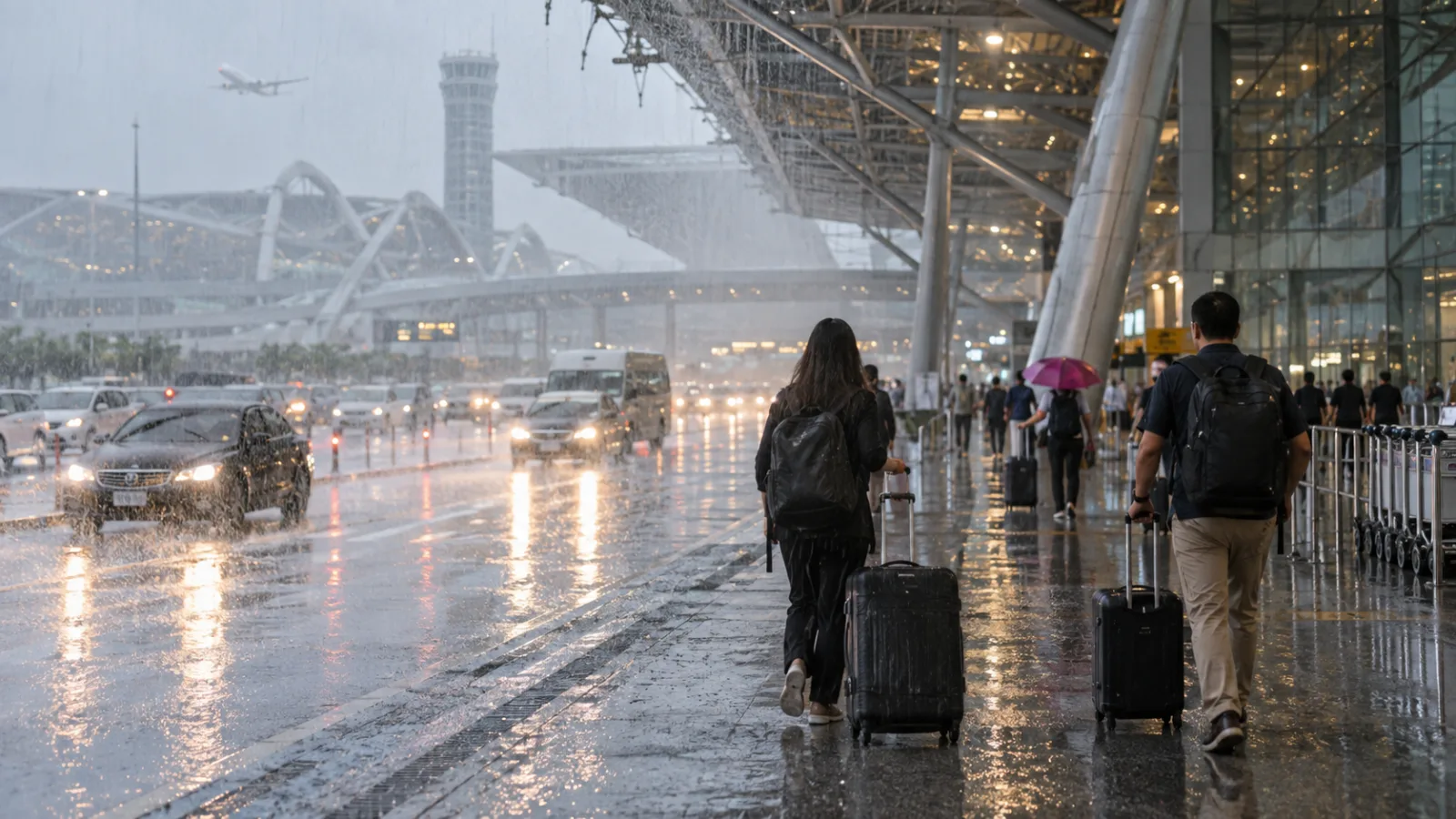
A cheap flight into Bangkok can become an expensive trip before you reach the hotel when heavy rain turns a short airport transfer into a long, uncertain journey. On 26 September 2026, Thailand’s Civil Aviation Authority warned passengers using Suvarnabhumi and Don Mueang to allow extra time because persistent rain had caused waterlogging in Bangkok and nearby provinces, affecting road access and potentially flight operations. The Thai Meteorological Department’s advisory covers 25–27 September and warns of heavy to very heavy rain, flash flooding, overflows and rough seas.
This is a short-lived weather problem, not a reason to treat every Bangkok flight as cancelled. It is, however, a good moment to change the way a budget trip is planned. The cheapest itinerary is not the one with the lowest fare on the screen; it is the one that still works after a delayed landing, a slow airport road, a lost taxi queue or a missed onward flight. The practical rule for this weekend is simple: protect the airport connection first, then optimise the fare.
What is happening now
The official aviation warning concerns both of Bangkok’s main passenger airports. CAAT says rain and standing water are affecting travel to and from the terminals, while weather may lead to delays or schedule changes. It specifically asks passengers to check their flight status through their airline’s official channel, leave earlier than usual and plan their approach to the airport rather than relying on normal travel times.
The weather background is also more serious than an ordinary afternoon shower. The Thai Meteorological Department says an active low-pressure cell and the monsoon trough are producing heavy to very heavy rain in the Central region, including Bangkok and its vicinity. Its warning says accumulated rain may trigger flash floods and overflows, and advises caution in low-lying areas and near waterways. It also warns that waves in the upper Gulf and upper Andaman Sea can reach 2–3 metres, with higher waves in thunderstorms, and tells small boats to remain ashore through 27 September.
Those two statements describe different parts of the same travel risk:
- Your flight may operate, but the road to the airport may be slow or temporarily impassable.
- The airport may be open, but a late inbound aircraft can move your departure gate and onward connection.
- Rail can remove road congestion on part of a journey, but it does not solve the walk from a flooded street to the station or a late-night arrival after service ends.
- A ferry, island transfer or day trip can be affected even when Bangkok’s airports continue operating.
Treat the situation as a reliability problem rather than a dramatic all-or-nothing closure. Keep checking the airline, airport and weather information close to departure. Social posts can help identify local conditions, but they should not replace an official flight-status or weather update.
The first budget decision: which airport and which connection?
Bangkok is not one airport with two names. Suvarnabhumi (BKK) is east of the city and has the Airport Rail Link. Don Mueang (DMK) is north of central Bangkok and is commonly used by low-cost carriers. A low headline fare can be misleading if it requires changing between the two.
A same-day BKK–DMK transfer is especially fragile in persistent rain. The airports are connected by an airport shuttle for eligible transferring passengers, but a traveller needs proof of the onward flight and identification. Suvarnabhumi’s current airport information says the shuttle operates from 05:00 to 24:00, departs every 30 minutes and is free for passengers transferring between the airports. The same information says it is not for members of the general public who are not making an airport-to-airport flight connection.
That condition matters. Do not book a cheap BKK arrival and a separate DMK ticket assuming that the free shuttle is a public bus. If the tickets are separate, you may need to arrange and pay for another transfer, and you remain responsible for collecting bags, clearing immigration, reaching the other airport and checking in before the second airline’s deadline.
For a budget itinerary, rank the choices like this:
- One ticket with a protected connection at the same airport.
- A direct airport transfer with a generous time buffer, booked only when the transfer rules are clear.
- Separate tickets with an overnight in Bangkok.
- Separate same-day tickets between BKK and DMK only when the savings are large enough to justify a possible replacement ticket.
The fourth option may still work in dry weather. During this rain episode, it is the option most likely to turn a fare saving into a second airfare. If you must use it, leave a large buffer and carry the money or credit needed to buy a replacement flight. Travel insurance may not cover a missed self-transfer simply because the first flight was late, especially if the policy excludes weather-related disruption or requires a minimum connection time.
Getting to Suvarnabhumi without paying for a panic transfer
Suvarnabhumi Airport’s official transport page lists taxis, ride-hailing services, public buses, the Airport Rail Link and the airport shuttle to Don Mueang among the available options. The most useful choice depends on where you sleep, the time of day and how much road exposure you can accept.
Airport Rail Link
The Airport Rail Link station is on the basement level of the terminal. Suvarnabhumi’s airport information lists service from 05:30 to 24:00. The train avoids much of the road congestion between the airport and the city, which makes it a strong default for a daytime departure from a neighbourhood near the line or a convenient interchange.
It is not a complete weather-proof route. You still need to reach the station in the city, carry luggage through the station, and leave enough time for platform access, queues and the final walk to check-in. If your flight is early, the first train may not be early enough. If your flight lands near midnight, the last train may have finished. Check the operating notice on the day rather than relying on a timetable saved from a previous trip.
The sensible calculation is door to terminal, not station to terminal. Add the walk or short vehicle ride from the hotel to the station, a buffer for wet streets and luggage, the train journey, and the time your airline requires for check-in and bag drop.
Taxi or ride-hailing car
A taxi is the flexible option when rain is heavy, luggage is bulky or your hotel is far from a rail station. At Suvarnabhumi, the airport says public taxis are available 24 hours on Level 1 between Gates 4 and 7, with a queue ticket required. It lists a 50-baht airport surcharge in addition to the metered fare and notes that tolls and luggage charges may apply under the relevant rules.
A car does not guarantee a faster journey. The price advantage of a taxi can disappear if the vehicle is held in traffic for a long time, while a ride-hailing quote can rise with demand. Ask the driver to use the official pickup area, keep the destination in the app or written in Thai, and build a road-delay reserve into the plan. Avoid accepting an unofficial offer in the arrivals hall simply because the queue looks long.
For a departure, consider leaving in two stages: reach a neighbourhood or hotel with more reliable rail access the night before, then use the train or a short taxi ride in the morning. One modest hotel night can be cheaper than a missed international ticket.
Bus
Public buses are the lowest-cost choice for some routes, but they need more tolerance for traffic and changing conditions. Airport information lists public routes and service windows that vary by route. The airport’s BMTA page, for example, lists A1 and A2 services at 30 baht and A3 and A4 at 50 baht, with operating periods that run into the evening but differ by route.
Use a bus when your schedule is loose and you have a fallback. Do not choose the cheapest bus purely for a flight that cannot be rebooked cheaply. Heavy rain can slow the road legs before and after the bus, and a familiar route can take much longer when standing water is widespread.
Getting to Don Mueang when the road is the weak link
Don Mueang does not have the same direct airport rail arrangement as Suvarnabhumi. The airport’s surrounding rail and bus choices can be useful, but many itineraries still include a road transfer. That makes the weather risk more visible: the flight may be on time while the final few kilometres are not.
For a DMK departure, ask the accommodation provider which nearby rail or bus connection is operating and how the last road segment is usually handled during flooding. Check whether a station entrance, footbridge or local road is low-lying. A route that looks short on a map may require wading through water with luggage, which is both unsafe and a poor way to protect a flight.
If your departure is early, staying near the airport can be the cheapest risk-control measure. Compare the total of one night, local transport and breakfast with the cost of replacing a missed ticket. The same logic applies to an overnight arrival: a budget hotel near the terminal or a well-connected area may cost less than a late, uncertain cross-city transfer.
Do not assume that a driver can safely pass every flooded street. Avoid driving through moving water, and do not trade a few hundred baht for a route that places a motorbike, taxi or pedestrian in danger. Official local warnings and airport instructions take priority over a map application’s estimated travel time.
A realistic budget for a rain-resilient Bangkok airport day
A useful budget has four layers: the planned journey, weather friction, food and a failure reserve. Exact prices move with route, demand, luggage and exchange rates, so the figures below are planning bands rather than guaranteed fares.
For a traveller staying in central Bangkok and using public transport where practical:
- Planned airport transfer: roughly 50–200 baht per person if the rail or bus route fits the accommodation, plus a short local connection.
- Taxi or ride-hailing fallback: reserve roughly 300–800 baht for a city-to-airport vehicle before tolls, peak-demand changes or a longer delay. The final amount depends heavily on the district and traffic.
- Food and water while waiting: roughly 150–400 baht per person for a simple airport or station day.
- Contingency: keep at least 500–1,000 baht immediately available for an unexpected short ride, a second local transfer or a meal during a delay.
- Accommodation buffer: if a same-day transfer or early departure is important, compare a room near the airport or a reliable rail corridor with the cost of a replacement air ticket. The right amount is not a universal number; it is the value of protecting the next non-refundable booking.
For a couple travelling light, a public-transport plan can stay inexpensive, but the reserve should still be shared in cash and on a payment card. For a family with checked bags, the cheapest per-person route may be awkward enough to fail in rain. Price the whole group’s transfer, not the nominal adult fare.
Keep the flight budget separate from the disruption reserve. Do not spend the reserve on a nicer dinner or an extra excursion on the assumption that the weather will improve. If the flight is cancelled, the reserve is also what pays for food, a hotel, a local transfer or a change fee while the airline explains its options.
How early should you leave?
There is no single safe number because the weather can change faster than a journey planner. Start with your airline’s stated check-in and bag-drop deadline, then add:
- the time to leave the hotel and reach the first transport point;
- a buffer for flooded or slow roads;
- the time to find the correct airport terminal and airline counter;
- security, immigration and walking time;
- extra margin if you are checking a bag, travelling with children or using a separate ticket.
On a normal day, people often work backwards from the scheduled departure. In persistent heavy rain, work backwards from the point at which you must be at the airport, not from the boarding time. If a flight is international and the airline closes bag drop well before departure, missing that cut-off can be just as damaging as arriving after boarding starts.
For a high-value or non-flexible flight, leaving earlier and waiting in the terminal is usually cheaper than gambling on the last normal journey time. Bring a power bank, a dry bag for documents and enough water or snacks to avoid paying for the first available option. Keep passports and phones sealed against rain; a soaked boarding pass can be replaced, but wet travel documents and electronics create a more serious problem.
What to do if the airline changes the flight
Check the booking directly with the airline, not only through a third-party booking page. Save screenshots of the original itinerary and every new notification. If a flight is delayed, ask whether the airline has reprotected you, whether checked baggage will follow the new routing and whether you must still report by the original check-in deadline.
For a cancellation, the options depend on the airline, ticket conditions, the cause of disruption and the applicable passenger-rights rules. Thailand’s aviation authority has said that assistance for weather-related delays or cancellations can depend on the circumstances and that severe weather is outside an airline’s control when safety requires schedule changes. Do not assume that a cash compensation payment is automatic. Ask clearly about rebooking, refund, meals, communication and accommodation, and keep receipts for costs that the airline explicitly agrees to cover.
A weather delay also has a knock-on effect. If you booked a hotel for one night, a ferry, a train or a second flight, contact each provider as soon as the delay is confirmed. Flexible cancellation is often worth more than a small discount during a volatile weekend. Do not leave the airport without knowing whether your checked bag has been unloaded, rerouted or held for the next service.
If you have separate tickets, the first airline normally has no obligation to protect the second ticket. That is the central reason not to use an optimistic two-hour self-transfer between BKK and DMK in this weather. A protected connection is more expensive at purchase time but can be far cheaper after disruption.
Should you postpone a Bangkok trip?
Postponement makes sense when the itinerary depends on several tight links: a late arrival, a same-day transfer to the other airport, an island ferry, a non-refundable event and an early flight home. It is less necessary when you are already in Bangkok, have flexible accommodation, can use rail for part of the airport journey and have a full day of slack.
The Thai Meteorological Department’s current advisory runs through 27 September, but the end date of a forecast is not a promise that every road will immediately dry or that every schedule will return to normal. Waterlogging, vehicle queues and aircraft rotations can continue after the heaviest rain has moved away. Recheck conditions before making a go/no-go decision.
If you are travelling beyond Bangkok, apply the same logic to boats and rural roads. The weather warning includes rough seas and advises small boats to stay ashore in relevant waters. Do not force an island or coastal connection because the flight into Bangkok was cheap. A missed ferry can strand you overnight, and a dangerous sea crossing is never a sensible budget saving.
A departure checklist for 26–27 September
The evening before travel:
- Check the airline’s app or website and confirm the operating airport, terminal and departure time.
- Check CAAT or airport notices, then look at the Thai Meteorological Department warning and local flood information.
- Confirm whether your hotel-to-airport route depends on a road known to flood.
- Decide on a primary route and a fallback route; note the last train or bus times.
- If changing airports, verify that you are eligible for the airport shuttle. Do not assume it is a general public service.
- Keep a disruption reserve separate from spending money.
- Confirm every onward booking and its change or no-show conditions.
On the day:
- Leave earlier than the normal journey planner suggests.
- Check flight status before leaving the hotel and again while travelling.
- Use official taxi queues or clearly identified transport services.
- Keep passports, medication, phones and documents in waterproof packaging.
- Do not walk or drive through moving floodwater.
- If the flight changes, contact the airline before buying an expensive replacement unless the departure deadline leaves no alternative.
- Photograph receipts and notifications if you need to claim under a policy or ask an airline for agreed assistance.
Bottom line
Bangkok remains reachable, but a budget itinerary built around normal road speeds is poorly matched to the conditions reported on 26 September 2026. The best low-cost adjustment is to reduce dependency on the road, avoid an unprotected BKK–DMK self-transfer, keep a real cash reserve and accept that an early airport arrival may be cheaper than a last-minute rescue.
The warning is date-sensitive. CAAT’s advice and the meteorological outlook can change, and airline schedules are live operational information. Check the official sources again immediately before departure. If the plan still works after adding a wet-weather transfer, an airport buffer and one realistic fallback, the fare may be worth keeping. If it only works when every road, flight and connection runs on time, it is not a cheap trip; it is a fragile one.
Related articles
Thailand on a Budget After 15 September 2026: Check Your Entry Period Before You Book a Long Stay
Thailand remains workable for a low-cost trip, but the visa-exemption framework changes on 15 September 2026. The practical budget question is no longer only airfare and hotels: it is whether your passport permits the stay your itinerary actually needs.

Voyager en Thaïlande avec un petit budget après le 15 septembre 2026 : vérifiez votre durée d’entrée avant de réserver un long séjour
La Thaïlande reste accessible avec un budget maîtrisé, mais la révision du régime d’exemption de visa du 15 septembre 2026 impose de vérifier la catégorie liée à votre passeport avant de réserver un itinéraire de plusieurs semaines.
Tajlandia niskobudżetowo po 15 września 2026 r.: sprawdź długość pobytu, zanim zarezerwujesz dłuższy wyjazd
Tajlandia nadal pozwala zaplanować niedrogą podróż, ale 15 września 2026 r. zmieniają się zasady zwolnienia z wizy. Przed zakupem biletu sprawdź, czy Twój paszport pozwala na pobyt zgodny z planem.
Tailandia con poco presupuesto después del 15 de septiembre de 2026: comprueba tu periodo de entrada antes de reservar una estancia larga
Tailandia sigue siendo viable para viajar con poco presupuesto, pero el marco de exención de visado cambia el 15 de septiembre de 2026. Antes de reservar, comprueba si tu pasaporte permite la duración real de tu itinerario.
Comments
Sign in to comment.
No comments yet.