Heathrow on 21–22 November 2026: the budget route when the Piccadilly line is closed
Heathrow’s Piccadilly line connection is unavailable from early Saturday 21 November through Sunday 22 November. Here is how to choose between the Elizabeth line, replacement buses and Heathrow Express without turning a short airport transfer into an expensive mistake.

Heathrow’s cheapest rail connection is not available for the weekend of 21–22 November 2026. Transport for London says there will be no Piccadilly line service between Hammersmith and Heathrow, including all terminals, from 01:30 on Saturday 21 November through Sunday 22 November. The closure also covers Friday and Saturday Night Tube services, so a late arrival cannot rely on the usual blue-line route after midnight. TfL’s stated alternative for central London is the Elizabeth line. Replacement buses will cover parts of the closed section, but they are not a like-for-like substitute for every airport journey.
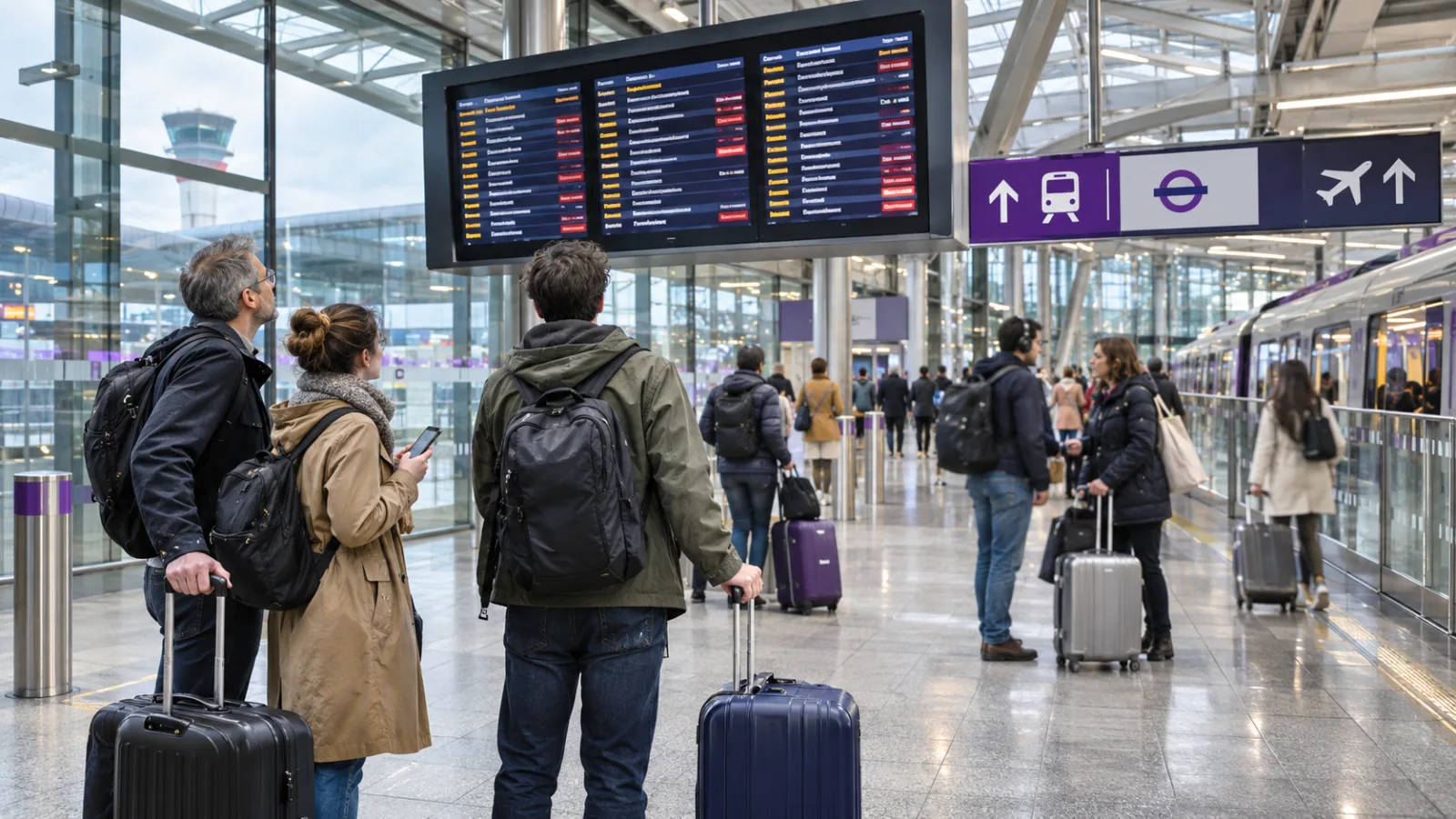
That matters because the Piccadilly line is normally the option many budget travellers choose when the flight is cheap but the airport transfer must stay cheap too. During this closure, the sensible plan depends on four details: your terminal, where you are staying, whether you are travelling during the night, and how much time you have before check-in or a connecting flight.
The closure is date-sensitive. It is a planned arrangement for this weekend, not a permanent change to Heathrow transport. Check the TfL status page and your airline’s flight information again on the day, especially if your journey begins late on Sunday or shortly after midnight on Monday.
What is closed, and what is still running
The affected Piccadilly line section runs from Hammersmith to Heathrow and Uxbridge. TfL also lists a Piccadilly line service-control strike running from Friday 20 November until Saturday evening 21 November. For airport passengers, the practical result is the same: do not plan a journey from central London to Heathrow around the Piccadilly line during the affected period.
Heathrow itself is not closed. Flights, terminal facilities and the airport’s other rail connections continue to operate, subject to the normal airline and airport conditions. The disruption is on the route between the airport and London, not a suspension of passenger flights.
The Elizabeth line remains the main rail alternative. It connects Heathrow with central London stations including Paddington, Bond Street, Tottenham Court Road, Farringdon and Liverpool Street. TfL says six Elizabeth line trains an hour serve Heathrow: all call at Terminals 2 and 3, four continue to Terminal 4 and two continue to Terminal 5, normally every 30 minutes. This makes it the most straightforward replacement for most daytime arrivals and departures.
Replacement buses are also planned. The most useful airport services for this weekend are PL3, between Hammersmith and Heathrow Central, and PL7, between Hammersmith and Heathrow Central via Hounslow and Hatton Cross. At Heathrow Central, passengers can use the airport’s inter-terminal connections to reach Terminals 4 and 5. These buses may be useful when you are already on the western side of London, but they are slower and more vulnerable to road traffic than a train.
The default budget choice: Elizabeth line with contactless payment
For most travellers coming from central London, start with the Elizabeth line rather than Heathrow Express. It is a normal TfL rail service, it accepts contactless payment, and it reaches several central destinations without an extra transfer at Paddington.
The route is especially convenient if you are staying near Bond Street, Tottenham Court Road, Farringdon, Liverpool Street or Canary Wharf. From a hotel near those stations, you can normally walk or take a short Tube connection to the Elizabeth line and remain on the same train to Heathrow. A traveller near Paddington can also use the Elizabeth line, although the Heathrow Express may be faster if the price is acceptable.
TfL says the journey between Paddington and Heathrow takes about 28 minutes on the Elizabeth line. That is a useful planning figure, but it is not a promise for the full door-to-door trip. Add time to reach the station, find the correct platform, walk through the airport, and allow for crowding on a weekend when many passengers are making the same substitution.
Use the same contactless card, phone or wearable device to touch in and touch out. Do not split the journey between different cards or devices, because the fare system may not match the trips correctly. If you are travelling as a group, each person needs a separate payment card or device unless you are using an appropriate ticketing arrangement. Parents should check how children’s fares apply before assuming that one adult’s contactless card can cover everyone.
There is an important fare detail: TfL says all Tube and Elizabeth line journeys to and from Heathrow are charged peak fares if they start, end or pass through Zone 1. That rule can make the airport leg more expensive than a normal off-peak London journey, even when you travel at a quiet time. The exact amount depends on the stations and payment method, so use TfL’s fare checker rather than copying an old blog post or a fare shown in a travel forum.
For a rough budget, allow the published Heathrow rail fare plus a small contingency for a local bus, Tube connection or luggage-related taxi. A solo traveller who is already close to an Elizabeth line station will usually have the cleanest low-cost plan. A couple travelling with large bags may still spend less on rail than on a taxi, but the time saved by a private vehicle is not guaranteed during busy weekend traffic.
When Heathrow Express makes sense—and when it does not
Heathrow Express remains available from Paddington. Its published Standard Class price is £26 for a single bought without an advance discount, while advance discounted singles start from £10 when booked early enough. The operator also lists a £30 same-day return and a £42 flexible return on its fare page, although prices and ticket conditions can change.
That makes Heathrow Express a poor emergency substitute for a budget traveller who buys at the station. A £26 single can cost several times the price of an advance ticket and can exceed the cost of the Elizabeth line by a wide margin. It may still be reasonable in three situations:
- You are already at Paddington and your flight or airport connection is time-sensitive.
- You booked an advance ticket at a low price and the train fits your plan.
- You are travelling with several people and the operator’s child or group conditions make the total more competitive than expected.
Do not buy an advance Heathrow Express ticket simply because the Piccadilly line is closed unless you have checked the conditions. An advance fare may be tied to a travel date or other restrictions, and a cheap ticket is not useful if a late flight, baggage delay or terminal transfer makes you miss the intended journey.
The train is non-stop from Paddington and can be attractive for a passenger who values a predictable ride more than the lowest possible fare. But “fastest” does not always mean fastest from your hotel. If you are staying in Soho, near Liverpool Street or in East London, reaching Paddington first can erase much of the time advantage and add another interchange with luggage.
Routes by starting point
From the West End, the City and East London
Use the Elizabeth line from the nearest practical central station. Bond Street is useful for Mayfair and much of the West End; Tottenham Court Road serves the Oxford Street and Soho area; Farringdon works well for the City and north-central connections; Liverpool Street is the natural choice for many East London hotels.
Allow extra interchange time if you are connecting from another Tube line. On a normal map, a short transfer can look simple, but a suitcase journey through a large station is slower than a platform-to-platform change. For a morning flight, schedule your hotel departure around the airport’s recommended arrival time rather than the theoretical train duration.
From Paddington
Compare the Elizabeth line and Heathrow Express at the moment you travel. The Elizabeth line is usually the budget default. Heathrow Express is the premium time-saving option, particularly when you already have a valid advance ticket or when the next Elizabeth line departure would leave you waiting.
Do not assume that a Heathrow Express ticket can be used on the Elizabeth line. They are different services with different ticketing arrangements. If you switch because of a disruption, check the operator’s instructions before passing through the barriers.
From Hammersmith and west London
The closure is most inconvenient for travellers who would normally board the Piccadilly line locally. TfL lists the PL3 replacement bus between Hammersmith and Heathrow Central. PL7 takes a more local route through Osterley, Hounslow East, Hounslow Central, Hounslow West and Hatton Cross before reaching Heathrow Central.
These services are useful as a fallback, but they should not be priced or timed like a train. Road traffic, boarding queues and limited luggage space can lengthen the trip. If your accommodation is close to a station served by the Elizabeth line, it may be cheaper and more reliable to travel east or north to that railway rather than take a replacement bus all the way to the airport.
From Uxbridge and the north-west suburbs
The weekend closure also affects the Piccadilly and Metropolitan line arrangements around Uxbridge. TfL lists replacement bus service ML1 between Harrow-on-the-Hill and Uxbridge, with connections through the western suburbs. This is not the route to choose casually for an early Heathrow flight: it can involve multiple changes and a long surface journey.
Check whether a local bus or National Rail route can bring you to an operating Elizabeth line station. West Ruislip, for example, may offer a connection into the wider network, but the best choice depends on your exact starting point and the current service status. Use a live journey planner on the day rather than relying on a static map.
Late-night arrivals and early departures
The closure includes Friday and Saturday Night Tube services on the affected section. That is the part most likely to catch a budget traveller who books a low-cost flight based only on the airfare.
If you land late on Saturday, first check whether an Elizabeth line train is still operating for your arrival time. TfL’s public information says the Elizabeth line is the recommended route between central London and Heathrow, but schedules and last departures matter. If the rail option has finished, compare the replacement night bus, a normal London bus combination, a coach, a pre-booked transfer and a taxi. The cheapest option may also be the slowest, which is a problem if your accommodation has a late check-in deadline.
For an early Sunday flight, work backwards from the airline’s required airport arrival time. A replacement bus that looks adequate in daylight may be too infrequent before dawn. A taxi split between two or three travellers can become the practical budget choice when the alternatives require a long overnight wait. That is not a reason to abandon the budget; it is a reason to price the complete journey before buying the flight.
If you are arriving on a late flight and have no checked bag, you may clear the terminal more quickly, but do not build a plan around an optimistic ten-minute transfer. Immigration, baggage reclaim and the walk to the transport station can vary sharply between terminals and arrival banks.
Terminal transfers: do not mistake Heathrow Central for every terminal
Many replacement-bus instructions refer to Heathrow Central, which is the transport hub for Terminals 2 and 3. Terminals 4 and 5 are separate stops. TfL says the Elizabeth line provides free inter-terminal transfers between Terminals 2 and 3, Terminal 4 and Terminal 5; passengers should use contactless or obtain a free inter-terminal transfer ticket from the station machines.
A traveller who is meeting someone, changing terminals or connecting to an onward flight should confirm the terminal before choosing the bus. PL3 and PL7 reach Heathrow Central, after which you may still need time to transfer to Terminal 4 or 5. That extra movement matters more than the headline journey time.
If you have a same-day airside connection, follow the airline’s connection instructions instead of treating a landside rail transfer as automatically acceptable. A cheap public-transport route is not a substitute for an eligible airside connection, a valid transit document or enough time to clear security again.
A realistic weekend budget
A useful airport-transfer budget has three layers:
- The fare from your accommodation to the operating airport rail station.
- The Heathrow rail fare or replacement-bus cost.
- A contingency for a missed connection, late-night change or short taxi ride.
For a solo daytime traveller near the Elizabeth line, the second layer is usually the main cost. For someone staying near Hammersmith, the replacement bus may avoid an extra Tube journey but take longer. For a family with several suitcases, a private transfer can look expensive until you multiply several rail fares and account for the cost of reaching a station with lifts and step-free access.
Do not use the Heathrow Express’s £10 advance fare as the normal price in a budget comparison. That is an advance offer, not a guaranteed walk-up fare. Likewise, do not treat a sample Elizabeth line fare from a previous year as fixed. TfL publishes 2026 fares and caps, and airport journeys have special fare treatment. Check the live fare before you make the final calculation.
A sensible contingency is money you can actually access during the trip, not a theoretical saving. Keep enough for a short taxi or ride-hail journey if the last train is cancelled, but check the pickup point and traffic conditions before accepting a high quoted fare. If the airline causes a major delay, ask the airline first about rebooking or assistance; do not assume that travel insurance or a transport operator will reimburse every extra cost.
Timing advice for flights
For a departure, plan the airport journey as if one connection will go wrong. On this weekend, that means adding time for the Elizabeth line interchange, a crowded replacement bus, or a platform change caused by a live service alteration.
For a long-haul flight, keep the original airline recommendation as your baseline and add a buffer for the closure. For a short-haul flight with only hand luggage, the temptation is to cut the margin because the terminal is familiar. That is precisely when the replacement route can turn a manageable delay into a missed check-in deadline.
For an arrival, do not book a non-refundable late-night transfer until you know the flight time and terminal. A flight that lands at 22:30 may not produce a passenger at the station at 22:45. Conversely, a pre-booked vehicle that waits through a long delay can cost more than the rail alternative. A flexible reservation is often worth more than the lowest headline price.
What to check before leaving your hotel
Check the following in the hour before departure:
- TfL’s live status page for the Piccadilly, Elizabeth and relevant replacement-bus services.
- The Elizabeth line destination: Terminal 4 and Terminal 5 trains are not identical, so confirm the branch.
- Your airline booking for the correct Heathrow terminal and any schedule change.
- The payment method you will use at the gates. Use the same contactless card or device throughout a TfL journey.
- The final train or bus option if travelling at night.
- A backup route from the station to the terminal if a lift, escalator or platform is unavailable.
Take a screenshot of the route and keep the official pages accessible offline. Journey planners can change after you leave Wi-Fi, and station staff may direct passengers to a different boarding point if a replacement bus queue becomes busy.
The practical decision
For a daytime journey from central London, take the Elizabeth line and budget for the Heathrow airport fare. It is the simplest replacement and usually the best fit for a low-cost trip.
For a journey beginning at Paddington, compare the Elizabeth line with Heathrow Express. Choose the Express only when the speed, an advance fare or the convenience of a non-stop train justifies the premium.
For west London, check the PL3 or PL7 replacement bus, but add road-traffic time. For a late-night or early-morning flight, verify the final operating service first; a taxi split between travellers may be cheaper than losing a flight or paying for an emergency hotel night.
The Piccadilly line is expected to be a normal option outside the stated closure period, but transport conditions can change. The fares, timetables and replacement arrangements above are a snapshot for 21–22 November 2026. Recheck the official TfL status page before you travel, and price the airport transfer as part of the trip rather than as an afterthought to the airfare.
Related articles
Gatwick’s September 2026 Assisted-Travel Strike Is Suspended: What Budget Flyers Should Still Check
Planned Gatwick assisted-travel walkouts have been suspended while Wilson James workers vote on a new offer. Here is what the change means for ordinary passengers, travellers who need help, and anyone trying to keep airport costs under control.

Забастовка службы сопровождения в Гатвике в сентябре 2026 года приостановлена: что всё ещё стоит проверить пассажирам с ограниченным бюджетом
Запланированные забастовки службы сопровождения в аэропорту Гатвик приостановлены: сотрудники Wilson James голосуют по новому предложению. Разбираем, что это значит для пассажиров, которым нужна помощь, и как пересчитать расходы на дорогу.
La huelga de asistencia al viajero de Gatwick en septiembre de 2026 queda suspendida: qué deben comprobar quienes vuelan con presupuesto ajustado
La huelga prevista del personal de asistencia al viajero de Gatwick ha quedado suspendida mientras los trabajadores de Wilson James votan una nueva oferta salarial. Esto es lo que todavía conviene revisar antes de viajar y cómo evitar gastos innecesarios en el aeropuerto.
La grève de l’assistance aux voyageurs à Gatwick en septembre 2026 est suspendue : les vérifications à ne pas oublier avec un petit budget
La grève annoncée à Gatwick a été suspendue pendant que les salariés de Wilson James votent sur une nouvelle offre salariale. Voici les vérifications utiles pour voyager avec ou sans assistance, maîtriser les transferts et éviter les coûts imprévus.
Comments
Sign in to comment.
No comments yet.