Los Angeles to Vancouver for $188: the fall budget works only if you price bags, rain and airport transit first
A cheap LAX-Vancouver fare can still make a useful autumn city break, but the real budget depends on Air Canada bag rules, YVR transit add-ons, hotel timing and Vancouver's wet-season backup plan.

A $188 round trip from Los Angeles to Vancouver is the kind of fare that looks simple until the trip is priced like a real weekend. The flight itself is the good part: Secret Flying listed non-stop LAX-YVR flights with Air Canada on September 10, 2026, with availability shown from late October through December 2026. That is a useful window for budget travelers because it sits after summer crowds and before the deepest winter holidays. It is also Vancouver's wet season, the period when a bargain can be cheap for a reason.
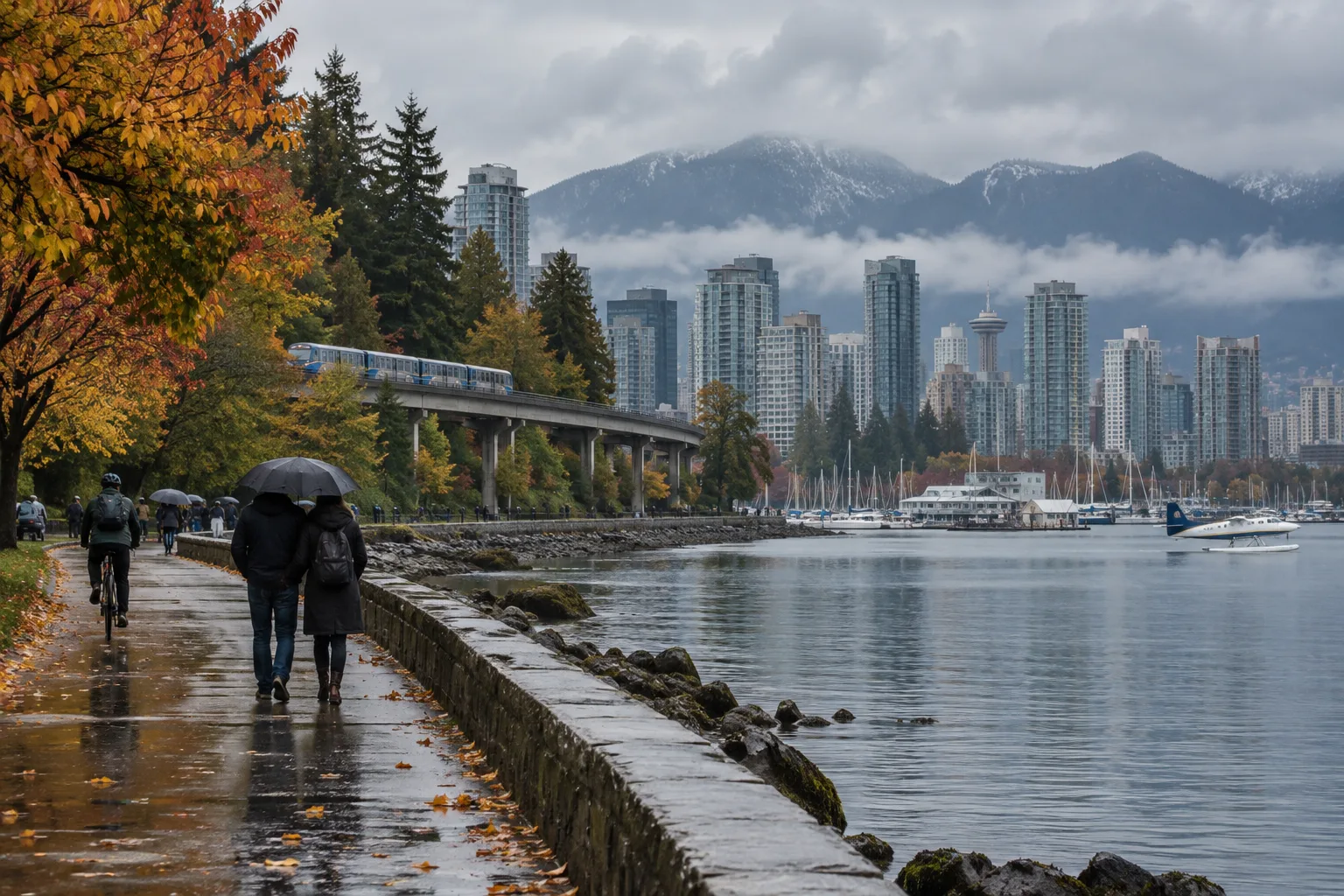
The right question is not whether Vancouver is worth visiting. It is whether this specific fare still works after you add the items that do not fit in the headline: Air Canada's Basic fare carry-on restriction, the YVR airport transit add-on, hotel prices that can swing sharply by date, short daylight in November and December, and the cost of paid attractions that can quietly turn a cheap flight into an expensive city break.
For a traveler starting in Southern California, this route is one of the cleaner international budget breaks available in fall 2026. It is non-stop, the flight time is manageable, the airport has a direct train into downtown, U.S. citizens do not need an eTA, and many of Vancouver's best low-cost days are built around walking, transit, public markets and parks rather than ticketed sights. The catch is that the trip needs to be planned around weather and baggage, not around a postcard version of the city.
The fare is current, but it is not a promise
Secret Flying's September 10 listing showed Los Angeles to Vancouver non-stop with Air Canada for $188 round trip, with sample dates from October 26 to November 2, October 29 to November 4, several November weeks, and early-to-mid December. The listing also carried the usual warning that prices and availability can disappear after publication. Treat the fare as a lead to verify, not as an entitlement.
That distinction matters in 2026. The U.S. Bureau of Labor Statistics reported that the airline fares index rose 25.5 percent over the 12 months ending July 2026 and 2.2 percent from June to July. A cheap transborder fare is therefore attractive, but also fragile. Airlines can reprice inventory quickly, and the lowest fare bucket may have the most restrictive rules.
Before booking, run the exact dates through Air Canada and at least one metasearch tool, then price the same itinerary with the bags and seats you actually need. A $188 base price can still be a good deal at $230 or $260 all-in. It is less compelling if a carry-on, checked bag, awkward flight time, airport transfer and higher hotel night erase the gap against a more flexible fare.
The most practical booking test is simple: if the fare requires Air Canada Economy Basic on a U.S.-Canada route and you cannot travel with one personal item, assume the headline price is incomplete. Air Canada's carry-on page says Economy Basic tickets purchased on or after January 3, 2025 allow only one personal item on board for travel within Canada and to or from the U.S., Mexico, Central America and the Caribbean. Standard carry-on baggage is not included on those Basic fares for these routes.
That does not make the fare bad. It changes the packing strategy. A three-night Vancouver trip in late October or early November can be done with a personal item if you pack a compressible rain shell, one warm mid-layer, spare socks and compact toiletries. It is harder if you need hiking boots, a laptop setup, formal clothes or bulky winter layers.
Entry rules: easy for many U.S. travelers, but still check documents
For U.S. citizens flying from Los Angeles to Vancouver, Canada does not require an electronic travel authorization. Immigration, Refugees and Citizenship Canada states that U.S. citizens are exempt from the eTA requirement and should carry proper identification such as a valid U.S. passport. The Canada Border Services Agency recommends a valid passport as the reliable travel and identification document for U.S. travelers.
U.S. lawful permanent residents are also exempt from the eTA requirement, but they need a valid passport from their nationality and proof of lawful permanent resident status, such as a valid green card or equivalent proof. Other nationalities living in the United States may need either an eTA or a visitor visa depending on citizenship and how they travel. Do that check before buying a nonrefundable fare.
On arrival by air, CBSA says travelers entering Canada complete a declaration and pass through the first border checkpoint. Advance Declaration can be submitted up to 72 hours before arrival at participating airports, including Vancouver, and CBSA's reminder checklist says it can reduce time at airport kiosks or eGates. It is not a visa shortcut and does not guarantee entry, but it is a useful low-effort step for a short trip.
Budget travelers should also avoid common border mistakes that create expensive delays. Do not bring cannabis across the border in either direction. Declare goods truthfully. If carrying CAN$10,000 or more, declare it. If traveling with minors, carry the documents CBSA recommends. The cheap version of this trip is the version where you clear the airport cleanly and get on the train.
The airport transfer is one of the reasons this route works
Vancouver International Airport is unusually convenient for a budget city break because the Canada Line connects YVR with Waterfront Station in downtown Vancouver. YVR says the Canada Line reaches downtown in under 30 minutes. TransLink's visitor information puts the YVR to downtown trip at about 25 minutes. That means there is little reason for a solo budget traveler to default to a taxi.
The fare detail matters. TransLink increased fares on July 1, 2026, and lists adult cash or contactless fares at CAD 3.50 for one zone, CAD 5.10 for two zones and CAD 6.70 for three zones. It also lists a CAD 6.50 YVR Airport AddFare for journeys starting at YVR-Airport, Sea Island Centre or Templeton stations and traveling outside Sea Island. TransLink notes that all bus trips are one-zone fares all day, while SkyTrain and SeaBus can require more zones depending on time and distance. After 6:30 p.m. on weekdays, and on weekends and provincial statutory holidays, the whole system moves on a one-zone fare for normal transit.
For most LAX arrivals headed downtown, budget the airport train as a normal fare plus the YVR AddFare. On the return trip from downtown to YVR, YVR's cruise travel guidance gives the downtown-to-airport fare as CAD 5.10 as of July 1, 2026, and says the trip takes about 25 minutes from Waterfront Station. The airport AddFare is for trips starting at the airport stations, not trips going to the airport from downtown.
A one-day transit pass can also make sense. TransLink lists the adult DayPass at CAD 12.55 and says it gives unlimited use of buses, SkyTrain, SeaBus and HandyDART for the service day, excluding West Coast Express. For a day that includes downtown, North Vancouver by SeaBus, a bus to Lynn Canyon, and a return ride, the pass is easier than counting zones. For a single downtown day with one or two short rides, contactless tap-to-pay may be enough.
There is one operational trap: late and early flights. TransLink's Canada Line schedule lists YVR-Airport to Waterfront first train at 5:09 a.m. and last train at 12:54 a.m., with Waterfront to YVR-Airport running from 4:48 a.m. to 1:08 a.m. The N10 NightBus covers overnight hours when the train is closed, but it is slower and less comfortable after a long flight. If the cheapest fare lands near midnight or departs before dawn, price the time penalty before booking.
When to go: October is the best balance, November is cheaper and wetter
The Secret Flying window runs from October to December. Within that range, late October into early November is the strongest budget compromise. Summer cruise traffic has faded, hotel pressure is usually lower than in peak months, and the city still has enough daylight for Stanley Park, Granville Island, Gastown, the Seawall and a North Shore transit day.
Environment and Climate Change Canada's 1991-2020 climate normals for Vancouver International Airport show the tradeoff clearly. October averages 10.3 C, with a daily maximum of 13.5 C and minimum of 7.0 C. November drops to a 6.4 C average, with a 9.3 C daily maximum and 3.6 C minimum. December averages 3.9 C, with a 6.6 C daily maximum and 1.2 C minimum.
Rain is the sharper variable. The same Canadian climate normals show total precipitation of about 123.9 mm in October, 174.6 mm in November and 172.2 mm in December at the Vancouver airport composite station. November and December are not impossible travel months. They just punish itineraries built around constant outdoor sightseeing.
October is the better pick for a first-time budget traveler who wants walks, photos and less need for paid indoor backups. November is for someone comfortable with wet shoes, shorter days and flexible plans. Early December can work if the flight is cheap and the hotel is reasonable, but holiday events can raise prices on weekends and the outdoor day is short.
If you can choose dates freely, avoid a Saturday-heavy trip unless the fare difference is large. Fly Monday to Thursday if that lowers both airfare and lodging. For a three-night trip, a Thursday-to-Sunday fare can look attractive, but downtown hotel rates often do the damage on Friday and Saturday. A Monday-to-Friday or Tuesday-to-Friday trip is less glamorous and often better value.
Where the money goes after the $188 flight
A lean three-night Vancouver budget from Los Angeles can be kept reasonable, but the city is not cheap. Destination Vancouver's research page reported downtown Vancouver hotel performance at CAD 343 average daily rate for January-June 2026 and CAD 518 ADR for June 2026. Those figures are not a quote for late October rooms, but they explain why lodging, not the flight, is the budget line to watch. Downtown Vancouver can be expensive even when the flight is not.
A realistic solo traveler budget for three nights after buying the $188 fare looks like this. Add CAD 25 to CAD 40 for local transit if you mostly use tap fares and perhaps one DayPass. Add CAD 90 to CAD 150 for food if you mix grocery breakfasts, market lunches and simple dinners. Add CAD 0 to CAD 50 for attractions if you stay with public parks and markets, or CAD 100-plus if you choose aquarium, lookout, paid bridge, museums and tours. Lodging is the swing item: a hostel bed, airport-area hotel, university-area stay or private room can change the total by hundreds of dollars.
Couples have a different math. Two people sharing a room can absorb Vancouver hotel prices better than one solo traveler. The airport train and transit remain cheap, but restaurant meals and attraction tickets double. A couple can justify a slightly better hotel location because each person is effectively paying half the room rate. A solo traveler may be better off choosing a clean hostel or a transit-connected room outside the downtown core.
Do not rent a car for a standard Vancouver city break. Parking, fuel, bridge traffic and hotel parking fees usually erase the benefit. The Canada Line, SkyTrain, SeaBus and buses cover the practical first trip well. A car makes sense only if the real purpose is a longer road trip beyond the transit network, and then the budget should be rebuilt from scratch.
Where to stay without damaging the trip
The cheapest bed is not always the cheapest stay. Vancouver rewards transit access more than postcard location. A room near a Canada Line or SkyTrain station can beat a slightly cheaper room that requires rideshares every night. For this route, useful areas include downtown near Waterfront or Vancouver City Centre, Yaletown-Roundhouse, Olympic Village, Commercial-Broadway, Mount Pleasant with bus access, and Richmond near the Canada Line if the hotel price is meaningfully lower.
Downtown is best for a first visit if the price is acceptable. You can walk to the Seawall, Gastown, Coal Harbour, Canada Place, Robson Street and transit hubs. It also makes rainy breaks easier because you can change plans without crossing the region. The problem is price. If downtown rates are high, do not force it.
Richmond can work for late arrivals, early departures and travelers who care more about food and airport convenience than nightlife. The Canada Line connects Richmond and YVR to downtown, but check whether the property is truly walkable to a station. Airport-area hotels often look close on a map and still require a shuttle, taxi or unpleasant road walk.
North Vancouver can be good for a quieter trip focused on the SeaBus, Lonsdale Quay, Lynn Canyon and mountain views, but it can be less convenient for a first-time city sampler. It is better when the hotel price is clearly lower or the itinerary is intentionally North Shore-heavy.
The rule is practical: before booking a room, map the exact door-to-door route from YVR and from the hotel to Waterfront Station after 10 p.m. If the route needs two transfers at night or a rideshare to feel tolerable, include that in the cost.
The low-cost itinerary that actually fits the season
A good fall Vancouver trip should have outdoor blocks that can move around the rain. Do not lock all scenic walks into one fixed day. Build a three-night trip with one downtown waterfront day, one North Shore day, and one indoor-market-neighborhood day. Then swap them based on the forecast.
Day one can be simple if the flight arrives before evening: take the Canada Line downtown, drop bags, walk Coal Harbour and part of the Seawall, then keep dinner casual. The City of Vancouver describes the Seawall as a 28 km uninterrupted waterfront path, with the Stanley Park portion taking about two to three hours to walk or one hour to cycle. You do not need to do all of it. In wet weather, a shorter Coal Harbour to Stanley Park edge walk is enough.
Day two should be the best-weather day. Use it for Stanley Park, English Bay, Granville Island or Lynn Canyon. Stanley Park is a strong budget anchor because the park itself is public, large and varied: the City of Vancouver lists 400 hectares of West Coast rainforest, trails, beaches, waterfront views, landmarks and casual food options. The park is usually open from 6 a.m. to 10 p.m. unless otherwise posted.
If conditions are dry enough, Lynn Canyon is the budget alternative to paying for a suspension bridge experience. The Lynn Canyon Park site says the park opened to the public in 1912 and that its suspension bridge stands about 50 meters above the canyon as part of the Baden Powell Trail. It also notes that the park can be reached by foot, bike, bus or car, and that pay parking applies from March 1 to October 31. For a visitor without a car, transit is the point: use the SeaBus and bus rather than paying for parking or a tour.
Day three should be weather-resistant. Granville Island Public Market, downtown galleries, cafes, used bookstores, Richmond food corridors or a short SeaBus ride to Lonsdale Quay all work better than pretending rain is not coming. Paid indoor attractions can be worthwhile, but do not buy them as a reflex. Vancouver's strength for a short cheap trip is that the city itself is the attraction when you are willing to walk and use transit.
Paid attractions: choose one, not five
The easiest way to overspend in Vancouver is to stack paid sights because the flight was cheap. The city has plenty of legitimate paid attractions, but a budget trip needs a ceiling. Pick one paid anchor if it matters to you, then fill the rest with public spaces and transit-friendly neighborhoods.
Capilano Suspension Bridge Park, Grouse Mountain, Vancouver Aquarium, FlyOver Canada, the Vancouver Lookout and major museums can each make sense for the right traveler. They do not all belong in one budget weekend. If the forecast is clear and you want mountain views, choose the mountain day. If it rains hard, choose a museum or aquarium. If you mainly want the suspension bridge feeling without the full ticket cost, put Lynn Canyon first and spend the saved money on a better meal or a safer flight time.
This is also where the bag rule comes back. If you pay extra to bring hiking gear for a one-day North Shore plan, that plan had better be realistic for the weather. In late October and November, trails can be wet, slick and dark early. Waterproof shoes are more useful than a second outfit.
Food budget: Vancouver is better when you do not overplan restaurants
For a low-cost trip, Vancouver food should be treated as part of the route. Granville Island can cover a market lunch. Richmond can cover a transit-based dinner if you are staying near the Canada Line or do not mind the ride. Downtown has quick-service and casual options, but the most obvious tourist streets are not always the best value.
A practical food plan is grocery breakfast, one market or casual lunch, and one deliberate dinner per day. If your lodging has no fridge or kettle, the breakfast line rises. If it has a kitchen, Vancouver becomes much easier. A hostel or simple hotel with usable common space may beat a more polished room that forces every meal outside.
Coffee, snacks and taxes are the quiet leaks. Canada prices display before tax, and tipping can raise sit-down meals. For a three-night trip, decide before departure whether this is a restaurant trip or a city-walking trip. Trying to make it both on a tight budget usually means cutting corners somewhere more important, such as lodging location or flight time.
What to pack if flying Basic
If the fare books into an Air Canada Basic ticket covered by the post-January 2025 carry-on restriction, the cleanest option is to pack one personal item and avoid baggage fees entirely. That means the bag must fit Air Canada's personal article dimensions: 33 cm high, 43 cm wide and 16 cm deep. The airline's standard carry-on size is larger, but that is not the included item on the affected Basic fares.
For late October through December, pack for wet pavement rather than deep winter. A waterproof shell, warm mid-layer, two shirts, one spare bottom layer, sleepwear, compact toiletries, charger, travel documents and extra socks can fit if you are disciplined. Wear the bulkier shoes and jacket on the plane. Do not pack an umbrella if it makes the bag fail the size test; buy a cheap one locally only if needed.
If you cannot make one personal item work, price the next fare class or baggage fee before booking. It may be cheaper to buy a fare that includes what you need than to fight the rules later. Air Canada says all carry-on baggage rules are strictly enforced and oversized bags may need to be checked with charges. Budget travel is not improved by arguing at the gate.
The strongest version of the trip
The best use of the $188 LAX-Vancouver fare is a three- or four-night shoulder-season city break in late October or the first half of November, booked only after confirming the fare still exists with the baggage setup you need. Use the Canada Line from YVR, stay near rapid transit, keep one paid attraction at most, and build the itinerary around movable outdoor blocks.
A workable three-night outline is: arrive and walk Coal Harbour or a short downtown loop; spend the clearest day on Stanley Park and the Seawall; use another dry half-day for Lynn Canyon or Lonsdale Quay; reserve the wettest stretch for Granville Island, Richmond food, galleries or cafes. That keeps the trip flexible without turning it into a shopping list.
The weak version is also easy to identify. It is a Basic fare booked without checking carry-on rules, a hotel far from transit because the nightly rate looked lower, a late arrival that misses the train, and an itinerary full of paid attractions chosen before the forecast. That trip may still be fun, but it is not the cheap trip the fare headline suggested.
Bottom line
This is a fare worth checking because the route is non-stop, the airport train is practical, and Vancouver's best first-trip experiences do not require a car. The deal is strongest for travelers who can pack light, travel midweek, tolerate rain and choose lodging by transit rather than by map distance alone.
Do the verification in this order: confirm the fare on your exact dates, check whether the ticket is Economy Basic, price baggage or a higher fare class, confirm your Canada entry document requirement, map YVR to the hotel by Canada Line, and compare hotel rates before committing. If those six checks still leave the trip near your target budget, Los Angeles to Vancouver in fall 2026 is a real budget opportunity, not just a cheap-flight screenshot.
Related articles

School AI tools for children: what parents should ask before the classroom chatbot arrives
New school AI rules are arriving faster than parent handbooks can explain them. Here is a practical way to judge classroom AI by age, privacy, supervision and real learning value.
Szkolne narzędzia AI dla dzieci: o co rodzice powinni zapytać, zanim chatbot trafi do klasy
Szkolne zasady dotyczące AI zmieniają się szybciej, niż rodzicielskie poradniki nadążają je wyjaśniać. Ten praktyczny przewodnik pomaga ocenić wiek, prywatność, nadzór i rzeczywistą wartość edukacyjną takich narzędzi.
KI-Tools in der Schule: Was Eltern fragen sollten, bevor der Klassen-Chatbot kommt
Schulische KI-Regeln verändern sich schneller, als Elternbriefe sie erklären können. Dieser Leitfaden hilft Familien, Alter, Datenschutz, Aufsicht, Bildschirmzeit und den tatsächlichen Lernnutzen eines Tools einzuschätzen.
Herramientas escolares de IA para niños: qué deben preguntar las familias antes de que llegue el chatbot al aula
Las normas escolares sobre IA avanzan más rápido que muchos manuales para familias. Esta guía ayuda a valorar una herramienta por edad, privacidad, supervisión y utilidad real para aprender.
Comments
Sign in to comment.
No comments yet.