Plitvice Lakes after 3 p.m.: when the cheaper September ticket saves money and when it costs more
Use the €25 September entry only after checking the entrance, boats, panoramic vehicles and ride home; otherwise the €40 morning ticket may be the cheaper trip.

The cheap September ticket at Plitvice Lakes looks simple: arrive after 15:00, pay €25 instead of the €40 adult day-ticket price, and keep €15 for dinner or the next bus. For a budget traveller moving through Croatia by bus, that number is tempting. It is also incomplete. The real cost of Plitvice is the ticket plus the entrance you choose, the internal boat and panoramic-vehicle timetable, the return connection to Zagreb, Zadar or Split, parking if you drive, and the price of fixing a plan that runs past the last practical ride.
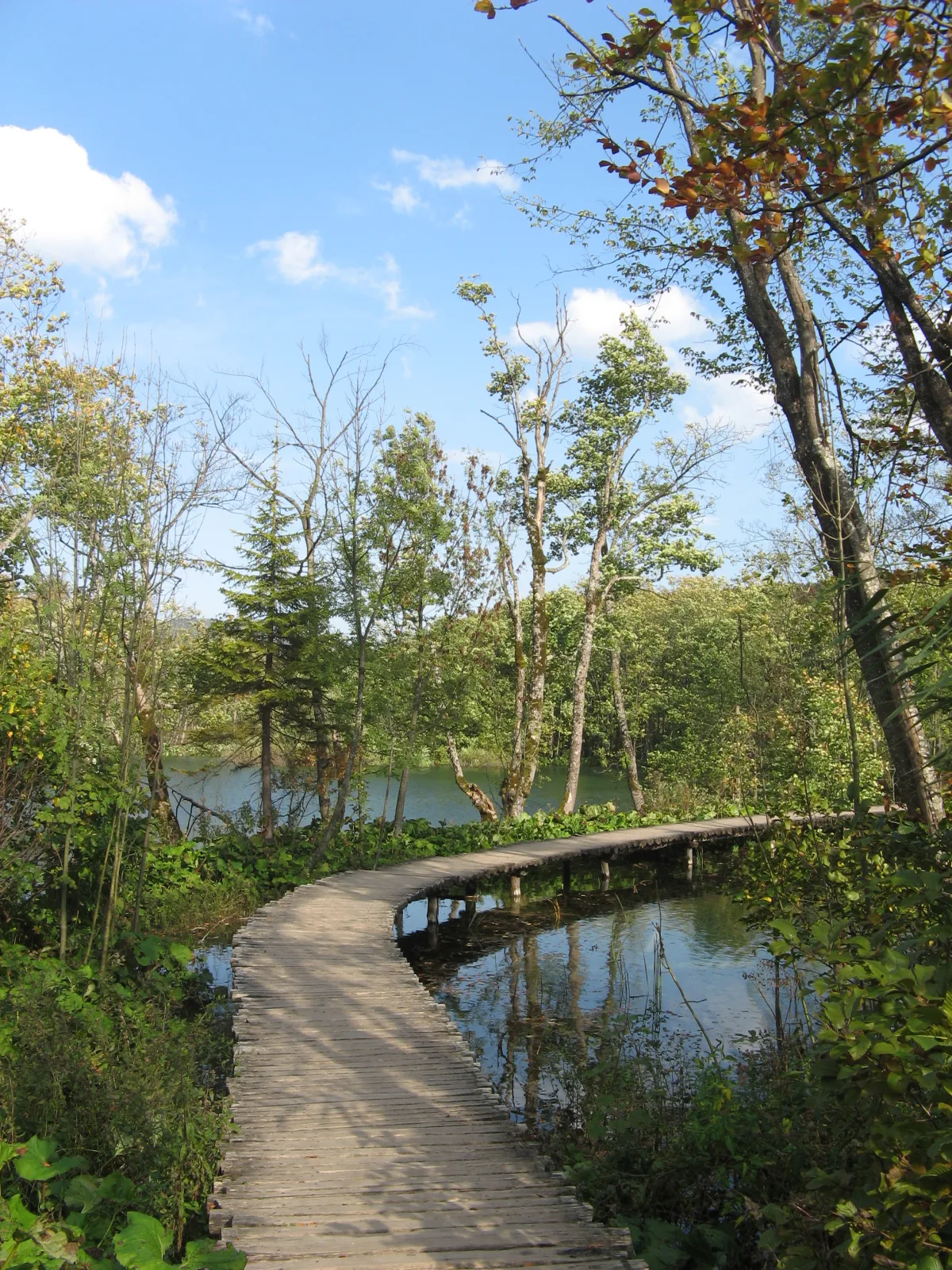
Photo: Someone35, Wikimedia Commons, CC BY-SA 3.0.
The official 2026 Plitvice Lakes National Park price list confirms the September hook: from 1 September to 30 September, the adult one-day ticket in the June-to-September season is listed at €40 in price band A and €25 in price band B, with the note that in September price A applies until 15:00 and price B after 15:00. Student and child prices have their own bands, and discount eligibility requires valid documentation. The same official material says the ticket includes the electric boat and panoramic train within the selected sightseeing programme, visitor insurance and VAT. Online tickets must be validated at the chosen official entrance and within the purchased period; visitors found in a zone where the ticket is not active can be treated as being without a valid ticket.
That turns the saving into a timing puzzle rather than a pure bargain. Plitvice is not a city museum where a late ticket simply shortens the visit. The park is a long water-and-forest system with two main entrances, marked programmes, boat points, panoramic-vehicle stations and seasonal working hours. On the working-hours page checked for this publication, Entrance 1, Entrance 2 and the auxiliary Entrance 2 were listed as open 07:00–19:00, ticket sales until 16:00 and parking lots until 20:00. The short boat P1–P2 was listed 07:00–19:00 every 30 minutes, while the long boat P2–P3 was listed 08:00–17:00 and P3–P2 08:30–17:30. Panoramic vehicles had last listed services in the early evening, with different cut-offs by segment. Those hours can change by season, weather and operational notice, so the final check belongs on the park website, not in an old trip report.
The €15 saving is real, but it buys a smaller day
If you enter after 15:00 in September, the published adult ticket difference is €15. That is enough to matter on a low-cost Croatia trip. It may cover a simple meal, a chunk of a hostel bed, luggage storage, or part of a regional bus fare. But the park does not expand its internal transport day because you bought the cheaper ticket. A 15:00 entry places you close to the end of the long-boat window, not at the start of a relaxed loop.
For a first visit, the danger is not merely that you see fewer waterfalls. The danger is building an itinerary that depends on the long electric boat, a specific panoramic vehicle, a chosen entrance, and a return bus, then discovering that one part of the chain is already finished or impractical. If the late ticket pushes you into a taxi, an unplanned hotel night near the park, or a missed onward connection from Zagreb, the €15 saving disappears quickly.
A better way to price the choice is to ask what the extra €15 buys. A morning ticket buys hours: time to start from the correct entrance, follow a longer programme, pause for crowds on the boardwalks, wait out a shower, eat without rushing, and still leave before the public-transport buffer is gone. A late ticket buys money back only if your chosen route is short enough, the transport home is confirmed, and you accept that this is a compact visit rather than the classic full Plitvice day.
How to get there without turning cheap into expensive
Official access is by road. Plitvice Lakes National Park states that it can be reached by state road D429 from the Zagreb/Zadar direction and D52 from the Otočac direction. D429 passes the two main entrance and reception areas, Entrance 1 and Entrance 2. Both entrances have paid visitor parking, and bus stops are situated close to the entrances. The two main entrances are about 3 km apart, so choosing the wrong entrance is not a harmless detail when you are carrying a backpack and counting minutes.
For public transport, treat every timetable as date-sensitive. The park points travellers to Zagreb Bus Station and to Lika Line for current schedules. Lika Line’s official site presents county public bus transport in Lika-Senj County, timetable and ticket-price checking, and ticket purchase at sales points including Plitvička Jezera, from the driver or online. It also carried a notice that some routes changed from 1 August 2026. That is exactly the kind of small regional update that makes an old blog timetable dangerous.
From Zagreb, the day-trip version can work when you choose an early bus, enter the park in the morning and keep a conservative return buffer. It becomes fragile with a late-entry ticket because you may be arriving just as the useful long-route window is closing. From Zadar, Split or the coast, the same rule applies with more distance and more risk: verify whether a direct service exists on your actual date, whether the stop is Entrance 1 or Entrance 2, whether the return is late enough, and whether the operator sells tickets online or only through a station/driver arrangement. Do not present a sample fare from a booking screen as guaranteed unless you have checked it at booking time.
Driving solves the last-bus problem but creates a different budget line. The official price list checked for this article listed parking in the 01.06–30.09 period at €2 per hour for automobiles, €7 per day for motorcycles and €18 per day for campers, trailers and buses. A car can be good value for two to four travellers sharing fuel, tolls and parking, especially if they sleep outside the park or combine Plitvice with a coast-to-inland route. For one solo budget traveller, a car hired mainly to chase the late-ticket discount can easily cost more than a morning bus plan.
What to budget in September
Start with the park ticket, because it is the fixed official anchor. For adults in September, the relevant one-day figures are €40 before 15:00 and €25 after 15:00 under the published 2026 price list. Students were listed at lower rates with valid student identification, and children aged 7–18 had their own prices. Children under 7 and some visitors with disabilities are listed separately in the official tariff. Always check the current park page before buying, because price bands change outside September and group rules have their own reservation conditions.
Add transport next. A bus day trip needs the current fare in both directions, the booking fee if any, and the cost of reaching the bus station early. If you are using Zagreb Bus Station, buy through the official station/operator route where possible and keep the ticket terms visible. If you are using a local Lika Line segment, check the current timetable and whether online purchase, sales-point purchase or driver purchase is available for that route. If you drive, add fuel, tolls, parking by the hour, and the value of keeping the car longer than planned.
Add small but real costs: water and food if you do not want park-café prices to set your budget, a power bank so an online ticket remains available for validation, luggage storage if your operator or accommodation does not handle bags, and a weather layer. September can feel like shoulder season, but boardwalks, wet steps and sudden changes in service still punish the traveller who packed for a beach transfer.
Finally add the contingency price. If the last usable bus leaves before you finish, your choices may be a taxi, a room near the park, a reshaped onward itinerary or a long wait. A cheap ticket that increases the chance of that outcome is not a cheap trip. This is why some travellers should willingly pay the €40 morning price: it buys enough slack to avoid the expensive fix.
When the after-15:00 ticket makes sense
The late ticket can be good value if you are already sleeping near Plitvice, especially in villages or accommodation that let you walk, take a short local ride or park without a long intercity return deadline. In that case the €25 entry can become a pleasant shoulder-season afternoon visit, followed by a night nearby and perhaps a morning bus onward. It also works for repeat visitors who know exactly which shorter section they want to revisit and are not trying to complete a long programme.
It can also work for road-trippers who arrive from the coast or Zagreb after lunch and treat the park as a compact afternoon stop, not as the main all-day attraction. The car must still be budgeted honestly: parking continues, fuel and tolls count, and a tired evening drive on unfamiliar roads is not a saving if it becomes unsafe. Build in time to exit before dark, especially if weather is poor.
The late ticket is weakest for first-time public-transport day-trippers from Zagreb who want the full park experience and a same-evening return. It is even weaker for travellers trying to connect onward to Split, Zadar, Rijeka or an island ferry the same night. One delayed bus, one crowded entrance queue, one missed boat or one wrong entrance can collapse the plan. If your whole day depends on everything running perfectly after 15:00, you are not buying a bargain; you are buying risk.
Entrance choice and route discipline
Entrance 1 and Entrance 2 are not interchangeable once the clock is tight. The park’s own access information notes that D429 passes both main reception areas and that the entrances are about 3 km apart. With a morning ticket, that mistake is annoying. With an after-15:00 ticket, it can determine whether you make the long boat or the correct panoramic-vehicle segment.
Choose the sightseeing programme before you buy. Match the online ticket to the selected official entrance and time period. Save the ticket offline and keep enough battery to show it. If the official website reports trail closures, altered boat service or seasonal reductions, choose a shorter open route instead of trying to force the route described in a summer guide.
A practical late-entry plan should look boring on paper: arrive before the entry window, know the exact entrance, keep the internal-transport cut-off visible, avoid a route that requires the last long boat in the wrong direction, and leave time to reach the bus stop or car park. The beautiful part happens after that. The budget part is making sure the beauty does not strand you.
Rules that budget travellers should not bend
Plitvice is a protected national park, not an open swimming hole. The official rules prohibit swimming in the park zone, fires, fishing and camping. Dogs must be on a leash, and the park’s ticket information says dogs must also stay leashed on boats and trains. Remotely controlled aircraft for filming from the air are banned. Cycling is forbidden where park rules indicate restrictions. These rules are not optional ways to save time or money.
Do not try to bypass ticket validation, enter a zone outside the purchased period, ride without the correct ticket, sneak onto closed paths, or ignore staff instructions. Apart from the obvious legal and safety issues, rule-breaking is bad budgeting: fines, removal from the route, lost time and travel disruption cost more than a properly planned ticket.
Weather deserves the same respect. Rain can slow boardwalk movement, make stairs slippery and trigger temporary route changes. Colder-season services and facilities may be reduced, and the park warns that opening hours vary by season. September is often more comfortable than high summer, but it is not a guarantee of full operating conditions. Recheck the park alerts and working-hours page on the travel day.
The budget decision tree
Choose the €40 morning ticket if Plitvice is the main point of the day, if this is your first visit, if you are travelling by bus from Zagreb or the coast, if you want a longer programme, or if your return transport is not very late. The higher ticket price is often the cheaper total plan because it reduces the chance of a taxi, emergency room or missed connection.
Choose the €25 after-15:00 September ticket only if at least one of these is true: you are staying nearby, you have a car and a safe exit plan, you want a deliberately short route, you have already confirmed the return connection, or you are prepared to treat the visit as a preview rather than a full-day exploration. The ticket is not a magic discount; it is a lower price for a shorter usable window.
Sleep near the park if the transport math is awkward. A simple room outside the entrance zone can be cheaper than forcing a return taxi or wasting a paid long-distance connection. It also lets you use the late ticket calmly or buy a morning ticket the next day. Compare the room cost with the true cost of uncertainty, not only with the €15 ticket difference.
Final check before buying
Before you buy, open the official Plitvice price list and confirm the September time band. Open the working-hours page and note the long boat, short boat and panoramic-vehicle times for the current season. Open the how-to-get-here page and confirm whether your bus stop and entrance match. Check Zagreb Bus Station, Lika Line or the relevant operator for your exact travel date. If driving, check parking rates and allow for hourly charging. If you need Croatia/Schengen entry permission, insurance or onward-ticket documents, verify them through official sources for your own nationality and route.
The conclusion is simple: the September after-3 p.m. Plitvice ticket can be a smart budget move, but only after the route, entrance, internal transport and ride home are already checked. For many first-time day-trippers, paying more for morning entry is not wasteful. It is the cheapest way to buy time, reduce risk and keep Plitvice from turning a €15 saving into the most expensive mistake of the Croatia leg.
Comments
Sign in to comment.
No comments yet.