Storm Austen in Devon and Cornwall: a budget weekend plan for October 23–25
Storm Austen is changing rail, road and coastal plans across Devon and Cornwall. Here is how to decide whether to postpone, how to reach the South West if you still travel, and how to protect a low-cost weekend budget from cancellations and unsafe detours.

Storm Austen is due to bring its most disruptive weather to south-west England from Thursday night into Friday, October 23. The Met Office has issued an amber wind warning for Cornwall, the Isles of Scilly, Devon and Plymouth from 03:00 to 10:00 BST on Friday, with a wider yellow warning covering more of the region. Gusts of 60–70 mph are possible widely, with stronger gusts around exposed headlands, alongside heavy rain and difficult travel conditions.
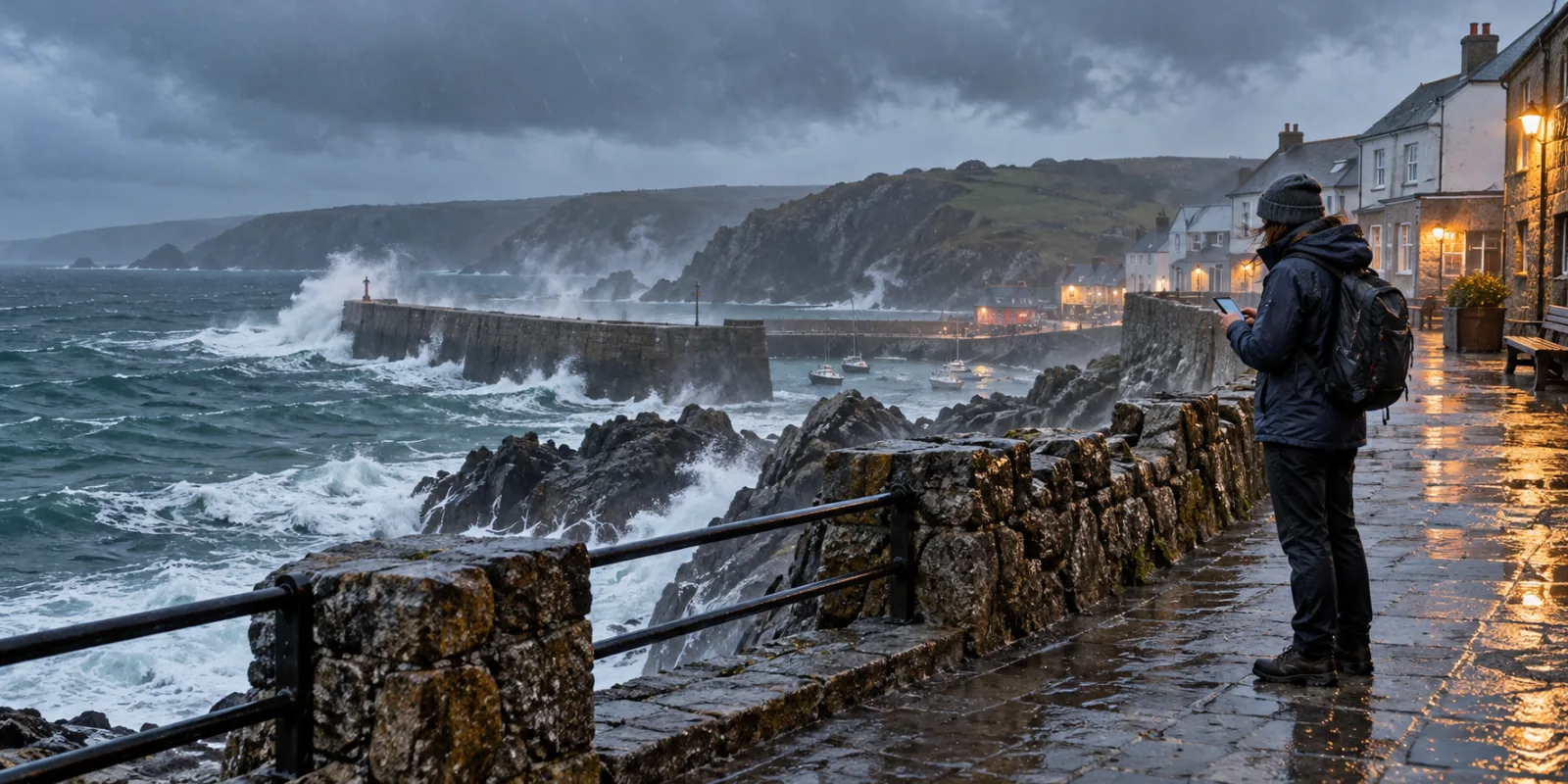
That matters to a budget traveller because the cheapest-looking plan is often the least resilient one: a non-refundable room on the coast, a tightly timed train connection, a last bus to a rural village and a return ticket that cannot easily be moved. This weekend needs a different calculation. The first question is not where to find the lowest fare. It is whether the trip still works after a cancellation, a closed coastal road or a day spent indoors.
The practical advice below is for people considering Devon or Cornwall between Friday, October 23, and Sunday, October 25. It is based on the warnings and transport notices available on October 22. Conditions and timetables can change quickly, so check the Met Office, National Rail and the relevant operator immediately before leaving.
What is changing on Friday
The Met Office describes Storm Austen as a spell of very strong north-westerly winds and heavy rain. Its amber warning says that longer journeys and cancellations are likely, and that some roads and bridges may close. Coastal roads, exposed railways, ferry services and minor roads are especially vulnerable. The warning also notes the possibility of flying debris, power cuts and dangerous waves.
This is not a prediction that every service will stop. It is a warning that the normal timetable is no longer a reliable planning assumption. A route may technically remain open while taking much longer, operating with fewer departures or requiring a replacement bus. A cheap ticket is not a saving if the journey ends after the last local bus or forces an emergency taxi across a county.
Network Rail and Great Western Railway have already announced amended services for Devon and Cornwall on Friday. Lower speed limits will apply on affected routes between the start of service and 13:00, meaning fewer trains and longer journeys. The announced long-distance pattern is London Paddington to Plymouth, with a local shuttle between Penzance and Plymouth. The Thursday night sleeper from London Paddington is due to terminate at Plymouth, and some early services may be cancelled while crews inspect the railway in daylight. CrossCountry has cancelled services between Penzance and Plymouth on Thursday and Friday.
Those details are operational information, not a promise that the timetable will remain unchanged. GWR says its amended timetable will be published through its journey checker and that updates will continue during Friday. If your train is cancelled, GWR says you can travel on the two trains immediately before or after the booked service, or claim a full refund if you decide not to travel.
The budget decision: postpone, relocate or continue
A useful way to decide is to put the weekend into one of three categories.
Postpone if your plan depends on a Friday morning arrival, a coastal walk, a ferry, a campsite, a cliff path or a same-day connection to the Isles of Scilly. The combination of an amber wind warning, heavy rain and possible closures makes those plans fragile. Postponing may cost a change fee, but it can still be cheaper than losing accommodation and then paying for a last-minute indoor alternative.
Relocate inland if your accommodation can be changed without a large penalty and you mainly want a short break rather than a particular coastline. Exeter is usually the most practical transport base in Devon because it has major rail connections, local buses and a larger supply of budget rooms than small coastal settlements. Plymouth can also work, but check the exact rail service before committing to a Friday arrival. The idea is to reduce the number of exposed road and bus legs, not to assume that an inland city is immune from disruption.
Continue with a flexible plan if you are already nearby, have refundable accommodation, can stay indoors during the worst warning period and are prepared to accept a slower journey. A flexible traveller can use Friday as a transport and museum day, then reassess coastal plans once the wind eases. Do not treat the clearing of rain as an automatic signal that cliffs, promenades, beaches or sea walls are safe.
The most important budget rule is to protect the return journey. Do not spend the entire contingency fund on reaching the destination. Keep enough for a room extension, a taxi to a safe rail or bus station, food during a delay and a replacement night if the last connection disappears.
How to get there without building in a failure
From London and the South East
The normal low-cost strategy is an advance rail ticket from London Paddington towards Exeter, Plymouth or Cornwall. For Friday, however, the ticket price should be checked alongside the amended timetable. A direct service may be less useful than a later departure with more connection slack, and a split-ticket itinerary can become awkward if one section is cancelled.
Use the GWR journey checker and National Rail before leaving for the station. Check the departure on the morning of travel rather than relying on a screenshot made when booking. If the operator offers a refund after cancellation, keep the booking reference and follow the stated process; do not buy a second expensive ticket before checking whether your original ticket can be accepted on another service.
If you are driving from London, allow more time than the map suggests and avoid planning a tight arrival around a coastal road. High-sided vehicles, caravans and vans are more exposed to gusts. Devon County Council is warning drivers about fallen trees, branches and debris, particularly on quieter roads where a hazard may not yet have been reported. A route that looks shorter through Dartmoor, Exmoor or a narrow coastal lane may be slower and less suitable than a main road.
From Bristol, Bath and South Wales
Rail and road connections from Bristol may be useful for Exeter, North Devon or Plymouth, but the same principle applies: check each leg, not just the first train. A journey planner can show a connection that is valid in normal conditions but leaves only a few minutes to change. During weather disruption, choose an itinerary with a substantial buffer and avoid the last departure of the day.
For North Devon, Barnstaple is the main public-transport gateway. It can be a sensible base for a revised trip, but do not assume that the final bus to an exposed village will run simply because the train reaches Barnstaple. Check the local bus operator’s live service information and ask your accommodation about the final walking route. Wet, windy darkness and an unlit lane are not a good place to discover that a taxi is unavailable.
From Cornwall and the Isles of Scilly
The Network Rail announcement is particularly important for travellers moving between Penzance and Plymouth. The local shuttle arrangement and CrossCountry cancellations mean that Cornwall is not behaving like a normal through-route on Friday. If you are in Penzance, St Ives, Newquay or a smaller coastal town, confirm the onward connection before leaving your accommodation.
The Isles of Scilly require an even more conservative decision. Flights and ferries can be affected by wind, and a cancelled crossing can strand a traveller beyond the dates of a cheap room or return ticket. Do not book a mainland connection immediately after a scheduled ferry or flight. If you are already on the islands, follow the operator’s instructions and do not make an independent coastal transfer plan based only on the published timetable.
A realistic low-cost budget
There is no single fare that can be presented as the price of this weekend. Rail tickets, rooms and local transport vary by departure point, booking time and availability, while weather disruption can remove the cheapest options. Instead, use a planning envelope and confirm live prices before paying.
For a solo traveller using rail, a modest Devon weekend might need roughly £170–£300 before long-distance transport from outside the South West. A simple room or hostel bed can consume around £35–£80 per night when available; food can be kept near £25–£40 per day with a supermarket breakfast, a packed lunch and one inexpensive hot meal; local buses and short urban journeys may add £10–£25 per day. Add the actual rail fare and a contingency of at least £50–£100 if the trip is weather-sensitive.
For two people sharing a basic room, a three-day Exeter or Plymouth plan might fit a rough local budget of £120–£210 per person before the main rail fare. That estimate assumes a shared room, inexpensive meals and limited paid attractions. It does not include a last-minute taxi, a non-refundable booking loss or a compulsory extra night. If your available budget cannot absorb one of those events, the trip is too tightly priced for this warning period.
A car can look cheaper when shared, but calculate the full cost: fuel, parking, possible overnight parking, tolls, and the price of being forced onto a longer route. In a storm, the car also carries a time risk. If a road closes, the extra cost may be measured in hours rather than miles. Avoid assuming that a rental car is a rescue option; driving in severe wind is itself a safety and availability issue.
The cheapest flexible adjustment is usually to remove one moving part. Stay two nights in one transport-connected town instead of changing accommodation, use one indoor attraction instead of several distant stops, and buy food near the accommodation rather than depending on a café at a coastal landmark. A lower-quality itinerary that still runs is worth more than a scenic itinerary that requires four perfect connections.
Where to base a revised weekend
Exeter: the most practical fallback
Exeter is a strong choice if the priority is keeping transport and accommodation manageable. It offers a city centre, museums, cafés, supermarkets and indoor alternatives within reach of the main station. That makes it easier to spend Friday out of the worst weather without paying for a full programme of taxis.
A sensible Exeter weekend would keep Friday local, use Saturday for a short day trip only after checking conditions, and leave Sunday morning flexible for the return. The city is not a guarantee of normal rail service, but it reduces dependence on a single exposed coastal road or a late rural bus.
Plymouth: useful, but check the Friday rail plan
Plymouth can work for travellers who already have accommodation there or who are approaching from the west. It has museums, historic sites, cafés and a large urban area, so a stormy day does not have to become an expensive emergency. The difficulty is the Friday rail arrangement: the Network Rail notice says long-distance services will run between London Paddington and Plymouth, while local services will shuttle between Penzance and Plymouth. Confirm the exact departure and stopping pattern before travelling.
Do not use Plymouth as a reason to walk the waterfront during the strongest winds. Promenades, harbour edges and exposed sea fronts can be dangerous even when the rain looks moderate.
Coastal villages and national parks: save them for the stable window
Devon and Cornwall are attractive precisely because of their exposed coast, cliffs, moorland and walking routes. Those features are poor value during an amber wind warning. A cancelled bus can strand you, a path can become slippery or blocked, and the most photogenic viewpoint may be the most hazardous place to stand.
If you still want a rural day, choose a route with several exits, daylight, mobile coverage and a nearby indoor fallback. Check the land manager or attraction directly for closures. Do not cross barriers, enter closed paths or substitute a beach walk for a cancelled activity without checking the conditions.
A safer itinerary for October 23–25
Friday, October 23: Treat the morning as a disruption window. Travel only if the operator confirms the service and you have a backup. Once in Exeter or Plymouth, stay within the urban area. Use museums, historic interiors, cinemas, libraries, cafés or a covered market rather than planning an exposed coastal walk. Keep your phone charged and carry a power bank because the Met Office warns that power cuts may affect other services, including mobile coverage.
Saturday, October 24: Recheck the warning, local road reports and the return timetable. If wind has eased and a local operator confirms service, choose one short outing rather than a chain of connections. Leave a large buffer before the final train. If the weather remains unsettled, keep the day in the base town. The Met Office has warned that the weekend may remain wet and windy even after the main storm passes, so Saturday is not automatically a clear-up day.
Sunday, October 25: Make the return the day’s main task. Avoid an itinerary that requires a coastal bus, a long walk and a train connection before a fixed departure. If your return is important, travel earlier and treat any sightseeing as optional. Check for engineering works and weather changes before leaving the accommodation.
What to pack when the forecast is part of the itinerary
A budget storm plan needs ordinary items that prevent small delays becoming expensive. Pack waterproof outer layers rather than relying on an umbrella, shoes with a secure grip, a dry bag or plastic pouch for tickets and electronics, a power bank, medication, water and a small amount of food. Carry a physical note of your accommodation address and the next confirmed connection in case your phone loses signal or power.
If you are driving, clear windscreen visibility is essential and a full tank gives more options during diversions. Do not stop under trees, beside unstable walls or close to the sea to take photographs. Devon County Council specifically warns about branches and debris on minor roads, while the Met Office advises people to stay away from dangerous waves and cliff edges.
The RNLI’s advice is direct: keep a safe distance from the water, do not enter the sea to rescue another person, and call 999 or 112 and ask for the Coastguard if someone is in trouble. A storm is not a good time to test a shortcut along a sea wall or harbour arm.
Refunds, changes and evidence
Before travelling, save the operator’s disruption page and the accommodation’s cancellation terms. If a train is cancelled, take a screenshot or note the service number and follow the railway’s refund or acceptance instructions. If a hotel offers a date change, ask for the confirmation in writing. Travel insurance may cover some losses, but weather warnings, operator cancellations and voluntarily abandoning a trip can be treated differently, so read the policy rather than assuming it will pay.
Avoid buying a replacement ticket until you know whether the operator will accept your original ticket on the next available service. Keep receipts for necessary costs, but do not assume that every meal, taxi or extra night will be reimbursed. If you book a separate attraction, choose a refundable or changeable ticket where possible and verify its opening status on the day.
The decision in one sentence
For Friday, October 23, a Devon or Cornwall trip is workable only when the accommodation is flexible, the route has slack and the main activity does not depend on the coast. If your weekend requires a ferry, a cliff walk, a rural last bus or a tight train connection, postponing is likely to protect more money than trying to force the original plan through Storm Austen.
All figures in this guide are planning ranges, not live quotations. Fares, rooms, warnings and train arrangements can change after publication. Check the latest Met Office warning, National Rail journey information, GWR updates, local road information and attraction notices immediately before departure.
Related articles

A robotaxi map is not a service
Tesla’s Miami geofence and Waymo’s standing-water recall show that the real robotaxi race is no longer about drawing bigger maps. It is about proving the operating domain.


A G3 Storm Has Already Hit: How to Use FT8 and WSPR to Measure the October 11 HF Recovery
NOAA recorded G3 geomagnetic activity on October 10 while CME effects continue into October 11–12. Here is a controlled way to use FT8, WSPR and ordinary band checks to separate ionospheric change from station problems.

A Glancing CME Is Due on October 2: How HF Operators Can Test the Path Without Blaming the Antenna
NOAA’s October 2 outlook points to a possible G1 disturbance from the flank of a September 28 CME. Here is a disciplined way to use FT8, WSPR, band reports and your own logs to separate a changing ionosphere from a station problem.

Solar flux 101, low Kp: what August 7 space weather means for FT8 and JTDX operators
A practical HF diagnostic workflow for a quiet but not high-margin propagation day: read the NOAA numbers, check spots, then decide whether the antenna or software really needs attention.

Comments
Sign in to comment.
No comments yet.