West Coast Trail on a budget: price the permit, ferries and Nitinaht water taxi before Vancouver Island
A practical cost-first guide to the West Coast Trail, where the cheapest plan starts with official reservations, boats and weather buffers.

A cheap West Coast Trail plan can fail before the first ladder. The official permit is not the whole bill, and the trail is not a coastal path where a late arrival can simply wait for the next opening. For the 2026 season, Parks Canada describes the West Coast Trail as a reservable 75 km backcountry route in Pacific Rim National Park Reserve, normally taking six to eight days end to end, with official access at Pachena Bay, Balaats’adt / Nitinaht Village and Gordon River. That makes it a strong budget-travel candidate only if the reservation, orientation, ferry, water-taxi and trailhead-transport pieces are priced before flights or Vancouver Island lodging are bought.
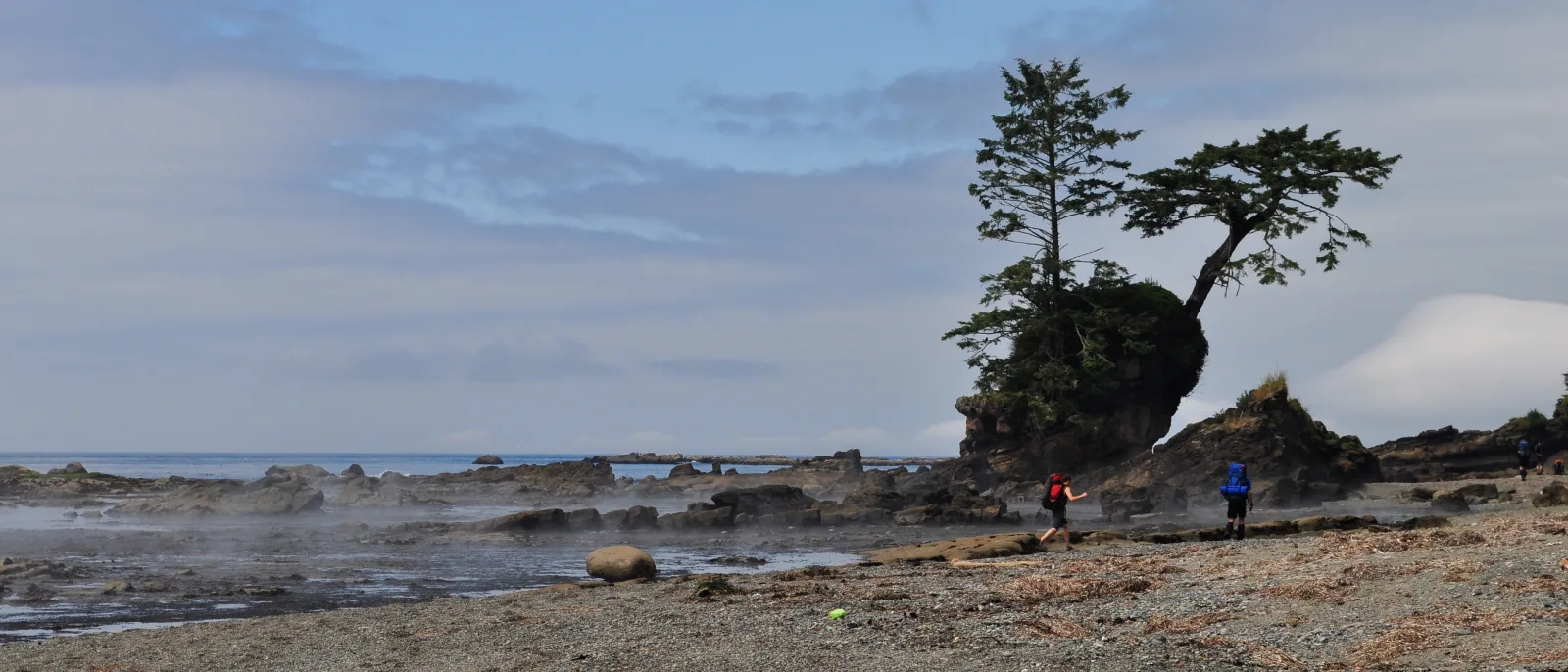
The official model: quota route, not walk-up shoreline
The West Coast Trail is open and reservable from May 1 to September 30 each year. Parks Canada’s 2026 reservation notice says reservations became available at 8 a.m. Pacific time on February 5, 2026, and that entries for Gordon River, Balaats’adt / Nitinaht Village and Pachena Bay can be booked online or through the call centre up to two days before departure. The important budget detail is the sentence many bargain hunters miss: standby spaces are no longer available, and all spaces are 100% reservable. If the right date is gone, a cheap ferry to Victoria or a non-refundable hostel bed will not create a legal trail slot.
The route is also governed by official entry and exit points. Parks Canada says hikers may start or finish at Pachena Bay in the north, Balaats’adt / Nitinaht Village at the mid-point, or Gordon River in the south; entry or exit elsewhere is not permitted unless evacuation is required. The Nitinaht Triangle is closed to guests. Carmanah Point and Pachena Point Light Stations and their surrounding grounds are closed to the public by Superintendent Order. A budget itinerary therefore cannot be built around an improvised shortcut, a beach landing, or a road access found on an old trip report.
This matters because the West Coast Trail is difficult even for experienced backpackers. The official description mentions more than 100 ladder systems, deep mud, fast-flowing rivers, cable cars, slippery roots and boardwalks, and rough West Coast weather. Parks Canada warns that help can take up to 24 hours to reach an injured hiker. The budget lesson is not to scare people away from a famous route; it is to stop treating low camping costs as permission to remove buffers. A too-tight plan can become expensive when a river is unsafe, a shuttle is missed, or a wet exit forces an extra night near the trailhead.
The mandatory cost stack
As checked for this article, Parks Canada’s West Coast Trail page shows an example fee table in Canadian dollars, taxes included, and says all fees are subject to change. The table lists a West Coast Trail Backcountry Use Permit of CAD 184.75 per person, an Orientation Fee of CAD 23.75 per person, and a reservation fee of CAD 11.50 per group when booking through the reservation service. Every hiker also needs a National Park Entry Pass or a valid Pacific Rim annual pass or Discovery Pass; youth receive free entry to Parks Canada places but still require the West Coast Trail permit. Those park-entry numbers should be checked on the current fee page before payment, especially around temporary admission programmes.
Ferry and water-taxi charges are the part that changes the shape of the budget. The official example lists the Gordon River ferry at CAD 28 per person where applicable and the Nitinaht Narrows ferry at CAD 28 per person where applicable. If using Balaats’adt / Nitinaht Village to enter or exit at Nitinaht Narrows, Parks Canada lists a one-way water-taxi fee of CAD 70 per person, paid in cash directly to the operator. In practical terms, a full Pachena Bay to Gordon River itinerary in the official example includes the permit, orientation, Gordon River ferry, Nitinaht Narrows ferry, reservation fee and park entry. A mid-point Nitinaht plan may have fewer food days, but it adds the water taxi and often an overnight positioning problem.
The cheapest honest calculation starts with the official charges, then adds transport to Vancouver Island, a way to reach the trailhead, food for a slow weather-adjusted pace, stove fuel, bear spray or rental gear if needed, one pre- or post-trail night where connections are fragile, and change or cancellation costs. It should not begin with a sample flight fare. Flight, ferry and bus prices fluctuate too quickly to publish as guaranteed bargains, and a low fare is irrelevant if it lands after the only workable briefing, bus or water taxi.
Three base scenarios before flights and lodging
For an end-to-end Pachena Bay to Gordon River plan, the direct official trail stack from the example fee table is CAD 23.75 orientation + CAD 184.75 permit + CAD 28 Gordon River ferry + CAD 28 Nitinaht Narrows ferry + CAD 11.50 reservation fee per group + park entry. A solo hiker should budget the group reservation fee as their own; two hikers split it. Before transport, food or gear, one solo adult is already looking at roughly CAD 276 plus park entry if the current table still applies. This is not a luxury price, but it is not “just camping” either.
For a Balaats’adt / Nitinaht Village to Gordon River plan, the official example keeps the permit and orientation, includes the Gordon River ferry, drops the Nitinaht Narrows ferry line, and adds the CAD 70 water taxi from the village to Nitinaht Narrows. That produces roughly CAD 318 before park entry for a solo hiker if the table is unchanged and the group reservation fee is not shared. It can still save money by reducing trail nights and food weight, but only if the approach to Balaats’adt is inexpensive and reliable. Shorter is not automatically cheaper.
For a Balaats’adt / Nitinaht Village to Pachena Bay plan, the official example lists the permit, orientation and CAD 70 water taxi, without the Gordon River or Nitinaht Narrows ferry lines. The direct trail stack is roughly CAD 290 before park entry for a solo hiker if the fee table is unchanged. This may be attractive for a shorter northern itinerary, yet it still depends on the once-daily water-taxi pattern and on getting to a remote village with limited services. It should be priced as a remote logistics plan, not as a casual half-trail discount.
How to get there without letting transport eat the saving
Parks Canada’s page lists West Coast Trail Express as a transport option and says the bus from Victoria to the Gordon River orientation centre near Port Renfrew takes about two hours, while the bus to the Pachena Bay orientation centre south of Bamfield takes about 5.5 hours from Victoria or 3.5 hours from Nanaimo. It also notes bus service between Port Renfrew, Balaats’adt / Nitinaht Village and Bamfield on gravel logging roads. The operator’s own site says it runs shuttle bus service from May 1 to September 30 from Victoria and Nanaimo to trailheads and between trailheads, picking up and dropping off at Victoria, Sooke, Port Renfrew, Gordon River, Mesachie Lake, Honeymoon Bay, Nanaimo, Nitinaht, Pachena Bay and Bamfield.
Do not treat that as a promise for your exact day until you have checked the current operator schedule and booked around the permit. Parks Canada explicitly says it provides transport listings for convenience and that hikers make their own arrangements. For a no-car traveller, the budget sequence should be: choose likely entry and exit, verify reservation availability, verify bus or shuttle days in both directions, then book the permit and outside transport. Reversing that order is how a cheap backpacking trip acquires taxi, motel and rebooking costs.
A road-trip group has different economics. Splitting fuel and one vehicle can reduce per-person transport, and it makes arrival at Pachena Bay, Gordon River or the Nitinaht junction easier. It does not remove the official entry rules, orientation, ferries or water taxi. It may add parking, gravel-road wear, one-way repositioning and an extra night if the driver must collect a car from the wrong trailhead. The road-trip version is cheapest only when the group prices vehicle logistics honestly instead of pretending the car is free.
The Nitinaht water-taxi trap
The mid-point option is tempting because Parks Canada says most end-to-end hikers spend six to eight days in the backcountry, while entering or exiting at Balaats’adt / Nitinaht Village can shorten the journey by a few days. The budget appeal is obvious: less food, fewer nights, less time away from work, and perhaps less gear rental. The catch is the boat. Parks Canada says the Balaats’adt / Nitinaht Village Water Taxi makes only one scheduled trip each way per day between the village dock and Nitinaht Narrows: around 8:00 a.m. from the village to the Narrows and around 4:30 or 5:00 p.m. from the Narrows back to the village, depending on the page section consulted.
That timing changes the cost calculation. If you arrive at Balaats’adt after the morning boat, Parks Canada warns that an overnight stay may be necessary before the 8:00 a.m. departure. If you are hiking out to Nitinaht Narrows and miss the late-afternoon boat, the budget problem is not simply waiting ten minutes; it may become food, weather and accommodation risk. Add the CAD 70 cash water-taxi fee, the need to carry enough Canadian cash because there are no banking services in Bamfield, Port Renfrew or Balaats’adt / Nitinaht Village, and the lack of cell service at Pachena Bay trailhead and Balaats’adt / Nitinaht Village, and the “shorter” itinerary becomes a logistics puzzle.
A sensible budget traveller treats Nitinaht as a separate plan rather than a cheaper default. It works best when the shuttle, village arrival, briefing and boat line up cleanly, or when the group deliberately buys an extra night as a buffer. It works poorly when it is used to rescue a permit date that no longer fits the transport grid. The cheapest Nitinaht plan is the one that avoids emergency improvisation.
When to go: September can be cheaper, not safer
September is attractive because the West Coast Trail remains reservable through September 30, crowds may ease after peak summer, and some outside accommodation or transport demand can soften. But it is also a late-season coastal hike on Vancouver Island. Parks Canada’s page warns that prolonged heavy rain, strong winds, high tides, large waves and short days are reasons the trail is closed outside the season, and those hazards do not politely wait until October. The official advice to start at least five hours before sunset is more important as days shorten.
The current Parks Canada page also carries a date-sensitive notice about regular fees applying as of September 8, 2026 after Canada Strong Pass conditions around the preceding period. That notice is useful because it reminds budget travellers that national-park admission rules can change by date. It should not be treated as a permanent discount rule. Before paying, check the fee page for the exact current admission, camping and reservation terms, and check any temporary programmes by date rather than by memory.
Late September needs the most conservative budget. A plan with no spare night, no extra food, no flexible exit, and a fixed same-day flight from Victoria or Nanaimo after the trail is not cheap; it is brittle. If rain makes a crossing unsafe or an injury slows the group, an extra hotel and rebooked ticket can cost more than the original savings. If you can only afford the route by removing all buffers, choose a shorter Vancouver Island hike or wait for a better booking window.
Cancellation rules are part of the price
Parks Canada’s cancellation wording is budget-relevant. As checked for this article, if a reservation is cancelled 21 days or more before the departure date, the West Coast Trail Backcountry Use Permit, Orientation Fee and ferry fees are fully refundable, while the reservation fee is non-refundable and a cancellation fee applies. At 20 days or less, the permit and orientation fee are non-refundable; only ferry fees are eligible for refund, and the cancellation fee still applies. This is not financial advice, and the terms should be rechecked at booking, but it shows why waiting for a perfect flight sale after buying the trail slot can be expensive.
The safer order is to hold the whole chain in view: permit date, entry point, exit point, operator transport, ferry or water taxi timing, park entry, food, gear and return buffer. If one link is uncertain, choose a refundable outside booking or a later permit. Cheap travel is not the same as zero-flexibility travel.
Safety rules that protect the budget too
The route’s safety rules are not optional costs to optimize away. Parks Canada says all hikers need a permit, orientation and check-in even for day hiking. It strongly recommends that at least one person per group carry bear spray and know how to use it because of increased human-wildlife interaction reports. It notes that there is limited cell service in Bamfield and Port Renfrew and no cell service at Pachena Bay trailhead or Balaats’adt / Nitinaht Village. It also tells hikers to leave a trip plan with a responsible person and to follow the advice of Parks Canada staff, First Nation Trail Guardians or ferry operators in an emergency.
For a budget article, this belongs in the cost section because ignoring it often costs more. Bear spray, a tide-aware schedule, realistic food reserves and a dry pre-trail night are cheaper than a rescue, evacuation, missed boat or medical delay. The West Coast Trail is a place where being frugal means paying for the official structure that keeps the trip predictable.
Practical logistics block
How to get there: plan backwards from one of the three official access points. Gordon River is near Port Renfrew and is the easiest southern anchor from Victoria by listed shuttle. Pachena Bay is south of Bamfield and takes longer from Victoria or Nanaimo. Balaats’adt / Nitinaht Village is remote and depends on road transport plus the once-daily water taxi if you are connecting to Nitinaht Narrows. Check current West Coast Trail Express or other operator schedules before paying, and do not rely on standby trail spaces.
How much to budget: use the official fee table as the base, not as the total. At the checked rates, allow roughly CAD 276 plus park entry for a solo full-trail Pachena Bay–Gordon River stack, roughly CAD 318 plus park entry for Balaats’adt / Nitinaht Village–Gordon River, and roughly CAD 290 plus park entry for Balaats’adt / Nitinaht Village–Pachena Bay, before outside transport, food, fuel, gear, accommodation and buffers. Split the reservation fee if travelling as a group, but do not split per-person permit, orientation, ferry or water-taxi charges.
When to go: May to September is the reservable season, with 2026 reservations opened in February. June to August generally offer longer days and higher demand; September may feel quieter but brings shorter daylight, higher rain exposure and a harder penalty for missed connections. If your plan uses Nitinaht, the boat schedule should decide your travel day. If your plan uses a same-day return after exit, add a night unless you can afford to miss the connection.
Bottom line
The West Coast Trail can still be a budget trip in the honest sense: camping replaces hotels, a shuttle can replace a rental car, and a well-matched group can share some outside costs. It is not a bargain if the permit is priced alone. The frugal version is the one that books only after the official reservation, orientation, ferries, water taxi, entry pass, shuttle and weather buffer all fit. On this route, the cheapest plan is rarely the thinnest plan; it is the plan that avoids paying twice.
Photo: “Beachwalking. West Coast Trail, Vancouver Island, BC, Canada” by Darren Kirby, Wikimedia Commons, CC BY 2.0. Official trip rules and fees should be checked again on Parks Canada pages before paying because prices, reservations and transport can change.
Related articles
Los Angeles to Vancouver for $188: the fall budget works only if you price bags, rain and airport transit first
A cheap LAX-Vancouver fare can still make a useful autumn city break, but the real budget depends on Air Canada bag rules, YVR transit add-ons, hotel timing and Vancouver's wet-season backup plan.
Portal Bridge Cutover: A Budget Train Plan for New York, Newark and Philadelphia Trips in October 2026
Five weeks of rail changes around New York Penn can turn a cheap Northeast train trip into an expensive scramble. The practical move is to price the backup route before you buy the ticket.

A robotaxi map is not a service
Tesla’s Miami geofence and Waymo’s standing-water recall show that the real robotaxi race is no longer about drawing bigger maps. It is about proving the operating domain.

Los Angeles–Vancouver à 188 $ : le bon plan d’automne dépend d’abord des bagages, de la pluie et du trajet depuis l’aéroport
Un billet LAX–Vancouver à 188 $ peut ouvrir la porte à une escapade abordable, à condition de vérifier les règles de bagages d’Air Canada, le supplément vers YVR, les hôtels selon les dates et un plan adapté à la saison humide.
Comments
Sign in to comment.
No comments yet.