Fairphone Gen. 6+ in the US: the seven-year ownership test
Fairphone’s first official US phone pairs replaceable parts with support promised through 2033. Here is how its repair case, warranty, carrier limits and everyday compromises hold up before you spend $649.99.

Fairphone’s US debut is a promise you can test
The Fairphone (Gen. 6+) arrives in the United States with an unusually concrete proposition: pay $649.99 for a phone designed to be opened, repaired and kept through 2033. That is more meaningful than a vague appeal to sustainability. Fairphone lists the parts an owner can replace, the prices of several common modules, a support horizon and carrier limitations. Those details make it possible to judge the device as a purchase rather than merely applaud it as an idea.
There is an immediate qualification. Although Fairphone launched the Gen. 6+ on August 18, 2026 as its first officially sold smartphone in the US, its American product page showed both “Out of stock” and “Coming soon” when checked. The phone therefore has a US price and sales channel, but buyers should not assume it is ready to ship. The same caution applies to replacement components listed in the American store.
The sole US configuration has 12GB of memory and 256GB of storage for $649.99 before tax, shipping or accessories. A microSD card can add up to 2TB. Compared with the earlier Gen. 6, the Plus model moves from Qualcomm’s Snapdragon 7s Gen 3 to the Snapdragon 7s Gen 4 and from 8GB to 12GB of DDR5 memory. It ships with Android 16. Those are sensible upgrades, but not a transformation into a flagship-performance phone. Fairphone’s speed comparisons come from its own laboratory, while IT Pro recorded Geekbench scores of 1,284 for a single core and 3,661 for multiple cores—credible midrange results, not category-leading ones.
That distinction matters because $650 buys formidable conventional phones. Fairphone is not offering the most processor power, the thinnest chassis or the broadest camera system at that price. Its premium pays for a different arrangement of priorities: access to components, a removable battery, a long stated support period and an attempt to make repair an ordinary ownership task.
What “repairable” means here
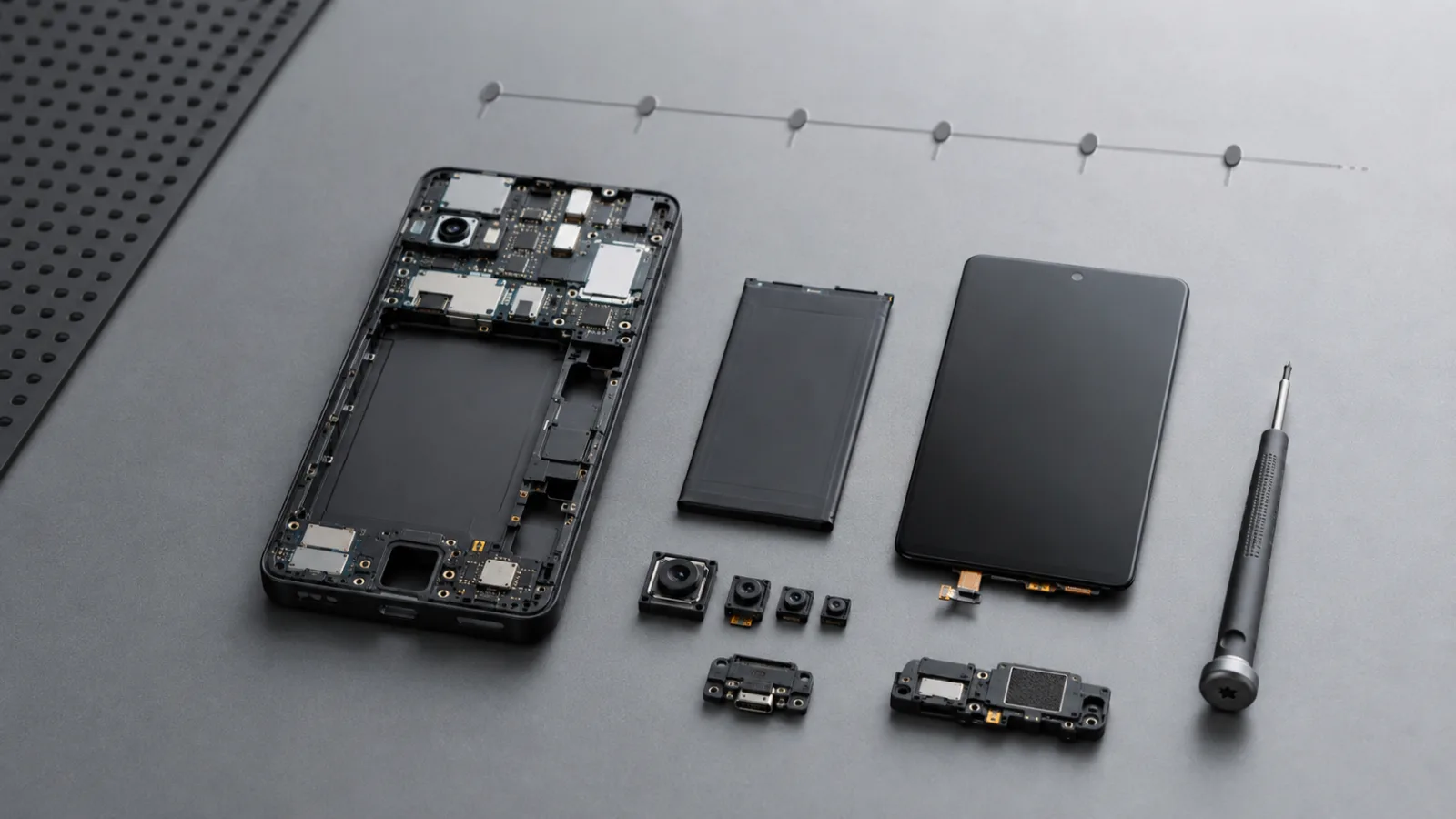
Fairphone advertises 12 user-replaceable parts, with a T5 Torx driver as the essential tool. This is not just a decorative back panel hiding a glued assembly. Ars Technica removed every user-serviceable module from a review unit in about 20 minutes, put the phone back together and had it working afterward. On the closely related Gen. 6, iFixit’s teardown awarded a 10 out of 10 repairability score.
That evidence establishes unusually easy access; it does not establish seven years of trouble-free ownership. The mainboard is not officially treated as a user-serviceable component, according to iFixit. A successful teardown by an experienced reviewer also does not guarantee that every owner will feel comfortable handling connectors and small screws. Most importantly, a repair-friendly design only delivers its full value when compatible parts remain obtainable at a reasonable price.
At least the initial US catalog makes the economics visible. It lists a Gen. 6/Gen. 6+ battery at $39.99, a display at $89.99 and a USB-C port at $19.99. Those prices are low enough to change the decision that follows a worn battery, cracked screen or damaged charging socket. On many sealed phones, uncertainty about labor, adhesive and part pairing nudges owners toward replacement. Here, a $20 port or $40 battery can plausibly extend the useful life of a device that is otherwise still adequate.
But the catalog was not yet functioning as proof of fulfillment: all three individual part pages showed “Out of stock” and “Coming soon” when checked. Shipping and tax would also raise the final repair cost. The listings demonstrate intent, compatibility and starting prices. They do not prove that a battery will be on the shelf in 2031, much less that every module will be continuously available through 2033.
The 2033 commitment has several moving parts
Fairphone says both software support and spare-parts availability will continue through 2033. Its launch announcement also promises six operating-system upgrades. Taken together, those pledges address the two common ways an otherwise usable phone becomes obsolete: physical damage that cannot be repaired economically and software that no longer receives adequate maintenance.
They should still be read as forward-looking commitments, not as longevity already delivered. The company has to maintain updates, supplier relationships, inventory and distribution for years after this launch. There is also a discrepancy in Fairphone’s own public wording: a support-search result refers to at least seven Android version upgrades, while the launch material promises six. Because the underlying support page could not be directly verified, six is the defensible figure for now. Buyers should also avoid collapsing OS upgrades, security patches, firmware support and continued compatibility with third-party apps into one promise. Each can have a different timetable and a different practical effect.
The US warranty adds another layer, but it is not identical to the support period. Fairphone’s summary says Gen. 6+ devices purchased in 2026 can receive five years of total device coverage: two standard years plus a three-year extension. Registration is required for the extension. The battery has a separate total coverage period of three years and two months rather than the full five years.
That summary is useful, but Fairphone labels it non-binding and refers customers to its Legal Hub for governing terms. The readily fetched global legal document defines a European territory, so it should not be presented as the US contract. An American buyer should read the applicable US terms during purchase, register within the required window and retain confirmation. The difference between a seven-year parts pledge, years of software support, five-year registered device coverage and shorter battery coverage is not fine print; it defines who pays when something fails.
A practical seven-year buying test
The right question is not whether the Gen. 6+ can theoretically last until 2033. Any individual phone might be lost, damaged beyond economical repair or retired because its owner’s needs change. A better test is whether Fairphone has removed enough predictable failure points to make long ownership a rational option.
First, consider the battery. It is removable, inexpensive by smartphone-part standards and central to extending useful life. A 4,415mAh cell will inevitably lose capacity with use; being able to replace it without heat, solvents or a repair-shop labor bill is a substantial advantage. The listed $39.99 price is encouraging, though future stock matters more than today’s catalog entry.
Second, consider the display and charging port. These are common reasons to abandon a phone whose processor and cameras still work. User-accessible modules at listed prices of $89.99 and $19.99 respectively make repair proportionate to the fault. The owner still accepts the risk of doing the work, and professional help may remain the better choice for some people, but the design does not deliberately put routine components beyond reach.
Third, consider performance headroom. Twelve gigabytes of RAM and expandable storage are generous for a midrange Android phone. The Snapdragon 7s Gen 4 should be sufficient for communication, navigation, media, banking and ordinary productivity. Yet buyers with demanding games, sustained creative workloads or a habit of keeping hundreds of heavy browser tabs should not assume repairability compensates for limited processing performance. A phone that feels slow for its owner’s actual work can become functionally obsolete even when every component is replaceable.
Finally, consider whether the manufacturer’s support promises survive contact with reality. That cannot be settled at launch. Prospective owners can, however, preserve their options by confirming stock before ordering, checking part availability periodically and treating registration and purchase records as part of the product rather than administrative chores.
Check your US carrier before you buy
Network compatibility is the most consequential US limitation. Fairphone supports bring-your-own-device use on AT&T and T-Mobile, but it does not support Verizon or mobile virtual network operators that use Verizon’s network. The phone is not Verizon-certified and lacks LTE Band 13. This is not a minor coverage footnote that a software update can necessarily fix; Verizon customers should treat it as a reason not to buy.
Compatibility on the supported networks also needs scrutiny. AT&T Wi-Fi calling and some carrier features are unavailable. Support among AT&T-based virtual operators is only partial, so the host network alone does not guarantee service. On T-Mobile, Fairphone says standard cellular 911 calling was validated, while Wi-Fi emergency calling, real-time text and alerts were not tested in all conditions. T-Mobile also does not support eSIM on this phone, according to the US product page, despite the hardware supporting both nano-SIM and eSIM.
Before placing an order, a buyer should identify the network behind any virtual operator, ask that operator to check the exact model or IMEI, and confirm the features that matter at home and at work. Voice over Wi-Fi can be essential in buildings with poor reception. Emergency-service behavior and accessibility features are not conveniences to discover after a number has been transferred. A generous repair policy cannot offset a phone that is a poor match for its owner’s network.
Everyday hardware: capable, with visible compromises
The 6.31-inch LTPO OLED can vary its refresh rate from 10Hz to 120Hz, a combination that supports smooth motion without running at the maximum rate continuously. The removable battery has a capacity of 4,415mAh. Charging is rated at 27W, with a 30W peak, but there is no wireless charging. IT Pro’s looped-video test lasted 15 hours and 45 minutes. That is a useful standardized result, not confirmation of Fairphone’s claim of two days in mixed real-world use; signal strength, brightness, applications and idle time can alter endurance dramatically.
The rear camera system pairs a 50-megapixel main camera with a 13-megapixel ultrawide, while the front camera is 32 megapixels. Reviews illustrate why specifications alone cannot settle camera quality. IT Pro judged the system favorably. Ars Technica, by contrast, found slower capture and autofocus as well as flatter colors to be the main compromise. These observations can coexist: one reviewer may value restrained processing and acceptable daylight results, while another is more sensitive to missed moments and presentation. Anyone for whom children, pets, sports or quick street photographs are a priority should pay particular attention to capture speed rather than megapixel counts.
At 193g and 9.6mm thick, the phone is not exceptionally heavy, but it is chunky by current standards; IT Pro specifically called the body bulky. The extra thickness may be an acceptable consequence of modular construction and a removable battery, but buyers accustomed to slim devices should handle one if possible. There is no 3.5mm headphone jack, so wired listening requires USB-C hardware or an adapter.
The IP55 rating also deserves precise interpretation. It indicates protection against dust ingress and water jets, not immersion. Rain or a splash is a different risk from dropping the phone into a sink or pool. Owners should not infer flagship-style submersion protection from the presence of an IP rating, and a repairable design is not permission to expose the device to water deliberately.
Who should pay $649.99 for it?
The Gen. 6+ makes the strongest case for someone who intends to keep a phone for years, values control over routine repairs and uses AT&T or T-Mobile directly. For that buyer, replaceable high-wear components are not an abstract ethical benefit. They reduce the chance that battery degradation, a broken port or a cracked display will force a full-device purchase. Expandable storage and 12GB of memory further reduce pressure to upgrade prematurely.
It is less convincing for a Verizon customer, a person dependent on an unsupported carrier feature, or anyone seeking top-tier performance and photography for the money. It also asks early US buyers to tolerate uncertainty. At the time of checking, neither the phone nor the highlighted replacement parts could be treated as immediately available. A launch catalog is not the same thing as an established American logistics operation.
The price comparison with mainstream rivals therefore needs to include more than the box. A conventional phone may deliver a faster processor, stronger water resistance, wireless charging or quicker photography today. The Fairphone offers the possibility of spending modest amounts on specific repairs later. It would be misleading to calculate a single total cost through 2033 without assumptions about breakage, battery wear, labor, shipping, taxes and resale value. The honest advantage is optionality: when a common part fails, the owner has a published repair route that may cost far less than replacing the handset.
That optionality has conditions. Parts must actually remain in stock. Instructions and support must remain accessible. Android and security maintenance must arrive with acceptable reliability. Owners must register for the warranty extension and understand the battery’s shorter coverage. They must also be willing either to perform simple mechanical work or find someone who will. Fairphone has designed a credible framework for long ownership; execution over the next seven years will determine its value.
What to verify before ordering
Start with availability rather than the launch headline. Confirm that the phone is in stock, note the expected dispatch date and calculate the delivered price with tax, shipping, a charger or case if needed. If repairability is the reason for buying, inspect the US spare-parts store at the same time. The current module prices are attractive, but an unavailable part cannot complete a repair.
Next, verify service with the carrier, using the precise model or IMEI when possible. Ask specifically about Wi-Fi calling, eSIM, emergency features and any accessibility functions you rely on. Customers of virtual operators should confirm the underlying network and the operator’s own device policy. Verizon and Verizon-based service should be ruled out under Fairphone’s present guidance.
Then save the warranty terms that apply to the US transaction and complete the registration needed for the additional three years of device coverage. Do not assume the battery shares the full five-year term: Fairphone’s summary gives it three years and two months in total. Keep the receipt and registration confirmation somewhere that will remain accessible after a phone failure.
Finally, judge the hardware you will use every day, not only the parts you might replace later. The screen, storage options and memory are competitive; the processor is midrange. The phone is relatively thick, lacks wireless charging and a headphone jack, and carries an IP55 rating that does not cover immersion. Camera reviews differ, with capture speed and autofocus the most notable concerns. Those compromises are manageable for many people, but longevity is worthwhile only if the device suits them throughout that time.
The Gen. 6+ is important because it turns repairability from a protest against disposable electronics into a product sold through an official US channel. It offers unusually persuasive evidence that a modern smartphone can be opened and restored without specialist machinery. What it cannot yet offer is proof of 2033 outcomes. Buyers should treat the support horizon as a measurable commitment: valuable today, worth monitoring annually, and ultimately judged by updates delivered and parts shipped—not by the ambition of the launch alone.
Related articles
Android 17 may make bloatware harder to remove. Check this before your next phone
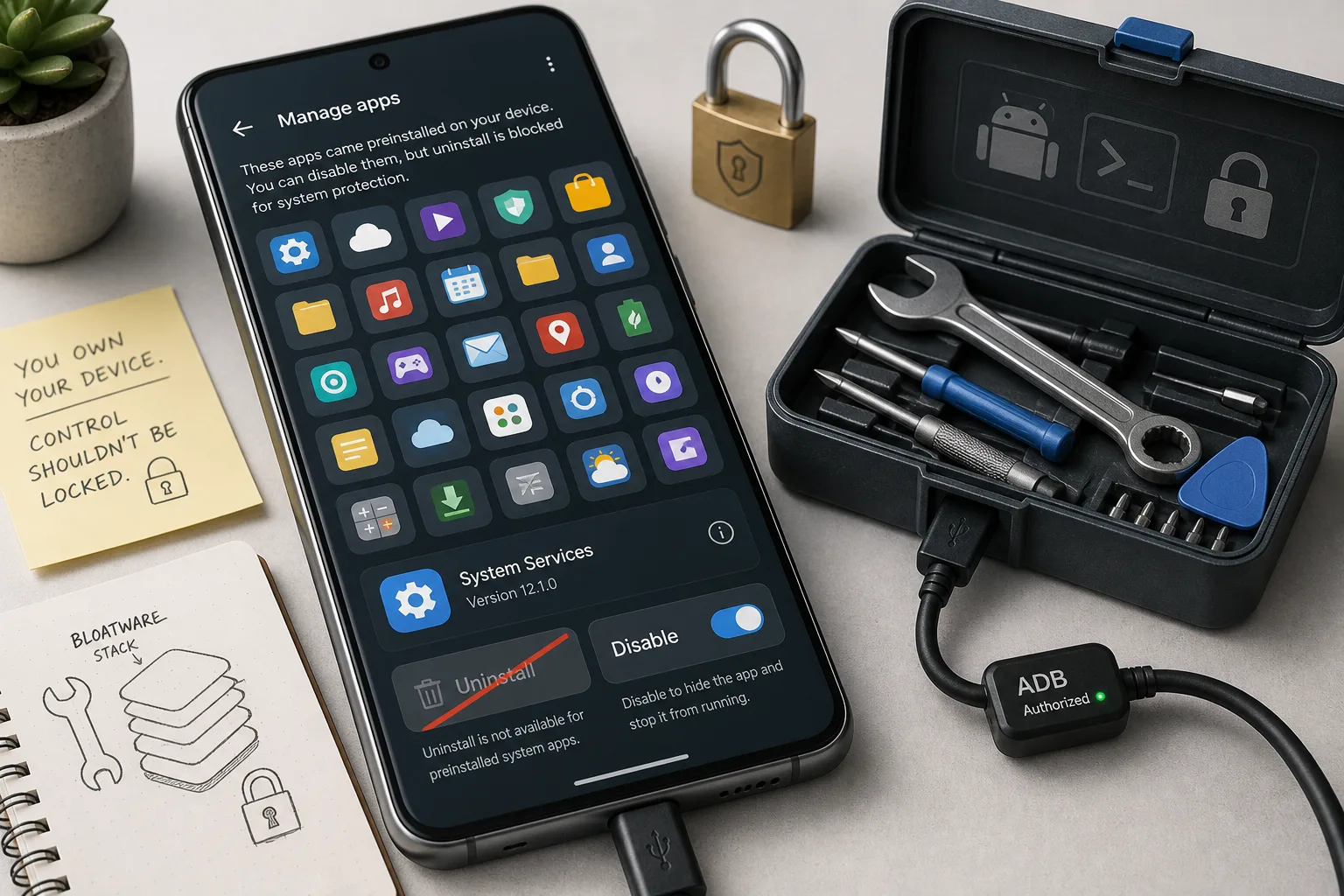
A reported Android 17 change weakens a long-running non-root debloating trick. For phone buyers, the practical question is no longer just specs — it is how much software control the device leaves you.
Android 17 усложняет борьбу с bloatware: что проверить перед покупкой телефона
Старый ADB-приём для удаления системных приложений без root может перестать работать в Android 17. Для покупателей смартфонов это вопрос не только настроек, а реального контроля над устройством.
Android 17 puede complicar la eliminación de bloatware: qué mirar antes de comprar un móvil
Un cambio señalado en Android 17 debilita un truco clásico de ADB sin root. Para quien compra un teléfono, el control del software empieza a ser tan importante como la ficha técnica.
Comments
Sign in to comment.
No comments yet.