Flock cameras show why smart security gadgets are no longer just cameras
Networked license plate readers are sold as practical safety devices. The backlash shows the real product is the database, access policy and governance around them.

A pole-mounted camera used to be a boring piece of municipal hardware. In 2026, a networked license plate reader is closer to a cloud gadget with a public-safety sales pitch, a subscription contract and a database behind it.
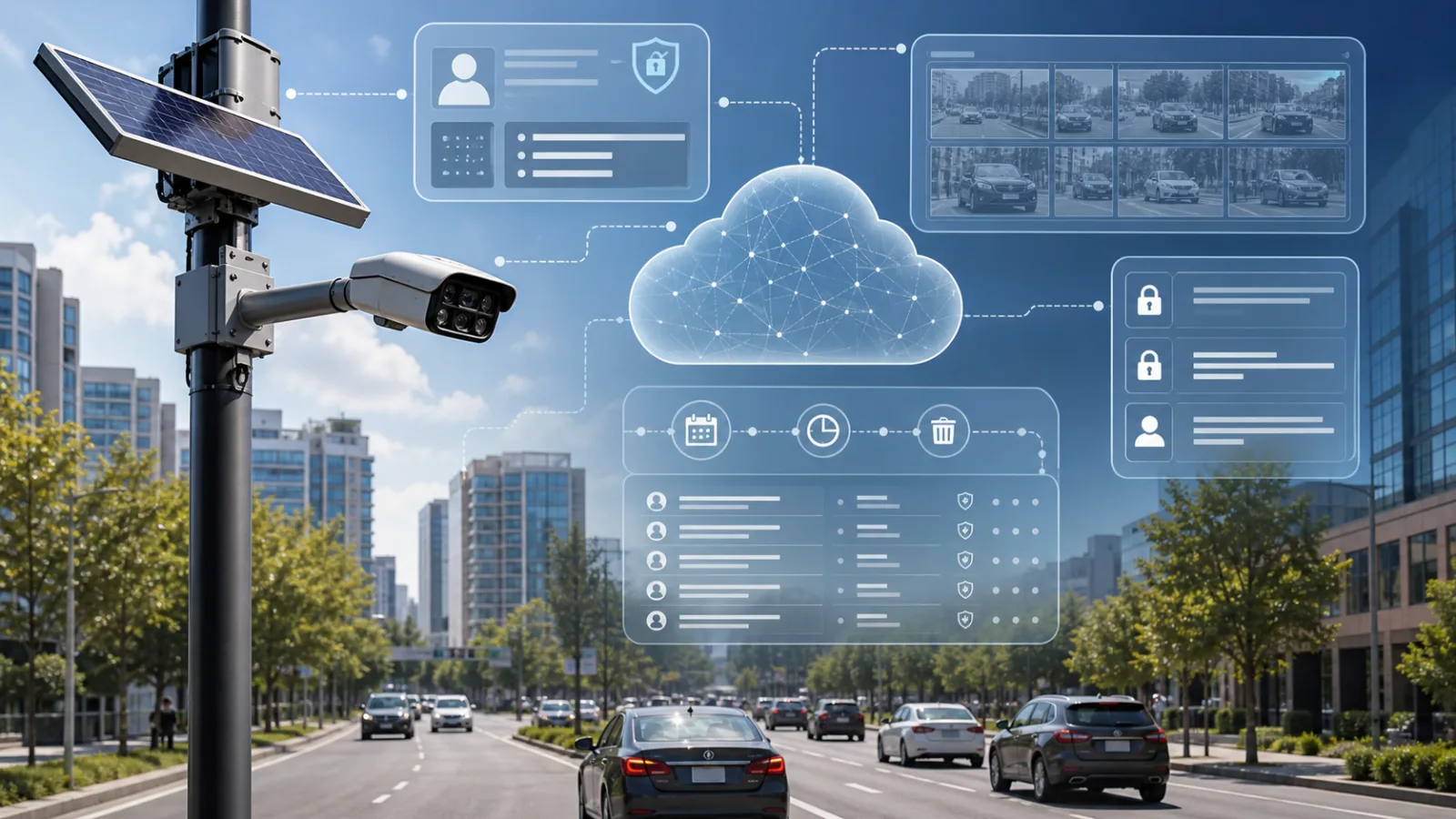
That is why the backlash against Flock Safety cameras matters for gadget buyers, not only for police departments and privacy lawyers. These devices are being sold to cities, schools, parking operators, apartment communities, homeowners associations and businesses as a practical security appliance. The hardware looks simple: a camera, a pole, solar power, LTE, night vision and software that reads plates. The product is not simple at all.
The buying decision is not really about the camera. It is about the database the camera feeds, who can query it, how long records live, what counts as a legitimate search, how abuse is audited and whether residents had a meaningful chance to say yes.
What the device does
Flock's own product page describes its license plate reader cameras as solar powered, LTE connected devices that can be deployed quickly and maintained as part of a subscription. The company says its fixed LPR network is used by 5,000-plus law enforcement agencies, 6,000-plus communities and 1,000-plus businesses, with billions of monthly plate reads.
The camera captures the rear of passing vehicles. It extracts the plate when possible and can also use vehicle details such as make, model and color. Flock advertises Vehicle Signature search, real-time alerts, hotlists, audit trails, transparency portals and a mobile app. Its FAQ says the cameras do not collect facial recognition or personal data, and that standard retention follows local LPR laws, with extended retention requiring governing approval when a customer wants more than the default.
That is the official version of the gadget: a focused vehicle-evidence tool. It is useful to police when a stolen car, missing person case or violent-crime suspect is associated with a vehicle. It is useful to private property owners who want alerts for known problem vehicles. It is cheaper and easier to deploy than a traditional camera network.
The critics' version starts in the same place and then asks a different question: if thousands of cameras record where vehicles pass, and if those records are searchable across jurisdictions, what is the practical difference between "vehicle evidence" and location tracking?
Why this is not ordinary CCTV
A conventional CCTV camera mostly records video. Someone has to know where to look, scrub footage and interpret the scene. It can still be invasive, but it is usually local and event-driven.
An ALPR camera turns movement into structured data. A plate read is a timestamp, a location, a vehicle identifier and often extra descriptors. That record can be searched later. It can be shared. It can trigger an alert. It can be combined with other cameras. It can outlive the moment when the car passed the pole.
That is the gadget shift. The value is not the image sensor. The value is the network.
Flock says its ALPRs "do not and cannot track vehicles, much less individual people," because they take point-in-time images on public roads. Privacy critics respond that enough point-in-time records become a path, especially when agencies can search many cameras or share data beyond a local boundary. Both claims can be technically true in their own frame. The device is not GPS. It also is not just a dumb camera.
For a neighborhood, campus or parking lot buyer, that distinction is the whole issue.
Why the backlash flared now
The Guardian reported on July 25 that it had identified at least 33 incidents of damage, vandalism or destruction of Flock cameras across 23 US states, many with anti-surveillance messages. The same report said Flock cameras operate in roughly 6,000 communities and scan plates billions of times each month. It also described a broader cancellation and rejection wave, with more than 80 cities disbanding, rejecting, not renewing or deactivating Flock contracts in recent years.
Do not read that as a how-to or as an endorsement of damaging equipment. It is a signal that the normal procurement process has failed in some places. When people believe a device watches public movement without public consent, the conflict stops being about specs.
Hacker News picked up the Guardian story, and the thread had 253 points and 151 comments when checked through the HN API. A second discussion around a St. Petersburg protest article had 150 points and 80 comments. Those threads were messy, but the recurring themes were clear: public safety, who owns public-space data, whether vandalism is civil disobedience, whether ubiquitous plate readers normalize surveillance, and whether a camera in public is different when it feeds a searchable vendor platform.
Local reporting adds the human version. Creative Loafing Tampa Bay wrote about a 77-year-old St. Petersburg resident who staged a solo protest in front of a Flock camera. The useful detail is not the stunt. It is that an ordinary resident saw a pole-mounted connected device outside his neighborhood and understood it as a private company's data collection point.
The case for the cameras
The pro-camera argument is not fake. Police departments like ALPRs because stolen vehicles and suspect vehicles move. A camera that can alert officers quickly may shorten an investigation or find a car that would otherwise disappear into traffic.
NPR's February reporting noted that police credit license plate readers with helping solve crimes, including high-profile cases. Flock says its products generate investigative leads, help recover stolen vehicles, locate missing people and support cases. For a city with limited staffing, a solar LTE camera that works without much local infrastructure is attractive.
Private buyers see a similar pitch. A business with a parking lot wants evidence after thefts. A gated community wants alerts for cars associated with burglaries. A school wants to know if a threatening vehicle appears near campus. In those contexts, a networked camera looks like a practical device that reduces friction.
The question is not whether the camera can help. It can. The question is whether the governance around it matches the power of the network.
The case against the cameras
The privacy argument is also not theoretical.
NPR reported that one main issue in city debates is who can access local camera data. Flock told NPR that each customer controls if, when and with whom information is shared, and that records show which agency initiated a search and for what purpose. But NPR also reported that some city officials later realized their data had been shared more broadly than they understood, including searches by federal agencies such as US Border Patrol. Flock said it had strengthened sharing controls, oversight and audit capabilities.
That is exactly the kind of problem a buyer should care about before signing a contract. A setting that looks like a checkbox in a dashboard can become a civic decision about immigration enforcement, protest monitoring or cross-state policing.
404 Media has reported on misuse concerns around Flock systems, including officers arrested after using Flock-related access to stalk people, and on FreeForm-style searches that can look for people or vehicle features rather than only a plate number. Flock disputes the "mass surveillance" framing and says misuse is a small fraction of activity across thousands of agencies. Even if misuse is rare, a connected camera product has to be judged by what happens when an authorized user behaves badly.
A home security camera can be unplugged. A neighborhood plate reader watches everyone who drives by, including people who never joined the HOA meeting, never read the contract and never opted into the database.
The buyer checklist
If your city, school, apartment community, business park or HOA is considering an ALPR camera, do not start with resolution, solar panels or installation time. Start with data.
Ask who owns the records. The vendor? The customer? The public agency? Can the vendor use the reads for product improvement or network features? What happens to data after cancellation?
Ask the retention period. Is it 14 days, 30 days, a year, or whatever local law permits? Who can extend it? Does an elected body or board have to approve a longer period?
Ask about sharing defaults. Is local data shared only with named nearby agencies, with a statewide network, with a national network, or with private customers? Can federal agencies query it? Are third-party requests logged and visible?
Ask what a search requires. Does a user need a case number? A stated purpose? Supervisor approval? Can they search by partial plate, vehicle color, make, model, bumper sticker, clothing description or natural language? Are broad searches blocked?
Ask how audit logs work. Who reviews them? How often? Are suspicious searches flagged automatically? Are audit results published? What happens when an employee misuses access?
Ask about false positives. What is the error-handling process if a plate read is wrong? Can an alert lead directly to a stop, or must an officer confirm the plate and context? Is there a public record of mistakes?
Ask about signage and notice. Will residents and visitors know the cameras are present? Will the locations be public? If the argument is that the camera deters crime, secrecy should need a strong justification.
Ask about cancellation. Can the customer remove the hardware promptly? Who owns the pole, solar panel and camera? What happens if the vendor objects or delays removal?
Ask for metrics. How many stolen vehicles recovered? How many serious cases solved? How many searches? How many external searches? How many false alerts? How many complaints? If the only evidence is a sales deck, slow down.
What private communities often miss
The hardest cases may not be city police contracts. They may be semi-private spaces: HOAs, apartment complexes, schools, retail lots, hospitals, office parks and gated roads.
These buyers can treat ALPR as a security gadget. The decision may happen in a board meeting with a small turnout. The people captured by the device may include delivery drivers, visitors, tenants, parents, employees and passersby who have no voice in the purchase.
That does not automatically make the device unacceptable. It does mean the buyer has obligations beyond "does it work?" A camera at the entrance of an apartment complex can reveal work schedules, medical visits, romantic relationships, religious attendance or political activity. Not because the device knows those facts by itself, but because location records become meaningful when someone asks the wrong question.
If a board wants to buy the camera, it should publish the contract, data policy, retention period, sharing list, audit process and complaint path before installation. Residents should not learn the rules by spotting a new black pole at the entrance.
What not to do
Do not damage cameras. It creates legal risk, may escalate local policing and gives vendors an easy way to turn a governance debate into a property-crime story. The practical route is less cinematic and more useful: contracts, public meetings, records requests, policy changes and measurable limits.
Do not accept "it only sees cars" as a complete answer. Cars are how people move. A vehicle database can expose people even if the camera never sees a face.
Do not accept "it is in public" as a complete answer either. Public visibility and mass searchability are not the same. A stranger seeing your car once is different from a vendor platform storing every pass for later queries.
Do not buy a connected security device without knowing the network behind it. Doorbells, dashcams, parking cameras and ALPRs all sit on the same curve: the device is cheap; the database is the product.
A better way to evaluate smart security
A good ALPR deployment, if a community chooses one, should be boringly governed. Narrow purpose. Short retention. Local default sharing. Strong audit logs. Public reporting. Clear signage. Independent review. No broad searches without a documented reason. No external agency access that surprises the people who approved the system.
That may sound like bureaucracy. It is actually the minimum viable product. Without governance, the camera is unfinished.
The Flock backlash is a gadget story because it shows what happens when a connected device crosses from convenience into infrastructure. People do not judge it by megapixels. They judge it by who can watch, who can search and who can say no.
Related articles

Ring TAKE makes smart cameras safer by default, but not fully private
Ring’s new encryption is a real improvement for ordinary homes, but owners still need to choose between cloud convenience, E2EE and local-first cameras.
Ring TAKE rend les caméras plus sûres par défaut, pas totalement privées
Le nouveau chiffrement de Ring améliore le quotidien, mais il faut encore choisir entre confort cloud, E2EE et caméras local-first.
Ring TAKE hace más seguras las cámaras por defecto, pero no totalmente privadas
El nuevo cifrado de Ring mejora la protección cotidiana, pero obliga a elegir entre comodidad cloud, E2EE y cámaras local-first.
Ring TAKE делает домашние камеры безопаснее по умолчанию, но не полностью приватными
Новое шифрование Ring — реальное улучшение для обычного дома, но владельцу всё равно придётся выбирать между облачным удобством, E2EE и локальными камерами.
Comments
Sign in to comment.
No comments yet.