iPhone Duo Preorders Open Today: The Foldable Ownership Checks That Matter Before Spending $1,999
Apple’s first foldable iPhone is now available to preorder, but the important decision is not whether the 7.6-inch screen looks impressive. It is whether you can accept the cost, care routine, accessory limits, and first-generation unknowns behind it.

Apple’s first foldable iPhone enters preorder today, October 16, with a starting price of $1,999 and store availability from October 23. The purchase looks familiar—choose storage, trade in a phone, add a case—but the ownership decision is different. The iPhone Duo is also a hinge, a flexible inner display, a dual-battery device, and a product whose long-term repair record does not yet exist.
Apple has published the important launch facts. It has not yet supplied the evidence that matters most after six months: how the hinge behaves around dust, how the inner panel ages, how much battery life changes under heavy use, and what an out-of-warranty display repair costs. That uncertainty should shape the preorder decision.
The Duo may be a useful computer for someone who repeatedly needs a phone-sized device to become a small tablet. It is a poor impulse purchase for anyone who mainly wants a faster iPhone, a better camera, or a premium phone that can be handled exactly like a conventional slab.
What is confirmed before ordering
Apple lists the iPhone Duo at $1,999 in the United States, with 256GB, 512GB, 1TB, and 2TB storage options. Preorders begin at 5:00 a.m. Pacific Time on October 16, 2026. Availability begins October 23 in more than 70 countries and regions, with a further 28 countries and regions scheduled for October 30.
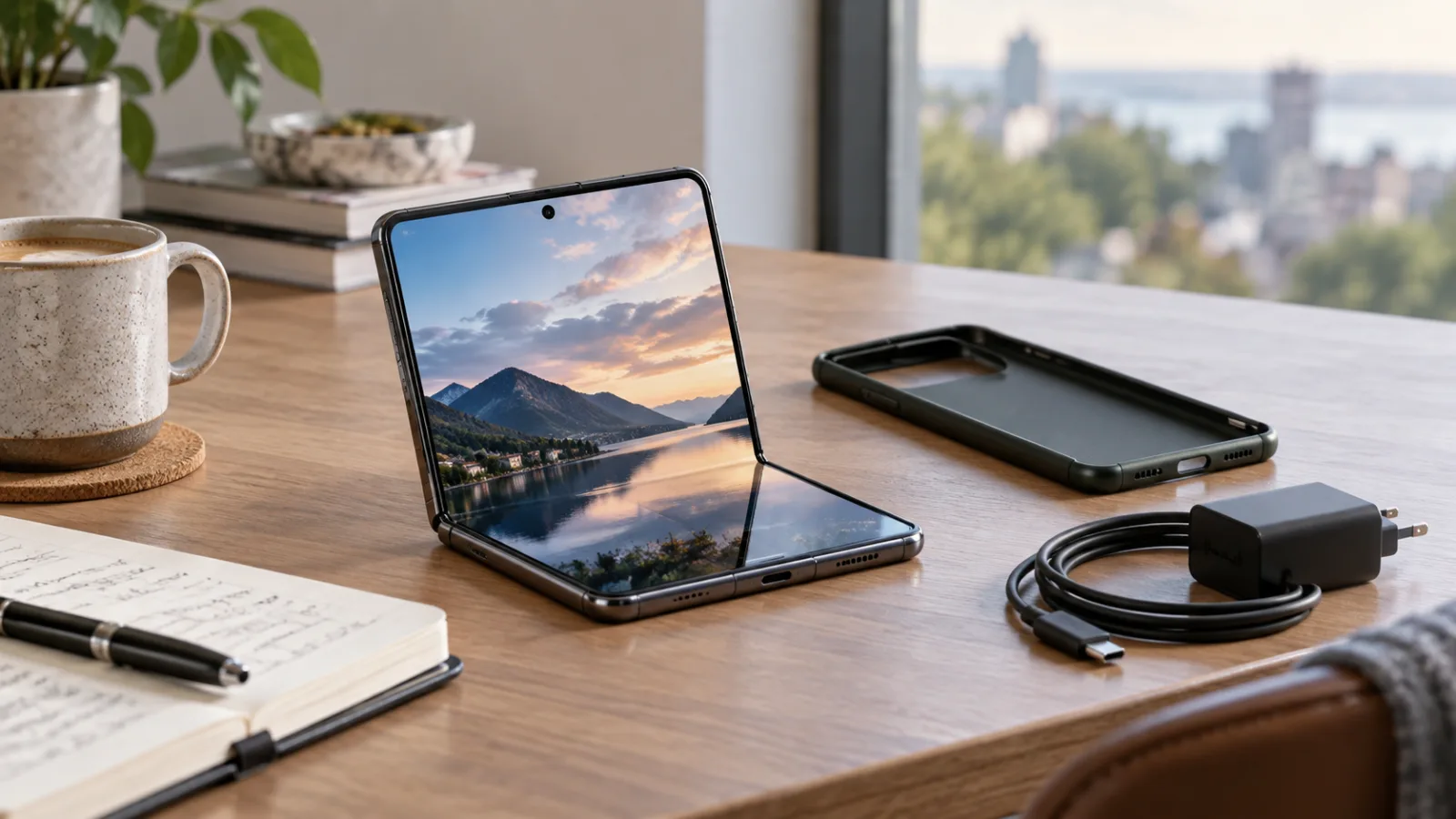
Closed, the phone has a 5.4-inch outer Super Retina XDR display. Open, it presents a 7.6-inch inner display. Apple says the inner panel is 50 percent larger than the iPhone 18 Pro Max display and that both screens use the same aspect ratio, allowing a more continuous experience between closed and open states. Both displays support ProMotion, Always-On functionality, and a claimed peak outdoor brightness of 3,000 nits.
Those are manufacturer specifications, not independent test results. Peak brightness normally describes a short-duration condition, not sustained full-screen brightness in direct sun. The same distinction applies to battery life, durability, and camera claims. Launch specifications are useful for understanding the design; they are not a substitute for long-term testing.
The phone uses Apple’s A20 Pro chip and a dual 16-core Neural Engine. Apple positions it for Apple Intelligence and Siri AI features. The camera system is a 48-megapixel Dual Fusion design. That does not mean it matches the camera hardware or zoom range of the iPhone 18 Pro Max. The interior screen is the headline feature, but the camera may be the component a buyer uses most often.
The Duo comes in star white and night sky. Apple’s iPhone Duo Case costs $79 in the United States, while the Folio with Kickstand costs $129. Protection is part of the product decision, not an optional decoration. A foldable has more exposed edges, a moving hinge, and an inner display that cannot be covered with an ordinary flat glass protector.
The upgrade is the open-screen workflow
A foldable earns its premium when the larger interior screen changes what you do. Watching video on a larger panel is pleasant, but it is not enough to justify a phone that costs about twice as much as a premium conventional model. The stronger case is repeated work that benefits from space: reading a document while keeping notes visible, checking a calendar beside email, using a map while planning a route, editing a photo with more room for controls, or taking a video call with the phone partly folded.
Apple is introducing iOS experiences designed around the Duo, including side-by-side app use, flexible viewing angles, and hands-free FaceTime. Apple says its own apps are optimized and that developers can adapt apps through updated APIs and the latest SDKs. That is encouraging, but “can adapt” is not the same as “has adapted.”
Before ordering, list the five apps you use most for work, school, or personal administration. Check whether each supports a useful landscape layout, split view, drag-and-drop, or persistent controls. A phone interface stretched across a large screen is still a phone interface. The important question is not whether iOS can display two apps; it is whether your apps make that arrangement useful.
The outer display matters just as much. At 5.4 inches, it is smaller than the main screen on most current iPhones. That may make quick messages and one-handed use comfortable, but it could feel cramped for typing, spreadsheets, navigation, and camera framing. The Duo makes sense if you are happy to open it for demanding tasks and use the exterior screen for short interactions. If you want one large slab all the time, the iPhone 18 Pro Max is the simpler fit.
The hinge and inner display are still unknowns
Apple describes the Duo’s titanium construction and hinge cover as durable, and the company has emphasized its engineering work around hinge reliability. It says the inner screen uses a nano-texture finish to reduce glare and make the crease less visible. Those choices may improve daily handling, but they do not remove the basic vulnerability of a foldable: one half moves against the other, while the flexible display is more difficult to protect than a conventional panel.
The most important missing information is a meaningful repair and replacement schedule. Apple has not published a consumer-facing lifetime rating for the hinge, a guaranteed fold count, or a detailed out-of-warranty price for replacing the inner screen. Until those figures are available, treat the Duo as an expensive mechanical product with a higher risk profile than an iPhone 18 Pro. That is not a prediction that it will fail. It is a reason not to assume that ordinary iPhone ownership applies unchanged.
The care routine is different. Do not press hard on the inner screen. Keep grit, metal fragments, and loose debris away from the hinge and display surfaces before closing the phone. Do not install an ordinary screen protector on the inner panel unless Apple explicitly approves it for the Duo. Be cautious with pockets that also carry keys, coins, or sand. These precautions are simple, but ignoring them can be more expensive than ignoring them on a slab phone.
Apple advertises water resistance, but water resistance is not waterproofing and does not cover every kind of exposure or damage. A hinge contains moving parts and fine clearances. Avoid treating the rating as permission to use the phone in a shower, at the beach, or in a pocket full of wet clothing. Liquid and grit are precisely the kinds of real-world conditions that laboratory ratings cannot fully describe.
Battery life needs a careful reading
A foldable has more screen area, more display hardware, and more physical constraints than a conventional phone. Apple describes the Duo as providing all-day power and uses a dual-battery design, but “all day” is not a universal measurement. Someone who opens the inner display for navigation, gaming, video editing, and multitasking creates a different load from someone who mostly uses the outer screen for messages and calls.
This is a strong reason to resist preorder urgency. Independent battery testing can show whether the large inner screen is efficient enough for a full working day, whether charging slows under heat, and whether sustained use causes performance limits. A buyer who needs dependable endurance for travel or field work should wait for those tests or plan for a compact USB-C power bank. That adds weight and makes the device less elegant than the launch presentation suggests.
Check the chargers you already own as well. Confirm whether your preferred wireless charger works with the folded phone and whether the case changes alignment or charging speed. USB-C itself is not the new problem; thickness, hinge geometry, and case design may make an accessory that works with a slab phone less convenient.
Do not overlook the camera compromise
The Duo’s camera system may be excellent, but the published configuration should be read as a design compromise, not proof that it replaces the iPhone 18 Pro Max for photography. A foldable has less internal volume to divide among screens, hinge, batteries, cooling, and cameras. Thinness can force choices around telephoto reach, sensor size, stabilization, and lens spacing.
When independent reviews appear, look at people in low light, moving subjects, distant signs, indoor scenes, and video stabilization—not just bright daylight samples supplied by the manufacturer. The Duo’s large screen may be excellent for reviewing and editing photos, but that benefit does not compensate for a camera limitation noticed on every trip.
There is also a handling question. A foldable can be useful for hands-free shooting and large previews, but its shape may make ordinary photography slower. The right design depends on whether you value a larger viewfinder and flexible angles more than the quick, familiar feel of a normal iPhone.
Price the ownership, not just the phone
The $1,999 starting price is only the first number. Add the case you trust, a possible Folio, sales tax, and any storage upgrade. If AppleCare or another protection plan is available, compare its deductible and accidental-damage coverage with the likely cost of an inner-screen or hinge repair. Monthly financing changes the timing of payment, not the total cost.
The storage ladder runs from 256GB to 2TB. Choose based on your current library and workflow, not on the idea that an expensive foldable deserves maximum storage. If you stream most media and use cloud photo storage, 256GB may be enough. If the Duo is replacing a phone and tablet and will hold offline video, games, photos, and work files, 512GB may be a more comfortable middle ground. The 1TB and 2TB models make sense only when you can name the data that will fill them.
Trade-in offers need the same care. A preorder discount can make the Duo resemble a normal iPhone purchase, but the value depends on the old phone’s condition, the inspection process, and whether credit arrives immediately or only after evaluation. Photograph the old phone before shipping it, keep tracking records, and read the condition criteria. Do not let a vague trade-in promise decide whether you can afford a first-generation foldable.
Who should preorder
The best candidate is someone who already knows the use case. You read and annotate documents on a phone. You switch between two apps repeatedly. You travel with a phone and small tablet and would prefer one device. You want hands-free video calls or a larger screen for maps, reading, and short editing sessions. You can pay for first-generation hardware and accept that accessories and repair information may improve after launch.
That buyer should still check local availability, return terms, insurance, and warranty treatment for accidental damage. A foldable is a poor choice if a damaged inner display would create a financial emergency. It is also a poor choice if your employer, school, or essential apps have not been tested on the new layouts.
Who should wait
Wait if your current iPhone is fast enough and your interest is mostly curiosity. Wait if camera quality is your top priority and the Duo has not yet been independently tested. Wait if you work around dust or grit, regularly use a phone outdoors in wet conditions, or handle devices roughly. Wait if you expect the Duo to replace a tablet but have not checked the apps that matter to you.
Waiting converts Apple’s claims into evidence. Early reviews can measure the hinge, screen handling, heat, battery endurance, camera output, app behavior, and repair options. Those results may confirm that the Duo is unusually well engineered. They may also show that its compromises are more noticeable in ordinary life than in a launch video. Either result is useful.
The best alternative may not be another foldable. The iPhone 18 Pro Max offers a larger conventional phone, a simpler protection routine, and a less complicated repair path. An iPad mini or iPad Air paired with a normal iPhone may provide more usable tablet space for less money, although it requires carrying two devices. Samsung’s established foldables and Google’s Pixel Fold line offer different software and camera priorities. Compare the workflow, not just the hinge.
Ten-minute preorder checklist
First, name the task the inner screen will replace. If you cannot name one, you are paying mostly for novelty. Then check the five apps you use most, confirm the storage you need, price protection, and read the return window.
Look up the exact local preorder time instead of trusting a converted headline. Use Apple or an authorized retailer, and be wary of links promising early inventory or unusually large discounts. The launch-day demand around an expensive product also creates opportunities for scams.
After delivery, inspect the hinge, both displays, the frame, and case fit before transferring all your data. Test charging, speakers, cameras, cellular service, Wi-Fi, and the apps you identified before the return period closes. Keep the packaging and proof of purchase. A first-generation device deserves a first-week inspection, even with Apple’s familiar logo.
The iPhone Duo matters because it changes the size of the iPhone without asking users to leave iOS. That makes it genuinely interesting. It does not make $1,999 automatically reasonable. The decision turns on whether the open-screen workflow will replace another device often enough to justify the hinge, protection routine, accessory cost, and unknowns that only long-term ownership can answer.
For most buyers, the right preorder question is simple: what will you do on the Duo’s 7.6-inch screen that you cannot do comfortably on the phone you already own? If the answer is specific and frequent, the form factor may be worth the risk. If the answer is only “I want to see what it is like,” wait for the first real durability and battery tests.
Related articles
iPhone 18 Pro 的可变光圈确实有用,但不值得所有人升级
iPhone 18 Pro 为主摄加入机械可变光圈,并带来手动曝光控制、新芯片和更长续航的官方说法。本指南解释这些变化会如何影响日常拍照、视频、换机选择,以及在完整评测发布前该如何判断是否值得购买。
苹果 2026 年 9 月新品已上市:升级是否值得,取决于第一天的设置
iPhone 18 Pro、Apple Watch Series 12、Ultra 4 和 AirPods 5 已于 9 月 18 日上市。真正需要判断的不是发布会上的哪项功能最吸引人,而是迁移、健康、音频、兼容性与退货检查能否避免一次昂贵的错配。
人们开始购买智能眼镜探测器,这才是面部 AI 设备的真正警讯
Antizuck 不能可靠发现所有带摄像头的眼镜,但它的流行说明智能眼镜必须赢得旁观者、场所和购买者的共同信任。
iOS 27 的 Siri AI 是兼容性测试,不是自动升级的理由
iOS 27 已经发布,但 Siri AI 是否可用取决于 iPhone 型号、系统语言、Apple 账户地区、测试版状态和当地监管。升级之前,先确认你的设备究竟能获得哪些功能。
Comments
Sign in to comment.
No comments yet.