Microclover lawns can beat the heat. They can also be the wrong answer
A viral clover patch stayed green under drought limits, but the practical lesson is not “plant clover everywhere.” Start with region, species, water, traffic and rules.

The little patch of clover that refuses to brown in July has become a very modern lawn argument.
A gardener on Reddit's r/Gardening posted a simple before-your-eyes comparison in mid-July: an active drought warning since June, watering limited to two days a week, temperatures in the high 80s and 90s, grass looking tired, and a volunteer patch of clover staying green. The post was picked up by The Cool Down on July 21. The original line that made people stop scrolling was almost too perfect: no fertilizer, no extra water, no cool weather, no mowing, not even seeding with microclover, and the patch still looked happy.
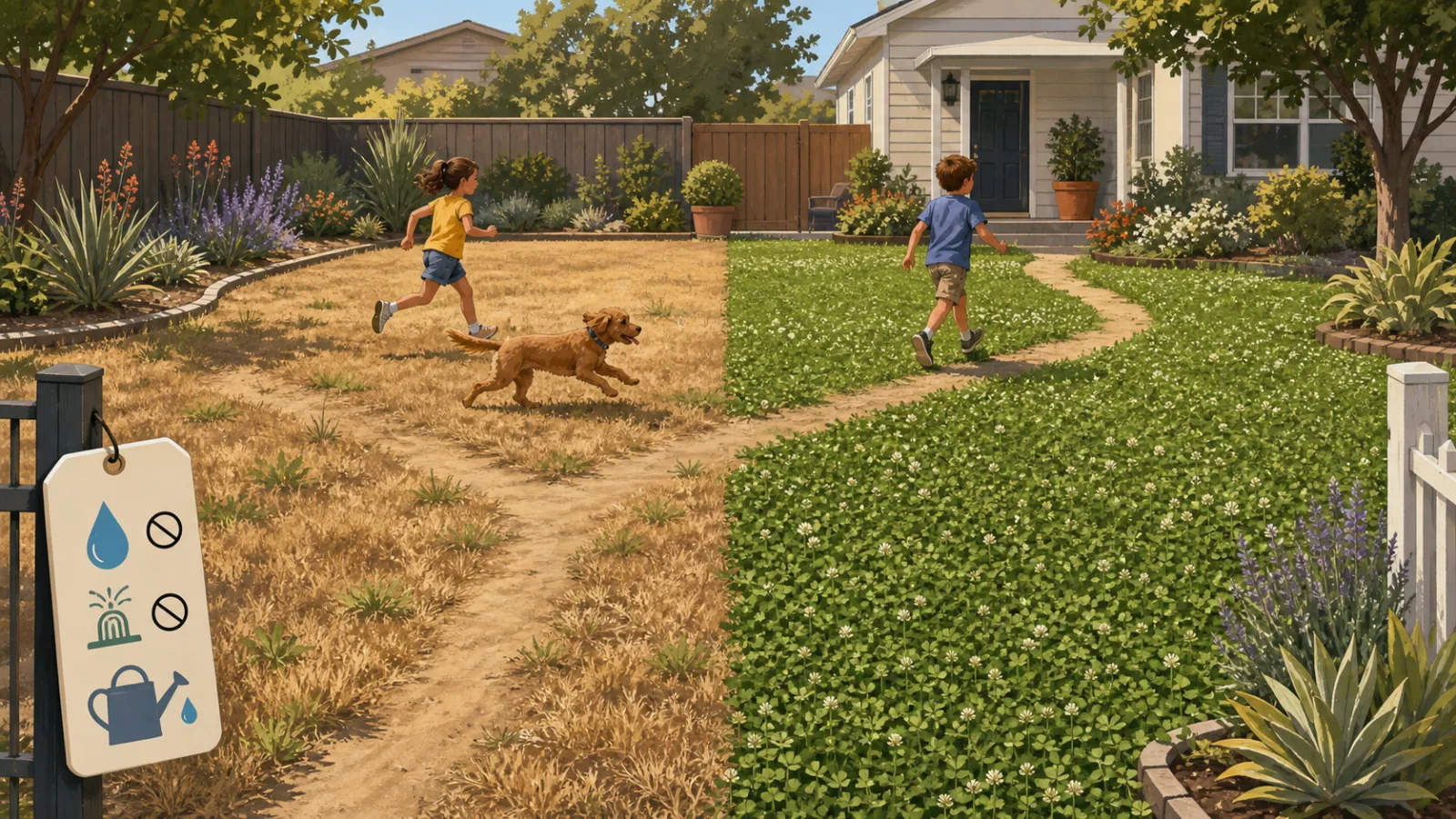
That is exactly why clover lawns are having a moment. Ordinary turf looks neat when water is cheap, rainfall is kind and nobody minds mowing. Under heat warnings, hose limits and rising water bills, that bargain changes fast. A plant that fixes nitrogen, fills bare spots, feeds pollinators and stays green with less fuss sounds like the obvious answer.
But the Reddit thread also showed the trap. A commenter argued that the plant looked like Japanese clover, not the dwarf white clover that people usually mean when they say microclover, and warned that it can be invasive in much of North America. That comment is the whole article in miniature: lawn alternatives can be excellent, but "clover" is not one plant, one climate, one rule or one guaranteed win.
If you are tired of watering a conventional lawn through drought, clover and ecolawn mixes are worth considering. Just do not buy a seed bag because one photo looked good. Start with the site, the region and the job that patch of yard has to do.
Why regular grass struggles in a hot summer
Most home lawns are built for appearance first. They are asked to be a green carpet, a walkway, a play surface, a dog run and a neighborhood status signal. That is a lot to ask from one plant community, especially when the weather turns hot and dry.
Turfgrass can be managed well, but it is not free. Clemson HGIC's July 2026 garden update, written during continuing drought in the South Carolina Lowcountry, says turfgrass needs about one inch of irrigation per week to look its best. Clemson also advises watching for drought stress, keeping blades longer so they shade the soil, and checking moisture rather than guessing. That is good summer turf advice. It is also a reminder that a traditional lawn stays attractive because someone keeps feeding the system with water, mowing time and attention.
Water restrictions make the weak spots obvious. A lawn that looks fine in May can thin out by late July, especially if it is cut short, compacted, shallow rooted, grown in poor soil or expected to stay lush under heat. When irrigation is limited to two days a week, the difference between a resilient lawn and a cosmetic lawn becomes visible.
The answer is not always to rip everything out. Sometimes the smartest move is to mow higher, water deeply and less often, fix compacted soil, reduce traffic, and accept summer dormancy in grasses that are meant to rest. But in many yards, the amount of conventional turf is simply larger than the household really uses. Those are the yards where alternatives make sense.
What microclover actually is
Microclover usually means a small-leaved, low-growing cultivar of white clover, Trifolium repens. It is used alone or mixed with turfgrass. Compared with older, taller white clover, microclover is bred for a tidier lawn look and closer mowing. It can help fill gaps, add nitrogen to the soil through its relationship with nitrogen-fixing bacteria, and reduce the need for synthetic fertilizer.
It is not the same as every plant people casually call clover. Japanese clover often refers to lespedeza, a different plant group. Some lespedezas are troublesome weeds or invasive in parts of North America. Other regions have their own problem plants sold or spread under friendly names. That is why identification matters. A good lawn replacement begins with the Latin name, the local extension office or native plant society, and an invasive species check.
This is also why the Reddit case should be treated as a field observation, not a universal recipe. The patch looked good under that gardener's conditions. It may have been the wrong plant for another region. Both things can be true.
What clover can do well
The best case for clover is practical, not ideological.
Clover can reduce fertilizer needs because it fixes nitrogen. In a mixed lawn, that can support nearby grasses and keep the surface greener with fewer inputs. It can flower and feed bees and other pollinators if you allow some bloom. It often fills thin patches where turfgrass keeps losing. It usually needs less mowing than a high-maintenance grass lawn, especially when mixed into an ecolawn rather than managed like a golf green.
Oregon State University Extension describes an ecolawn as a low-input mix of grasses and broadleaf species that can tolerate ordinary lawn use. OSU's version may include dwarf perennial ryegrass, hard fescue, yarrow, clover or microclover, English daisy, Roman chamomile and other low-growing plants. The promise is not zero maintenance. It is a different kind of maintenance: less water once established, little or no fertilizer, and mowing every two or three weeks instead of weekly in many situations.
That "once established" part matters. OSU is clear that regular watering is still needed for germination and establishment, especially during the first summer. A new clover lawn seeded into July heat without irrigation can fail as quickly as grass. The low-water benefit comes after roots and coverage are in place.
Where the clover pitch gets oversold
Clover is often marketed as drought-proof. That word should make gardeners suspicious.
University of Wyoming and Colorado State University turf specialists have both cautioned that clover is not a magic drought shield. In some conditions its water use can be close to Kentucky bluegrass or only modestly lower. Clover can stay green longer in one yard and collapse in another depending on soil depth, temperature, rainfall pattern, mowing, traffic and species. It can also go dormant or thin under extreme heat or dry soil.
Clover also changes weed control. Broadleaf herbicides that remove dandelions, plantain and other broadleaf weeds can also damage or kill clover. If you want clover in the lawn, the old spray-and-forget lawn program no longer fits. You have to manage weeds through establishment, density, mowing height, hand removal, spot treatment where appropriate, and prevention.
Then there are bees. A flowering clover lawn is good for pollinators, but it may be a bad fit for the exact strip where toddlers play barefoot or a dog rolls all afternoon. You can mow before bloom in high-traffic play zones, keep clover in lower-use areas, or choose a mixed grass/clover approach rather than a flowering carpet everywhere.
Appearance can be an issue too. Clover does not look like elite turf. It can patch, bloom, spread differently through seasons, and brown or thin in winter depending on climate. Some people love that softer look. Some HOAs, landlords and neighbors read it as weeds. The landscape may be healthier and still cause trouble if it looks unmanaged.
Alternatives are regional
The better question is not "clover or grass?" It is "what should this part of the yard be?"
In dry, sunny regions where it is locally appropriate, buffalograss can be a strong low-water turf option. It is not universal. It has a warm-season growth habit and will not behave like a cool-season lawn in every climate.
Fine fescues can work well in cooler regions and shade. University of Maryland Extension notes that fine fescues need less frequent mowing than tall fescue and should not be mowed during hot, dry summer conditions. They do not tolerate heavy foot traffic, so they are better for low-use areas than a soccer corner.
Sedges can give a grass-like look without the same mowing routine, if you choose species suited to the region and site. Pennsylvania sedge and other Carex species can be useful in shade and under trees, but a sedge is not automatically a lawn for running dogs.
Creeping thyme and low herbs can be beautiful between pavers or in low-traffic sunny strips. They are not good replacements for a rough play lawn. Many flowering groundcovers dislike constant foot traffic.
Native meadow or pollinator plantings can replace unused turf, but they take planning. Maryland Extension warns that native meadows can be expensive to establish and may take about three years to mature. They require weeding during establishment and occasional mowing. A meadow is not a lazy lawn; it is a managed planting.
Mulch, paths, shrubs and planting beds are also lawn alternatives. Sometimes the best replacement for grass under a tree is not clover. It is a mulched bed with shade-tolerant native plants and a clear edge.
A practical decision tree
Start with use. If the area takes daily foot traffic, dogs, children and wheelbarrows, keep some tough turf or use a grass/clover blend. If it is mostly seen from the window, you have more options.
Look at sun and soil. Full sun, dry slope, compacted strip beside a driveway, damp shade under trees and irrigated play lawn are different habitats. Do not solve them with one seed mix.
Check your region. Ask a local extension service, native plant society or invasive species database whether the species is recommended, tolerated or a problem. Do not rely on the common name on a marketplace listing. For clover, look for whether you are buying microclover or white clover cultivars, not an unidentified "clover lawn" mix.
Check water for the first season. Even low-water alternatives need moisture to establish. If your area is under strict watering limits right now, July may be the wrong time to seed. Use the summer to plan, kill or weaken unwanted turf safely, improve soil and choose a planting window.
Check rules. HOAs and municipalities often care about height, edging and the appearance of neglect. A clover lawn with a crisp border, mowed path and a small sign explaining pollinator planting is easier to defend than a random patch of weeds. Some places have laws protecting native plantings; others do not. Read local rules before you transform the front yard.
Think about chemicals. If you need broadleaf herbicides to keep a pristine turf look, a clover lawn will frustrate you. If you want fewer herbicides, you must accept some hand work and a more mixed plant community.
How to start without wrecking the whole yard
Do not replace the entire lawn in a weekend because one Reddit photo looked good.
Pick a test area first: a sunny dry strip that already burns, the edge of a path, a slope that is annoying to mow, or a patch where grass keeps failing. Avoid making your busiest play zone the first experiment.
Identify the existing plants. If volunteer clover is already thriving, find out what it is. Take close photos of leaves, flowers and growth habit, then ask a local extension office or knowledgeable regional gardening group. If it is an invasive or aggressive weed in your region, do not encourage it just because it is green.
Prepare the site. Seed needs soil contact. Rake out thatch, reduce competition, loosen the surface lightly and address compaction. In some cases you can overseed microclover into existing turf. In others you need to remove or suppress the old grass first.
Time it well. Spring or early fall is often safer than peak summer for cool-season regions. Warm-season alternatives have different windows. The goal is to establish roots before the most stressful weather arrives.
Water for establishment. This is the part many low-water lawn stories skip. Seeds and seedlings need consistent moisture. After establishment, the watering schedule can drop. Before establishment, drought tolerance is mostly marketing.
Mow differently. Clover and ecolawn mixes often do better when not scalped. Higher mowing shades soil, protects crowns and reduces stress. Letting some flowers bloom helps pollinators, but mow bloom in play areas if stings are a concern.
Keep edges tidy. A neat border, path, low mowing strip or defined bed line can make an alternative lawn look intentional. That matters for neighbors, HOAs and your own patience.
What to do in July
If the lawn is already stressed in late July, the first job is triage, not renovation.
Raise the mower height or stop mowing the worst areas until growth resumes. Short mowing during drought heats the soil and removes the leaf area grass needs to recover.
Prioritize water. Trees, shrubs and new plantings usually matter more than keeping every square foot of lawn green. Clemson's July advice to check moisture levels is practical: use a moisture meter, a trowel or a screwdriver test rather than watering on habit.
Let some turf go dormant if it is safe to do so for your grass type and climate. Brown is not always dead. But newly planted ornamentals, young trees and vegetable beds may not recover from the same neglect.
Observe where clover, yarrow, sedge, fescue or other groundcovers are already winning. Your yard is giving you clues. The best replacement zones are often the places where the current lawn has been telling you it does not want to be lawn.
Plan the renovation window. Order the right seed or plants, check local rules, mark the test area, and decide how you will water during establishment. If restrictions make establishment impossible now, wait. A failed seeding wastes more water than a patient plan.
The verdict
Clover can be a smart lawn alternative. So can microclover blends, ecolawns, fine fescue, sedges, buffalograss, native groundcovers, mulch beds and paths. The right answer depends on climate, water, use, rules and the exact plant.
The Reddit clover patch is a good nudge, not a prescription. It shows why people are done pretending that every yard needs the same thirsty turf carpet. It also shows why plant identification and local advice matter.
If you want a lower-water yard, start by shrinking the lawn where lawn is least useful. Test a small area. Choose species that belong in your region. Water the first season enough for roots to establish. Keep the edges intentional. Then expand what works.
The best drought lawn is rarely one miracle seed. It is a yard with less unnecessary turf, more regionally suitable groundcover, and a watering plan that protects the plants you actually need.
Comments
Sign in to comment.
No comments yet.