Australia's Solar Sharer turns midday surplus into a household benefit
A three-hour free-power window is not magic; it is a practical test of whether homes can help use renewable energy when the grid has too much of it.

Australia's new Solar Sharer Offer is easy to misread. The headline version says households can get three hours of free electricity in the middle of every day. The useful version says something more interesting: a power system with too much midday solar is starting to teach homes when electricity is most valuable.
That is why the policy belongs in Good Tech News. It is not a miracle bill-cutter, and it is not proof that electricity can be free all day. It is a practical attempt to turn a grid problem into a household benefit. When rooftop solar pushes daytime wholesale prices very low, and sometimes negative, the grid needs more flexible demand. Washing machines, dishwashers, heat-pump water heaters, pool pumps, home batteries, electric vehicles and pre-cooling can all move some load into the sunny hours.
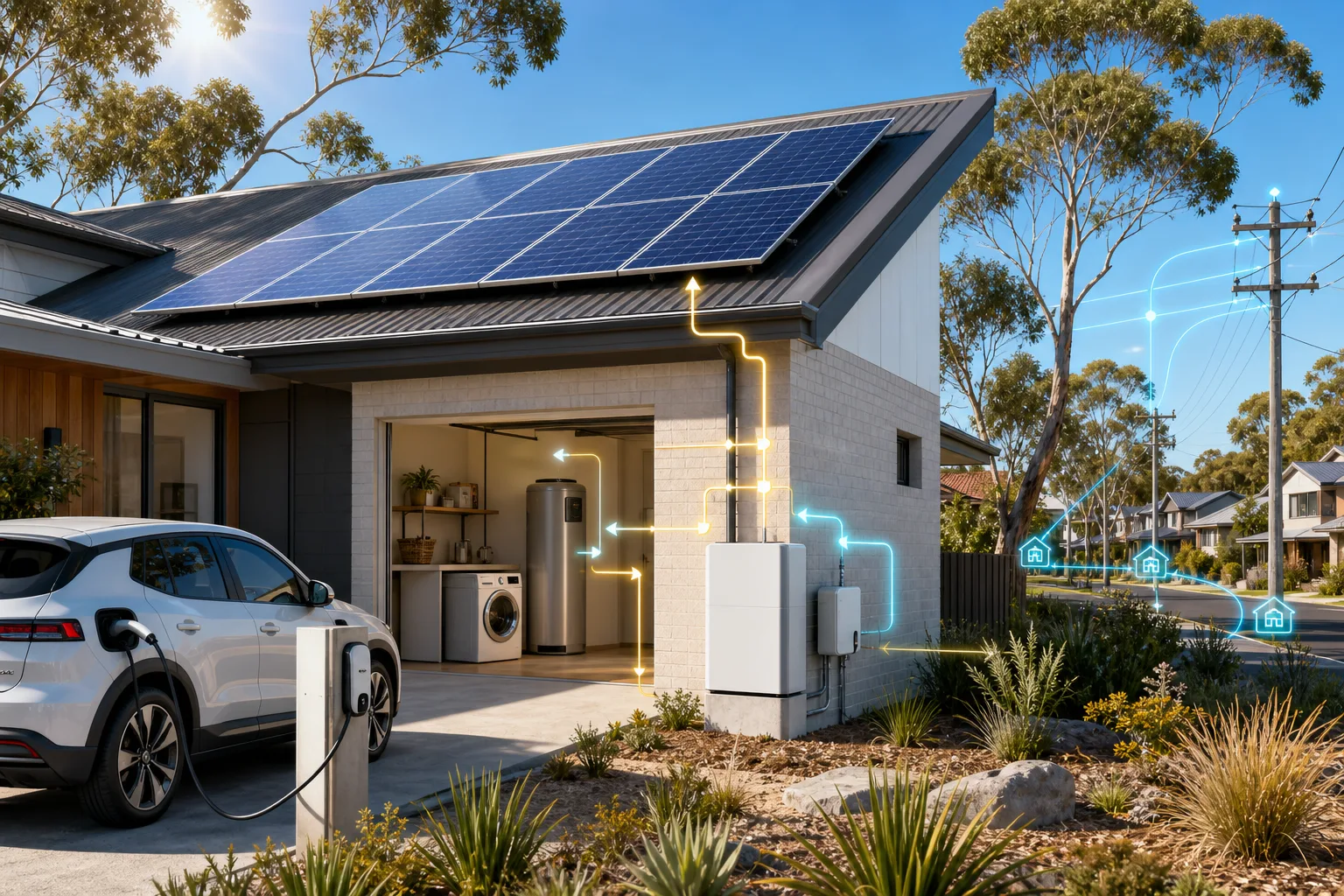
From 1 July 2026, large electricity retailers in Default Market Offer regions — New South Wales, South Australia and south-east Queensland — must make a Solar Sharer plan available to eligible households. The core promise is simple: up to three hours of free electricity during the middle of the day, capped at 24 kWh per day, for customers who opt in and have a smart meter.
The catch is just as important as the promise. This is not free electricity in the whole-bill sense. Households still pay the daily supply charge and pay for power outside the free window. Some plans may recover costs through higher rates at other times. The technology story is therefore also a consumer story: the offer is good news only when the whole bill works and the household can safely shift enough demand.
That honest caveat makes the Australian experiment more useful, not less. It shows what the next phase of clean energy may look like: not only more solar panels and batteries, but tariffs, meters, appliances and habits designed around when renewable electricity is abundant.
What the Solar Sharer Offer actually does
The official Australian government framing is deliberately narrow. The Solar Sharer Offer gives eligible households a daily three-hour window of free electricity in the middle of the day. It applies in the Default Market Offer areas of New South Wales, South Australia and south-east Queensland. It is not automatic for every household and it is not a universal national tariff.
The window is different by region. In New South Wales and south-east Queensland, the free period runs from 11am to 2pm. In South Australia, it runs from 12pm to 3pm. The daily free usage is capped at 24 kWh. Households need an eligible smart meter, must be in an eligible area, and must opt in to a plan offered by a retailer required to provide it. Renters and homeowners can both qualify, and a household does not need rooftop solar panels to join.
That last point is important. Australia already has very high rooftop solar adoption, but many people cannot put panels on their own roof: renters, apartment dwellers, people in shaded homes, or households that cannot afford the upfront cost. A tariff that shares the benefit of midday solar surplus is one way to let more people participate in the renewable system even without owning generation.
The offer is also a signal to retailers. Large retailers with more than 1,000 customers in the relevant Default Market Offer areas must make at least one eligible Solar Sharer plan available. The exact plans still matter. The government and consumer explainers repeatedly tell customers to compare the whole bill, not only the free window.
That is the policy in plain language: free power for a limited daytime window, not free power as a lifestyle. It is an invitation to move flexible demand into the hours when the grid is already rich with solar.
Why midday power became the problem worth solving
For most of the twentieth century, household electricity pricing trained people to think in averages. Power came from large central plants; demand rose in the morning and evening; the customer saw a tariff that barely reflected hour-by-hour grid conditions. Solar changes that logic.
Australia is one of the clearest examples. Rooftop solar is now common enough that the middle of the day can become a supply-heavy period. When the sun is bright and household demand is not high enough, wholesale prices can fall dramatically. In some intervals they go negative, which means the system is effectively paying for demand or paying generators not to produce.
That does not mean the grid has too much clean energy in any simple sense. Evening demand still has to be met. Networks still need stability. Some generation may be curtailed. Batteries, interconnectors, flexible industry and better forecasting all matter. But the household side is a large piece of the puzzle. If millions of homes continue to run the biggest flexible loads after work, the grid still faces an evening peak even after a sunny day.
The Solar Sharer Offer tries to make the price signal legible. Instead of asking people to study wholesale prices or install complex energy-management systems, it says: here is a daily window when energy is abundant; if you can move some load there, you may benefit and the system may benefit too.
That makes the policy a behavioral technology as much as an energy tariff. Smart meters measure the timing. Retail plans create the incentive. Appliances and chargers provide the flexible demand. Consumers decide whether the routine fits their lives.
The good news: renewable abundance is becoming visible
The positive part of this story is not that a retailer has found a clever promotion. The positive part is that renewable generation is now abundant enough in some regions that policy has to ask a new question: how do we use the surplus well?
That is a better problem than scarcity. It means the system has moved beyond the early stage where solar was only a small supplement. Midday solar is now large enough to shape tariffs, consumer advice and grid operation. The challenge is no longer simply to install panels; it is to make the rest of the system flexible enough to capture their value.
For households, the most direct benefit is cost control. A family with an electric vehicle, a home battery, a heat-pump water heater or schedulable appliances may be able to shift meaningful consumption into the free period. Charging a car, heating water, running a dishwasher, drying clothes or pre-cooling a home can all be moved more easily than cooking dinner or running lights after sunset.
For renters and people without solar, the offer is especially interesting. They have often been locked out of rooftop-solar savings. A tariff based on system surplus does not solve every equity problem, but it creates a path for non-owners to benefit from renewable abundance.
For the grid, the benefit is demand shaping. If enough flexible loads move into the middle of the day, less solar may be wasted, evening peaks may soften, and investments in storage and networks may be used more efficiently. The scheme is small compared with the whole power system, but it tests a pattern many countries will need: tariffs that help demand follow clean supply.
The fine print: free is not the same as cheaper
The biggest risk in the story is the word "free." It is accurate inside the defined window, but misleading if households hear it as a promise that their total bill will fall.
Electricity bills contain several parts. There is the usage charge for energy consumed. There is the daily supply charge. There may be different rates by time of day. A plan with a free midday window can still be expensive if evening and morning rates are higher, if the supply charge rises, or if the household cannot shift much consumption into the free period.
ABC's consumer coverage and specialist sources such as SolarQuotes stressed this point: compare the full plan. A household with an EV and home battery may do very well. A low-usage household that is away during the day and has few schedulable loads may see little benefit. A solar-only household may already have cheap daytime energy from its own system and may care more about feed-in tariffs, battery economics or evening rates.
This is why the best advice is not "sign up immediately." It is: check whether your load is flexible, read the supply charge and outside-window rates, compare the whole bill through official comparison tools, and treat the free window as one feature of a tariff, not the whole tariff.
There is also a safety angle. Scheduling appliances is useful, but not every appliance should run unattended. Dryers, old appliances, heaters, pumps and charging equipment should be used according to safety guidance and manufacturer instructions. A good energy tariff should not encourage households to take silly risks to chase a few free kilowatt-hours.
The good news survives the fine print, but only if the fine print is visible.
Who benefits first
The obvious early winners are households with flexible electric loads.
Electric-vehicle owners can shift charging into the free window if the car is at home during the day. That may be common for remote workers, retirees, households with a second car, or people who can charge on weekends. It is less useful for commuters whose car is parked elsewhere from 11am to 2pm.
Home-battery owners can charge during the free period and discharge later, though the economics depend on battery size, round-trip losses, export rules and evening tariffs. The policy may make batteries more attractive for some households, but it should not be sold as a universal battery subsidy.
Heat-pump water heaters, pool pumps and smart appliances are strong candidates because they can often be scheduled with little inconvenience. Pre-cooling a well-insulated home before the evening peak can also help, especially in hot weather, although the benefit depends on climate, insulation and comfort.
Renters can benefit if they have a smart meter and a suitable plan, but they may have less control over appliances, hot-water systems or building efficiency. Apartment dwellers may also face embedded-network limits. That is why the eligibility details matter.
Low-income households are a mixed case. Some may benefit from free daytime energy, especially if they are home during the day. Others may lack flexible loads, efficient appliances or the ability to absorb higher rates outside the window. If the policy is to be socially useful, consumer protection and clear comparisons must be part of the rollout.
Why this matters beyond Australia
Australia is not the only country dealing with the duck curve, negative prices and renewable surplus. California has lived with similar solar timing issues. Parts of Europe have seen negative wholesale prices. Texas, Spain, Germany and the Netherlands all face versions of the same question: how do you make demand more flexible as variable renewable generation grows?
The Australian experiment is interesting because it makes the signal simple for households. Dynamic pricing can be more economically precise, but it is harder for ordinary people to understand and may expose them to risk. A three-hour free window is blunt, but readable. People can plan around it.
That simplicity is both strength and weakness. If millions of people start large loads at the same moment, the grid can face new ramps or local network pressure. If retailers price the rest of the day poorly, consumer trust suffers. If the free window does not match actual solar conditions on cloudy days or in particular network areas, the signal becomes less efficient. If the plan mainly helps households with EVs and batteries, equity critics will have a point.
But policy experiments do not need to be perfect to be useful. They reveal how consumers respond, which loads move, how retailers price around the rule, and whether simple time-based incentives can reduce waste and peak pressure. Other regions can learn from that evidence before copying the model.
What households should check before opting in
The practical checklist is short.
First, check eligibility. You need to be in one of the eligible regions, have or obtain a smart meter, and be with a retailer required to offer a Solar Sharer plan. Embedded networks and some account types may not qualify.
Second, compare the entire bill. Look at the daily supply charge, the price outside the free window, any controlled-load or solar feed-in changes, and the contract terms. Do not compare only the three free hours.
Third, estimate shiftable load. Which appliances can you move into the window without inconvenience or safety risk? EV charging, hot water, pool pumps, dishwashers, washing machines, dryers, home batteries and pre-cooling are the obvious candidates, but each home is different.
Fourth, avoid unsafe automation. Do not run risky appliances unattended simply because the tariff rewards daytime use. Energy savings are not worth fire, water damage or equipment stress.
Fifth, review the first bills. A tariff that looks good on paper may not fit actual behavior. Smart-meter data should make it easier to see whether the plan is saving money or merely moving costs around.
Finally, remember that the policy is optional. The best outcome is not every household joining. The best outcome is the right households joining, shifting real load, and proving that clean-energy abundance can be shared without confusing consumers.
What this says about the future of energy technology
The Solar Sharer Offer is a small policy compared with building transmission lines, grid batteries or new renewable capacity. But it points to a larger shift.
The future power system will not be managed only from the supply side. It will be managed through millions of flexible devices: cars, heaters, batteries, pumps, appliances, thermostats and building controls. Some of that flexibility will be automated. Some will be driven by tariffs. Some will be shaped by simple routines: charge now, heat water now, cool the house now, wait until later.
That is why a three-hour free window is more than a consumer perk. It is a public interface for the clean-energy grid. It translates a complex system condition — midday renewable surplus — into a household decision.
There are risks. Retailers can design confusing plans. Wealthier households may capture more value. Smart-meter access can become a bottleneck. Poor communication can turn a good idea into mistrust. But the direction is right: instead of treating renewable surplus as waste, give people a reason to use it.
Good technology news does not have to be naive. In this case, the achievement is practical and limited: Australia is testing whether a simple tariff can make solar abundance useful to more people. If it works, the lesson will travel. If it fails, the failure will still teach regulators and retailers how not to design consumer energy plans.
Either way, the old idea of a flat, invisible electricity system is fading. The grid is becoming more dynamic, and households are becoming part of its balancing logic. The important question is whether that transition can be made understandable, fair and genuinely useful. Solar Sharer is one of the clearest tests so far.
Related articles

Digital-only consoles are turning gadget ownership into a trust problem
Sony's disc and digital-library stories are not just PlayStation news. They show why buyers need to judge modern devices by accounts, stores and licence rules, not only by hardware specs.

Las consolas solo digitales convierten la propiedad en una cuestión de confianza
Las noticias sobre Sony no son solo un asunto de PlayStation: muestran por qué conviene evaluar cuentas, tiendas y licencias antes de comprar el próximo dispositivo.
Comments
Sign in to comment.
No comments yet.