ARRL November Sweepstakes 2026: Check the Exchange and Online Log Workflow Before CW Weekend
The 2026 ARRL November Sweepstakes begins November 7. This practical checklist focuses on the exchange, operating-time rule, Cabrillo details, and the online-only submission workflow that can derail an otherwise valid log.
What changes for the 2026 November Sweepstakes workflow
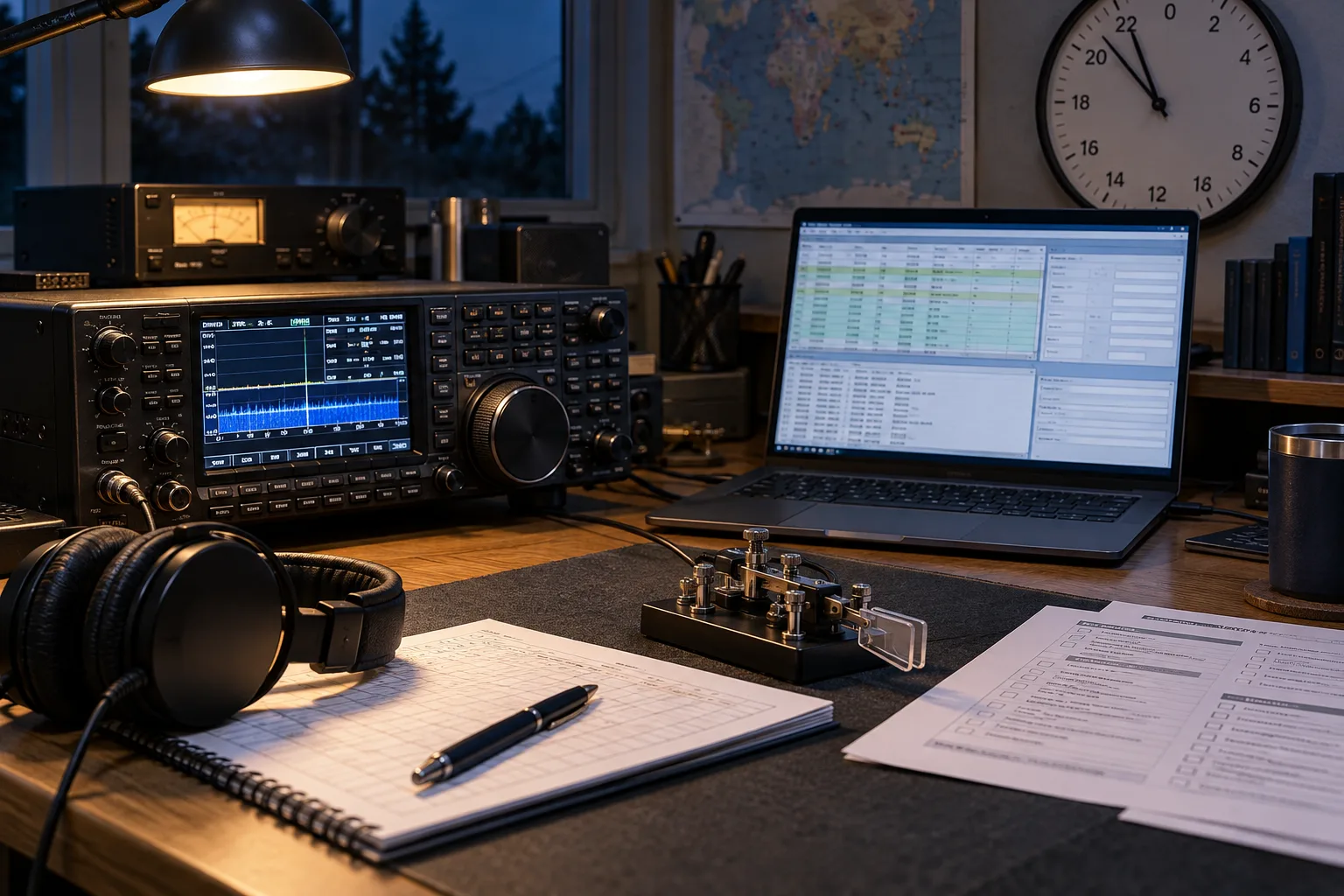
The 2026 ARRL November Sweepstakes CW weekend begins at 2100 UTC on Saturday, November 7, and continues through 0259 UTC on Monday, November 9. For an operator preparing a station, the important change is not only when the contest starts or which bands are available. It is what happens after the last contact: the current ARRL Sweepstakes information says that, beginning September 30, 2026, online log submission is required for ARRL/IARU HF contests. That makes the submission path part of contest preparation, not an administrative detail to discover after the radio is switched off.
The practical implication is simple. A contact can be made correctly and still leave the operator with a preventable problem if the resulting log is prepared according to an older workflow. Before the weekend, identify the current ARRL contest page and the ARRL Contest Log Submission portal, and treat those current instructions as the controlling reference for the electronic handoff. The portal is the destination for the finished log; the contest information page is the place to check the event guidance that applies to this Sweepstakes. Having both pages ready before the opening bell reduces the chance that a tired operator will rely on a saved form, an old local procedure, or a rule reference that no longer describes the submission method.
That caution matters because the available rules material is not perfectly aligned on the question of paper. The Version 2.1 ARRL November Sweepstakes rules still contain older language describing paper-log handling, while the current Sweepstakes page states that online submission is required for ARRL/IARU HF contests from September 30, 2026. Those statements should not be treated as interchangeable instructions. The older PDF remains useful for the contest’s operating and exchange requirements, but the current ARRL page and submission portal should control the final delivery workflow for the 2026 event. In other words, use the rules to understand what must be recorded, and use the current online system to determine how that record must be delivered.
This is a workflow issue rather than a reason to change the way the contest is operated. The operator still needs a complete, reviewable contest log, but the end point is now an online submission. That distinction is especially useful for stations whose software, templates, or paper habits were built around earlier Sweepstakes procedures. A pre-contest check should answer three questions: Is the contest software configured for the ARRL November Sweepstakes? Can it produce the required Cabrillo output? Can the operator reach the current submission portal and recognize the correct event when it is time to upload?
The answer to the first question begins with the event itself. This section concerns the CW weekend scheduled for November 7–9, 2026, while the ARRL calendar separately lists the Sweepstakes CW and Phone dates. Confirming the mode and weekend before opening the logger prevents a basic setup error: preparing a phone log for the CW contest or selecting a generic contest template that does not capture the Sweepstakes exchange. The remaining sections of this checklist address the fields and operating limits that make that log usable, but the workflow starts here, before the first serial number is sent.
A useful way to think about the change is as a handoff with two checkpoints. The first checkpoint is at the operating position: every contact must be entered in a form that preserves the information the rules require. The second is after the contest: the log must be converted or validated in the expected Cabrillo format and submitted through the current ARRL online route. If either checkpoint is skipped, the operator may have a record of the contacts without having a submission ready for the contest’s review process.
For that reason, do not wait until the deadline window to discover whether an older form, an export setting, or a paper-oriented instruction is still relevant. The current page and portal establish the online-only direction for this event, while the Version 2.1 rules remain the reference for the contest details that the logger must capture. Keeping those roles separate gives the rest of the preparation a clear order: first confirm the current submission workflow, then configure the exchange and category fields, then protect the log during operation, and finally audit the Cabrillo file before uploading it.
Build the exchange and category checklist before calling CQ
The safest way to approach the November Sweepstakes is to settle the exchange before the first contact. Under Version 2.1 of the rules, the exchange is built from a consecutive serial number, a precedence, the station’s call sign, a two-digit check representing the year of the operator’s first license, and the ARRL or RAC section. The call sign is also included in the transmitted exchange, so it needs to be treated as a required part of the message rather than as a detail that can be left to the other operator’s log. In practical terms, both stations must know what they are sending and what they are recording before the rate increases.
Prepare a written or on-screen exchange template that keeps the fields in a fixed order. The serial number should advance consecutively, while the precedence, call sign, two-digit check, and section should remain easy to verify at a glance. This is especially useful when a contact is copied under pressure or when a call sign, section abbreviation, or check is repeated for confirmation. A clean template also reduces the risk of changing the exchange format halfway through the contest, which can make later log inspection more difficult. The objective is not merely to complete the contact on the air; it is to preserve every exchange element in a form that can be checked after the contest.
Before selecting a frequency, confirm the permitted bands: 1.8, 3.5, 7, 14, 21, and 28 MHz. The event is CW-only, so the operating setup, macros, memory keyer, and logging program should all reflect that mode. A band plan that stays within those limits helps prevent an otherwise valid contact from being recorded outside the contest’s allowed operating scope. It is also worth checking that the logging software has dedicated fields for the serial number, precedence, call sign, check, and ARRL or RAC section instead of relying on a single free-form exchange note.
Category selection belongs on the pre-contest checklist as well. Decide the intended category before calling CQ, then make sure the station configuration and operating assistance match that choice. The rules distinguish power and spotting-assistance choices, so the selected category should be consistent with how the station will actually operate. Do not leave those decisions until the log is being prepared for submission: category information is part of the contest record, and an unclear choice can create avoidable work during the final audit.
The same advance check applies to the Limited Antennas Overlay. If that overlay is relevant to the station, identify it before the contest and record the choice alongside the main category. Keeping the overlay decision visible helps prevent a mismatch between the station’s operating description and the information entered later in the log header. The checklist should therefore include the main category, power, spotting assistance, and Limited Antennas Overlay as separate confirmations, even when the operating plan itself is simple.
A compact preparation list can be reviewed before the first CQ:
- Confirm CW-only operation and restrict the station to 1.8, 3.5, 7, 14, 21, and 28 MHz.
- Load the exchange fields in a consistent order: consecutive serial number, precedence, call sign, two-digit first-license-year check, and ARRL or RAC section.
- Include the call sign in the transmitted exchange and verify that it is captured in the log.
- Choose the category before operating, including the applicable power and spotting-assistance selections.
- Decide whether the Limited Antennas Overlay applies and keep that choice consistent in the station record and final log.
This preparation also gives the operator a quick way to diagnose a questionable contact. If one field is missing, the call sign is uncertain, or the section was copied incorrectly, the issue can be addressed while the exchange is still fresh. The more consistent the message and logging fields are from the start, the less likely it is that a high contact rate will produce an incomplete record. The exchange checklist is therefore both an on-air aid and the foundation for the later log review.
Protect the log during the 30-hour contest period
The 2026 November Sweepstakes runs from 2100 UTC on Saturday through 0259 UTC on Monday, but that window is not a 30-hour operating allowance. The rules limit operation to no more than 24 hours, with off-times of at least 30 consecutive minutes. Treat the limit as part of the operating plan before the first contact: decide how breaks will be recorded, keep the contest clock visible, and track the running total instead of trying to reconstruct it after the weekend.
The important practical detail is that listening counts as operating time. A station is not necessarily on a qualifying break simply because its transmitter is silent. If the operator continues listening during the claimed off-time, that period should not be treated as rest. Plan genuinely inactive intervals of at least 30 consecutive minutes, and mark their start and end while they happen. This is particularly important when moving between running and search-and-pounce operation, because a short pause in transmitting can feel like downtime even when the station remains active.
A simple time log is enough to prevent many mistakes. Record the start and end of every break, note any change in the operating plan, and let the logging software or a parallel checklist show how much operating time remains. Planned pauses provide room to stop before the 24-hour ceiling rather than discovering late in the contest that an intended break was too short to count. Before stepping away, make the station status clear; when returning, mark the restart time and confirm that the logger is ready for the next contact.
The contact record needs the same discipline. The Sweepstakes exchange includes a consecutive serial number, precedence, call sign, two-digit first-license-year check, and ARRL or RAC section, with the call sign included in the transmitted exchange. Make sure the next serial number is clear before calling or answering, and verify unusual call signs and sections while they are still fresh. A missing or incorrect section, check, call sign, or serial number can make a genuine contact difficult to credit when logs are later compared.
Stations may be worked once regardless of band, so a band change does not create an assumption that the same station is available for another valid contact. Use duplicate checking in the logging program, but do not accept an automatic match without checking the actual call sign. A partial call, similar call, or rushed serial number can be entered incorrectly and later look like a duplicate or fail to match the other station’s record. Asking for a repeat while the contact is in progress is usually safer than repairing an uncertain exchange afterward.
After the contest, review the log as though it will be compared with the other stations’ records. Check that serial numbers progress sensibly, call signs are complete, sections are present, and the check field is recorded as a two-digit year value. Pay particular attention to contacts made near operating breaks or changes in activity, where time entries and exchange fields are most likely to drift. The aim is not to rewrite the event, but to resolve discrepancies while the operator can still distinguish what was heard and what was sent.
Keep the time record and exchange record aligned before moving to the electronic submission stage. Cabrillo generation cannot reliably restore a missing section, an uncertain serial number, or an off-time that was never recorded. If the logger presents a field differently from the rule language, verify the result against the current ARRL contest instructions and submission workflow. A careful operating clock, accurate exchange entry, and final duplicate review preserve the evidence needed for the log to survive the later cross-check.
Finish with a Cabrillo and submission audit
When the contest ends, treat the log as an entry that still needs verification, not as a file that can be uploaded without inspection. First, stop the operating clock at the correct moment and make sure the final operating-time total matches the category and the 24-hour limit. The off-time record should also make sense: the rules require off periods of at least 30 consecutive minutes, so a late correction to the operating schedule can affect more than one field in the log. Listening counts as operating time, which makes the recorded operating period part of the compliance check rather than a private note for the operator.
Next, review the contact records for the fields that determine whether an exchange can be checked. Look for missing or malformed serial numbers, precedence indicators, call signs, two-digit first-license-year checks, and ARRL or RAC sections. Confirm that the station call sign is represented correctly in the exchange data and that entries are assigned to the intended contact rather than shifted by one line during rapid logging. Since a station may be worked only once regardless of band, inspect possible duplicates across the entire log rather than checking each band in isolation. A duplicate is not a reason to rewrite a valid record casually; it is a reason to compare the call, time, band, and exchange before deciding how the logging program should handle it.
The category audit should happen before Cabrillo generation. Confirm the operating mode, power category, spotting-assistance choice, and any Limited Antennas Overlay selection. Check the operator and station information as well, because an otherwise complete contact log can still be associated with the wrong entrant details or an unintended category. If the software asks for fields that were not part of the operating plan, use the current ARRL contest instructions to resolve the choice. Older paper-log wording or legacy form behavior should not override the current online workflow described for ARRL and IARU HF contests.
After the content review, generate the Cabrillo file required for the entry and validate it with the tools available in the logging program or through Cabrillo assistance when needed. Open the resulting file as plain text or in a validation view and check the header fields, category information, operator details, and contact lines. The goal is not to make the file look tidy; it is to ensure that the submitted file expresses the log you actually operated, with the exchange and category information preserved in the expected format. If a conversion form is used, compare its output with the original logging software export before submission. A successful conversion alone does not prove that the category or exchange values are correct.
Submit the finished electronic log through the ARRL contest log-submission portal. For the 2026 November Sweepstakes, the practical deadline is seven days after the event at 0259 UTC. The submission is not complete merely because the upload page accepted a file: retain the application confirmation and verify that it identifies the correct contest and entry. The confirmation from the application determines the electronic submission time, so it is the record to check if the upload occurs close to the deadline. Keep the Cabrillo file and confirmation together until the entry has been fully recorded.
A compact final sequence helps prevent the most avoidable errors:
- Stop and verify the operating clock, including qualifying off-times.
- Review duplicates and the six exchange elements against the original log.
- Confirm mode, power, assistance, overlay, operator, and station information.
- Generate and inspect the Cabrillo file before uploading it.
- Submit through the ARRL portal before 0259 UTC seven days after the event.
- Save the application confirmation as proof of the electronic submission time.
The current ARRL contest page and submission portal should control the final decision whenever an older form, saved software template, or printed rules reference appears to conflict with the online process. That last comparison is a small part of the contest, but it closes the gap between making contacts successfully and delivering an entry that can be processed under the current workflow.
Related articles
The FCC’s D2D Satellite Proposal Is a Mesh and Microwave Issue, Not Just a Phone Story
The FCC’s new D2D satellite NPRM focuses on 2.4 and 5.8 GHz Part 15 operation. For hams, mesh builders and microwave experimenters, the useful response is measured data, not panic.
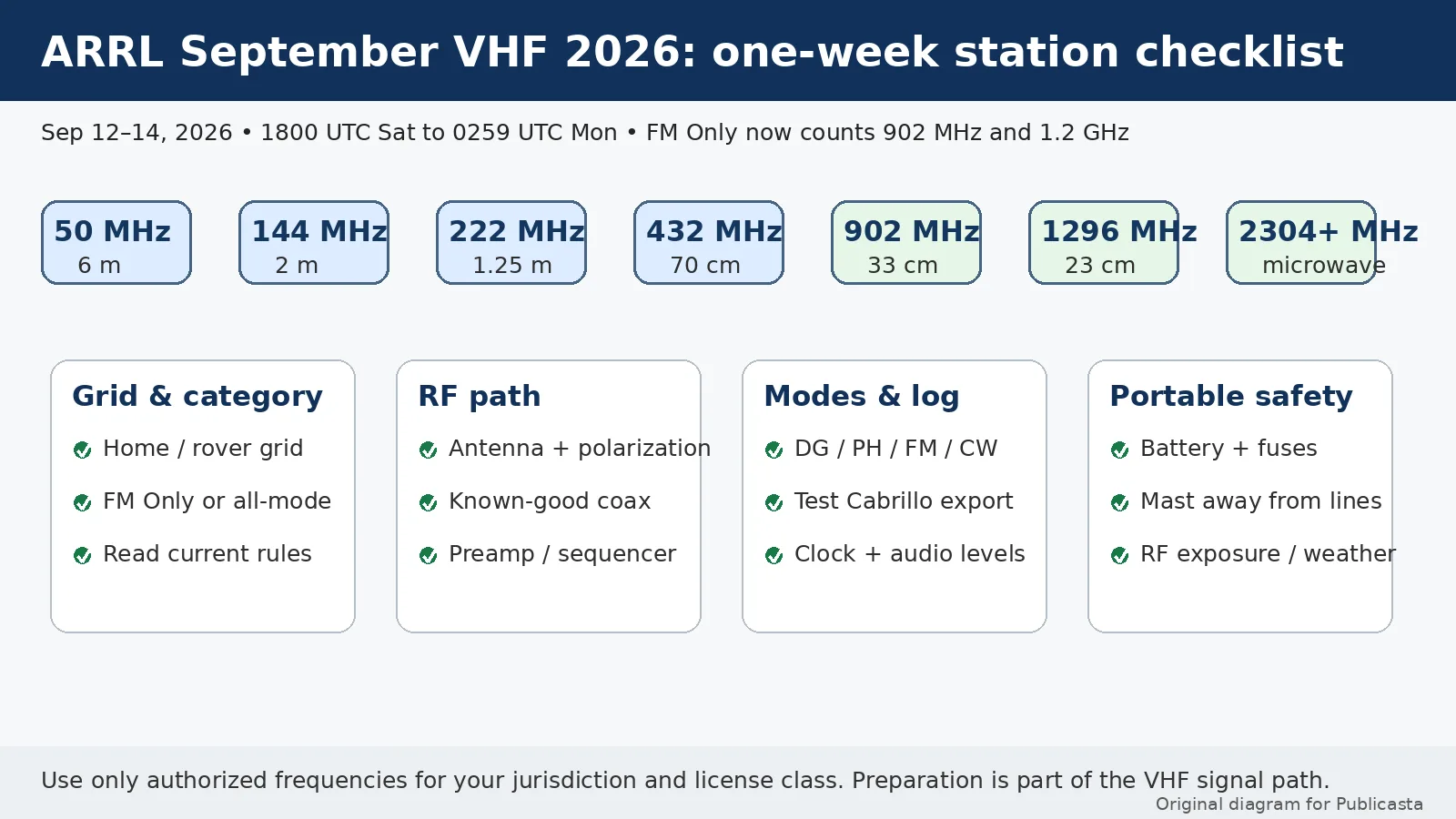
ARRL September VHF 2026: prep bands, grids and logs before contest weekend
A practical one-week station checklist for the September VHF Contest, including the FM Only 902 MHz and 1.2 GHz scoring change.
Use the Reverse Beacon Network to Test a Station Before the Next Contest
ARRL’s October 27 contesting session is a useful prompt to treat contest preparation as measurement: use RBN spots, controlled CQs, and a simple log to separate propagation, coverage, and station faults.
Der D2D-Satellitenvorschlag der FCC ist eine Mesh- und Mikrowellenfrage – nicht nur eine Telefongeschichte
Der FCC-Vorschlag zu Direct-to-Device-Satelliten betrifft Part-15-Betrieb bei 2,4 und 5,8 GHz. Für Funkamateure, Mesh-Bauer und Mikrowellen-Experimentatoren zählen jetzt Messdaten statt Alarmismus.
Comments
Sign in to comment.
No comments yet.