ARRL September VHF 2026: prep bands, grids and logs before contest weekend
A practical one-week station checklist for the September VHF Contest, including the FM Only 902 MHz and 1.2 GHz scoring change.

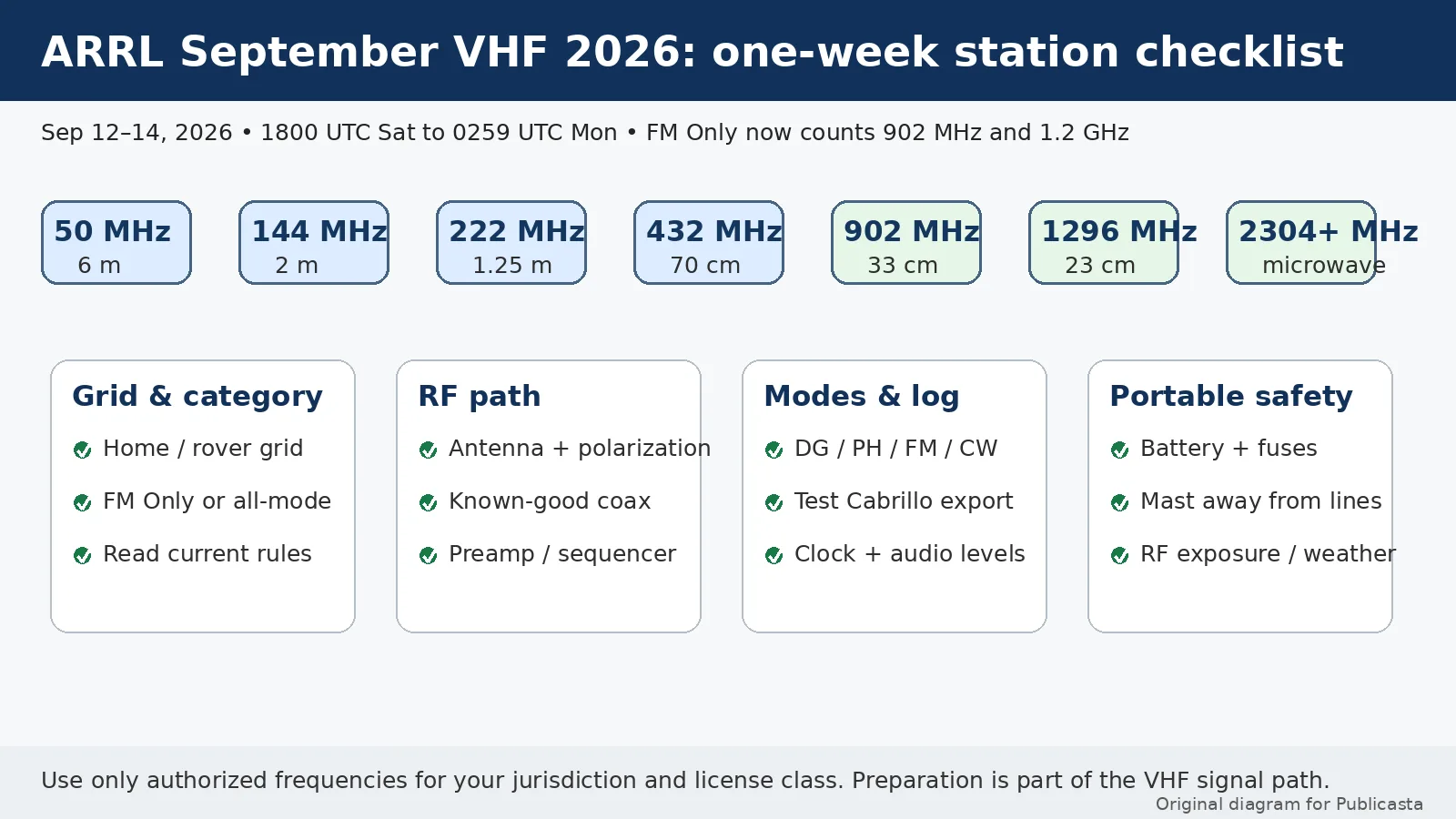
One week before the ARRL September VHF Contest is the right time to stop buying parts and start proving the station. The 2026 event runs September 12–14, with the contest period beginning at 1800 UTC Saturday and ending at 0259 UTC Monday. ARRL’s current September VHF page also carries a practical change for the FM Only category: contacts on 902 MHz and 1.2 GHz can now count toward the score, where the FM-only scope had previously been limited to 50, 144, 222 and 432 MHz. For a modest fixed station, portable setup or rover, that rule note is not a reason to improvise on contest morning. It is a reason to verify bands, grids, modes, feed lines, power, logging and safety while there is still time to fix ordinary failures.
What is current, and what is not
The current facts are narrow and important. ARRL describes the September VHF objective as working as many amateur stations as possible in as many different 2-degree by 1-degree Maidenhead grid squares as possible, using authorized frequencies above 50 MHz. The 2026 date is September 12–14. The operating window is 1800 UTC Saturday through 0259 UTC Monday. All legal modes are permitted, and ARRL’s Cabrillo guidance on the event page maps digital modes to DG, SSB phone to PH, FM voice to FM and CW to CW. Logs are due within ten days after the event; electronic Cabrillo upload through ARRL’s contest-log-submission web app is the preferred route.
The FM Only notice is the fresh operator hook. The newly countable 902 MHz and 1.2 GHz contacts do not magically make a dual-band handheld into a microwave station, but they do change the value of hardware that may already be on the shelf: 33 cm mobiles, 23 cm transverters, spare antennas, preamps, sequencers, duplexers, low-loss jumpers and logging profiles that were easy to ignore in an FM-only plan. If the gear can legally transmit in the operator’s jurisdiction and license class, and if it can be tested safely, it deserves a line on the station checklist.
The timeless part is just as important. VHF contest success is rarely rescued by a last-minute purchase. It is built from height, clean feed lines, accurate grids, enough battery, known mode settings, a readable log and disciplined operating. A single-band 2 m station on a good hill with a working log may produce a better weekend than a multi-band pile of adapters that has never been keyed into a dummy load. Treat the rule change as a planning signal, not as pressure to assemble untested hardware at the edge of the contest.
Start with the legal band inventory
Write a band inventory before touching the rack. For many US and Canadian operators the obvious contest list begins with 50, 144, 222 and 432 MHz, then continues to 902, 1296 and higher microwave bands where equipment, license privileges and local regulations allow. Readers outside the US and Canada need an extra caution: ARRL’s objective and scoring notes are centered on stations in the US and Canada and their possessions, while frequency allocations, power limits and license classes are jurisdiction dependent. This article cannot turn a regional contest page into universal legal advice.
The inventory should say more than 'I have 70 cm.' For each band, note the radio or transverter, output power at the transmitter, estimated loss to the antenna, antenna type, polarization, preamp or sequencer status, rotator or mast arrangement, and whether FM, SSB, CW or digital operation has actually been tested. A band that exists only because a menu item says it exists is not a contest band yet. It becomes usable when the operator has made a clean local contact, checked SWR or return loss, confirmed audio and PTT behavior, and knows how it will be logged.
For 902 MHz and 1.2 GHz, cable and connector discipline matters more than many new operators expect. Losses that are tolerable on 2 m can erase a weak UHF or microwave signal, and a poor adapter stack can become the weakest part of the station. Use the week before the contest to replace mystery jumpers with known-good short leads, label band-specific coax, verify N/SMA/BNC adapters, and measure or at least sanity-check the receive path. If a transverter requires sequencing to protect a preamp, test the sequence slowly now, not when a rare grid appears.
Logging is a station component, not paperwork after the fun
The exchange in a VHF grid contest is only useful if it lands in the log correctly. Maidenhead grid squares are simple enough to say on the air, but easy to mistype after a rover move, GPS app change or hurried correction. Before the contest, set the logging program to the right contest, confirm the operator’s home grid or first rover grid, create band and mode buttons that match the station plan, and make a test Cabrillo export. The goal is not bureaucracy; it is avoiding the Sunday-night discovery that 1.2 GHz FM contacts were entered under the wrong band or that digital QSOs exported with a strange mode label.
ARRL’s mode mapping on the September VHF page gives a useful checklist: DG for digital modes, PH for SSB phone, FM for FM voice and CW for CW. That does not mean every logger will guess correctly from rig control. CAT, audio interfaces, WSJT-X/JTDX style digital setups, voice memories and FM rigs should be checked with dummy entries. A local test contact or club dry run is better than discovering that the laptop clock drifted, the serial port name changed or the contest template was left on a previous event.
Rovers and portable operators should treat grid changes as a failure point. Put the grid source in the station notes: GPS receiver, phone app, paper map, offline map or grid-locator tool. Preload expected operating sites and parking spots. If the station crosses grid boundaries, decide how the operator will announce, log and label the move without mixing contacts. If internet service is unavailable at a hilltop, the grid plan still needs to work. A laminated card with grids, access notes and battery plan can prevent more errors than another browser tab.
Mode planning for modest stations
All legal modes are permitted, but not all modes solve the same problem. FM is efficient for local activity, simplex openings, club groups and the now-more-interesting FM Only category. SSB and CW are often stronger tools for weak-signal VHF contacts when the station has suitable antennas and local activity. Digital modes such as FT8 or MSK144 can help on weak paths, meteor scatter or difficult openings, but they require accurate timing, clean audio, controlled power and patient operating. The right plan is not 'use everything'; it is 'know which mode each band is actually ready to support.'
For small stations, the highest return may come from coordination before the event rather than power during the event. Check local club calendars, VHF society notes, repeater-group announcements and legal contest practice in advance. Use these sources to learn where activity is likely, not to invent prohibited assistance or out-of-band shortcuts. If a rule detail about spotting, scheduling or internet assistance matters to your category, read the current ARRL rules directly before operating. Do not rely on folklore from a different contest.
The week-before test should include receive practice. Listen on likely calling frequencies, check waterfall displays where used, confirm squelch and tones are not hiding simplex signals, and verify that headphones or speakers are usable in wind and vehicle noise. A signal you cannot identify is not a contact; a waterfall trace is only evidence to slow down and copy correctly. The practical operator habit is to log the callsign, grid, band and mode only after the exchange is real, legal and understood.
Portable and rover preparation
A portable station wins or loses before the first CQ. Access, parking, permission, daylight, weather, battery capacity, mast guying, RF exposure and trip hazards are not glamorous contest topics, but they decide how long the station stays on the air. Walk through the setup sequence at home: mast base, guys, antenna orientation, coax routing, power distribution, laptop shelter, paper log backup and teardown. If the process needs two people, do not pretend one tired operator will manage it safely in the dark.
Power deserves its own rehearsal. Label batteries with chemistry, capacity and last charge date. Fuse DC lines near the source. Carry spare fuses, Powerpole jumpers, a known-good meter, charging cables and a way to keep connectors out of wet grass. Estimate current draw per band and mode instead of assuming a battery that runs an FM handheld will also run a laptop, transverter, preamp and rotator controller. For vehicle operation, avoid cable routes that interfere with driving, pedals or airbags, and do not operate in a way that distracts the driver.
Antenna height helps, but safety outranks a few extra decibels. Stay away from power lines, unstable edges, roof work without protection and masts that cannot be lowered under control. RF safety also remains real above 50 MHz, especially with gain antennas and close portable layouts. Keep people out of the main beam, know where the antenna points, and use power levels appropriate to the band, antenna and exposure situation. The contest score is not worth an unsafe mast, a shorted battery or a public-site incident.
The bench checklist for 902 MHz and 1.2 GHz
The FM Only expansion makes the upper bands more visible, so verify them as complete signal chains. For each of 902 MHz and 1.2 GHz, if you intend to use it, test transmitter, receiver, antenna, feed line, power supply, microphone or audio path, PTT, preamp protection and logging entry. Make at least one local or dummy-load sanity test where legal and appropriate. A contact cannot count if the station cannot hear, cannot be heard, or cannot record the band and mode correctly.
Look for small incompatibilities. Some radios label 1.2 GHz as 1200 MHz, 1240 MHz or 1296 MHz in menus; some loggers want a standard band label rather than an exact frequency; some transverters need an intermediate-frequency offset; some FM rigs have memories with tones, offsets or repeater settings that are wrong for simplex contest work. Clean memories and plain labels are worth the time. The goal is to reduce contest-morning decisions to operating, not configuration archaeology.
Do not force an upper band into the plan if it is not ready. A 2 m, 70 cm and maybe 6 m station with clean antennas and a good site can still have a useful weekend. The rule change creates opportunity for operators who already have legal, working hardware; it is not a requirement. If 902 or 1296 tests reveal a bad coax run, overheating transverter, unstable LO or questionable antenna, write it down for the next event and keep this weekend’s plan honest.
A one-week schedule that avoids last-minute chaos
Seven days out, confirm the rules, category, operating window and station inventory. Six days out, test every radio path into a dummy load or local legal contact and mark bands as ready, questionable or dropped. Five days out, build the logging profile, export a test Cabrillo file and verify grid data. Four days out, repair only failures that have a clear fix; do not redesign the station. Three days out, pack cables, fuses, tools, weather protection and paper backups. Two days out, charge batteries and print or save site notes. One day out, stop major changes.
That schedule is deliberately conservative. Amateur radio operators like experimenting, and VHF contesting rewards experimentation, but the weekend itself is a poor laboratory for unknown power wiring or untested microwave adapters. Put new ideas into a notebook unless they are needed to fix a blocking fault. The operator who spends Friday night sleeping, charging batteries and checking the weather often beats the operator who spends Friday night installing drivers.
The final takeaway is simple: the expanded FM Only scoring bands are useful only when contacts are clean, legal and logged. ARRL’s 2026 September VHF page gives the date, period, objective, mode labels and the 902 MHz / 1.2 GHz notice. The operator’s job this week is to turn those facts into a station that survives real terrain, real cables, real batteries and real grids. Preparation is not less technical than operating; in VHF contesting, it is part of the signal path.
Related articles
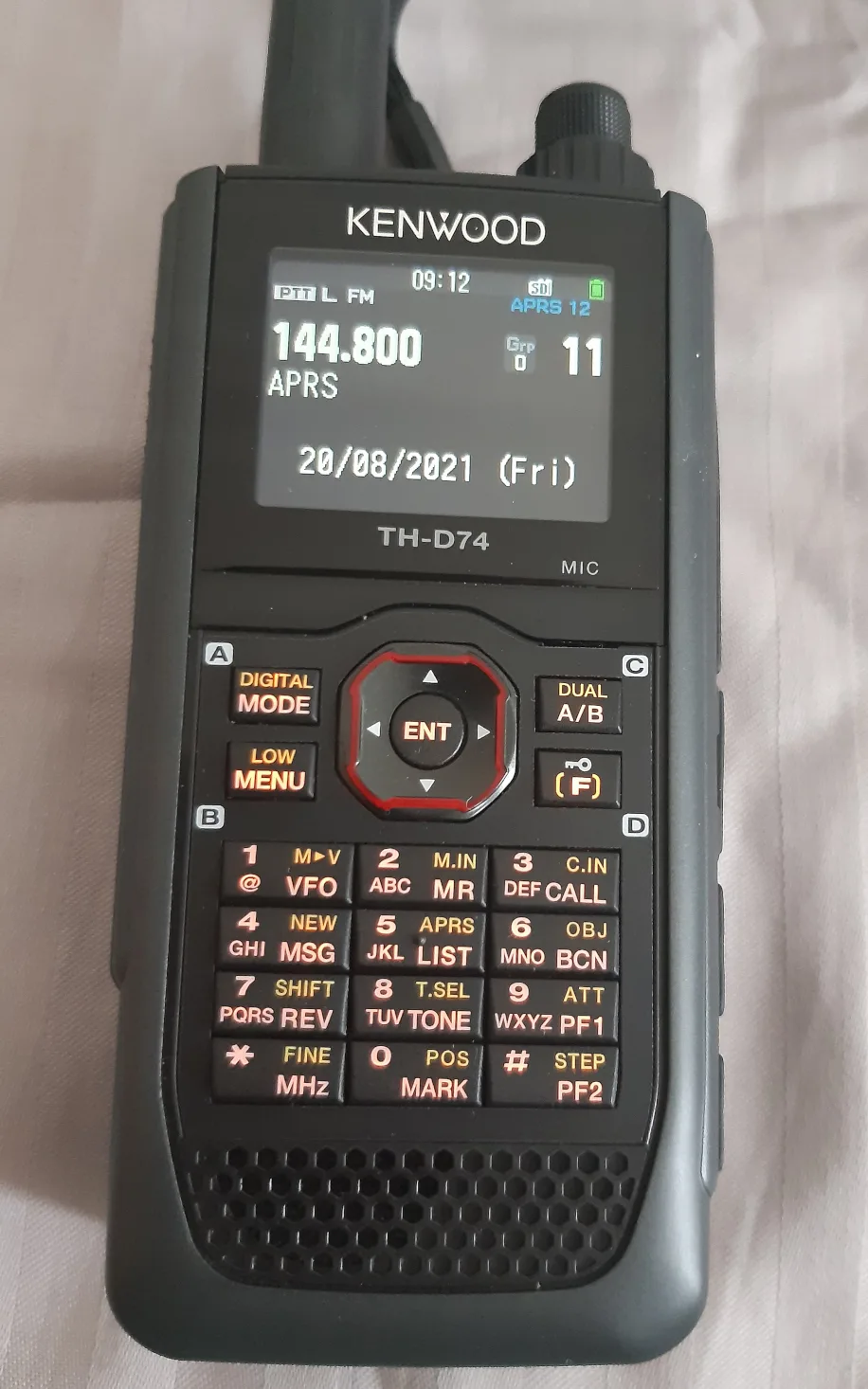
APRS and SSTV from a balloon: a receive-station checklist before the next club launch
A recent Kopernik Observatory balloon request is a useful reminder: clean VHF audio, correct mode settings, UTC logs and receive-first discipline matter more than expensive gear.
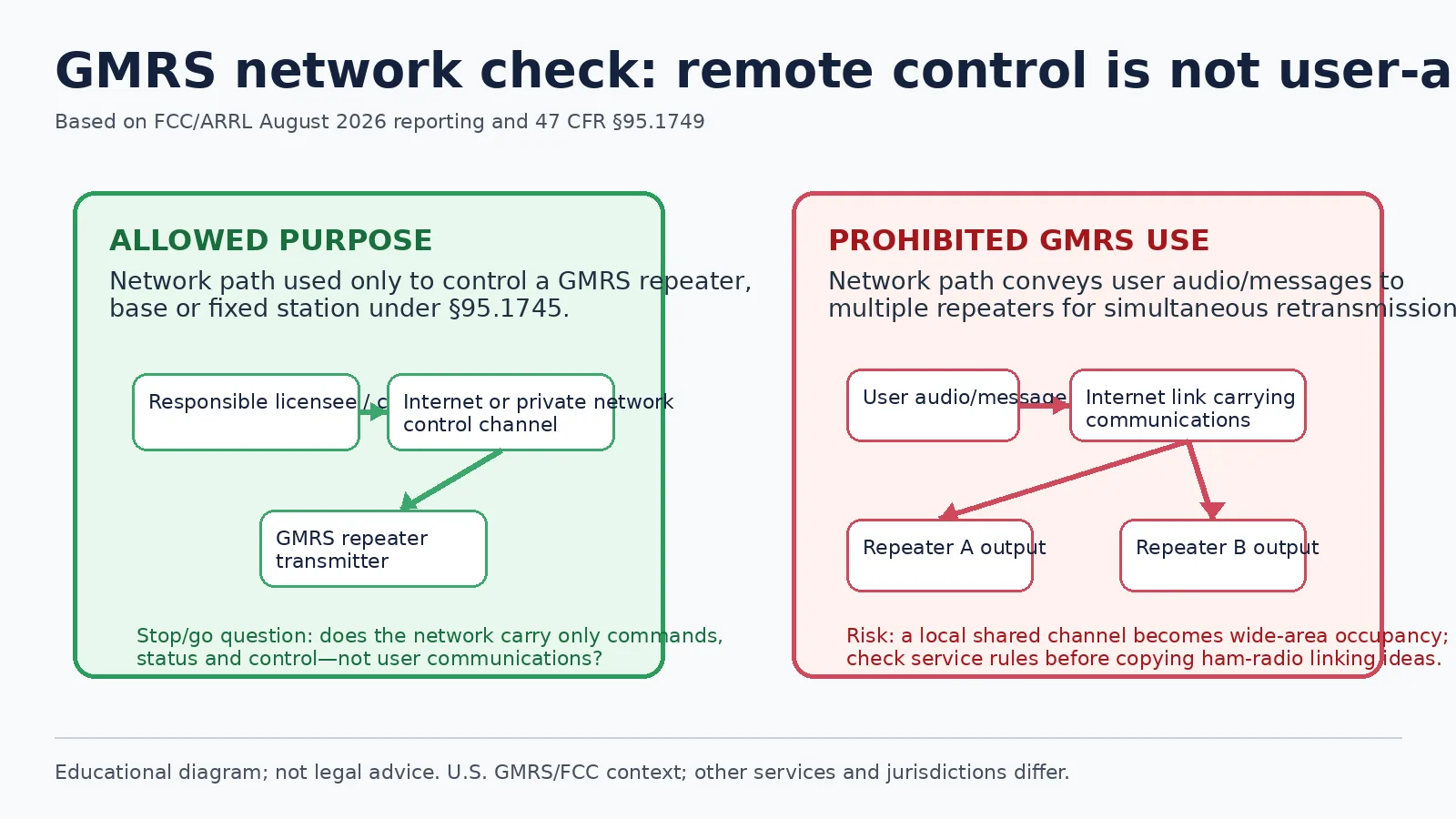
Remote control is not repeater linking: the FCC GMRS warning ham builders should read
An FCC notice over a linked GMRS repeater network turns into a practical service-first checklist for operators planning IP links, gateways or remote control paths.
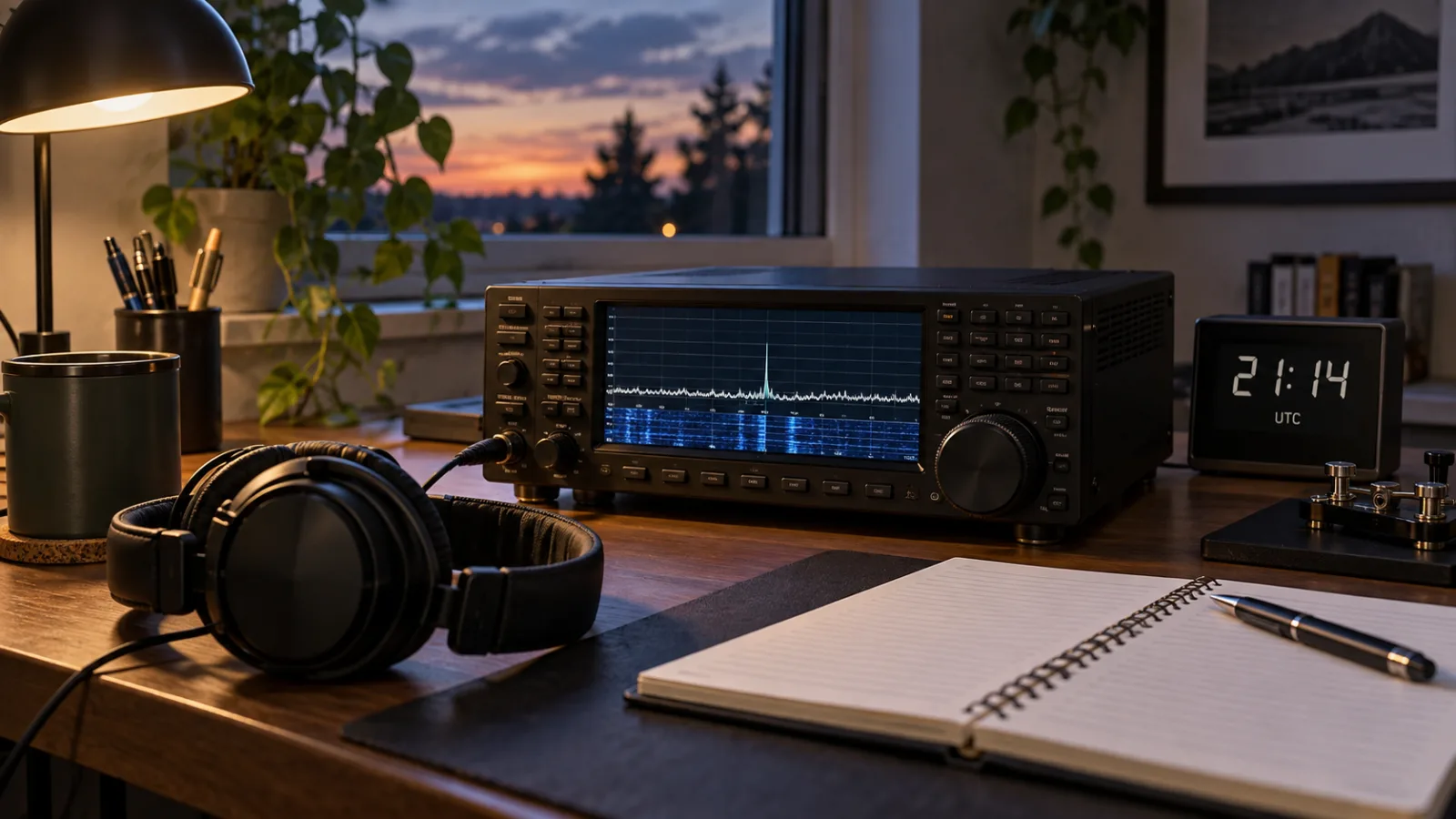
Wrześniowa aktywacja EMCOMM ORARI: jak zbudować zdyscyplinowaną stację odbiorczą dla 7,110 MHz, JS8Call i nasłuchu satelitarnego
ORARI prosi krótkofalowców o wsparcie operacji kryzysowej od 11 do 24 września. Najbezpieczniejszy pierwszy krok to odbiór: poprawne strojenie, rzetelny log UTC i cisza tam, gdzie trwa ruch ratunkowy.
APRS und SSTV vom Ballon: Empfangsstation vor dem nächsten Clubstart vorbereiten
Die Kopernik-Anfrage zeigt den praktischen Kern: sauberes VHF-Audio, richtiger Modus, UTC-Log und Empfangsdisziplin zählen mehr als teure Hardware.
Comments
Sign in to comment.
No comments yet.