Battery-First Radio Planning for Outdoor Events: What a Mountain Bike Course Teaches Operators
A recent Maryland cycling event shows why reliable field communications begin with terrain, staffing, power and message discipline—not simply choosing a handheld. Here is a practical way to design and test a small event network.

A radio plan can look perfectly reasonable on paper and still fail at the first hill, bend in the trail or low-battery warning. The recent Maryland Interscholastic Cycling League Adventure Ride at Deep Creek Lake is a useful reminder. Garrett County Amateur Radio Emergency Service volunteers covered a mountain-bike course with amateur-radio equipment powered by batteries because the required operating locations did not have ordinary AC power. The report also noted that the GMRS handhelds used by the cycling teams had more limited range for that terrain. eHam.net’s account of the event is brief, but the engineering problem behind it is familiar to anyone who has supported a road race, parade, search exercise, trail event or public-service drill.
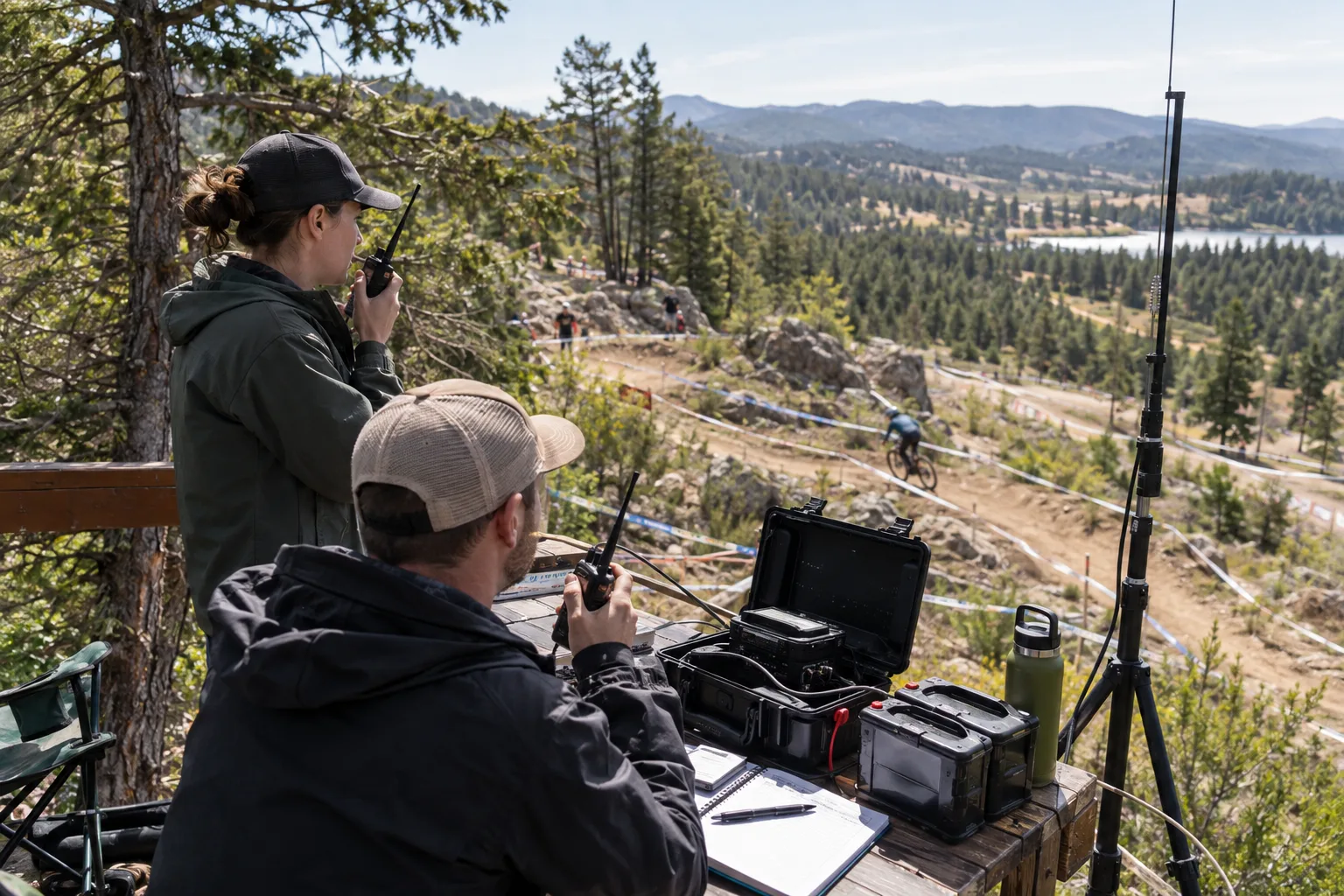
The important lesson is not that amateur radio automatically beats GMRS, or that a particular repeater will solve every coverage problem. It is that field communications are a system. Antenna height, terrain, radio placement, traffic volume, battery reserve, operator training and the event’s actual information flow matter as much as the label on the front of the radio. A reliable plan starts by describing the job precisely, then selects the simplest network that can meet it.
This is an operating and preparation guide, not a claim about one jurisdiction’s emergency authority. Frequencies, licensing, repeater access, privacy rules and the use of third-party messages depend on the country and service involved. In the United States, routine amateur operations remain governed by FCC Part 97; the narrow emergency provisions in 47 CFR 97.403 do not turn an ordinary sporting event into an emergency or authorize casual operation by unlicensed people.
Start with the message, not the radio
Before programming channels, write down what participants actually need to communicate. A trail marshal may need to report that a rider has stopped at a checkpoint. A medical team may need to request transport. A course director may need a count of riders through a point. A sweep operator may need to report a blocked trail or a missing volunteer. Those are different messages with different urgency, length and routing requirements.
A useful first pass divides traffic into three classes:
- Immediate safety traffic: a crash, medical problem, dangerous obstruction or person who cannot be located.
- Operational traffic: checkpoint counts, course status, vehicle movements, timing changes and resource requests.
- Administrative traffic: breaks, meals, equipment questions and routine updates.
The first class must be short and interruptible. The second needs accuracy and a record. The third should not compete with either. If all traffic uses one channel with no discipline, routine conversation can bury the one message that matters. If the event is small, one operator can often handle more than one role, but the plan should still distinguish priority.
Define the minimum information for each urgent call before the event begins. A practical format is location, problem, people affected, immediate danger, assistance required and callback or contact point. On a course, saying only that there is a problem near the bridge may be insufficient. A better report identifies the checkpoint, trail direction, nearest access point and whether the person is conscious and mobile. The exact script should match the event’s maps and terminology.
This is where radio provides value beyond pressing push-to-talk. A disciplined operator can turn an incomplete observation into a useful message without forcing the control point to ask the same questions repeatedly. The radio cannot repair an undefined incident process, however. Decide who receives safety calls, who dispatches medical help, who speaks with event officials and who records the event log.
Map the course as a radio problem
A road map is not a coverage map. Two points that appear close together can be separated by a ridge, a deep hollow, dense vegetation or a building. A low-power handheld at waist height may work around one bend and disappear around the next. Conversely, a modest station placed above the course can provide a useful footprint without increasing every field radio’s transmit power.
Break the operating area into named locations. Mark the start and finish, check-in points, medical posts, parking areas, road crossings, likely radio dead zones, high ground and vehicle-access routes. Then ask which locations need to talk directly and which only need to reach a control point. This distinction often reduces the network requirement. A remote marshal does not necessarily need to hear every other marshal if the control station can relay concise traffic.
Use a short pre-event survey when possible. Walk or drive the route with the actual radios, batteries and antennas that will be used. Test from the locations where operators will stand, not only from an open parking lot. Record both directions: can the field station hear control, and can control hear the field station? Many apparent coverage successes are really one-way paths created by a better antenna at the base.
Test at the expected time of day. Vegetation, traffic, people, weather and equipment placement may change the result. A quiet weekday survey is useful, but it is not a substitute for a deployment rehearsal. If the event is in a valley, test the valley. If an operator will be moving, test while moving. If a station will work from a vehicle, test with the vehicle’s body and engine arrangement in the same configuration.
Treat signal reports cautiously. A strong signal is not the same as a usable network. The real questions are whether the operator can understand the audio, whether the channel remains available during several simultaneous calls, and whether the path remains stable when people move. A marginal but intelligible link may be acceptable for a low-volume checkpoint report and unacceptable for a busy medical net.
Choose the network architecture
There are four common patterns for a small outdoor operation: simplex, repeater, cross-band or portable relay, and a mixed design. The right answer is usually the simplest architecture that passes the coverage and traffic tests.
Simplex is direct radio-to-radio communication on a shared frequency. It has few dependencies and is easy to explain. It can work well for a compact venue, a small number of operators or a team positioned within line of sight. Its limitations are equally clear: terrain blocks stations, a low handheld antenna has little margin, and every user shares the same airtime. A simplex plan should identify a primary working channel, a backup channel and a calling or coordination channel only where local band plans and rules support that arrangement.
A repeater improves coverage by placing the receiver and transmitter at a better location. It does not create infinite capacity. The system may be unavailable because of a power failure, an access problem, an interference issue or a site outage. Even a healthy repeater can become a bottleneck when many people speak without pauses. The plan should include a simplex fallback and should state exactly when control will move traffic there. Operators should not assume that a repeater is available merely because they can hear its beacon or identify. Access tones, timeouts, coverage, coordination and permission are local matters.
A portable relay or repeater can be useful when permanent infrastructure does not cover the route. Its advantage is placement: a ridge, tower, building or other safe elevated location may solve the geometry of the course. Its cost is operational complexity. Someone must install it, protect it, power it, monitor it and recover it. Antenna support, feed line loss, weather exposure, grounding and battery reserve become part of the radio plan.
A mixed design often gives the best resilience. Field teams can use a repeater as the primary path, while the control point monitors a simplex fallback. A high station can cover the main course while a vehicle or pedestrian operator fills a shadowed section. A separate channel can carry routine logistics, leaving the safety channel clearer. The details must be coordinated and legal in the relevant jurisdiction; the principle is to prevent one failed component from taking down the whole operation.
The recent Deep Creek Lake example also illustrates why service comparisons should be specific. GMRS and amateur radio are different services with different licensing, equipment and operating rules. A GMRS handheld may be exactly right for a family or event team that needs a simple, standardized service. Amateur radio may offer a broader choice of antennas, repeaters, portable relays and experienced volunteer operators. Neither service is a universal substitute for the other, and neither overcomes a bad site survey.
Elevation usually beats brute force
When a handheld fails to reach a control point, the instinct is often to increase power. That can help in some cases, but it also consumes battery faster, can increase interference and may not solve a ridge or building blocking the path. An antenna with better placement often produces a larger practical improvement than a higher power setting.
For a field station, consider the radio, antenna, feed line and support as one unit. A quarter-wave or similar antenna mounted clear of the operator’s body can outperform a rubber antenna pressed against a chest or hidden inside a vehicle. A temporary station with a properly supported antenna and low-loss feed line may provide more usable coverage than several additional handheld watts. Keep the antenna away from power wiring and metal obstructions when practical, and follow safe practices for masts, guy lines and overhead hazards.
Portable elevation is not free. A mast can fall, a feed line can become a trip hazard and an antenna can attract attention in a public area. Assign responsibility for setup and inspection. Do not improvise near overhead electrical lines. Use ballast and guying suitable for the wind, keep people clear of the support and establish a weather shutdown rule. Radio performance is never a reason to accept an unsafe antenna installation.
Vehicle stations can be effective because the vehicle provides a stable power source, a larger antenna option and mobility. They also create their own constraints: the engine may need to run, the vehicle may block the antenna, and a driver cannot safely manage a radio while moving unless the arrangement complies with local law and event policy. A vehicle placed on high ground can be valuable as a relay, but only if it can remain there and its operator has a defined role.
Design the battery budget in watt-hours
Battery planning is more than bringing spare packs. Estimate the energy used by the radio, accessories and support equipment, then add reserve for delays and cold weather. A simple first calculation is:
energy used = average current × supply voltage × operating hours
The result is watt-hours when current is in amperes, voltage in volts and time in hours. If a station averages 0.35 A from a 12 V source for eight hours, the nominal energy requirement is 33.6 Wh. That figure is not a promise of runtime. Conversion losses, battery age, temperature, receive current, transmit duty cycle, cable losses and the need to avoid deep discharge all reduce practical capacity.
Transmit duty cycle matters. A radio that draws several amps while transmitting but only a fraction of an amp while receiving can run for a long time on light traffic and fail early on a busy net. The same nominal battery can produce very different results depending on how often users transmit. Estimate a conservative duty cycle from the event’s expected traffic, then test it under realistic conditions. If you have no measured data, use the manufacturer’s current figures as a starting point and build more reserve than the arithmetic suggests.
Separate critical and noncritical loads. The control radio, relay and emergency lighting may be critical. A laptop charger, display or convenience USB load may not be. A battery pack that appears large can be depleted by accessories that were not included in the radio estimate. Label connectors and fuses. Keep the power path understandable to an operator who did not assemble it.
A good field kit has a reserve rule such as keeping one-third of the planned battery capacity unused until the event is complete. The exact percentage depends on the system, temperature and consequences of failure. The important part is that the team does not wait for the first low-voltage warning before deciding what to do. Define when to swap batteries, who carries replacements and whether a vehicle or solar charger is allowed to be part of the plan.
Solar charging can extend an operation, but it should not be counted as guaranteed energy unless the panel, controller, battery and weather have been tested together. A small panel in shade may maintain a station during light demand and contribute very little during a busy net. A generator or vehicle can provide more dependable support but adds fuel, noise, maintenance and safety considerations. Every source needs a fallback.
Keep airtime usable
A technically strong network can still fail because of poor operating procedure. Event traffic should be concise, structured and acknowledged. Operators should pause briefly after pressing push-to-talk so the repeater or receiver opens, speak across the microphone rather than into clothing, identify the destination, deliver one thought and release the button. Long explanations belong in a phone call, in-person briefing or written log when those channels are available.
Use plain language for locations. Do not make volunteers memorize a complicated code system unless the event uses it consistently. A checkpoint name, trail segment, access road and direction of travel are usually more useful than an unshared nickname. If the map uses numbers, use those numbers on the radio. The control station should have a printed or offline copy of the map with every radio location marked.
A control operator should manage the queue. When several stations call at once, acknowledge them in order and state who is being handled. For safety traffic, the control operator may need to interrupt routine messages. For ordinary traffic, the operator can ask a station to stand by rather than allowing a series of overlapping transmissions. This is a human skill, not a software feature.
Use read-backs for details that can cause a wrong dispatch: a trail number, vehicle description, checkpoint count, medication name, room number or coordinate. The receiving operator repeats the key information, and the sender confirms or corrects it. A read-back costs seconds and can save a second trip to clarify the message.
Maintain a simple event log. Record the time, originating station, message summary, action taken and completion time for significant traffic. The log supports handoffs between operators and makes the post-event review concrete. It also prevents a control operator from relying on memory after several hours of interruptions. Avoid recording unnecessary personal information, and follow the event organizer’s privacy and retention requirements.
Plan for people who are not radio operators
Many field events have a mixed team: licensed amateur operators, volunteers using another radio service, medical staff, officials and participants who do not carry radios at all. The plan must define who is allowed to transmit on which service. A radio being physically available does not make a person authorized to use it. In the United States, amateur stations are subject to Part 97 licensing and operating requirements except for narrow circumstances addressed by the rules. Other services have their own authorization rules.
Give every radio user a short briefing. It should cover the radio’s controls, the assigned channel, the call format, the meaning of stand by, the emergency escalation path, battery exchange and what to do if the radio fails. Do not assume that a person who can change frequency understands the event plan. Lock or simplify controls when the equipment supports it, and use labels that match the printed plan.
If volunteers from different services must exchange information, do it through an approved and planned interface or through designated operators. Do not treat an amateur frequency as a general-purpose channel for unlicensed event traffic. Do not casually bridge services with improvised equipment. Coordination should preserve the legal status and operating discipline of each service.
Privacy deserves attention as well. Medical information, names of minors, phone numbers and other sensitive details should not be broadcast more widely than necessary. Radio is not automatically private because the channel is hard to find. Use the minimum information required to move help, and use a different authorized communication path for details that do not belong on an open channel.
Run a failure drill before the start
A short drill can reveal more than a long equipment checklist. Turn off the primary repeater or pretend it is unavailable. Move a checkpoint to its actual operating position. Ask a field station to use the backup battery. Create two simultaneous calls and have control prioritize them. Have one operator leave the planned location. If the team cannot explain what happens next, the plan is not finished.
Test the following cases:
- A field station cannot reach control but can hear another station.
- Control can hear a field station but the field station cannot hear the reply.
- The primary repeater is busy, offline or inaccessible.
- A battery is missing, depleted or incompatible with the charger.
- The event runs two hours late.
- A key operator must leave the position.
- A medical call requires the radio channel while routine traffic is active.
- Cellular service works for some volunteers but not for others.
The drill should end with a revised map and a short written decision tree. For example: try the primary channel once, move to the backup after a defined interval, send a runner if safe, use a vehicle relay, or report to the nearest control point. The exact sequence depends on the terrain and event, but it should not be invented during the incident.
What to carry in the field kit
A practical kit is built around recovery from predictable failures. In addition to the radios and charged batteries, consider spare antennas, programming information, compatible charging leads, fuses, a multimeter, short power cables, labels, weather protection, a flashlight, a paper map, pens and a printed contact sheet. Bring the tools needed to repair the system you actually deployed, not every tool in the workshop.
Keep at least one radio configured as a known-good spare. It should be tested on the same channels before deployment and assigned to a person who knows where it is. Spare batteries should be identified by status, not placed in one unmarked bag. If several radio models are in use, color-code equipment and connectors so an exhausted battery is not confused with a charged one or connected to an incompatible device.
For a base or relay station, add a power-distribution plan. Use appropriate fusing close to the battery, protect connectors from rain and strain, secure cables against trip hazards and keep batteries stable. Lithium batteries require transport, charging and storage practices appropriate to the chemistry and manufacturer’s instructions. Lead-acid batteries need ventilation and safe handling. Never place a charging system where a short circuit, spill or overheating event can endanger volunteers.
The kit should also include a way to shut the station down cleanly. A field system that has no obvious master disconnect encourages people to pull random connectors under load. Label the radio power, accessories and charger paths. A few minutes of labeling before deployment can prevent a confused shutdown in poor weather or low light.
Measure success by completed messages
Coverage bars and signal reports are useful indicators, but the event’s real outcome is whether the required messages were delivered accurately and on time. After the event, review missed calls, repeated messages, dead zones, battery swaps, channel congestion and unnecessary traffic. Ask field operators where the plan forced them to improvise. They usually know which assumptions were wrong.
Do not judge the network only by whether every station could talk to every other station. Full connectivity may be unnecessary and may create extra airtime demand. A better question is whether each critical location could reach the person responsible for acting on its message, using a backup path when the primary path failed. A relay architecture can be more reliable than a fully connected group if control procedures are clear.
Compare the plan with the actual timeline. Did the first battery change happen earlier than estimated? Were operators transmitting more often than expected? Did a checkpoint need a second radio because routine traffic blocked safety traffic? Did the control station become overloaded? These observations improve the next deployment more effectively than buying a higher-power radio without understanding the failure.
The practical takeaway
The Maryland cycling event is a small but useful case study because it combines the constraints that make field radio difficult: distance along a course, uneven terrain, dispersed operators, battery-only locations and a mixture of radio services. Its lesson is not to choose one brand or service by reputation. It is to design around the communications job.
Write the message requirements. Map the terrain. Test the actual radios from the actual positions. Put the best antenna location where it helps the network. Estimate energy in watt-hours and keep reserve. Separate safety traffic from routine traffic. Give every operator a short procedure. Provide a simplex or other lawful fallback. Then run a failure drill while there is still time to change the plan.
ARRL emergency-communications guidance has long emphasized the same practical foundations: identify primary and backup paths, understand repeater coverage, use low power when it is sufficient, and maintain a power contingency. The ARRL Simulated Emergency Test resources are useful for turning those principles into a rehearsal. ARRL field guidance also discusses primary and secondary repeaters, simplex fallback and battery, generator or solar contingencies.
For a real emergency in the United States, 47 CFR 97.403 addresses essential communications involving the immediate safety of human life or immediate protection of property when normal systems are unavailable. That provision is deliberately narrow and should not be used as a substitute for licensing, event planning or ordinary coordination. For routine public-service work, the safest approach is the same one that makes the radio system technically stronger: define the authority, know the rules that apply to the service, and practice before the event starts.
Related articles
ISS SSTV Series 34: A Practical UHF Receive Plan for the Final October Passes
ARISS Series 34 is sending Robot 36 images about ARISS hardware from the ISS on 437.550 MHz. Here is a receive-first workflow for Doppler correction, pass timing, recording, decoding, and submitting usable images without relying on a perfect station.

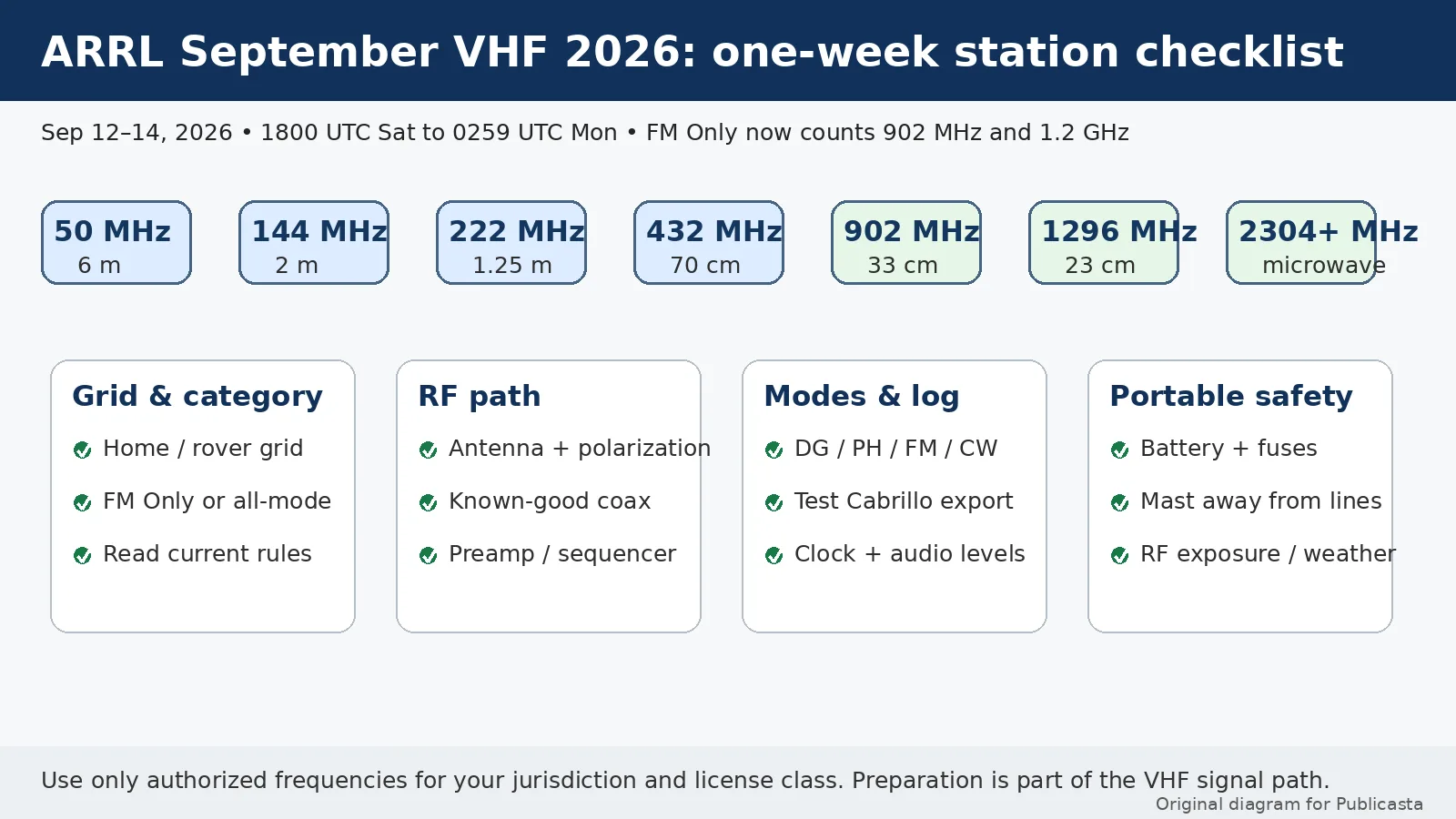
ARRL September VHF 2026: prep bands, grids and logs before contest weekend
A practical one-week station checklist for the September VHF Contest, including the FM Only 902 MHz and 1.2 GHz scoring change.
Activate All RI 2026: a practical plan for chasing or activating all 61 Rhode Island parks
Rhode Island’s Activate All RI weekend runs September 11–13, 2026. Here is how to use the schedule, live spots, portable station, band changes and ADIF logging workflow without treating a planned activation as a guaranteed contact.
LILYGO T-Watch Ultra with LoRa: What It Can Actually Do, and Where It Stops
The T-Watch Ultra looks like a LoRa communicator on the wrist, but its real value is more specific: an ESP32-S3 development platform with a radio, display and sensors. Here is what the hardware enables—and what it does not replace.

Comments
Sign in to comment.
No comments yet.