AI coding agents are becoming infrastructure. Treat them that way.
Claude Code, Bun, Codex and OpenCode show why development teams now need platform controls for the agents that read, edit and run their code.

One awkward thing happened in developer tooling this week: several unrelated debates started pointing at the same conclusion. AI coding agents are no longer only clever helpers inside an editor. They are becoming part of the software-delivery platform itself, with runtimes, release channels, quotas, context windows, security prompts, cache behavior, shell access and economic constraints that can change underneath a team’s workflow.
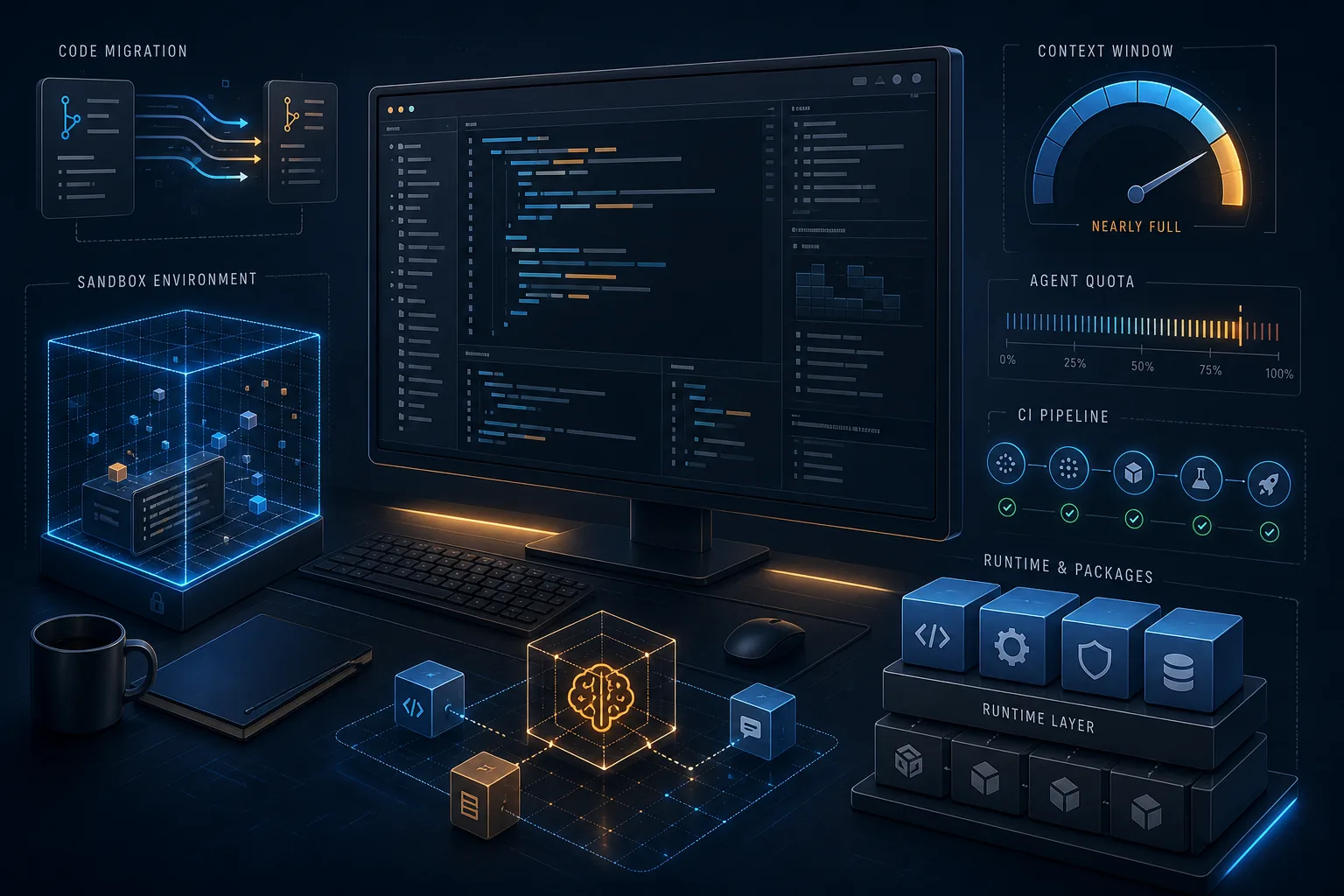
The visible spark was Simon Willison’s inspection of Claude Code. His post checked the installed Claude binary with simple command-line probes and found evidence that recent Claude Code builds bundle Bun 1.4 and Rust source-file paths. That lined up with Jarred Sumner’s public explanation that Bun had been rewritten from Zig to Rust and that Claude Code was already running the Rust port. Anthropic then described the Bun work as an example of large-scale migration with Claude Code: a rulebook, dependency map, test suite, adversarial reviewers and repeated compiler-driven repair loops around a migration that generated roughly a million lines in under two weeks.
Taken alone, that is a strong engineering story. A widely used JavaScript runtime moved a large body of systems code with AI assistance, and an agentic developer tool appears to have consumed that runtime before most users noticed. But the same news cycle also brought an OpenAI Codex metadata change discussed on Hacker News as a reduction in context size from 372k to 272k, a new destructive-action safety instruction in Codex metadata, Max Woolf’s running critique of unpredictable weekly quota resets for agent products, and a sharp community argument over OpenCode’s security and caching behavior. The combined message is not “AI agents are bad” or “AI agents are magic.” It is more operational: tools powerful enough to rewrite infrastructure now need to be governed like infrastructure.
The quiet runtime swap matters because it was quiet
The Claude Code and Bun story is easy to misread. The most interesting point is not whether every detail of the Rust port is elegant, nor whether a ten percent Linux startup improvement is dramatic. The important point is that the implementation substrate of a popular agent changed in a way that many ordinary users did not perceive. Simon Willison’s article is valuable precisely because it was reproducible rather than promotional: inspect the binary, look for the Bun version string, look for Rust source-file paths, compare that with Bun’s public posts and Claude Code release notes.
In normal infrastructure, a quiet runtime change can be good. Boring is often the goal. If a package manager, compiler, browser engine or database library changes internals and the test suite stays green, users are spared noise. The difference here is that coding agents sit at the junction of source code, shell commands, model context, remote services and human approval. The runtime is not a small implementation detail when it controls the tool that reads a repository, edits files, invokes builds and summarizes decisions to the developer.
That does not mean Anthropic or Bun did something wrong by shipping a better runtime. It does mean teams should stop treating the local agent binary as a disposable chat client. The binary is part of the development stack. It deserves version pinning, changelog review, license notice inspection, reproducible installation paths and rollback planning. If a company would not let a random untracked build runner operate inside production repositories, it should not let a self-updating agent do so without a similar control plane.
The Bun migration shows what mature AI-assisted change can look like
The optimistic side of the story is real. Anthropic’s migration write-up is not a casual “the model rewrote our code” victory lap. The process it describes looks closer to disciplined modernization work: define a rulebook, map dependencies, identify behavioral gaps, create stress tests, translate incrementally, run compilers and tests, use reviewers adversarially, and keep mechanical checks as the judge. That is exactly the kind of environment where language models can be useful: lots of repetitive structure, strong feedback from compilers, existing behavior to preserve, and a human team deciding what counts as done.
For engineering leaders, this is the part worth studying. A code migration that once looked like a multi-quarter rewrite can become a controlled, evidence-driven program if the project has enough tests and enough architectural clarity. The AI agent is not replacing verification; it is consuming verification. The better the test suite, the dependency map and the acceptance criteria, the more useful the agent becomes. That is a very different adoption lesson from asking a model to “modernize this service” and hoping for the best.
The same lesson applies outside Bun. A team moving from one framework to another, updating a large dependency surface, converting build systems, or replacing handwritten wrappers can use agents effectively when the job is decomposed into deterministic slices. Give the agent a small target, run the compiler, run regression tests, inspect the diff, fix the rulebook, repeat. The model supplies speed and breadth. The organization supplies boundaries and judgment.
The risk is that companies will copy only the glamorous part. “A million lines in under two weeks” is a memorable number; the less glamorous part is the harness that made the number meaningful. Without tests, review and rollback, the same volume is not progress. It is a large unknown diff with a confident story attached.
Context windows are now a product contract
The Codex context-window discussion points at a different pressure. Developers do not experience context as an abstract token number. They experience it as whether the agent remembers the plan, keeps the constraints, understands the architecture and can reason over a long debugging session without flattening the details into a lossy summary. A change from 372k to 272k, if that is what the shipped metadata effectively did for a given model path, is not merely a pricing tweak. For some workflows it changes the kind of task the tool can handle.
Hacker News comments around the Codex change were predictable but important. Some developers argued that compaction makes raw context less important. Others said compaction is exactly where detail disappears: design constraints become generic bullets, investigation trails lose the failed hypotheses, and the next turn has to rediscover what the previous hour already established. Both sides can be right depending on the workload. Small edits tolerate compaction. Complex migrations, security reviews, paper-heavy research and cross-repository debugging often do not.
This is why context should be treated as a product contract for professional agent tools. If a vendor changes the effective window, cache behavior or compaction strategy, enterprise users need to know. Not because every change is malicious, but because the workflow depends on it. Platform teams already track compiler versions, database query planners and CI image changes. Agent context is moving into the same category.
The new destructive-action safety language discussed in the Codex PR is another sign of maturation. Telling an agent not to use broad recursive destructive commands against $HOME, /, a workspace root or similarly wide targets is sensible. The interesting part is that these instructions live inside model and tool metadata that users may not read, even though they shape the safety boundary of local automation. Safety policy hidden in changing prompts is better than no policy, but it is not enough for regulated or high-stakes environments. Teams need enforceable guardrails outside the model: filesystem sandboxes, command allowlists, disposable worktrees and logs that humans can audit.
Quotas and resets are part of reliability, not just billing
Max Woolf’s quota-reset article captures a frustration that many heavy agent users recognize: the product feels like an assistant, but the operating envelope feels like cloud capacity management mixed with subscription psychology. Five-hour windows, weekly quotas, surprise resets and provider-specific limits are not just consumer inconvenience. For teams using agents in actual delivery work, they become reliability variables.
A developer who runs out of quota during a weekend experiment is annoyed. A platform team that builds a migration workflow around an agent and then discovers that usage limits reset unpredictably has a planning problem. A security team that relies on an agent for first-pass code review needs to know whether the tool will be available consistently, what model tier it will use, and how fallbacks behave when capacity tightens. Procurement needs this too: a subscription that looks cheap per seat may be expensive if the effective limit forces parallel accounts, manual retries or work stoppages.
This does not mean vendors should publish every capacity detail. It does mean professional tiers need operational transparency: documented limits, stable reset semantics, usage telemetry, administrative controls and a clear explanation when the envelope changes. Agent productivity is increasingly tied to GPU availability, cache economics and competitive release timing. Those are real business constraints, but customers need contracts rather than folklore.
Open-source harnesses do not remove the governance problem
OpenCode’s current backlash shows the other side of the market. Many developers want open-source or local-first harnesses because they dislike opaque vendor tools. That instinct is healthy. Open code makes it possible to inspect defaults, patch behavior, wire local models and build internal policy. But an open-source agent harness is still an agent harness. If it reads broad filesystem context, shells out to tools, prunes or compacts sessions badly, misses prompt cache opportunities, or defaults to remote behavior in surprising ways, the risks are operational rather than merely ideological.
The polemical “Stop Using OpenCode” post should not be treated as the final verdict on the project. Some complaints may be version-specific, some may be fixable, and Hacker News commenters pushed back on the severity of several claims. But the discussion is useful as a checklist. Does the tool explain what it reads? Does it keep cache-stable system prompts? Does it separate project configuration from user secrets? Can it run inside a network-restricted container? Are approval prompts precise enough for dangerous actions? Can a team disable remote providers by policy? Does compaction preserve facts that matter, or only vibes?
Those questions apply equally to closed tools, open tools and internal forks. The fact that a repository is visible on GitHub does not automatically make it safe for production use. The fact that a vendor is established does not automatically make it transparent. Teams need to evaluate the harness, not only the model.
The security model has moved beyond “do not paste secrets”
The old advice for AI tools was simple: do not paste secrets into a chatbot. Terminal agents make that advice inadequate. A coding agent can traverse a repository, read ignored files if permissions allow it, inspect commit history, run package scripts, download dependencies, modify shell startup files through symlinks if protections are weak, and send selected context to remote services. Even when the tool is honest and well designed, the attack surface is larger than a text box.
Recent security research around coding agents has already shown why repository trust matters. A malicious project can shape instructions, trick setup steps, hide dangerous behavior in build scripts, or exploit weak approval summaries. The human may think they are authorizing a harmless edit while the agent has a broader filesystem effect. That is not a reason to abandon agents; it is a reason to run them like privileged automation.
A sane baseline is not complicated. Use disposable worktrees or containers for unfamiliar repositories. Mount only the project directory, not the whole home folder. Keep cloud credentials, SSH keys and production tokens out of the agent’s reachable environment. Require human review for network egress, package installation and destructive commands. Log commands and file changes. Make CI the merge gate, not the agent’s confidence. For high-risk repos, start with read-only analysis and review tasks before granting edit or shell permissions.
The important shift is cultural. Agents should not be approved because a developer likes them. They should be approved because the organization understands where they run, what they can read, what they can send, what they can change and how to recover when they are wrong.
What teams should do now
The practical answer is not to ban everything until the market settles. The tools are already useful, and the Bun migration demonstrates that disciplined teams can extract real value. The answer is to create an agent adoption policy that looks more like platform engineering than tool enthusiasm.
First, inventory the agents actually in use. Many organizations will discover that developers have already installed several: Claude Code, Codex, Cursor-like tools, open-source harnesses, local-model wrappers and experimental CLIs. The goal is not punishment. The goal is visibility. You cannot govern a tool you do not know exists.
Second, classify repositories. A public demo project, an internal service with no secrets, a regulated product repository and an infrastructure-as-code repo should not all have the same agent permissions. Create tiers: read-only allowed, edit allowed in disposable branches, shell allowed in containers, network restricted, secrets forbidden, production access never mounted. Make the default safe enough that developers can move quickly without inventing their own controls.
Third, pin and record versions. Keep the agent binary, model path, runtime version, configuration and allowed tools in a project-local record. When a vendor changes context windows or bundled runtimes, the team should be able to correlate behavior with a release. When a migration succeeds, the organization should know which agent setup produced it.
Fourth, make tests the contract. The lesson of Bun is not that AI-generated rewrites are automatically trustworthy. It is that compilers, tests and reviewers can make large generated changes reviewable. If a project lacks tests, use agents to help build characterization tests before using them for sweeping migrations. A weak test suite is not a reason to give the agent more autonomy; it is a reason to give it less.
Fifth, monitor cost and capacity. Context windows, cache hits, quota resets and fallback models affect delivery. Track usage at the team level, not only the individual subscription level. If a workflow depends on a long context window, document that dependency. If a vendor changes the limit, treat it as a platform event.
What vendors should provide
The vendor side is equally clear. Professional agent products need better operational contracts. Changelogs should include runtime changes, model-routing changes, context-window changes, cache-policy changes and safety-policy changes. Enterprise channels should offer slower, stable release tracks. Administrators should be able to enforce allowed providers, local-only mode, telemetry policy, network behavior, workspace boundaries and destructive-command rules.
Binary transparency also matters. If a tool bundles a runtime, users should be able to see the version, license notices and update path without reverse engineering. If an agent depends on hidden prompt policy to avoid dangerous actions, the vendor should expose the policy in a form administrators can review and supplement with real enforcement. If quotas reset unexpectedly, customers should have a canonical status or usage endpoint rather than social-media archaeology.
Open-source projects have a different version of the same obligation. They need secure defaults, clear local-versus-remote configuration, cache-stable prompts, reproducible releases and documentation that explains the threat model honestly. “You can read the code” is not a substitute for a design that minimizes surprise.
The bottom line
AI coding agents have crossed a threshold. They are useful enough to help with serious migrations, popular enough to shape developer habits, and powerful enough to deserve infrastructure-grade controls. The week’s arguments about Claude Code, Bun, Codex, quotas and OpenCode are not separate dramas. They are symptoms of a young platform category becoming operationally important before all of its contracts are mature.
The right response is neither panic nor blind adoption. Use the tools where verification is strong. Limit them where trust boundaries are weak. Ask vendors for the same clarity expected from compilers, CI systems, package registries and cloud platforms. Most importantly, remember that an agent’s output is only one part of the system. The runtime, context window, quota model, sandbox and approval design are now part of the software supply chain too.
Related articles
Grok Build shows why AI coding agents need a new trust boundary
The repository-upload backlash around xAI’s Grok Build is a warning for every team adopting coding agents: prompt privacy is no longer the whole risk model.

When an AI eval becomes a real security incident
OpenAI and Hugging Face turned a benchmark failure into a practical warning about agent sandboxes, network egress and defensive access to strong models.

Grok Build shows why AI coding agents need data boundaries
The Grok Build backlash is less about one vendor than a new rule for development teams: AI coding agents need sandboxing, egress controls and repository-aware governance.

What Grok Build changed about trusting AI coding agents
The xAI backlash is not only about one CLI. It shows why teams need to verify what AI coding agents read, upload, store and leave behind.

Comments
Sign in to comment.
No comments yet.