An AI Image Is Not Proof: How to Handle a Message Claiming Someone Found Your Lost Pet
A new wave of lost-pet scams uses stolen details, urgent payment demands and AI-generated images. Here is a calm verification plan that protects your money, accounts and search effort without dismissing a genuine finder.

A message saying someone has found your missing dog or cat should feel like a breakthrough. It may arrive when you are exhausted, worried and ready to believe almost anything. That emotional pressure is exactly what makes lost-pet scams effective.
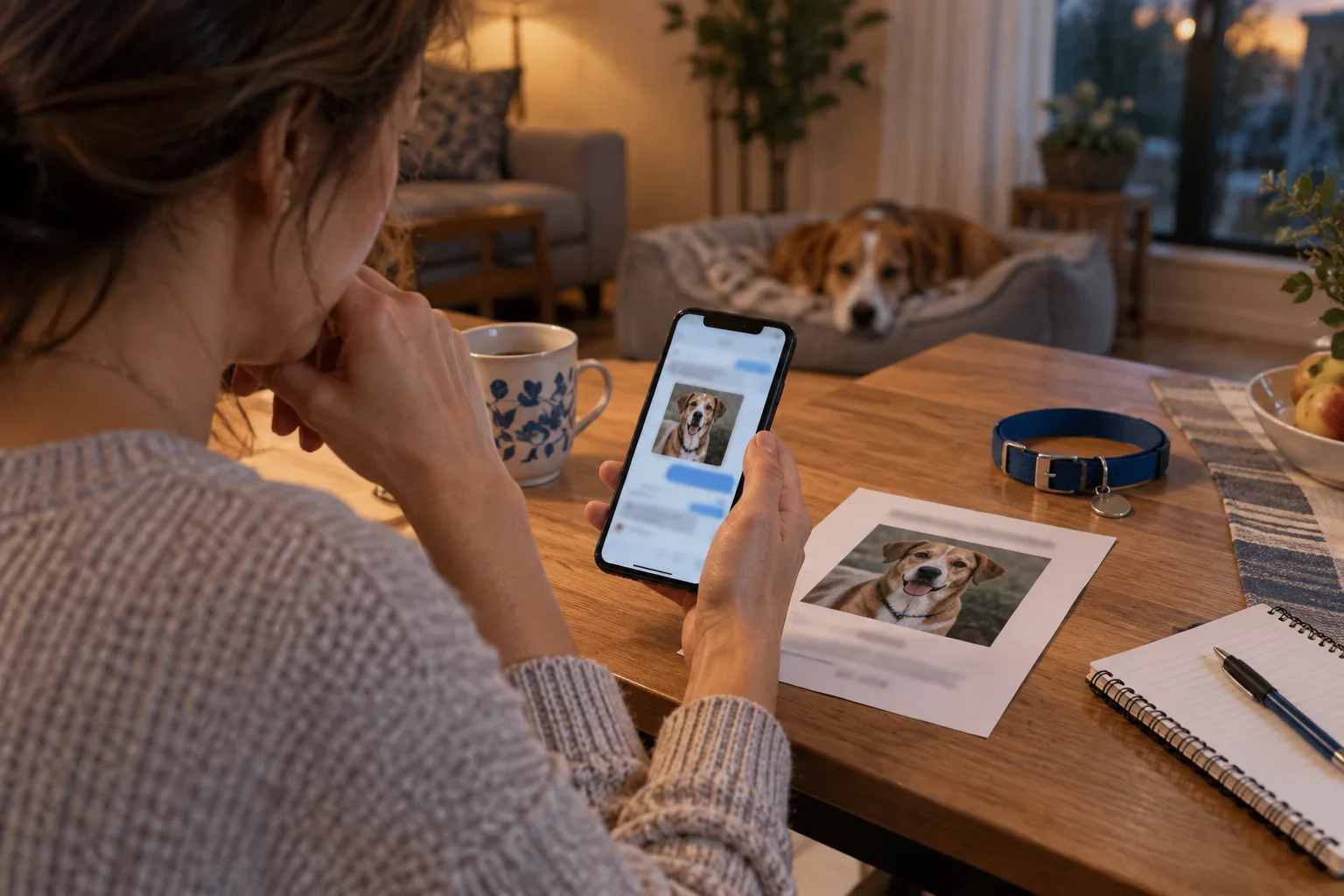
Police warnings and consumer-protection guidance now describe a sharper version of an old fraud pattern: scammers copy details from public missing-pet posts, contact the owner directly and use fabricated images or videos to make the story look convincing. In one recent warning, Norwalk, Connecticut, police said residents were being targeted with AI-generated images of supposedly found pets. The Federal Trade Commission has separately warned that scammers may use AI-generated pet images and videos, impersonate shelters or animal hospitals, and demand unusual forms of payment.
The practical lesson is not to distrust every stranger who contacts you. Genuine finders exist, and a fast response can help a real animal get home. The useful rule is narrower: treat a message as an unverified lead until the person can answer questions that were not visible in your public post, provide a live or current proof of possession, and agree to a safe handoff without rushing you into payment or account access.
Why a convincing photo proves very little
A photograph can show that an animal resembling yours exists. It does not, by itself, show who took the photograph, when it was taken, where the animal is now or whether the sender has any connection to the animal.
A scammer may download the clearest picture from your lost-pet poster, crop it, alter it or ask an image generator to place the animal in a different room. The result may contain small visual errors, but visual inspection is not a reliable security system. AI images are improving, and a real photograph can also be old, stolen or unrelated to the claim.
The same problem applies to short videos. A clip may look more persuasive than a still image, but it can still be copied from another account, edited, or generated. It may also show a similar-looking animal rather than your pet. A video is useful only when it is paired with details the sender could not have obtained from your public post and a live verification step.
The FTC's current advice for animal-related scams is consistent on the central point: do not let an emotional story remove your normal checks. The agency says scammers have used fake distress images, impersonated animal hospitals and requested gift cards, cryptocurrency, payment-app transfers or wire services. Those payment methods are dangerous because recovery is often difficult or impossible.
The first response: slow the conversation down
If a message arrives, take a screenshot of the profile, phone number, email address, message and any attached image before replying. Do not delete the conversation while trying to report it. Preserve the exact wording, because the sequence of requests may help a platform, police department or fraud-reporting service understand what happened.
Then pause. A real finder who has safely contained an animal may be impatient, but a legitimate person should still be able to tolerate basic verification. Scammers benefit from urgency. They may say the pet is injured, the shelter is closing, a driver is waiting, or treatment will stop unless money arrives within minutes. The time pressure is part of the mechanism, not proof that the situation is real.
A short response is enough:
Thank you. I am trying to verify this safely. Please do not move the animal or pay anyone on my behalf. I will call the local shelter or police non-emergency line independently, and I need a current live video or an in-person handoff at a public location.
Do not click a link sent by the person until you know who they are. Do not install an app, share a password, forward a one-time code or send a copy of your identity document. A finder does not need access to your email, social account or phone verification messages to return a dog or cat.
Ask for information that was never public
Your original post probably included a name, breed or type, color, approximate size, neighborhood, collar description and a photograph. Those details are useful for a genuine search, but they are also a ready-made script for a scammer.
Prepare one or two private identifying details before posting publicly. Examples include a small scar, a non-obvious marking under the chin, the side of a chipped ear, a particular response to a harmless sound, or a distinctive but non-sensitive feature of the collar. Do not publish those details in the first notice. Keep them for verification.
When someone claims to have your pet, ask open questions before supplying the answer:
- Where exactly did you see the animal, and at what time?
- Which direction was the animal moving?
- What was it wearing when you saw it?
- Can you describe a marking that was not included in the public post?
- What does the animal do when you say its name or make a familiar sound?
- Can you send a fresh photograph holding a handwritten note with today's date and a word I choose now?
These questions are not a perfect test. A frightened animal may not respond normally, and a good-faith finder may have seen it only briefly. But a person who refuses every reasonable question, answers only with details copied from your post, or changes the story repeatedly has not provided useful confirmation.
Avoid giving the private detail first. If you tell the sender, “My dog has a white patch on the inside of the back leg,” they can simply repeat it. Ask them to describe the feature in their own words, then compare what they say with your records.
Use a live check, not just another attachment
A current live video call is stronger than a forwarded image because it allows you to request a simple action in real time. Ask the person to show the animal from several angles, move the camera away and back, and hold up a handwritten phrase or today's date. Keep the request harmless and brief. Do not ask them to frighten, restrain or manipulate the animal.
A video call can still be faked or staged, so treat it as one part of a check rather than absolute proof. Look for whether the person can answer ordinary follow-up questions without reading from your post. If they claim to be at a shelter, end the conversation and call the shelter using the number on its official website, not a number supplied in the message. If they claim to be at a veterinary hospital, independently find the hospital's published number and ask whether the animal is there.
Do not use the sender's link to verify the organization. Fraudsters can create pages that resemble real shelters, clinics or police departments. A separate search, a known local contact and a call you place yourself are safer.
For an in-person meeting, choose a public place with staff or cameras, such as a police-station lobby, municipal animal shelter or veterinary clinic. Bring another adult. Tell the other person in advance that no payment will be made at the meeting and that you will independently confirm any claim of medical treatment. If the person refuses a normal public handoff and insists on a private address, an advance fee or a courier arrangement, stop treating the contact as a routine reunion lead.
The payment traps most often used in the story
The demand may be called a reward, transport fee, boarding fee, rescue fee, release fee, medical deposit, insurance payment or reimbursement for fuel. The label matters less than the structure: the stranger says money must be sent before you can see or collect the animal.
The most dangerous requests commonly involve gift cards, cryptocurrency, wire transfers or payment apps sent to an account that cannot be independently tied to a real shelter, clinic or person. The FTC specifically identifies these payment methods as warning signs in pet scams. A request for a normal payment method is not automatically safe, but an insistence on an irreversible or hard-to-recover method is a strong reason to stop.
A legitimate shelter may have formal fees, and a veterinary clinic may require payment for care. That does not mean you should pay a stranger through a direct message. Call the organization through an independently found number, ask for the animal's intake or patient details, and follow the organization's normal process. Do not allow a sender to create an emergency payment channel outside that process.
Be particularly cautious when the sender says the pet is in another city or with a driver. Long-distance claims create room for repeated charges: fuel, a crate, insurance, a permit, temperature control or a second emergency. If the animal cannot be located in a verifiable place, each new fee is simply another request attached to an unproven story.
Never give away a verification code
One version of the lost-pet scam does not start with money. The person claims they want to make sure you are the owner and asks you to send a six-digit code that has just arrived by text or email. That code may be used to take over an account, create a phone number or reset access to a service.
The safe rule is simple: a code sent to your phone or email belongs only to the service that generated it. Never forward it to a supposed finder, rescue worker, delivery driver or animal-control employee. If someone says the code is needed to prove you are a real owner, end the exchange.
If you already shared a code, act promptly. Change the password for the affected account from a trusted device, review recovery email and phone settings, sign out other sessions, enable multi-factor authentication through the service's own settings, and contact the provider's official support channel. If your phone number or email may have been taken over, contact the carrier or email provider directly. Do not use a support link supplied by the suspicious contact.
Also review what your public post reveals. A phone number, home address, daily routine, pet name and family names can help scammers sound informed. You can edit future notices to use a dedicated email address or a masked contact route, avoid posting your exact home location and remove personal details after the pet is safely home.
Separate a genuine sighting from a plausible story
A good report usually contains concrete observations: the location, time, direction of travel, the animal's behavior, whether it entered a yard or building, and what the witness did next. It may be incomplete, because a person who sees a frightened cat under a car or a dog crossing a road may not get close enough to identify it.
A scam story often contains the opposite mix. It may be highly emotional but vague about location. It may claim the animal is badly injured without naming a verifiable facility. It may answer questions with more questions, avoid a live call, use several accounts, or insist that you delete your public post before it will help.
Do not confront the person or accuse them publicly while you are still checking. Save evidence, stop sending information, block the account if necessary, and report it through the platform. Public arguments can expose more of your personal details and may warn the scammer that you are collecting evidence.
A real sighting that cannot be verified immediately should still be logged. Record the time, location, direction, description and contact details, then compare it with other reports. Ask the witness not to chase the animal. Pursuit can make a frightened dog run farther or cause a cat to hide more deeply. If the animal is visible, the most useful action may be to keep eyes on the location from a safe distance and contact local animal services or a knowledgeable rescue group.
Build your lost-pet post for recovery and privacy
The best protection starts before a scammer contacts you. A public post should make it easy for neighbors to recognize the animal without handing over every detail needed to impersonate a finder.
Use a recent, clear photograph and a short description of the last confirmed location. State whether the animal is frightened, likely to run, or unsafe to approach. Give a reliable contact method, but consider using a separate email address or a platform message form rather than publishing a personal number everywhere. Ask people to report sightings with the exact time and location, not to chase the animal.
Keep a private record containing multiple photographs, veterinary or adoption records, microchip information, distinctive markings and the private verification detail. Do not post the microchip number, full address, account recovery information or a photograph of an identification document. If the animal has a collar tag, do not publish every number or code printed on it.
Contact the local animal shelter, animal-control office, veterinary hospitals and microchip registry through official channels. A microchip is not a live tracking device, and it does not replace a current registry phone number. The registry can help only if the contact details are accurate and an animal is scanned by an organization or clinic with access to the relevant system.
Check the local shelter's lost-and-found listings yourself. If someone says the animal has been taken to a shelter, do not rely on a screenshot or a social-media page; call the shelter using its official contact information. Keep your post updated when a sighting is confirmed, resolved or no longer active. Clear updates reduce confusion and make it harder for old information to be reused against you.
What to do if you sent money or information
Do not keep paying because the scammer promises that one final transfer will release the animal. Stop contact and preserve the evidence. If you paid by card, bank transfer, payment app, wire service or cryptocurrency, contact the provider immediately through its official website or number and ask whether the transaction can be reversed or flagged as fraud. Speed matters, but recovery is not guaranteed.
Report the fraud to the relevant platform and to the Federal Trade Commission at ReportFraud.ftc.gov in the United States. If the person threatened you, came to your home, impersonated a local official, or you believe an animal is actually being harmed, contact local police or animal-control authorities. For a suspected account takeover, use the affected service's official account-recovery process and change reused passwords elsewhere.
If you posted your address, routine or family information, consider additional privacy steps. Tell household members not to engage with new contacts, review social-media privacy settings and watch for follow-up messages pretending to be banks, shelters, police or delivery services. A scammer who learns that you responded once may try a second approach using the information you disclosed.
None of this means that every unexpected message is fraudulent. It means that the emotional importance of a missing animal should not decide whether a claim is true. Verification protects both the owner and the real finder.
When veterinary help belongs in the plan
A person may claim that your missing pet is injured or needs urgent treatment. Do not diagnose the animal from a photo or accept a stranger's description as a medical fact. If the pet is physically recovered and appears hurt, weak, has trouble breathing, is bleeding, has been exposed to a possible poison, is not eating or drinking, or shows a sudden change in behavior, contact a veterinarian or emergency veterinary service promptly. Ask the clinic directly what to do rather than following medical instructions from a social-media contact.
If the pet is not recovered but someone reports a possible injury, pass the location and description to local animal-control services, the shelter or a veterinary hospital through independently verified contact details. A genuine emergency still deserves a safe response; it does not require you to bypass verification or send money to an anonymous account.
The current wave of AI-assisted deception changes the appearance of the scam, not the underlying test. A believable image is still only a claim. A safe recovery lead has a place, a time, independently checkable details and a handoff that does not depend on panic. Keep those standards even when the message appears to show the face you have been desperate to see.
Related articles

iOS 27’s Siri AI rollout is a compatibility test, not an automatic upgrade reason
iOS 27 is available, but its headline Siri AI features depend on your iPhone, language, Apple Account region, beta access and local regulation. Here is what actually changes for owners and buyers.
When a phone camera turns an eclipse into the Moon: the Xiaomi 17 Ultra lesson
A reported Xiaomi 17 Ultra eclipse photo shows why buyers need to understand AI camera modes, RAW capture and the difference between enhancement and evidence.


Slotstream makes a 104 GB local LLM a Mac SSD problem worth testing
The new MIT runtime streams Qwen3.8-Flash-Next experts from SSD, showing a clever path around memory limits — with speed, disk and license caveats.


Bonsai 27B shows what local AI can do before the cloud call
PrismML’s compressed 27B model is less about replacing the cloud than about moving private, routine AI work closer to the user’s device.

Comments
Sign in to comment.
No comments yet.