A New Dog Memory Study Offers an Early Clue About Aging—But It Is Not a Home Dementia Test
A University of Arizona study used treat-based memory and flexibility tasks to detect subtle age-related differences in dogs. Here is what the research means for owners, what to observe at home, and when behavior changes need veterinary attention.

A senior dog that starts wandering at night, getting stuck behind furniture or forgetting a familiar routine may be showing more than ordinary slowing down. But the same outward change can also come from pain, poor vision or hearing, illness, anxiety, or a disrupted environment. That is why a new canine cognition study is useful mainly as a reminder to observe carefully—not as a reason to diagnose a dog from a game at home.
Researchers at the University of Arizona have developed a roughly 40-minute assessment called CANID, short for Cognitive Assessment for Neuropsychological Impairments in Dogs. The assessment uses three treat-based tasks to measure memory, impulse control and behavioral flexibility. In a report published by the university, the researchers say the method detected subtle cognitive differences in some dogs around seven or eight years old, before the more obvious signs owners often associate with canine cognitive dysfunction appear later in life.
The work gives owners a practical question to consider: how can you notice a meaningful change in an aging dog early, while still leaving diagnosis to a veterinarian?
What the new assessment actually measures
The study was led by Stephanie Hargrave, a doctoral researcher, with Evan MacLean and colleagues at the University of Arizona. The team tested 239 dogs in Tucson and California, and many of the dogs were assessed again six months and one year later. Their scores were sufficiently consistent over time to support the use of the tasks in research on canine aging.
The assessment is not a quiz that produces a simple “normal” or “dementia” result. It combines performance across several kinds of problem solving.
In the first task, a dog watches a treat go into a clear tube that is open at both ends. The obvious route is to push toward the treat through the closed front of the tube. The dog must instead inhibit that first impulse, move around the obstacle and approach the open end. This is a test of detour behavior and impulse control.
In the second task, a dog watches a treat being hidden behind one of four barriers. After a delay of up to 40 seconds, sometimes with a distraction, the dog must remember where the treat went. This tests short-term memory under controlled conditions.
The third task examines flexibility. The dog learns which route around a barrier is open, then the researchers quietly block that route and change the correct path. A dog that can adjust readily is showing behavioral flexibility; a dog that keeps repeating the old route is having more difficulty changing its strategy.
These tasks are informative because they separate several abilities that owners often describe with one vague word: “confused.” A dog may remember where food was hidden but struggle to change a well-learned response. Another may be physically able to move around a barrier but lose interest quickly. A research assessment can record those differences more carefully than a casual household impression.
The university’s report also says that the study does not establish a test owners can run independently. It requires trained staff, standardized equipment and consistent scoring. A dog failing to find a treat behind a cushion is not equivalent to failing CANID, and a dog succeeding at a home puzzle is not proof that its memory is healthy.
Why an early clue matters
Canine cognitive dysfunction is an age-associated syndrome involving progressive changes in thinking and behavior. Veterinary sources commonly group the signs into several domains: disorientation, changed social interaction, sleep-wake disruption, house-soiling, altered activity, anxiety, and learning or memory changes. The pattern is sometimes summarized as DISHAA.
Owners often notice the signs gradually. A dog may first pause at a familiar doorway, sleep more during the day, or need extra guidance on a usual walk. Months later, the same dog may pace at night or appear unable to find its way out of a corner. Because each change can look small in isolation, families may write it off as “just getting old.”
That delay matters for two reasons. First, some interventions are easier to organize when a dog is still comfortable and able to participate in ordinary routines. Second, cognitive dysfunction is not the only possible explanation. Cornell’s College of Veterinary Medicine notes that a veterinary evaluation may need to consider pain, arthritis, seizure disorders, systemic illness, vision loss, hearing loss and other conditions that can produce similar behavior.
The CANID research is therefore best understood as an effort to improve measurement. It may help researchers identify subtle differences earlier, compare dogs over time and study which factors are associated with healthier aging. It does not tell an owner that a particular dog has dementia, and it does not replace a physical examination.
The study also challenges a tempting assumption about size. It is easy to imagine that large breeds must experience cognitive decline earlier because they often have shorter lives. The researchers reported a different pattern: dogs may follow a broadly similar trajectory, while many large dogs die before reaching the later stage at which major cognitive impairment becomes obvious. Small dogs may be more likely to live long enough for those changes to become visible. That is a population-level observation, not a prediction for an individual animal.
What owners can watch for at home
The useful home “test” is not a pass-or-fail puzzle. It is a calm record of how the dog functions in familiar situations. Look for changes that persist, repeat or affect daily life.
Orientation and navigation
Notice whether your dog:
- gets stuck behind furniture or in a corner;
- stares at walls or into space more often than before;
- hesitates in familiar rooms or seems unable to find a usual exit;
- becomes lost in a yard or follows an unusual route through the home;
- needs help locating a bed, door, water bowl or family member.
One awkward moment means little. A repeated pattern, especially one that is growing more frequent, is worth writing down and discussing with a veterinarian.
Sleep and nighttime behavior
A change in the day-night rhythm is one of the more noticeable signs for many families. An older dog may sleep for long periods during the day and then wander, vocalize, pant, or seek attention at night. Nighttime restlessness can also be related to pain, needing to urinate, breathing problems, anxiety, medication effects, or other medical issues. The behavior should be documented rather than labeled automatically as cognitive decline.
Record when it happens, how long it lasts, what the dog does, and whether anything reliably precedes it. A short phone video, if taken without disturbing the dog, can be more useful to a clinician than a memory of a difficult night several weeks earlier.
Interaction and learned routines
Some dogs become unusually clingy; others withdraw. A dog may stop greeting familiar people, seem slower to respond to a known cue, or lose interest in a game it once enjoyed. But reduced response can also reflect hearing loss, discomfort, fatigue, or a change in the value of the reward.
Try not to “test” the dog repeatedly or increase pressure when it does not respond. A failed cue is information, not disobedience. Use a familiar, low-stress routine and observe whether the response varies with lighting, distance, flooring, noise, time of day or physical effort.
House-soiling and activity
New accidents in a previously house-trained dog deserve attention. So do a marked drop in exploration, repetitive pacing, sudden restlessness, or a loss of interest in walks and play. These changes can overlap with urinary problems, gastrointestinal illness, orthopedic pain, sensory decline and anxiety. They should not be treated as evidence of dementia without a veterinary assessment.
A safer way to use food games
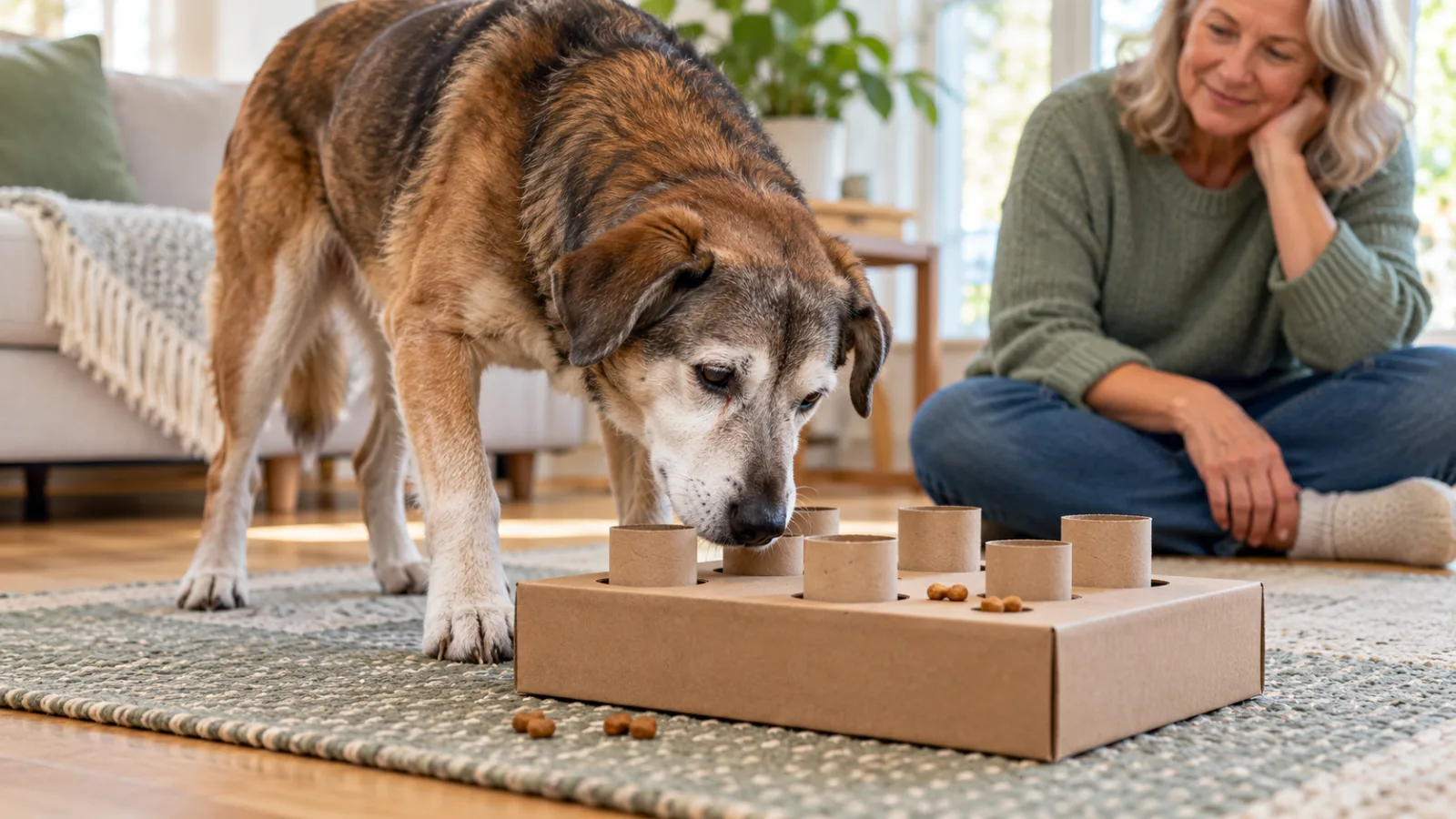
Food-based enrichment can be enjoyable for many dogs, including older dogs, but it should remain easy, supervised and appropriate to the individual animal. The aim is to provide a manageable opportunity to sniff, search or solve a simple problem—not to create a stressful examination.
Start with a game the dog already understands. Place a small portion of its normal food or a familiar treat in an open, easy-to-reach location. Let the dog watch you place it, then allow it to find the food without a long delay. If that goes well, hide it behind one visible object, such as a stable box or a low container with no sharp edges. Keep the route clear and stop while the dog is still interested.
A few principles make the activity more useful and safer:
- Use food that fits the dog’s existing diet and account for treats in the day’s total intake.
- Avoid tiny objects, loose packaging, plastic pieces, string, or anything the dog might swallow.
- Do not place food behind furniture where an older dog could become wedged.
- Keep the floor non-slip and remove obstacles that could cause a fall.
- Make the first version obvious enough that success is likely.
- If the dog becomes frustrated, circles repeatedly, pants, freezes, or walks away, end the game and simplify it next time.
- Never use failure as a reason to scold, restrain or physically guide the dog into position.
A dog that does not solve the game may be tired, unfamiliar with the setup, less food-motivated, unable to smell well, or uncomfortable moving. A dog that solves it may simply have learned that particular game. Neither result is a diagnosis.
For some older dogs, sniffing along a short, familiar route is better enrichment than a puzzle. Gentle exploration, calm social contact, short training sessions and predictable access to resting places can all provide mental activity without requiring difficult problem solving. The best activity is one the dog can perform comfortably and willingly.
Make the home easier to navigate
If an older dog is showing confusion or anxiety, environmental adjustments can reduce the number of problems it has to solve each day. Veterinary behavior guidance commonly emphasizes consistency and enrichment, and owner-care resources recommend keeping important parts of the home predictable.
Keep beds, food and water in stable locations. Avoid rearranging several rooms at once. Use gates to block stairs or unsafe areas rather than expecting a confused dog to remember a new boundary. Add non-slip runners over slippery flooring if the dog struggles to stand or turn. Make sure a night light does not create harsh shadows that could be more confusing.
A quiet resting area can help a dog retreat from household activity. If the dog is waking at night, keep the route to the door clear and provide an easy-to-clean sleeping area. If there are multiple pets, make sure the older dog can reach food, water and rest without being crowded.
Routine is useful, but it should be flexible enough to accommodate comfort and bathroom needs. Meals, walks and bedtime occurring in a familiar order can make the day easier to predict. A sudden change in schedule may temporarily worsen confusion in a vulnerable dog, while a gradual change is often easier to manage.
These steps support comfort; they do not cure an underlying disease. If the behavior is new, worsening or interfering with eating, sleeping, walking, toileting or social contact, arrange a veterinary appointment.
Why medical causes must be checked first
Behavior and health are connected. Merck Veterinary Manual guidance on behavior problems stresses the importance of ruling out medical contributors, with pain being a particularly important factor in behavior cases. A dog that seems irritable, withdrawn or unable to settle may be reacting to discomfort rather than losing memory. A dog that stops responding to cues may have reduced hearing or vision. A dog that paces at night may be uncomfortable, need to urinate more often, or have another condition that needs attention.
A veterinarian may ask for a detailed history and perform a physical examination. Depending on the signs, the clinician may recommend tests to look for problems that can resemble cognitive dysfunction. The purpose is not to turn every aging change into a complicated workup; it is to avoid assuming that a treat puzzle has explained a health problem.
Bring a timeline. Note the first date you noticed the change, whether it is constant or intermittent, what makes it better or worse, and whether appetite, drinking, bowel movements, urination, mobility or sleep have changed. Include videos when they can be captured safely. List supplements, prescription products and recent household changes. This information can make the appointment more productive.
Red flags that should not wait for a game or a routine check
Contact a veterinarian promptly for a sudden behavior change, collapse, seizure-like activity, severe disorientation, loss of balance, inability to stand, breathing trouble, repeated vomiting, suspected poisoning, a painful injury, or a dog that is not eating or drinking. New aggression, intense vocalization, or apparent confusion can also reflect pain or illness and should not be managed solely with training.
Urgency depends on the whole picture, including the dog’s age, existing conditions and severity of the sign. If you are unsure whether a symptom is serious, call a veterinary clinic for guidance. Do not give medication or supplements based on an online article, and do not attempt to treat a suspected neurological or behavioral disorder at home.
What this study changes for ordinary owners
The most useful lesson from the University of Arizona work is not that every owner needs a canine memory test. It is that aging is easier to understand when observations are specific. “He seems different” can become: “For the past three weeks, he has paused at the back door at night, needed help finding the water bowl twice, and no longer turns when called from the left side.” That is information a veterinarian and a family can act on.
Owners can use simple food games as enrichment if the dog enjoys them, but should not interpret success or failure as a medical result. Keep the activity easy, safe and repeatable. Watch the dog’s comfort rather than chasing a score. At the same time, track everyday function: sleep, navigation, interaction, toileting, appetite, mobility and interest in familiar activities.
The researchers’ assessment may eventually improve early detection and help studies of prevention or treatment. For now, the owner’s job is more modest and more practical: notice patterns, reduce avoidable confusion, preserve comfortable routines, and seek veterinary advice when a change persists or affects quality of life. An aging dog does not need to pass a home exam. It needs careful observation and support that matches what its body and behavior are showing.
Related articles
Dog Longevity Research Is Moving Forward—What Owners Can Use Now and What Still Needs Proof
A major dog-aging study has received new funding, and a clinical trial is testing whether rapamycin can improve healthy lifespan. Here is what the research means for ordinary owners—and which longevity claims should still be treated cautiously.
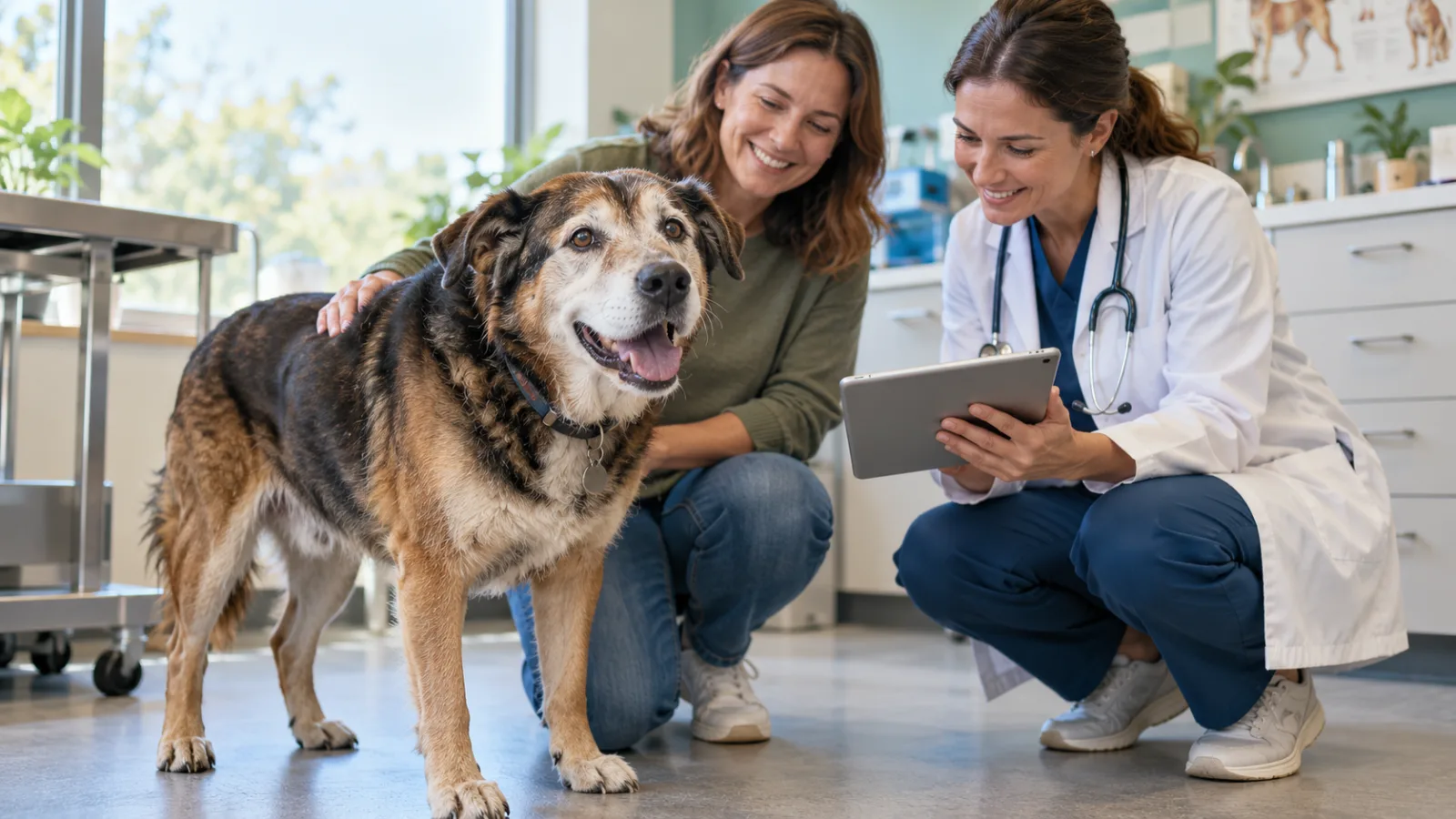
No-pull harness or better training? What actually helps a dog that drags on the leash
A practical owner’s guide to leash-pulling, harness choice, calm training habits and the red flags that belong with a veterinarian, not a stronger piece of gear.

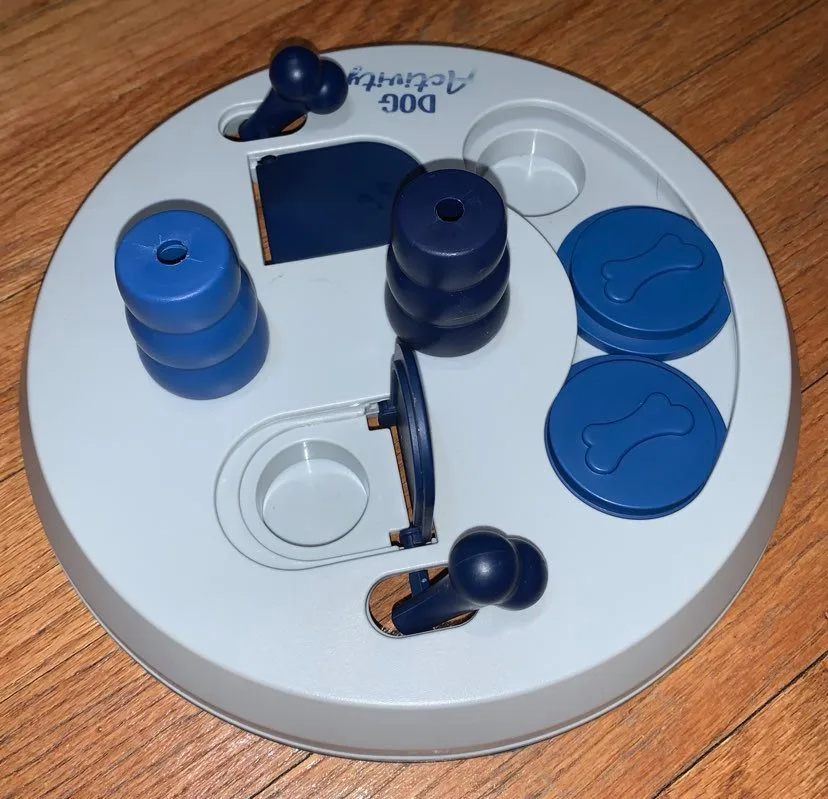
The dog keeps chewing everything: safe enrichment ideas and when to call the vet
A practical owner guide to matching puzzle toys, chews and routines to the dog in front of you without missing anxiety or medical red flags.
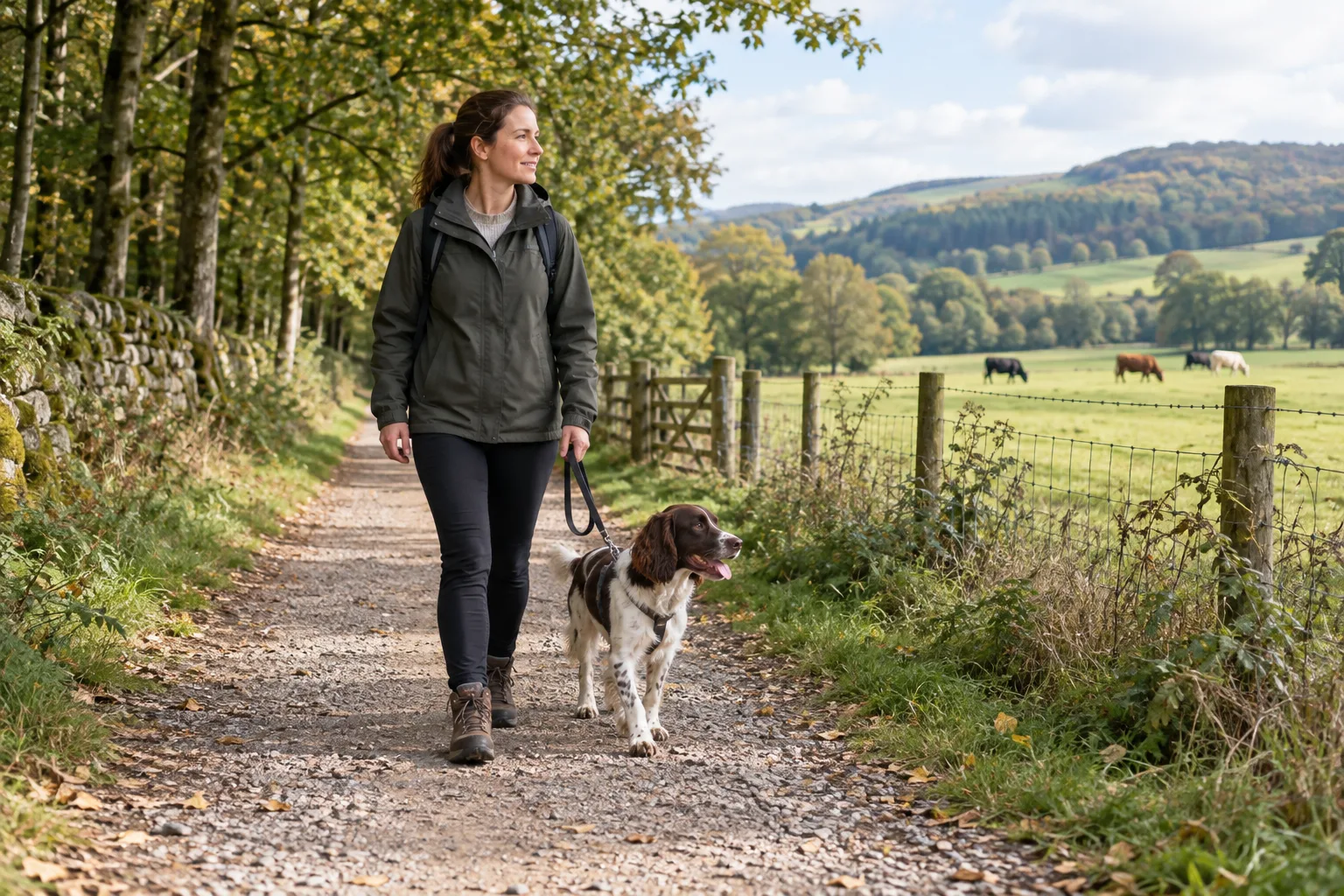
The distracted dog walk: how to protect wildlife, livestock and your dog without ruining the outing
A new University of Surrey study links missed dog waste, wildlife disturbance and livestock encounters to divided attention. Here is a practical way to make walks safer, calmer and easier to manage.
Comments
Sign in to comment.
No comments yet.