EleTac Makes Robot Touch a Hardware Cost and Reliability Test
King’s College London and JAIST researchers built a soft, vision-based gripper inspired by an elephant’s trunk. Its significance is less about copying nature than testing whether tactile sensing can become cheap, integrated and practical enough for real robotic work.

A robot can identify a grape, a metal pipe and a playing card with the same camera system. It cannot safely handle all three with the same grip. The grape needs low force and a stable contact; the pipe needs a firm hold; the card may require the robot to detect a thin edge before it can lift it. Vision can tell a machine what an object looks like, but it does not by itself tell the machine whether the object is slipping, compressible, hollow or already in contact.
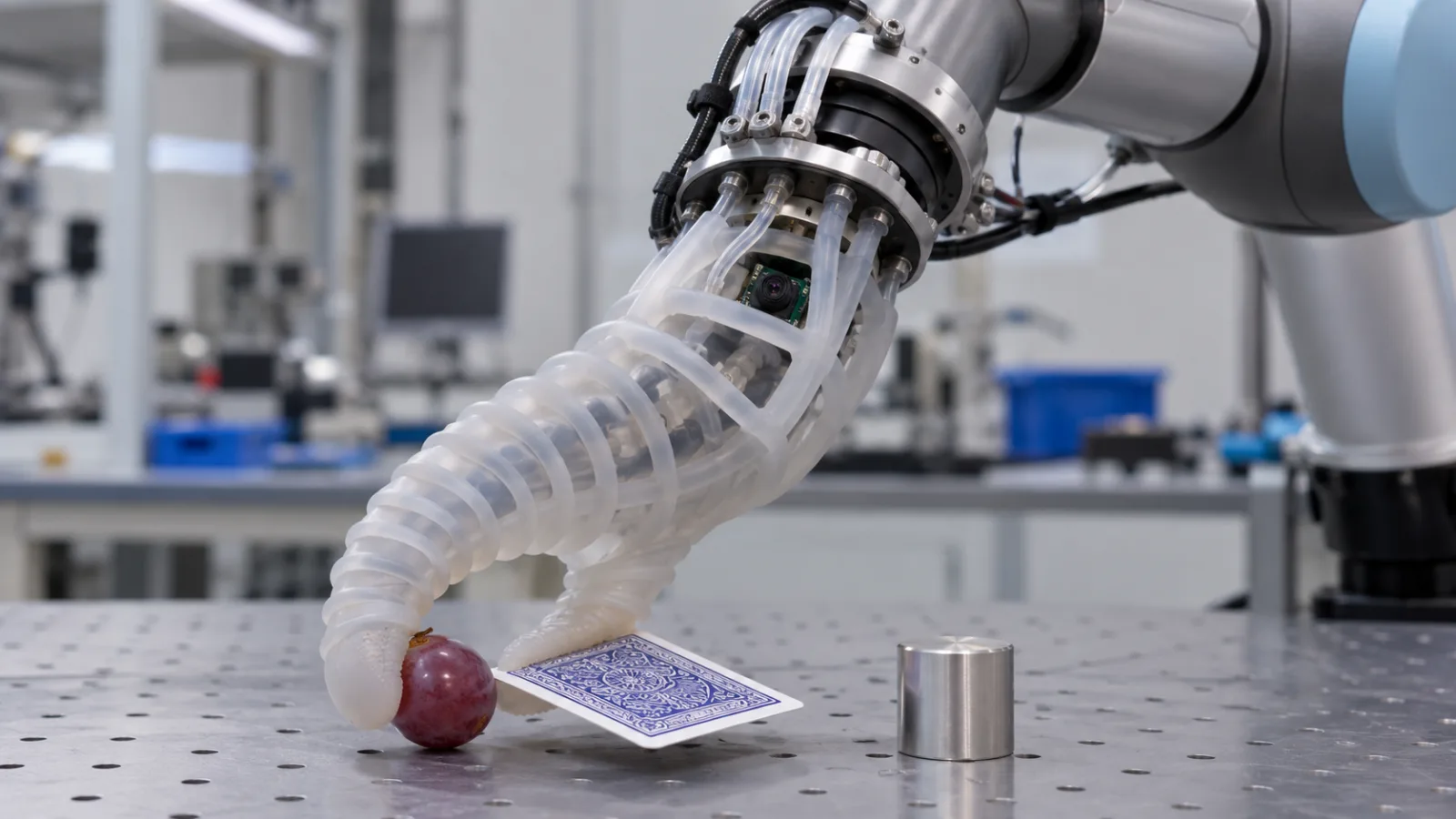
That gap is the point of EleTac, a soft robotic gripper developed by researchers at King’s College London and the Japan Advanced Institute of Science and Technology. The work was highlighted by King’s College London on November 23, 2026, after the underlying research appeared in IEEE Transactions on Robotics. The prototype takes inspiration from the tip of an elephant’s trunk and combines a compliant silicone surface with a camera-based tactile sensor.
The interesting question is not whether a robot can imitate an elephant. It is whether touch can be designed as a replaceable, affordable subsystem instead of an expensive specialist project. That is a more useful test for the robotics industry, where a gripper is rarely judged by a laboratory demonstration alone. It has to survive contact, remain calibrated, work with different objects, and fit inside a production budget.
What EleTac actually changes
EleTac uses a soft, rubber-like silicone shell at the end of a trunk-inspired gripper. A camera sits inside the shell. When the gripper touches an object, the shell deforms. The camera observes the changing shape and uses those visual changes to estimate information about contact, including the object’s shape, size and the force being applied.
This is a form of vision-based tactile sensing. The camera does not look at the object from a distance in the ordinary computer-vision sense. Instead, it looks at the deformation of the gripper’s own skin. The contact surface becomes a sensor, and the gripper becomes part of the measurement system.
That arrangement matters because soft robotics has a recurring engineering trade-off. Soft materials conform to irregular objects and reduce the risk of damage, but they are difficult to model precisely. A rigid finger is easier to control geometrically, while a compliant finger can absorb uncertainty. Adding conventional force and torque sensors to a soft mechanism can restore some information, but it also adds wiring, packaging, calibration work and cost.
The EleTac paper describes the device as combining tactile sensing and proprioception in the same soft structure. Proprioception here means estimating the gripper’s own state and movement, while tactile sensing describes what happens at the contact surface. The researchers’ broader design argument is that a manipulator can serve as its own sensor rather than carrying a separate stack of sensing modules for every function.
The prototype is not a complete general-purpose robot hand. It is a focused gripper designed to explore how a soft, deformable end effector can grasp and sense at the same time. That distinction is important. The device demonstrates a route to better manipulation; it does not prove that a humanoid robot can now handle every household or factory object without supervision.
Why the elephant-trunk analogy is useful
An elephant’s trunk is an appealing model because it combines flexibility, strength and rich contact with a large variety of shapes. It can pick up delicate items, push or pull heavier objects, explore surfaces and adjust its behavior without enclosing the object in a rigid hand.
The researchers are not trying to reproduce the biology nerve for nerve. They borrow a design principle: put compliance and sensing across the same broad contact area. The result is closer to a soft probe or adaptive gripper than to a miniature human hand.
That choice can solve problems that fixed fingers and suction cups handle poorly. A suction cup works best when a surface is reasonably smooth and the seal is reliable. A rigid parallel gripper works well when objects arrive in predictable orientations and the contact geometry is known. A soft, sensing surface has a better chance with objects that vary in shape, texture or stiffness.
The potential applications cited by the research team include manufacturing, search and rescue, and exploration or excavation in granular material. These are plausible application areas, but they should be read as targets rather than deployments. In a factory, for example, the gripper would still need a compatible actuator, an arm, a controller, protective materials, cleaning procedures and a way to detect when its own silicone surface has degraded.
The cost claim changes the conversation
King’s College London says the silicone tip costs about 50 pence to produce and that the complete device costs under £75. The university contrasts that with tactile prototypes using multiple high-accuracy or high-torque sensors that can cost more than £10,000. The comparison is useful as an indication of component economics, but it is not the same as a production-system cost comparison.
A low-cost sensing skin does not make the robot around it inexpensive. The camera, lighting, processing hardware, actuator, mechanical structure, calibration fixtures and software all remain part of the system. Industrial users also pay for integration, validation, maintenance and downtime. A sensor that costs very little but needs frequent replacement or careful recalibration may not be cheap over a full operating cycle.
Even so, the price difference points to a real bottleneck. If tactile sensing requires a bespoke, high-value instrument for every new robotic hand, it becomes difficult to scale beyond research labs and carefully controlled pilot cells. A low-cost soft sensor could make it easier for system integrators to add touch where vision is insufficient.
The most important result would therefore not be the lowest prototype price. It would be a repeatable manufacturing process that produces many sensor skins with similar behavior. Robotics companies need predictable calibration, known wear characteristics and stable performance across temperature, lighting and material batches. Those are the conditions under which a cheap component becomes a useful industrial component.
What the experiments show
The researchers report that EleTac can grasp and lift a variety of objects, including delicate items such as grapes and playing cards. The device is also described as capable of estimating small contact forces, with the university reporting sensitivity to forces as low as 0.25 newtons.
The experiments support a narrow but meaningful claim: a compliant gripper can use deformation observed by an internal camera to obtain useful tactile information without a separate high-cost sensor at every contact point. The gripper can adapt its grasp to objects that are not identical, and it can use contact information during manipulation rather than relying only on an initial visual estimate.
The paper also discusses applications such as exploration and excavation in granular media and adaptive surface following. These tests matter because they move beyond the familiar demonstration in which a robot picks up a handful of known objects from a clean table. Contact-rich tasks are where tactile sensing earns its keep. The robot must respond to what it feels, not merely execute a preplanned trajectory.
Still, the reported results should not be turned into a success rate for general robotic manipulation. The paper’s demonstrations are controlled experiments. They do not establish how EleTac performs after thousands or millions of cycles, under dust or oil, with occluded cameras, or when the object’s texture changes unexpectedly. They also do not establish how quickly the sensor can be recalibrated after a small tear or permanent deformation.
A careful reading of the work leads to a useful distinction. EleTac demonstrates that the sensing principle is viable. It does not yet answer whether the complete device is durable, maintainable and fast enough for a production line.
Why integrated sensing is attractive to robot builders
Many robotic systems separate perception, planning and actuation. A camera observes the scene, software estimates the object pose, a planner selects a grasp, and the arm executes the motion. This pipeline works well when the scene is structured and the object properties are known. It becomes fragile when the object shifts, the surface is slippery, the payload is deformable or the first contact is not where the model expected it to be.
Tactile feedback closes part of that loop. It gives the controller a signal after contact, when the robot can no longer rely solely on an external view. A gripper can detect that an object has not seated correctly, that a card is slipping, or that a force is rising faster than expected. That information can support small corrections before a drop or a damaged part occurs.
Putting the sensor into the soft structure has a second advantage: contact is measured where manipulation happens. A wrist force-torque sensor can tell a robot that a load changed, but it may not tell the robot exactly which part of a broad, flexible surface is touching the object. Distributed or full-surface sensing can provide a richer picture of contact geometry.
The trade-off is that the sensor becomes part of the mechanism’s body. It must tolerate the same mechanical abuse as the gripper. A separate sensor can sometimes be swapped out as a module; an optical sensor embedded in a deformable shell may require a different repair procedure. Integration simplifies one problem and creates another.
The limitations that matter before deployment
The first limitation is durability. Silicone is compliant, but no soft surface is immune to abrasion, cuts, contamination or permanent deformation. A gripper used around sheet metal, sharp edges or rough castings would face a different wear profile from one handling fruit or laboratory samples. The cost of replacing the skin matters just as much as the cost of making it.
The second is calibration drift. A camera-based tactile system interprets changes in appearance and shape. The mapping between image, deformation and force can change if the camera moves, illumination changes, the silicone ages or the surface picks up residue. A lab can recalibrate under controlled conditions. A factory needs a procedure that an operator or maintenance technician can complete without rebuilding the experiment.
The third is speed. Tactile information is useful only if it arrives quickly enough to influence the motion. A robot handling fragile objects may need to adjust grip force in a fraction of a second. A sensing method that is accurate but slow may be suitable for inspection or deliberate manipulation and unsuitable for high-throughput picking.
The fourth is force range. Detecting a very light contact is valuable, but a useful industrial gripper must also hold heavier loads without saturating or damaging its sensing surface. Sensitivity and load capacity are not interchangeable. A device optimized for grapes may need a different mechanical design from one intended for metal parts.
The fifth is generalization. The researchers report performance across a range of objects, but an industrial buyer will ask a more operational question: how many new objects can be introduced before new data, new calibration or a new gripper geometry is required? That question connects tactile sensing to the same deployment economics that affect other forms of physical AI.
Where the design could be useful first
The first commercial opportunities are likely to be bounded tasks in which the robot already has a defined workspace and the value of preventing damage is high. Examples could include sorting fragile produce, handling laboratory samples, picking irregular packaging, inserting flexible materials, or following a surface during inspection.
These tasks do not require a robot to understand the entire world. They require a machine to make better decisions at the moment of contact. That is a more realistic entry point than promising a universal hand for every environment.
Food handling is an obvious example because objects vary in firmness and are easily bruised. But food environments also expose the gripper to moisture, washdown procedures and hygiene requirements. A prototype that performs well on a clean laboratory bench would need substantial redesign before it could be used in a regulated food facility.
Search and rescue presents the opposite challenge. A soft, sensing gripper could help an operator or autonomous system explore uncertain surfaces, but the environment may contain dust, rubble, sharp fragments and unstable loads. The gripper would need to be robust enough to tolerate contact while remaining sensitive enough to distinguish a fragile object from debris.
Manufacturing may offer the clearest path if the gripper is assigned to a specific class of variable parts. A robot could use tactile feedback to compensate for small pose errors or to confirm that a part is seated. Yet factories often prefer specialized tools when cycle time, repeatability and maintenance are more important than flexibility. EleTac’s value would be strongest where part variation makes rigid automation expensive to reconfigure.
How to evaluate a tactile gripper claim
The useful metric is not whether a robot can pick up an object once. Buyers and researchers should ask for a test that resembles the intended workflow.
A serious evaluation should report the object set, the number of trials, the failure modes and the intervention policy. It should say whether the robot was allowed to retry, whether a human corrected the object between attempts, and whether the model saw the same objects during training. A high success rate on familiar objects can hide a system that fails immediately when shape, texture or orientation changes.
The test should also include cycle life. How does the sensor behave after repeated compression, lateral contact and cleaning? Does its force estimate drift? Does the controller know when the sensor itself is no longer trustworthy?
Latency deserves its own measurement. The relevant figure is not only camera frame rate. It is the time from physical contact to a usable control response, including image processing, inference and actuator movement. A slow but precise sensor may be useful in one workflow and dangerous in another.
Finally, the economics should be expressed per operating hour, not just per prototype. That calculation should include replacement skins, calibration labor, rejected parts, downtime, compute and integration. This is where the distinction between a clever research device and a deployable robot becomes visible.
What EleTac says about the next phase of physical AI
Physical AI is often discussed as if better models will solve manipulation by themselves. EleTac points in a different direction. Better behavior may depend on better physical interfaces: materials that deform predictably, sensors that remain inexpensive, and mechanisms that give learning systems clean feedback at the point of contact.
That does not make the intelligence problem disappear. The robot still needs a controller that can interpret tactile signals and choose a safe action. It still needs task-specific data, recovery behaviors and boundaries for when to stop and ask for help. But a robot cannot learn reliable contact behavior from vision alone if the critical information is hidden behind an object or produced only after the gripper touches it.
The project also illustrates why soft robotics is difficult to commercialize. Soft structures can reduce mechanical complexity in one sense while increasing the burden of sensing, modeling and maintenance. A soft part that is cheap to manufacture may be expensive to validate. A camera that replaces multiple sensors may simplify wiring but make calibration more dependent on material consistency.
The result is not a universal robot hand. It is a credible experiment in making touch part of the gripper rather than an expensive accessory attached after the mechanism is designed. That is a narrower claim, but it is the one that matters.
The practical verdict
EleTac’s contribution is best understood as an architecture and cost test. It shows that a soft contact surface can both manipulate objects and provide tactile information through an internal camera. The reported sensitivity, low material cost and range of demonstrations make the approach worth watching, especially for tasks where rigid grippers and vision-only systems struggle.
The next evidence should come from longer trials, independent replication and real operating conditions. Engineers will need to see cycle-life data, contamination tests, calibration procedures, force-range measurements and failure recovery. They will also need to know how easily the gripper can be rebuilt when the soft tip wears out.
If those tests go well, the impact may appear in ordinary robot cells rather than headline demonstrations. A picking system may gain a cheap tactile tip, a manipulator may handle more part variation, and a maintenance team may replace a compliant skin instead of redesigning a whole end effector.
That is why the elephant-trunk inspiration is less important than the engineering decision behind it. The advance is not that robots have acquired a poetic imitation of animal touch. It is that researchers are testing whether touch can become a practical, modular and affordable part of the machine.
Comments
Sign in to comment.
No comments yet.