The US robot ban is no longer theoretical: HoverAir and Unitree show the new robotics split
A flying pocket camera and a robot-dog distributor now show the same shift: robotics is moving from gadget hype into supply-chain regulation, national-security review and regional manufacturing choices.

The American debate over foreign robots has moved from policy papers into checkout pages. A pocket camera with detachable wings, HoverAir Versa, appears to have stopped taking full US orders only days after launch. At the same time, RoboStore, a major North American seller of Unitree robot dogs and humanoids, is pivoting from importing Chinese platforms toward building its own Robo Inc. machines on Long Island. These are not identical cases, but together they show a new robotics market split.
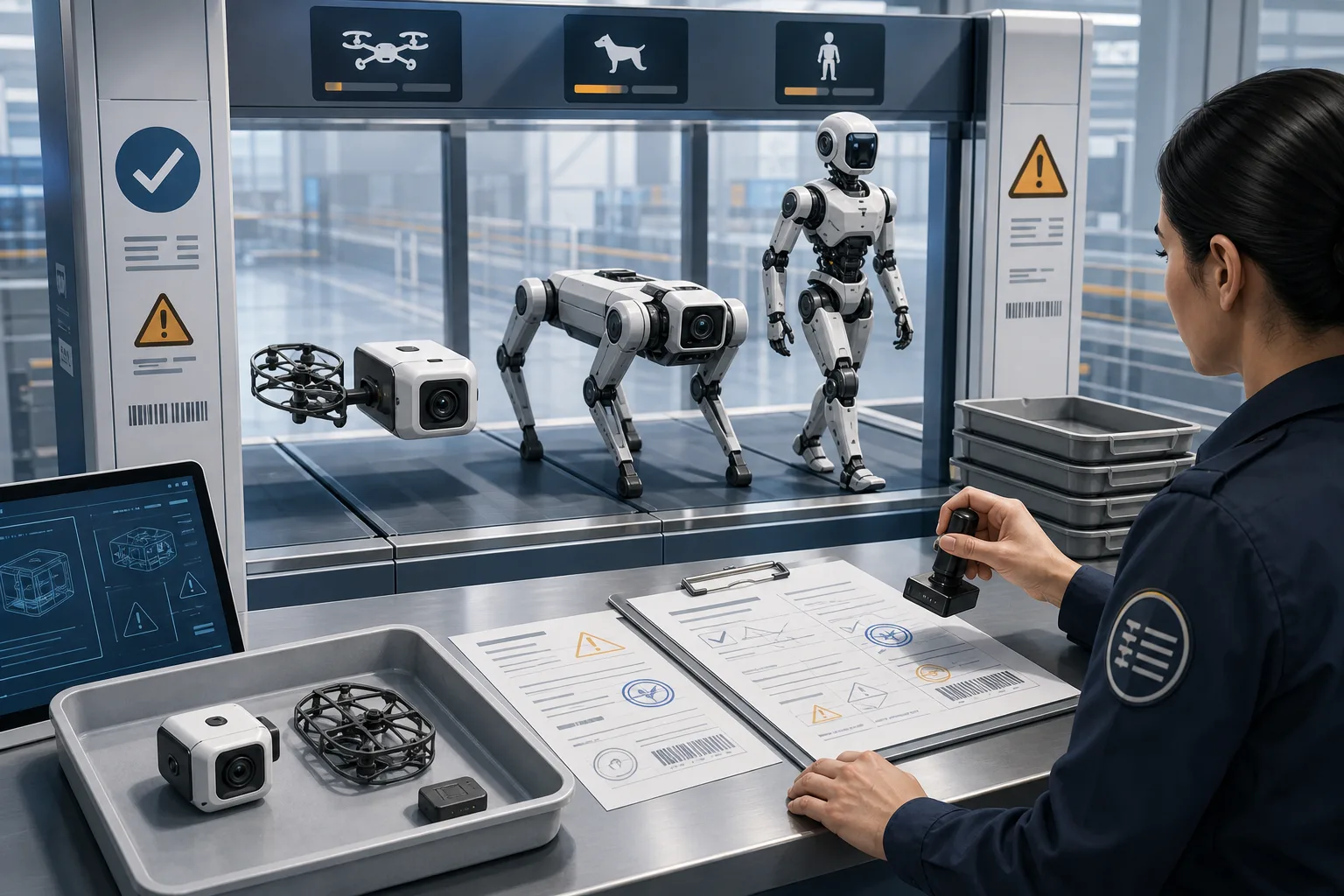
The old consumer question was simple: is the robot good, cheap and useful? The new question is more complicated: can it be certified, imported, serviced, updated and legally sold next year? For drones, robot dogs, humanoids, research platforms and autonomous camera devices, regulation is becoming part of the product. That is a major change for a field that grew partly because Chinese hardware made capable robots affordable to creators, universities and startups.
The Federal Communications Commission’s July action added foreign-produced advanced robotic devices and power inverters to the Covered List after national-security determinations by executive-branch agencies. TechCrunch described the move as a ban on new foreign-made humanoids, robot dogs and power inverters, with possible exceptions when a device is found not to pose a risk. IEEE Spectrum and other robotics sources have been covering industry reaction. The core logic is clear: robots are not just electronics. They sense, move, map, transmit and can receive remote updates.
That logic now affects very different products. HoverAir Versa is being marketed as a two-in-one camera: handheld gimbal plus self-flying flight kit. Unitree platforms are legged robots used by hobbyists, developers, universities and companies. One sits close to consumer photography; the other sits close to robotics research and physical AI. Both are caught in the same broader shift: autonomy hardware is becoming a supply-chain-security category.
What happened to HoverAir Versa
HoverAir Versa launched as a clever modular product. Without wings it is a compact gimbal camera. With the Flight Kit, it becomes a self-flying camera platform with propeller cages, auto flight modes and a 230-gram flying configuration described in early coverage. Gizmodo noted the company’s careful language: Zero Zero Robotics and HoverAir avoided calling it a drone and leaned on “Intelligent Self-Flying Camera.” That wording was not just marketing style. It was part of the regulatory story.
The Verge reported on August 21 that the transforming modular drone had already been halted in the US, only three days after its Indiegogo debut. According to The Verge, US buyers would receive the camera but not the Flight Kit, and the FCC database no longer appeared to show an authorization entry for HoverAir Versa. PetaPixel framed the same story as a flying gimbal camera that appeared to have been caught by the US ban.
The cautious wording matters. Unless the FCC or company publishes a clearer final statement, the safest description is that US full-kit orders appear halted and the flying component is apparently caught in the regulatory problem. That is still enough to matter. For a buyer, the distinction between “banned,” “authorization pulled,” “orders halted” and “logistics update” may be legally important, but the practical result is similar: the promised flying camera bundle is not simply available in the US as launched.
HoverAir also exposes a definition problem. If a product is a camera in one configuration and an unmanned aircraft in another, what is being regulated: the camera, the flight accessory, the complete bundle, the software, the radio module, the propulsion system or the foreign producer? Consumer robotics is full of these hybrids. The more modular the device, the more likely it is that lawyers, regulators and platform companies will argue over where the robot begins.
Why Unitree matters beyond one distributor
The Unitree case shows the same pressure on a different part of robotics. Unitree’s quadrupeds and humanoids became common because they were capable and relatively accessible. For universities and startups, that matters. A lab does not always need a perfect American-made robot; it needs a platform cheap enough to buy, break, repair and put in the hands of students.
Ars Technica reported that RoboStore, a major North American channel for Unitree robots, says it sold and deployed more than 1,500 robots and served more than 150 universities. The company is now turning toward Robo Inc., with a 66,000-square-foot Long Island facility and commercial versions targeted for early 2027. If that plan works, it is exactly the kind of local industrial base US policymakers want.
But the transition is not free. Import bans can create demand for domestic robots before domestic alternatives are equally mature, equally cheap or equally available. Universities, startups and integrators may face higher prices, delayed projects and narrower hardware choices during the gap. That cost does not show up in a national-security headline, but it shows up in research budgets and prototype timelines.
RoboStore’s pivot is also a test of whether distribution knowledge can become manufacturing capability. Selling Unitree robots teaches a company what customers want, what breaks, what support costs and what features matter. Building reliable legged robots at scale is another challenge. The success or failure of that pivot will be watched by anyone betting on regional robotics supply chains.
Why the FCC is treating robots as infrastructure
The strongest argument for restrictions is that autonomous systems are not passive gadgets. A robot can contain cameras, microphones, inertial sensors, depth sensors, wireless radios, mapping software, cloud accounts, firmware update channels and mobile apps. A drone or robot dog can move through sensitive spaces. A humanoid used in a lab can be connected to code, datasets and networks that matter.
From that perspective, the Covered List logic is not surprising. Telecom equipment, surveillance cameras and power inverters have already been treated as cyber-physical risk. Robots combine communication, sensing and motion. If a foreign-produced platform can collect data, receive updates or be controlled remotely, regulators will ask who can influence it and what happens if that influence is abused.
The difficult part is proportionality. A border patrol drone, a university quadruped, a camera for travel creators and a solar inverter are not the same product. A ban that treats categories broadly may be easier to enforce, but it can also catch devices whose real-world risk differs sharply. That is why exception processes, transparent criteria and technical audits matter.
Robotics needs a more precise safety and supply-chain language. Regulators should distinguish local operation from cloud dependence, open firmware from opaque update channels, commodity radio modules from tightly integrated platforms, and research-only robots from consumer devices. Without that precision, companies will either overcomply, underinvest in the US market, or invent naming tricks that make regulation even messier.
The argument for the ban
Supporters of the restrictions see robots as the next sensitive hardware category. Drones can map cities, facilities and infrastructure. Robot dogs can patrol, inspect or enter buildings. Humanoids may eventually work in warehouses, factories and public settings. If those machines are produced by companies subject to foreign-government influence, national-security agencies will not treat them as harmless toys.
There is also an industrial-policy argument. Cheap, mature imports can prevent domestic firms from reaching scale. If the US wants a robotics industrial base, it may need procurement rules, security rules and protected demand. Otherwise domestic companies may be asked to compete with subsidized or faster-moving foreign suppliers before they can build the manufacturing depth policymakers want.
A third argument is resilience. Robots depend on spare parts, software, batteries, sensors and cloud services. A country that depends heavily on foreign autonomous systems may later discover that maintenance, updates or replacements are fragile during a political crisis. The ban is one blunt way to force buyers to think about that before robots become more embedded.
These arguments are serious. Robots are moving from demos into infrastructure, education, security, inspection and industrial work. The question is not whether governments should care. They should. The question is whether broad blocking is the best path, or whether testing, certification, escrowed firmware, data-path disclosure and local-service requirements can manage some risks without cutting off useful platforms too quickly.
The argument against the ban
Critics see a different risk: slowing the practical spread of robotics by removing the most affordable and mature hardware. DJI dominates consumer and prosumer drones for a reason. Unitree became common in robotics labs for a reason. HoverAir, Insta360-style flying cameras and similar devices matter because they bring autonomous camera behavior to ordinary creators without a military budget.
If compliant alternatives cost much more, fewer students learn on real robots. Fewer startups can prototype quickly. Fewer creators test autonomous camera workflows. Fewer small businesses can justify inspection or mapping tools. A robotics market can be made safer on paper while becoming smaller, slower and less experimental in practice.
There is also a terminology problem. HoverAir Versa shows how fuzzy the boundary can be. A flying camera is functionally a drone even if the maker avoids the word. A robot dog may be a research platform, a security device, a toy, a developer kit or an inspection machine depending on who buys it. Laws built around broad labels can become hard to predict.
Finally, abrupt restrictions can reward companies with enough money to rebuild supply chains while punishing smaller teams and buyers. A large distributor may pivot to domestic manufacturing. A university lab cannot easily recreate a whole robot platform. A crowdfunding buyer cannot rewrite FCC policy. The costs are uneven.
What buyers and labs should do now
If you are buying a drone, flying camera or robot in the US, treat regulatory status as a product feature. Check FCC authorization, shipping restrictions, region-specific bundles, refund terms and whether accessories are certified separately. Do not assume a campaign page means the full kit will ship to your country unchanged.
If you are backing a crowdfunding robotics product, read updates and comments, not just the hero page. The HoverAir Versa story shows that a campaign can change between launch excitement and fulfillment reality. Ask what happens if a flight kit, radio module, battery or dock cannot ship to your region.
If you are a university or lab, document your hardware bill of materials, spare-part sources and cloud dependencies. Identify alternatives before a platform becomes unavailable. If a robot is central to a course or research program, decide whether you need a US-compliant substitute, a local-service agreement, extra spare units or a software abstraction layer that lets students move between platforms.
If you are a robotics startup, certification risk should be part of product design before launch. Modular accessories, radios, cameras, telemetry, cloud accounts and app permissions can all become regulatory issues. A clever naming strategy may help marketing for a week; it will not solve certification if the device functions as an aircraft or autonomous robot.
If you are outside the US, this still matters. The US market is large enough to shape product roadmaps, supplier choices and investor priorities. A product redesigned for compliance in one region can change globally. A platform withdrawn from one market can affect documentation, firmware support and accessory availability elsewhere.
What happens next
Expect more modular products testing definitions. Companies will try to separate camera cores, propulsion kits, docks, radio modules and autonomy features. Some will do this for legitimate compliance reasons. Others will do it to keep selling while the rules catch up.
Expect more local assembly and integration. RoboStore’s Robo Inc. plan is one example. Other distributors may try similar moves: import fewer complete systems, build more locally, source compliant radios, or turn into system integrators. This may create jobs and expertise, but prices are likely to rise at least during the transition.
Expect more exceptions and lobbying. Robotics companies will argue that some platforms are low risk, research-limited, locally operated or auditable. Buyers will ask for exemptions. Regulators will refine definitions. Courts and Congress may pull the market in different directions.
Expect regional robotics markets to diverge. A drone, robot dog or humanoid available in Asia or Europe may not ship to the US in the same form. Software features may differ by region. Accessory kits may be separated. Labs may standardize on different platforms depending on national rules.
The real robotics lesson
The HoverAir and Unitree stories are not just about China, and they are not just about bans. They mark the moment when everyday robotics became part of infrastructure policy. Robots are physical AI systems. They move, see, connect, update and sometimes act near people. That makes them exciting and sensitive at the same time.
For the Robots and Autonomous Systems audience, the important question is changing. It is not only “which robot is most advanced?” It is “which robot can be bought, certified, maintained, updated and legally used over the next few years?” A cheap, capable robot that cannot ship is no longer an accessible platform. A compliant robot that is too expensive may slow adoption. A domestic robot that exists only on a roadmap does not help a student this semester.
The next phase of robotics will be shaped as much by supply-chain trust, certification and manufacturing geography as by sensors and models. That may make robots safer and create local industries. It may also make them more expensive and less available. The trade-off is no longer theoretical. It is already visible in a flying camera campaign and a robot distributor’s factory plan.
Related articles
San Mateo’s humanoid robot permit push tests the rules for physical AI
A Silicon Valley county is not banning humanoid robots; it is asking what permits, fire rules, supervision and labor disclosures must exist before commercial deployment.
Hyundai’s Atlas strike is really about who writes the rules for humanoid robots
The Ulsan walkouts are formally about wages, but Atlas turns them into an early test of how factories should negotiate humanoid automation before it is fully mature.

Qualcomm’s PickNik Deal Puts Open Robot Motion Planning at the Center of Physical AI
Qualcomm’s planned acquisition of PickNik is less about buying a robot than owning a critical layer beneath many of them. The outcome will depend on whether MoveIt can gain hardware acceleration without losing the openness that made it useful.
IROS 2026’s Digit Demo Shows the Next Humanoid Test Is Measurable Reliability
A first-try mobile-manipulation run on Agility’s Digit v4 is a meaningful research signal, but not proof of general warehouse autonomy. The real test is repeatability, recovery, safety and cost in a working facility.
Comments
Sign in to comment.
No comments yet.