Qualcomm’s PickNik Deal Puts Open Robot Motion Planning at the Center of Physical AI
Qualcomm’s planned acquisition of PickNik is less about buying a robot than owning a critical layer beneath many of them. The outcome will depend on whether MoveIt can gain hardware acceleration without losing the openness that made it useful.
Qualcomm’s agreement to acquire robotics software company PickNik is a significant event in a part of robotics that rarely produces dramatic videos: the software layer that plans how a machine should move, avoid collisions, and manipulate objects. The transaction does not deliver a new humanoid, warehouse fleet, or autonomous vehicle. It targets infrastructure that can sit underneath many different kinds of robots.
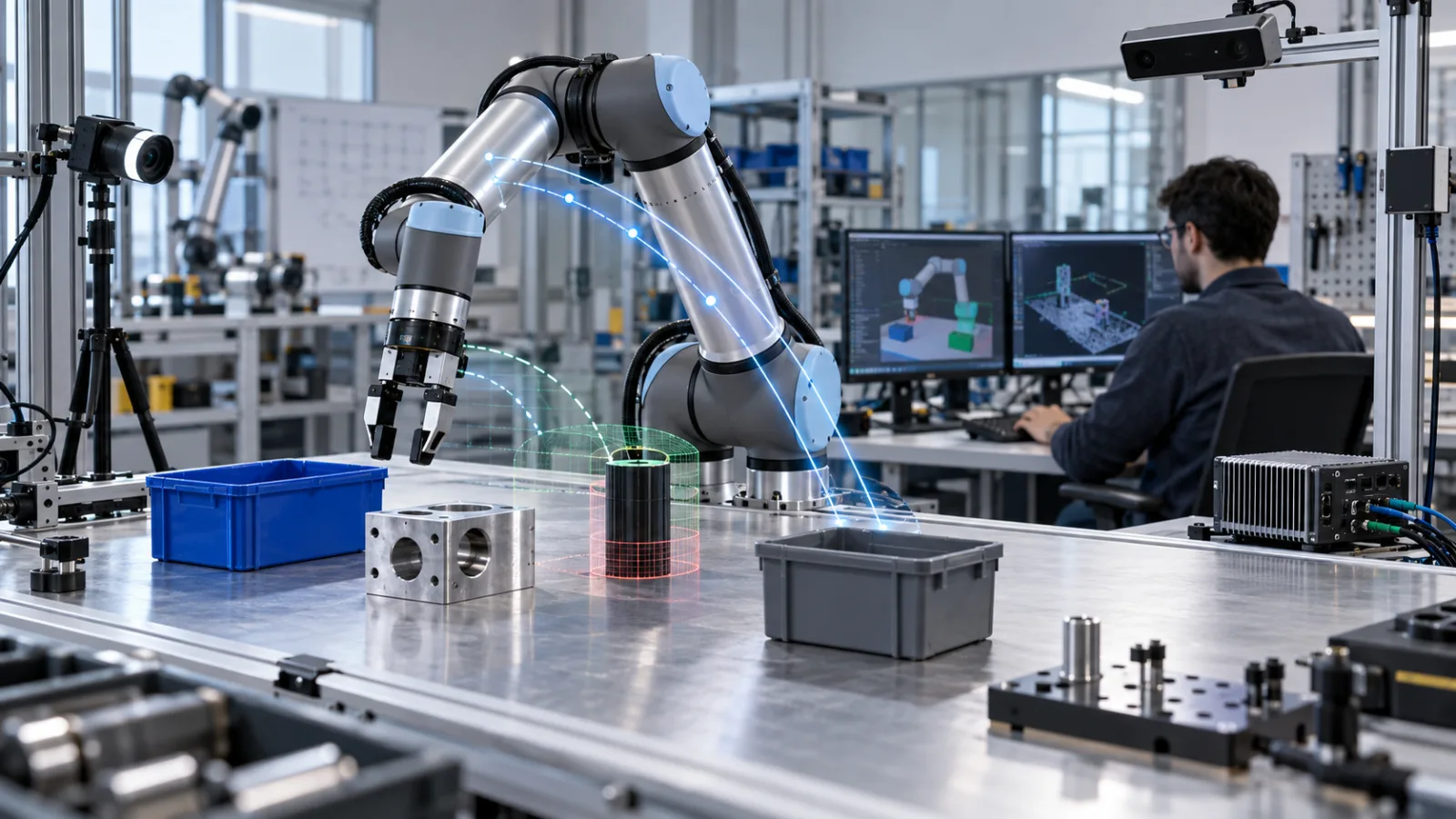
That makes the deal easy to underestimate. A robot can have capable motors, cameras, a large multimodal model, and a polished demonstration, yet still fail to perform a useful task if its motion planner cannot turn a high-level instruction into a physically valid sequence. The system has to understand the robot’s geometry, the surrounding world, the constraints on its joints, and the consequences of moving a gripper through a crowded workspace.
On September 23, Qualcomm announced an agreement to acquire PickNik and said that MoveIt, MoveIt Pro, and future PickNik technologies would be integrated more closely with its Dragonwing robotics platforms. Qualcomm also said that MoveIt 1 and MoveIt 2 will remain open source, community-driven, and supported across third-party hardware. The transaction is still subject to customary closing conditions, so this is a planned change in ownership rather than a completed integration. Qualcomm’s announcement is the primary source for those commitments.
The useful way to read the deal is as a test of whether robotics can build a dependable common software layer while the hardware market remains fragmented. It also raises a question that will matter to developers more than the acquisition headline: can an open framework gain commercial resources and edge-computing optimization without becoming effectively tied to one chip platform?
What MoveIt actually does
MoveIt is built on the Robot Operating System and is used for robotic manipulation and motion planning. It is not a general-purpose robot brain, and it does not independently decide what a factory, hospital, laboratory, or home robot ought to do. Instead, it provides tools that help a developer describe a robot and its environment, calculate feasible movements, check for collisions, and execute a plan through the robot’s control stack.
The distinction matters because “the robot understands the task” and “the robot can safely carry out the next motion” are different engineering problems. A vision-language-action model might interpret a request such as “pick up the container beside the tool.” A planning framework still has to determine whether the arm can reach the container, whether the chosen grasp is compatible with the object, whether the wrist will hit the workbench, whether another robot has entered the same space, and whether the resulting trajectory respects joint and velocity limits.
MoveIt’s planning scene is the central representation for that work. The official documentation describes it as a model of the robot’s current state, geometry, kinematics, dynamics, and the surrounding world. That information supports forward and inverse kinematics, constraint evaluation, and collision checking. The framework can test both the robot against its environment and the robot against itself.
Those functions are not glamorous, but they are where many physical-AI claims meet the floor. A language model can suggest a sequence that sounds sensible while remaining impossible for the hardware. A learned policy can produce a promising trajectory in a demonstration while lacking a reliable account of a newly introduced obstacle. Motion planning supplies a layer of explicit geometric reasoning and validation between a policy’s intent and the actuator commands.
It is also why MoveIt is not a drop-in guarantee of safety. Collision checking depends on the quality and freshness of the robot model, sensor data, calibration, object geometry, allowed-collision rules, and control system. A planner can reject a trajectory that it knows is invalid, but it cannot reason correctly about an obstacle that was never represented or a gripper that is miscalibrated. A valid plan is not the same thing as a certified safe machine.
Why Qualcomm wants this layer
Qualcomm has spent years building low-power and heterogeneous computing platforms for devices that need to process data near where it is generated. Its Dragonwing branding now covers industrial and robotics-oriented compute platforms. The PickNik agreement gives Qualcomm a software team and a widely used open robotics project that can connect those processors to actual manipulation workloads.
The company’s stated objective is to make it easier to move from AI models such as vision-language models and vision-language-action models to planning, manipulation, and real-time control. It also highlighted integration with Arduino VENTUNO Q boards, presenting that route as a way to reach a broad developer community. In practical terms, Qualcomm is trying to make its hardware more relevant at the point where a robot must perceive, plan, and act continuously rather than merely run an isolated inference benchmark.
This is strategically different from selling a complete robot. A robot maker owns the whole product and can hide much of its software stack behind a single application. A chip company wants many manufacturers, research groups, system integrators, and developers to use its compute platform across different machines. A hardware-agnostic robotics framework can serve as the bridge between those markets.
The advantage Qualcomm is seeking is not simply that MoveIt can run on a Dragonwing board. The larger opportunity is to optimize a familiar development workflow around the processor’s AI accelerators, CPU cores, connectivity, and real-time capabilities. If a developer can use the same planning concepts across a tabletop arm, mobile manipulator, inspection robot, or custom research platform, then the chip vendor has a chance to become part of the default stack rather than an interchangeable component selected late in a project.
That ambition has a practical limit. Motion planning is only one part of a deployed robot. Perception, state estimation, grasp selection, task sequencing, actuator control, safety-rated monitoring, networking, simulation, fleet management, and maintenance remain separate concerns. Faster inference or tighter integration can reduce latency and development work, but it cannot eliminate the integration burden.
The open-source promise is the most important detail
Qualcomm’s announcement explicitly says that MoveIt 1 and MoveIt 2 will remain open source under their existing license, with community-driven roadmaps, open resources, and support for third-party hardware. PickNik founder Dave Coleman made the same point in his account of the transaction, writing that the project would remain hardware agnostic and that the company would continue supporting open-source MoveIt and ROS. PickNik’s explanation also gives useful context on the project’s history and contributor base.
That promise addresses the obvious concern around a commercial acquisition. Open projects can lose contributors if users believe a new owner will steer development toward a proprietary platform or make competing hardware second-class. Even when the source remains public, governance, release priorities, documentation quality, maintainer availability, and the treatment of external contributions can change the real experience of using the software.
The immediate statement is reassuring, but the long-term test will be operational. Developers will watch whether important features land first on Qualcomm hardware, whether third-party drivers continue to receive attention, whether build and deployment instructions remain practical outside the Dragonwing ecosystem, and whether the project’s governance gives external maintainers a meaningful role.
There is a genuine tension here rather than a simple contradiction. An open project can benefit from a larger company’s engineering staff, testing resources, developer relations, and ability to fund long-term maintenance. The same project can also become less neutral if the owner’s commercial priorities shape performance work, documentation, or roadmap decisions. The outcome will depend on how much independence Qualcomm gives the maintainers and how visible those decisions are to the community.
The Open Source Robotics Alliance is part of that context. Qualcomm and PickNik are both founding members, and Qualcomm said it would continue supporting ROS and projects including Space ROS. That does not create a legal guarantee of neutrality, but it places the deal inside a broader institutional effort to maintain shared robotics infrastructure rather than leaving every major component under a single product vendor.
Why the timing matters
Robotics companies are currently trying to combine learned policies with classical control and planning. The industry’s most ambitious systems promise more flexible behavior in warehouses, factories, homes, and other environments that cannot be fully scripted. Yet robots still need predictable interfaces and constraints when they move around people, valuable equipment, or fragile objects.
The resulting architecture is increasingly layered. A high-level model interprets language, images, or demonstrations. A task-level system decides which subgoals to pursue. A motion planner turns those subgoals into trajectories. A controller translates trajectories into actuator commands. Monitoring systems check whether the real robot is diverging from the expected state. Human operators may intervene when uncertainty or failure crosses a threshold.
MoveIt sits in the middle of that stack. It can accept goals from more intelligent systems without pretending to replace them, and it can provide structured motion capabilities to systems that do not use a large AI model at all. That makes it useful during the transition from conventional industrial automation to more adaptive physical AI.
The transition is not as clean as the phrase “AI for robotics” suggests. Traditional automation often works because the environment, tooling, object presentation, and sequence are tightly controlled. Learned policies can handle more variation, but they introduce new uncertainty and require data, evaluation, and monitoring. A shared planning layer can help connect the two approaches, but it cannot make an unstructured task structured by itself.
The most credible near-term applications are therefore likely to be bounded ones: a known robot, a defined workspace, a limited family of objects, and a clear recovery procedure. This can still be valuable. Mobile manipulation, laboratory automation, warehouse handling, food and pharmaceutical processing, and space robotics all contain tasks where a small amount of flexibility removes expensive custom programming. The goal is not universal autonomy in one release; it is a shorter path from a tested capability to a repeatable deployment.
What could improve for developers
If Qualcomm executes well, developers could see improvements in several areas. The first is hardware bring-up. Robot teams often spend too much time connecting sensors, compute, middleware, motion planning, and control components before they can evaluate the actual application. Better-supported reference platforms could reduce that initial integration work.
The second is edge deployment. A laboratory prototype can rely on a workstation, generous cooling, and a stable network. A mobile or industrial robot usually cannot. It may need to make decisions locally because network latency, connectivity loss, privacy requirements, or safety constraints make cloud dependence unsuitable. More efficient on-device computation could make it easier to run perception and policy models alongside planning and control.
The third is the path from experiment to product. MoveIt Pro is PickNik’s commercial platform for advanced robotics systems, while MoveIt itself remains the open-source foundation. The separation gives organizations a possible route from public tools to paid support, deployment assistance, and production-oriented features. Qualcomm’s resources could expand that route if the company invests in documentation, testing, reference designs, and support rather than focusing only on silicon performance.
The fourth is access for smaller teams. A robotics group does not need to invent every component of a manipulation stack, but it often has to integrate many components itself. A supported combination of ROS, MoveIt, edge compute, and development boards could make credible prototypes more affordable for universities, specialist manufacturers, and early-stage companies. The effect would be largest where the robot’s value comes from a specialized task rather than enormous production volume.
None of these benefits arrives automatically with an acquisition. Hardware abstraction can conceal important differences instead of removing them. A board that runs a demonstration may still lack the drivers, real-time behavior, thermal headroom, certification path, or support commitment required by a production customer. Developers will need to evaluate the full system, not just the number of supported models or the speed of an inference benchmark.
Who benefits first
The first beneficiaries are likely to be teams already using ROS and MoveIt or considering them for manipulation projects. They can gain from better-supported compute targets without abandoning a familiar framework. Research groups may benefit from access to more capable edge platforms and from a larger company’s ability to maintain software over a longer period.
System integrators are another important group. Integrators have to combine robots, cameras, grippers, safety systems, conveyors, and business software for customers with different requirements. A common planning layer can reduce repeated engineering, especially when the integrator works across robot brands or needs to adapt a cell to a new product.
Manufacturers of robot arms and mobile manipulators may also gain, provided the hardware support remains genuinely cross-platform. They can concentrate on mechanical design, sensors, end effectors, and application-specific behavior while relying on a mature planning framework for common manipulation functions.
End users will benefit later and less visibly. A factory manager will not necessarily care whether MoveIt is underneath a machine. The relevant outcomes are shorter commissioning, fewer failures, easier reconfiguration, better maintenance, and a lower total cost of ownership. Those outcomes require validation in the user’s environment, not just a successful software demonstration.
Consumers are unlikely to see a direct effect soon. Home robots have harder perception and safety problems than controlled industrial cells, and a motion-planning framework does not solve household ambiguity, privacy, or liability. It may become part of a consumer robot stack eventually, but this deal is more immediately relevant to developers and industrial deployments than to people waiting for a general-purpose household helper.
Cost and maturity: what the deal does not tell us
Neither Qualcomm’s announcement nor PickNik’s public explanation gives a purchase price or a timetable for the acquisition’s closing. They also do not provide a detailed product roadmap for how MoveIt will be integrated with Dragonwing. That means it would be premature to claim a specific performance improvement, lower robot price, or accelerated deployment schedule.
There is also no reason to treat the acquisition as evidence that general-purpose robots are ready for ordinary workplaces. MoveIt can make motion planning more accessible, but a deployable robot still needs reliable hardware, accurate sensing, appropriate end effectors, recovery behavior, safety engineering, operator training, and a business case. The same software can support a research prototype and a production machine with very different levels of robustness.
Maturity should be judged at the system level. Useful questions include:
- Can the robot detect when its model of the world is wrong?
- Can it stop safely when a person or unexpected object enters the workspace?
- Can an operator inspect, modify, and replay plans?
- Does the system recover from a failed grasp without creating a second failure?
- Are latency, calibration drift, and network loss tested under real operating conditions?
- Can the customer continue operating the robot if the preferred compute platform changes?
A motion planner helps answer some of those questions, especially around geometry, constraints, and trajectory validity. It does not answer all of them. The distinction is important because the robotics industry has repeatedly confused a capable subsystem with a finished product.
The strategic risk for Qualcomm
Qualcomm is entering a market where developer trust can matter more than a single benchmark. Robotics teams often build systems over years, accumulate custom drivers and calibration data, and choose tools partly because they do not want to be trapped by one supplier. If Qualcomm is seen as using MoveIt mainly to funnel developers toward Dragonwing, some of the project’s strongest users may look for alternatives or maintain their own forks.
The company’s best argument is therefore not that Qualcomm hardware is faster. It is that developers can gain better performance and support while preserving the ability to use other hardware when their application requires it. That argument will be tested by the details: upstream contributions, release cadence, support for non-Qualcomm platforms, transparent governance, and the quality of examples that work outside a showcase environment.
Qualcomm also has to prove that it understands robotics as an operations problem. A chip company naturally emphasizes compute, but robots fail for reasons that sit outside the processor: dirty lenses, worn grippers, bad object models, poorly placed pallets, ambiguous instructions, changing lighting, network interruptions, and human behavior. A software stack that acknowledges those conditions will be more valuable than one that only makes the nominal path faster.
The strategic opportunity for PickNik
For PickNik, the deal offers a path to scale the project’s reach without abandoning the identity that made it credible. The company’s own account says that more than 560 people have contributed to MoveIt, with thousands of forks and extensive use across research and industry. Those figures describe a community asset, not merely a conventional proprietary product.
A larger owner could fund testing across more robot configurations, improve documentation, support long-lived releases, and help turn successful research integrations into repeatable deployment patterns. It could also make it easier to align open tooling with the requirements of edge AI, real-time systems, and commercial support.
The danger is that scale can make a project heavier and slower. Developers value open robotics software partly because they can inspect it, adapt it, and combine it with unfamiliar hardware. If new layers become difficult to understand or if important capabilities move behind commercial offerings, the project could lose the flexibility that made it a common foundation. The acquisition’s success will be measured by how much additional capability arrives in the open layer, not just by the size of Qualcomm’s robotics business.
What to watch next
The most informative signals will come after the announcement, not from the announcement itself. Developers should watch for the first concrete integration releases, supported Dragonwing and Arduino configurations, and evidence that the same workflows continue to operate on third-party hardware. They should also look for changes to MoveIt’s governance, maintainer structure, issue response, and release process.
Technical teams evaluating the ecosystem should test complete workflows rather than isolated demos. A fair evaluation would include scene updates, collision objects, inverse kinematics, trajectory execution, sensor delays, operator intervention, and recovery from failed plans. It should compare performance and reliability across at least two compute targets when hardware neutrality is a requirement.
Customers should ask vendors which parts of their robot stack depend on MoveIt, which parts are proprietary, and what happens if a component is discontinued. They should request evidence from the intended operating environment: cycle-time distributions, intervention rates, fault logs, calibration procedures, and maintenance requirements. A polished manipulation video is not enough to estimate deployment cost.
For researchers, the acquisition creates an opportunity and a responsibility. More capable edge platforms may make it easier to test learned policies close to the robot. At the same time, the continued openness of MoveIt should be treated as a community practice that needs contributors, review, documentation, and independent testing. Open source is not simply a licensing label; it is a way of keeping the stack usable when no single vendor’s priorities match every user’s needs.
The larger lesson
Robotics progress is often narrated through bodies: a humanoid walking, a drone navigating, or a robot arm completing a difficult grasp. The Qualcomm–PickNik agreement points to a quieter constraint. For many machines, the bottleneck is not only the body or the model. It is the connective tissue that lets different models, sensors, planners, controllers, and hardware platforms work together predictably.
Owning that connective tissue can be strategically valuable, but it is also easy to damage. Qualcomm gets a chance to make open manipulation software easier to deploy on efficient edge hardware. PickNik gets resources to extend a project that already spans research and production use. Developers get a reason to expect better integration, but also a reason to pay close attention to neutrality and governance.
The deal should therefore be judged by a practical standard: does it help more teams build robots that can perform bounded tasks repeatedly, recover when conditions change, and remain maintainable across hardware generations? If the answer is yes, the acquisition will matter well beyond Qualcomm’s product line. If the answer is no, the industry will have acquired another prominent robotics stack without solving the deployment problem that sits between a plan on a screen and a machine on the floor.
For now, the strongest verified conclusion is narrower. Qualcomm has agreed to acquire a company responsible for an important open robotics framework, and it has publicly committed to keeping MoveIt open and hardware agnostic. The next stage is not a promise of general-purpose autonomy. It is a test of whether commercial scale can strengthen shared robotics infrastructure without turning it into a disguised single-vendor funnel.
Related articles

Mojo’s open-source compiler is the real test after the 1.0 release
Modular has opened Mojo’s compiler, tooling and language sources under Apache 2.0 with LLVM exceptions. That removes the loudest adoption blocker, but developers still need to test buildability, governance, MAX boundaries and real use cases.

Snapdragon 8 Elite Gen 6 brings 30-billion-parameter AI to phones. Here is what buyers should actually wait for
Qualcomm’s new flagship chips promise faster phones and much larger on-device AI models, but the useful question is not how many parameters fit in a demo. It is whether a finished phone can sustain the gains without excess heat, battery drain, or cloud dependence.

Fairphone Gen. 6+ in the US: the seven-year ownership test
Fairphone’s first official US phone pairs replaceable parts with support promised through 2033. Here is how its repair case, warranty, carrier limits and everyday compromises hold up before you spend $649.99.

Should You Buy the Valve Steam Frame? Only If Wireless PC VR Is Already Your Main Use Case
Valve’s new headset is not a cheap way into VR. It is a premium Steam-first device with excellent streaming promise, a young standalone library, short battery limits, and a reservation system that rewards patience.

Comments
Sign in to comment.
No comments yet.