A robotaxi map is not a service
Tesla’s Miami geofence and Waymo’s standing-water recall show that the real robotaxi race is no longer about drawing bigger maps. It is about proving the operating domain.

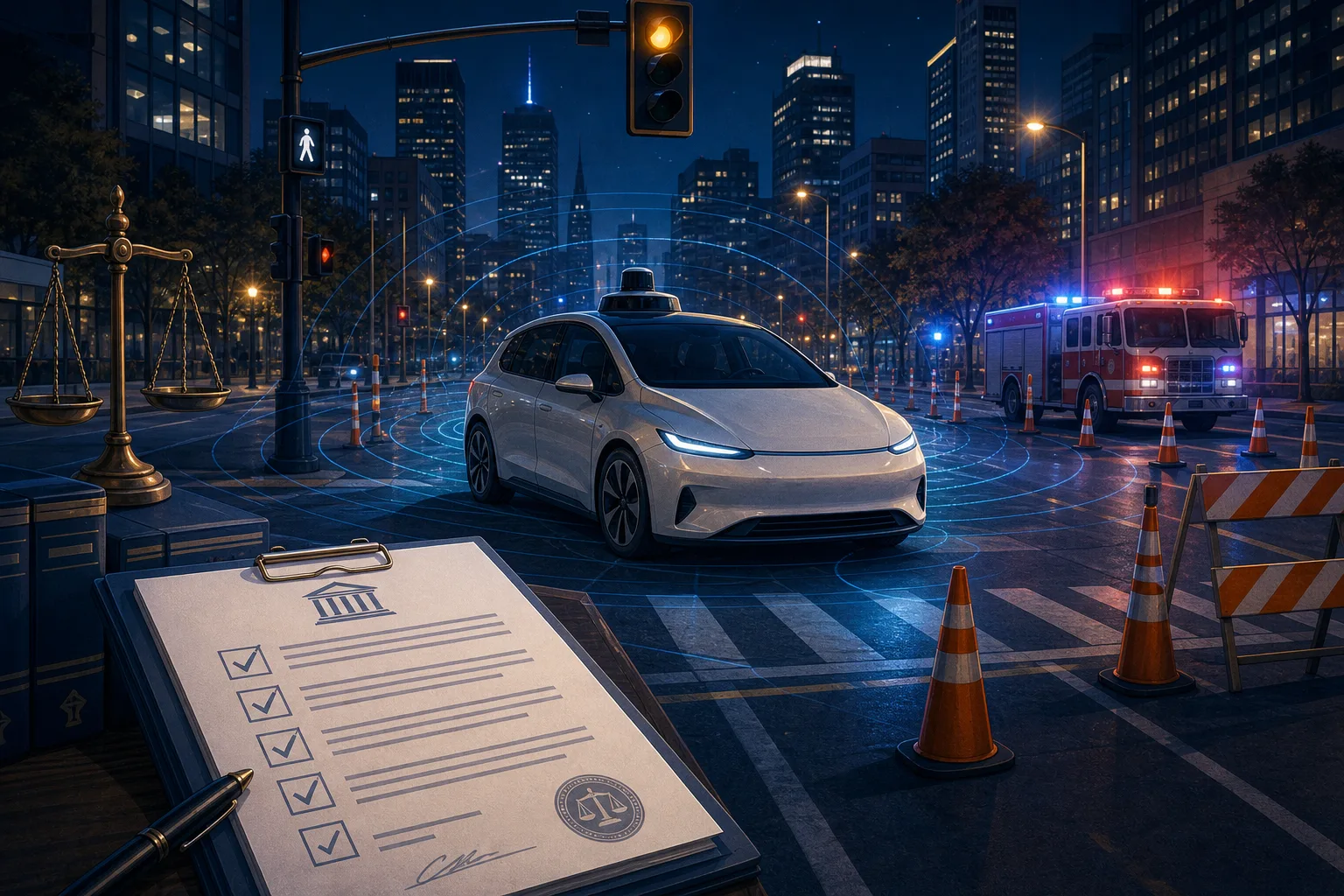
A robotaxi map looks reassuring because it turns autonomy into a shape: here is the city, here is the border, here is where the car will work. In 2026, that picture is starting to look too simple. The harder boundary is not the line around a neighborhood. It is the operational design domain: rain, standing water, construction, school-zone behavior, remote assistance, crash reporting, fleet size, availability and the ability to prove that fixes keep working after the press release is gone.
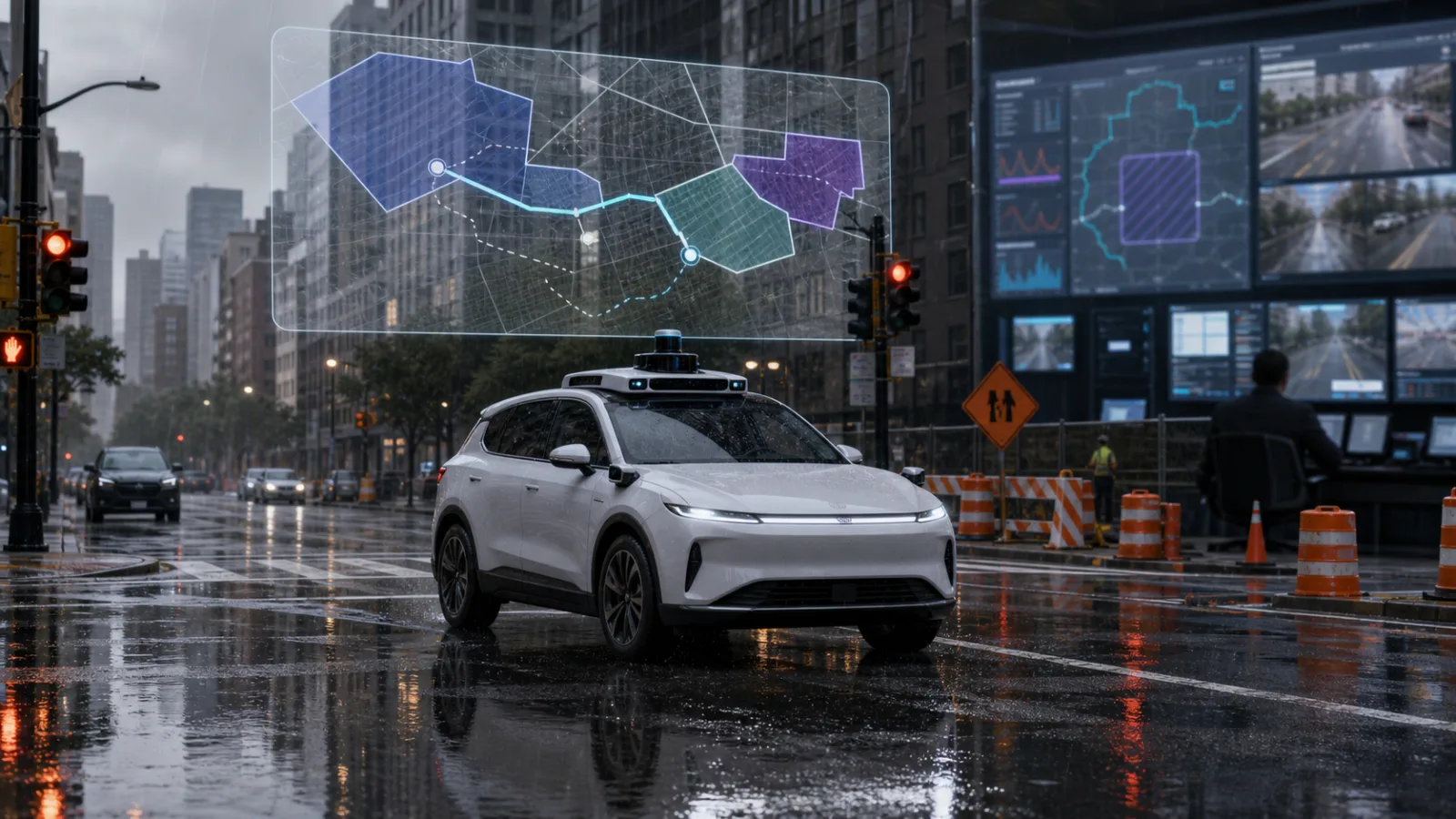
That is why two different stories now belong together. Tesla has shown or shared a small Miami Robotaxi geofence, according to Electrek, while its Austin rollout remains far smaller than the mass-market robotaxi network investors were promised. Waymo, the more mature operator with a multi-sensor stack and a public service in multiple cities, issued a voluntary NHTSA recall covering 3,791 fifth- and sixth-generation automated driving systems because its software could allow vehicles to slow and then drive into standing water on higher-speed roadways.
The lesson is not that one company has solved robotaxis and another has failed. It is more useful, and less tribal, than that. Robotaxis have left the demo stage. Because they are becoming real transport infrastructure, the real problems are now visible: not just perception and planning in good weather, but validation, supervision, remote operations, local rules, bad roads, flood risk, and how much the public can learn when something goes wrong.
A geofence is not a service
Tesla’s Miami story is a good example of how autonomy can look bigger on a map than it is on the street. Electrek reported on July 3 that Tesla’s Robotaxi account had shared a Miami service-area map covering a small part of the metro area, mostly West Miami and a strip toward Doral and Sweetwater. The described area excludes downtown Miami, Miami Beach and the airport. Electrek’s own framing was blunt: a geofence, not a launch.
That distinction matters. A geofence says where a system might operate. It does not say how many vehicles are available, whether rides are public, whether the cars are unsupervised, whether a safety monitor is present, how often remote assistance is needed, how the service performs in rain, or whether riders can reliably get a car when demand is not convenient for a demo.
Tesla’s Austin rollout shows why those details matter. Electrek reports that Tesla launched Robotaxi in Austin in June 2025 and that, roughly a year later, the service remains small. The same reporting says city officials put the Austin fleet around 50 vehicles, with a much smaller unsupervised subset. Electrek also describes a widened Austin map with limited active vehicles and periods when waits stretched or no car was available. Those figures should be attributed, because Tesla has not provided the same kind of official, independently audited robotaxi fleet disclosure that would settle the question.
Still, the pattern is familiar in robotics. A demo can expand its perimeter before the underlying operation can expand its reliability. In a warehouse, that means more aisles before the robot handles every pallet and exception. On a sidewalk, it means more blocks before the delivery robot handles every curb cut and pedestrian habit. In a robotaxi service, it means a bigger polygon before the system has proved availability, safety and recovery across the messy reality of a city.
Austin matters more than Miami because it is the operating record
Miami is the headline because it is new. Austin is more revealing because it has been running. If a robotaxi service is meant to become an everyday mobility layer, the useful questions are prosaic. How many active vehicles are there? How many miles are truly driverless? Are passengers onboard? Is there a safety monitor? How often does a remote operator intervene? What kinds of events lead to pauses? How quickly does the fleet recover after a fix?
Tesla’s own communications have often emphasized scale and future capability. The constraint described in the recent reporting is less glamorous: safety validation. That phrase sounds bureaucratic, but it is the central engineering problem. A robotaxi operator must not merely train a model that can drive many routes. It must demonstrate that the model, vehicle, maps, remote operations and local procedures remain safe when the distribution shifts.
That is where city-scale autonomy becomes different from consumer driver assistance. A private driver-assistance feature can place responsibility on the human behind the wheel. A robotaxi service is a public operation. It must decide when to refuse a ride, when to slow, when to call for help, when to leave a flooded route, when to pull over, and how to explain those choices to regulators and riders.
The public map is therefore the least interesting part of the system. The more important map is invisible: all the conditions under which the vehicle is allowed to operate, all the conditions that force it to degrade, and all the conditions that require human support.
Remote assistance is part of the safety case
Remote operations are often discussed as if they were a footnote. They are not. For a robotaxi fleet, remote assistance can be a recovery mechanism, a way to resolve ambiguous scenes, a method for fleet management, and sometimes a direct operational risk.
TechCrunch reported in May that newly unredacted NHTSA-submitted narratives showed two Tesla Robotaxi crashes in Austin while a teleoperator was remotely driving. The reported crashes were low-speed, with a safety monitor behind the wheel and no passengers onboard. Electrek’s account of the same unredacted narratives said the incidents involved a 2026 Model Y and occurred during Tesla’s early robotaxi operation. One described a teleoperator driving up a curb and into a metal fence at about 8 mph; another involved a construction barricade at about 9 mph.
Those details should not be inflated into a claim of high-severity danger. The more precise point is stronger: remote operation is not magic. If a remote operator can influence or directly control a robotaxi, then latency, situational awareness, interface design, authority handoff and logging become part of the safety architecture. A company cannot market autonomy as if remote help were irrelevant and then rely on remote help as a quiet fallback.
The terminology matters, too. “Remote assistance” can mean guidance, route approval, scene interpretation or direct driving. “Teleoperation” can mean a stronger form of control. Different operators use different architectures. Regulators, cities and riders should ask what exactly is allowed, when it is used, how often it happens, and whether a human is advising the autonomy system or driving the vehicle.
Waymo’s standing-water recall shows the maturity problem, not just a bug
Waymo is the better benchmark for mature robotaxi service. It has more public operating history, a multi-sensor hardware stack and official safety pages that cite more than 100 million real-world miles. It says it serves tens of thousands of riders weekly across several regions and cites a Swiss Re analysis showing far fewer bodily-injury and property-damage claims than human-driver baselines over a measured mileage set. Those claims are company-framed and methodology-dependent, but they place Waymo in a different stage of deployment from a tiny launch map.
That makes the standing-water recall more interesting, not less. NHTSA recall 26E026 covered 3,791 Waymo fifth- and sixth-generation ADS units. The official defect description said the software may allow a vehicle to slow and then drive into standing water on higher-speed roadways. The risk was loss of vehicle control, increasing the chance of a crash or injury. Waymo’s interim remedy modified the scope of vehicle operations to increase weather-related constraints and updated vehicle maps; NHTSA documents say all affected vehicles received the interim update by April 20, 2026, while a final remedy was still under development in the filing.
This is exactly the kind of problem that separates robotics infrastructure from a clean demo. Standing water is not exotic. It is part of ordinary city weather. Yet the correct behavior depends on perception, map context, road speed, forecast data, local drainage, route selection and fallback policy. A human may also make bad decisions around flooded roads, but a fleet operator has to prove that its system recognizes the hazard consistently enough to scale.
TechCrunch later reported that Waymo paused or halted service in Atlanta, San Antonio, Dallas and Houston during severe-weather and flood-risk events. Waymo said an unoccupied vehicle in Atlanta encountered a flooded road and stopped before being recovered, and TechCrunch tied the pauses to the recall and the incomplete final remedy. That does not mean Waymo’s entire national service collapsed. It means weather and flooding were no longer external context; they became operational inputs.
The ODD is the real product
In robotics, the operational design domain is the set of conditions under which the system is designed to operate. For robotaxis, it includes geography, road type, speed range, traffic density, weather, lighting, construction, temporary signs, school zones, emergency vehicles, map freshness, remote-assistance rules and rider behavior. The ODD is not a legal appendix. It is the real product boundary.
A service area map is only one slice of the ODD. A robotaxi might be allowed on a sunny arterial road but not during flash-flood risk. It might be allowed in a neighborhood but not on a highway. It might drive without a safety monitor in one zone while using a supervised or limited mode in another. It might accept riders in one city and only test with employees in another. It might continue operating through light rain but pause when forecast, road sensors or fleet observations suggest water accumulation.
The best operators will be the ones that define these boundaries clearly and enforce them automatically. The worst outcome is a vague public story in which every map expansion is treated as capability, every limitation is hidden as caution, and every remote handoff is described with soft language.
For cities, the ODD should be a permitting question. Before allowing expansion, officials should ask for active fleet size, driverless miles, crash narratives, disengagement or assistance metrics, weather pause criteria, emergency responder protocols, school-zone behavior, construction-zone handling, data retention and a process for software-change validation. The answer does not have to be public in every detail, but it must be legible enough for oversight.
Metrics that matter more than announced cities
Robotaxi companies love city lists because city lists are easy to understand. They suggest momentum. But the robotics metrics that actually matter are less tidy.
Active vehicles matter more than registered vehicles. Paid public rides matter more than invitation-only demos. Driverless passenger miles matter more than miles with a safety monitor. Crash narratives matter more than raw crash counts. Service pauses matter because a paused fleet may be safer than a reckless fleet, but frequent pauses change the user value proposition. Remote-assistance events matter because they reveal what the autonomy stack cannot yet resolve alone.
Recall quality also matters. A recall is not automatically a scandal. In software-defined robotics, recalls and over-the-air fixes may be a normal part of maturing. The question is whether the operator detects the issue, scopes it honestly, applies an interim constraint, ships a final remedy, verifies the remedy and communicates the operational impact. Waymo’s standing-water recall is serious, but it is also a useful public artifact because NHTSA documents describe the defect and remedy path.
The same applies to Tesla’s NHTSA-submitted crash narratives. Low-speed incidents with no passengers do not tell the whole safety story. But the narratives reveal details that press releases often omit: whether ADS was engaged, whether a safety monitor was present, whether remote takeover occurred, what object was hit, and what the vehicle was trying to do. For robotaxi accountability, narrative quality is as important as dashboard numbers.
Tesla and Waymo are different, but the bottleneck is shared
It is tempting to reduce the field to a brand argument: Tesla’s camera-first, FSD-centered approach against Waymo’s more sensor-heavy, mapped, fleet-operated approach. The technical differences are real. They matter for cost, scaling, perception redundancy, validation strategy and public confidence.
But the current bottleneck is broader than one stack. Both approaches must answer the same infrastructure questions. Can the system refuse unsafe conditions? Can it detect the difference between a passable wet street and a flooded roadway? Can it handle temporary construction without inventing a path? Can remote operators help without creating a new failure mode? Can the company show regulators enough evidence without turning every incident into a public-relations fight?
Waymo’s advantage is that it already operates at a larger and more mature public-service layer. Tesla’s advantage, if it can make the safety case, is potential manufacturing scale and a huge installed base of vehicles and driving data. But robotaxi service is not only about fleet size. A million vehicles that cannot operate unsupervised in defined conditions are not a robotaxi network. A smaller fleet that pauses safely and documents limits may be more trustworthy than a larger map that hides uncertainty.
Zoox, Baidu Apollo Go, Pony.ai and the legacy of Cruise all reinforce the same point: autonomy grows through bounded deployments, operational discipline and regulatory tolerance, not just model improvement. The companies that survive will likely be those that treat the city as a partner and the ODD as a contract, not those that treat every exception as a temporary public misunderstanding.
What riders should want to know
For a rider, the useful questions are not ideological. Is this ride truly driverless? Is there a safety monitor? Can a remote operator directly drive, or only advise? What happens in heavy rain? Will the app tell me if the service is paused because the weather is outside the ODD? If the car gets stuck near construction, who resolves it and how long does that take? If there is a crash, will the narrative be public enough to understand what happened?
These questions do not mean robotaxis should never launch until they are perfect. Human-driven transport is not perfect either. The point is that autonomous transport changes the accountability model. A bad human driver is one person. A bad fleet behavior can be reproduced across thousands of vehicles until the software, maps or operating rules change.
That is why trust will come less from confidence language and more from boring transparency: clear ODD limits, published safety methodologies, useful incident narratives, consistent recall handling, honest service availability and visible cooperation with cities.
The real race is operational trust
The robotaxi race is entering a less cinematic stage. A new city polygon still matters. It shows ambition and local preparation. But the real contest is not who can draw the largest service area first. It is who can keep vehicles available, useful and safe when the weather turns, a road floods, a construction crew moves cones, a school bus stops, a teleoperator takes over, or a regulator asks for the narrative.
That makes 2026 an important year for autonomous transport. Tesla’s Miami geofence and Waymo’s standing-water recall look like opposite stories: one about expansion, one about restraint. Together they describe the same transition. Robotaxis are becoming real enough that maps no longer persuade by themselves.
For the next phase, the question is not whether a company can put a robotaxi on a street. The question is whether it can operate a fleet as public infrastructure, with limits that are honest, measurable and enforced before the puddle becomes a crash report.
Related articles
San Mateo’s humanoid robot permit push tests the rules for physical AI
A Silicon Valley county is not banning humanoid robots; it is asking what permits, fire rules, supervision and labor disclosures must exist before commercial deployment.
Robotaxis at the school gate: what the Waymo probe really tests
NHTSA’s redacted Waymo file turns a low-speed Santa Monica collision into a bigger question about robotaxi caution and public evidence.
Robotaxis are now a fight over who writes the rules of the street
Uber, Waymo, Tesla, New Jersey and NHTSA are turning autonomous taxis from a technology rollout into a public-policy test for cities.
Robotaxis are now a fight over city rules, not just AI
Uber, Waymo, Tesla and regulators are turning autonomous taxis into a policy battle over sensors, labor, emergency response and who controls the ride market.
Comments
Sign in to comment.
No comments yet.