UBTECH’s Liuzhou Factory Puts Humanoid Robotics’ Manufacturing Problem on the Clock
UBTECH has started production at a Liuzhou factory designed for more than 10,000 industrial humanoid robots a year. The important question is no longer whether a robot can be demonstrated, but whether capacity can become dependable output and useful work.

UBTECH has brought a new industrial humanoid robot factory into production in Liuzhou, Guangxi. The facility is designed around a production rhythm of one robot every ten minutes and planned annual capacity above 10,000 units. Chinese state media and local reporting describe a digitally coordinated plant where robots participate in the work of producing other robots. Xinhua reported the launch on September 13, after the production ceremony on September 12.
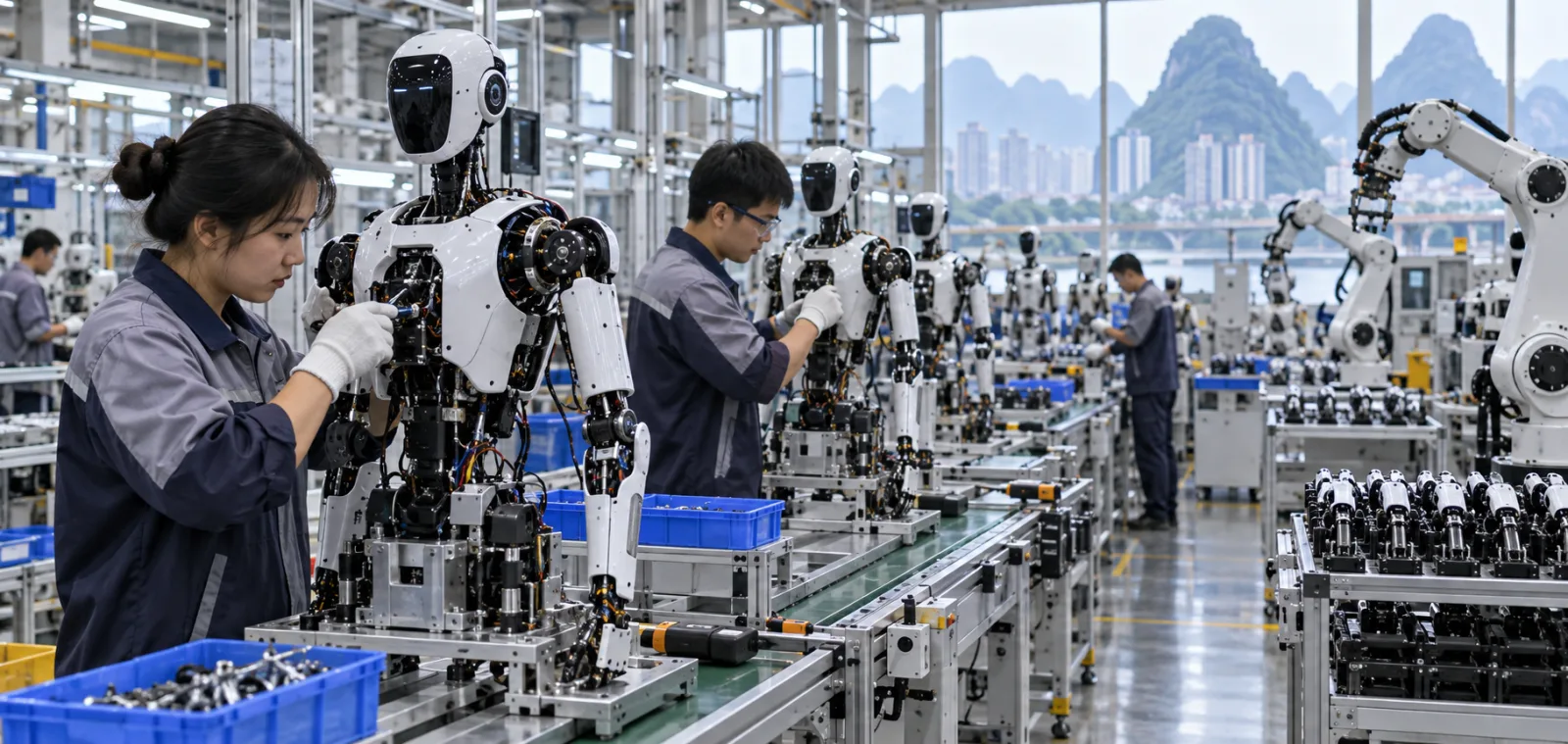
That is a significant development, but the headline number needs to be read correctly. A line designed to complete one unit every ten minutes is not the same thing as a factory delivering 10,000 reliable robots, nor does it show that those robots can operate profitably on a customer’s floor. It is a claim about industrial capacity: the ability to organize parts, assembly, testing, software, calibration, storage and dispatch around a repeatable flow.
This makes the Liuzhou plant interesting for a reason that is easy to miss. The immediate test is not whether humanoid robots can replace people in a general sense. It is whether a manufacturer can turn a complicated, rapidly changing machine into a product with predictable yield, service requirements and field performance. That manufacturing problem will determine how much of the current humanoid-robot boom becomes an actual industrial market.
What UBTECH has actually announced
The facility is described as a “super smart factory” for industrial humanoid robots. It is intended to make robots from UBTECH’s Walker S series and Cruzr series. Reporting based on the launch materials says the line has a designed takt time of ten minutes and planned annual capacity above 10,000 robots. The same report says the factory uses industrial simulation for planning and a digital management system for coordinating production. A contemporaneous account from IT Home attributes those details to Liuzhou’s municipal media.
A separate report from China News Service, reproduced by Eastmoney, adds useful detail about the physical workflow. Cruzr robots are used in material supply tasks such as depalletizing, palletizing, loading and transport. The final assembly area combines collaborative robots, assistive manipulators, automated guided vehicles and rotating fixtures. A digital scheduling system is intended to coordinate inventory movement and warehouse operations.
The phrase “robots making robots” therefore describes a mixed production system, not a lights-out factory in which humanoids have eliminated human labor. The available reporting does not establish that every operation is autonomous, that people are absent from the line, or that the plant can sustain its designed rhythm continuously. Industrial factories routinely depend on technicians, quality engineers, maintenance teams, logistics workers and software operators even when many individual tasks are automated.
The distinction matters because the production problem is not solved by adding a humanoid body to an assembly line. A factory must control variation. It must know whether a motor, joint, cable, sensor, battery or hand has been installed correctly; whether the robot’s calibration survives transport; whether its software version matches the hardware; and whether a fault can be diagnosed without turning every service call into a research project. A digital factory can make those processes more visible and more repeatable, but it cannot remove the underlying engineering work.
Why ten minutes is a useful number—and an incomplete one
In manufacturing, takt time is the interval at which a finished product must leave a line to meet a target. It is a planning measure, not a guarantee of nonstop output. A ten-minute design cadence corresponds to six units per hour while the line is running at nominal speed. The annual target is lower than a simple 24-hour calculation because real factories include shifts, maintenance, changeovers, material shortages, inspection, rework, downtime and periods in which demand does not justify maximum output.
That is why the headline should be treated as a capacity milestone rather than a delivery count. The plant may eventually produce more than 10,000 units a year. The announcement does not, by itself, show the line’s utilization, first-pass yield, defect rate, mean time between failures, labor requirement or cost per completed robot. It also does not show how many robots have already been accepted by customers after deployment.
Those missing measurements are not minor accounting details. They are the bridge between a production demonstration and a viable product business. If a robot leaves the line quickly but requires extensive manual calibration, frequent replacement parts or remote intervention, its effective cost may remain high. If the machine works only in a tightly prepared environment, the customer may need to redesign the facility around it. If each new task requires a large amount of engineering, the robot may behave more like a configurable automation project than a general-purpose worker.
The factory can still be valuable under those conditions. Early industrial products often improve because manufacturers learn from repeated builds. A higher-volume line creates more opportunities to identify weak components, simplify assembly and collect operational data. But the direction of improvement must be measured. More units are not automatically more maturity.
The manufacturing bottleneck is unusually severe for humanoids
A conventional industrial robot is usually built for a narrow range of motions in a defined workspace. A humanoid adds many subsystems that must cooperate while the machine walks, balances, reaches, grasps and handles loads. It needs compact actuators, gearboxes, motor controllers, batteries, sensing, computing, protective structures, hands and software. The packaging challenge is difficult enough before the robot enters a changing factory environment.
The body also creates a quality-control problem. A small error in an arm joint may affect the reach of a tool. A slightly incorrect camera alignment may change depth estimates. A difference in friction or backlash can alter the behavior of a learned controller. A cable that survives a short demonstration may fail after thousands of repeated bends. A battery system designed for laboratory operation may become a bottleneck when the robot is expected to work across multiple shifts.
UBTECH’s own product material shows where the company is concentrating effort. On its Walker S2 product page, the company says the robot can perform an autonomous battery swap in three minutes using a dual-battery system and coordinated arm movements. It also lists a 15-kilogram payload, a large waist rotation range and binocular RGB vision. These are relevant industrial features because uptime, reach and handling capacity often matter more to a factory than a robot’s ability to hold a conversation.
The battery-swap system illustrates both the promise and the operational burden. A robot that can exchange its own battery may spend less time waiting for a charge. It also needs a compatible station, spare batteries, a safe exchange procedure, monitoring and a way to handle a failed swap. The factory and the customer must validate the complete system, not just the robot’s isolated movement.
Likewise, a 15-kilogram payload is meaningful only in relation to the actual task. The relevant questions are how far the robot carries the load, how often it repeats the motion, how accurately it places the object, what happens when the object is misaligned, and how performance changes as the battery level falls. Industrial buyers care about completed cycles and unplanned stops, not the maximum value printed in a specification sheet.
The production line may become a training environment
One of the more consequential claims around the Liuzhou plant is that it will connect manufacturing capacity with real industrial training. China News Service reported that UBTECH plans to work with Liuzhou’s manufacturing resources and use real workstations to continue iterating and training embodied-intelligence robots. That creates a feedback loop: the factory makes robots, the robots work in factories, and the resulting operational data informs later software and hardware revisions.
This is a sensible strategy for a company building machines whose behavior depends on both physical design and learned control. A robot can be improved through simulation, but factories contain details that are hard to model perfectly: reflective surfaces, worn fixtures, inconsistent packaging, vibration, occlusion, human traffic and objects that are not quite where the work instructions say they should be. Repeated deployment exposes those conditions.
The feedback loop also carries a risk. A manufacturer may improve performance on the tasks and layouts it sees most often while giving the impression that the robot has become broadly capable. A system trained on depalletizing and inspection in automotive plants may still be poor at warehouse work, construction, healthcare or domestic tasks. The quality of the data depends on how varied the environments are and how honestly failures are recorded.
The right question is not simply how much data the company has. It is whether the data can be connected to measurable improvements: fewer human interventions, longer periods between failures, faster recovery from errors, lower commissioning costs and better performance on new but related workstations. Without those measures, “industrial data” remains a promising input rather than evidence of general autonomy.
What the announcement says about the market
The Liuzhou launch comes as humanoid robotics moves from isolated demonstrations toward reported sales and formal production targets. UBTECH’s 2026 interim-results announcement, filed through the Hong Kong Stock Exchange company-information system, gives a financial reference point. The company reported first-half revenue of RMB 1.269 billion and said revenue from full-size embodied intelligent humanoid robot products and services reached roughly RMB 590 million. Industry reporting based on the same results said UBTECH reported 921 full-size humanoid robots sold in the first half.
Those figures should not be treated as a clean count of identical autonomous factory workers. The company’s product category includes more than one type of full-size embodied robot and can include systems, services and customized solutions. A unit sold is also not the same as a unit operating at a customer’s target utilization. Still, financial disclosure is useful because it exposes the scale of the commercial challenge. The company is no longer presenting only research milestones; it is trying to build a business whose revenue, losses, cash needs and delivery obligations can be examined.
The company’s 2025 annual report provides additional context. It describes industrial work around handling, sorting and quality inspection, and lists training or deployment activity with manufacturers including automobile and electronics companies. UBTECH’s industry-solutions page similarly presents examples involving automotive assembly, wind-power manufacturing and logistics. These are not proof that every listed task is fully autonomous or economically superior to specialized machinery. They do show the type of work the company is targeting: repetitive, structured operations where the surrounding process can be instrumented and where a human-shaped machine might use existing equipment.
That last point is the strongest practical argument for a humanoid form. The case is not that two legs are inherently better than wheels, rails or a fixed arm. In many factories, specialized automation will remain faster and cheaper for a known task. The humanoid argument is flexibility: a machine that can reach shelves, fixtures and tools designed for human workers may be deployed without rebuilding the entire site. Whether that flexibility pays for the additional mechanical complexity is an empirical question.
Capacity does not settle the cost question
A factory capable of producing 10,000 humanoids could lower unit costs through purchasing power, standardized assembly and learning effects. It could also reveal that the difficult parts remain expensive. Hands, high-performance actuators, batteries, force sensing, compute modules and protective components may account for a large share of the bill of materials. Software, commissioning and after-sales support can be even more important to the customer’s total cost.
A buyer should calculate the economics at the level of a completed work cell. That includes the robot, spare batteries, charging or swapping equipment, safety barriers, network and software integration, training, maintenance, teleoperation support, insurance and the cost of pauses when the system fails. The comparison is not always a human wage. It may be a fixed industrial robot, a conveyor change, a lift-assist device or a redesigned workflow.
The humanoid becomes more attractive when the task changes frequently, when existing infrastructure is expensive to modify, or when the same machine can cover several nearby jobs. It becomes harder to justify when the work is stable and high-volume enough for dedicated automation. A production line designed for a single part may not benefit from a machine optimized for human-like adaptability.
This is why the Liuzhou factory could benefit the market even if the robots do not quickly become general-purpose workers. Manufacturing at scale can force companies to state clearer prices, service commitments and performance guarantees. It can also reveal which components are genuinely common across applications and which are still custom-engineered for every customer. That information is more valuable than another carefully selected demo.
Safety remains a system responsibility
Industrial humanoids will work around people, moving equipment and heavy objects. The production announcement does not establish a safety certification, a universal operating envelope or a standard level of human supervision. Those questions depend on the robot, its software, the work cell, the risk assessment and local regulations.
A robot that can plan a task or recover from an error is not necessarily safe to operate without a person nearby. Vision can be blocked. A gripper can lose an object. A human can enter a restricted area. A software update can alter behavior. Battery systems and high-torque joints introduce hazards even when the robot is standing still. Safe deployment therefore requires physical safeguards, emergency stops, speed and force limits, monitoring, maintenance procedures and clear rules for intervention.
The autonomy claims on a product page should be read in the same way as the factory’s throughput claim: as a description of designed capability under stated conditions. The practical measure is how the machine behaves across long periods, including abnormal situations. Buyers should ask for intervention rates, failure categories, recovery times, incident records and the conditions under which the vendor expects remote assistance.
There is also a data-safety issue. A fleet that records video, force signals, task outcomes and human interventions can help improve the robot. It can also capture sensitive industrial information. Customers will need agreements covering ownership, retention, access, security and the use of production data for training. A digitally coordinated factory can improve traceability, but traceability is useful only when access is controlled and records can be audited.
The next milestones to watch
The most informative evidence from Liuzhou will arrive after the ceremony. Four measurements deserve particular attention.
First, watch sustained output rather than the designed interval. Does the plant produce at a stable rate over weeks and months? How much of the line is active? How often does a change in robot model interrupt production?
Second, watch quality and rework. A credible ramp-up should eventually disclose or demonstrate lower defect rates, shorter calibration time and fewer failures after delivery. The useful denominator is not robots assembled; it is robots accepted and operating.
Third, watch deployment density. A growing number of robots in a single factory group can indicate a repeatable use case, but it can also reflect a pilot or a subsidized strategic project. The stronger signal is a range of customers paying for comparable results in different sites.
Fourth, watch customer economics. Reports of a robot doing a task are less important than the cost per completed cycle, uptime, human intervention and time required to integrate it. If those figures improve, the industry is moving toward a product. If they remain private while capacity headlines grow, the market is still being asked to trust potential.
The Liuzhou plant is therefore best understood as an industrial test bench with a very large ambition. It addresses a real constraint: humanoid robots cannot become common if every machine must be assembled like a one-off prototype. It may help UBTECH standardize production, build a supply network and gather more operational data. It may also expose the gap between making a robot and making one that works every day at a cost a customer can defend.
That gap—not the phrase “robots making robots”—is the central story. The factory has made humanoid production more tangible, but it has not yet proven that a ten-minute takt time becomes dependable industrial labor. The evidence will come from yield, uptime, intervention, service cost and repeat orders. Those are slower metrics than a launch event, and they are the ones that will decide whether humanoid robotics has reached manufacturing scale or merely built the capacity to pursue it.
Related articles

Скрытая проверка в Claude Code: почему AI-агенту в терминале нужны правила supply chain
История с Claude Code показывает: coding agent с доступом к shell и репозиторию нельзя оценивать как обычный чатбот.

Люди покупают детекторы умных очков. Это главный сигнал для AI-гаджетов на лице
Antizuck не умеет надёжно находить все очки с камерой, но его популярность показывает: smart glasses теперь должны заслужить доверие не только покупателей, но и окружающих.

Bonsai 27B показывает, что локальный AI может делать до облачного вызова
Релиз PrismML важен не как обещание заменить облако, а как повод проектировать гибридные AI-системы, где приватные рутинные шаги остаются ближе к устройству.

AI-финансовый советник уже полезен. Главный риск — как вы спрашиваете
Исследование MIT Sloan показывает: LLM могут давать приличные финансовые подсказки, но качество зависит от prompt, контекста и проверки.

Comments
Sign in to comment.
No comments yet.