Xiaomi-Robotics-1 tests whether household robots can finally scale
A 100,000-hour robot foundation model points beyond flashy demos, but the hard test is reliability in messy real homes.

Xiaomi-Robotics-1 arrived with the kind of claim robotics has been waiting years to test: that robot policies may finally have a scaling path comparable to the one that changed language and vision models. Xiaomi says its new vision-language-action model was trained on more than 100,000 hours of real-world manipulation trajectories collected with UMI devices, then post-trained on cross-embodiment robot data, including more than 7,200 hours from real robots in real homes. The promise is not merely another machine folding a shirt on camera. The promise is a route around robotics’ data bottleneck.
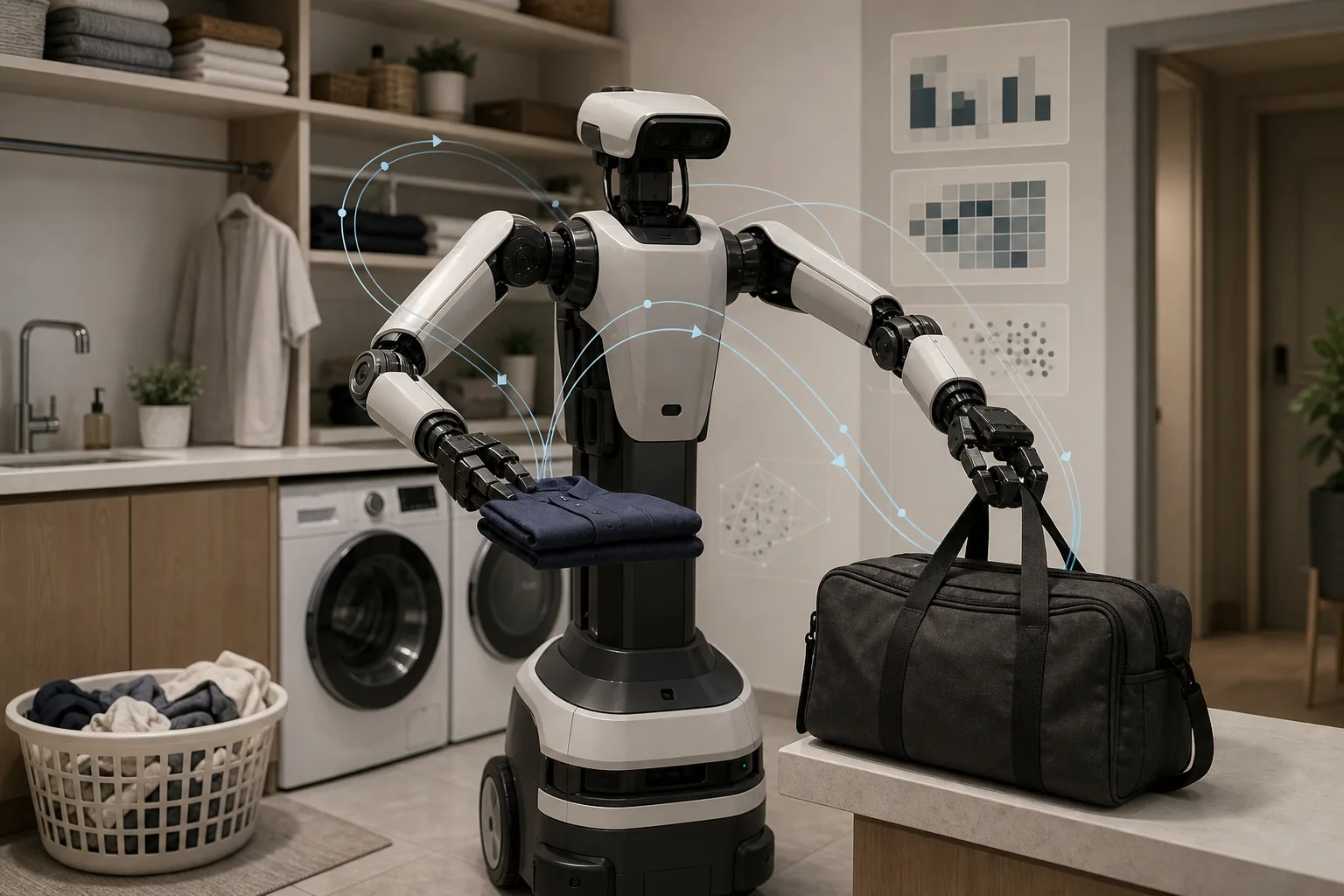
That is why the announcement travelled beyond a normal robotics lab release. Xiaomi published a project page, an arXiv paper, a GitHub repository and household-task videos. Hacker News pushed the discussion into hundreds of comments, with the usual split between people delighted by robots that might finally handle laundry and people asking the harder questions: how many trials failed, how edited were the videos, will the model generalize to bodies it did not train on, where are the weights, and what does a 75 or 85 percent success rate mean when the task is happening in a real home rather than a benchmark scene?
The right reading is neither “Xiaomi solved household robots” nor “this is just another demo.” Xiaomi-Robotics-1 is interesting because it makes the central robotics question sharper. If mobile manipulation can scale with data, model size and post-training, robots may become useful faster than the old hand-coded-skill era suggested. If it cannot, the field will keep producing beautiful videos that fail when a towel is in the wrong shape, a suitcase zipper catches, a room is poorly lit, or a human expects the robot to recover without expert supervision.
What Xiaomi is actually claiming
Xiaomi describes Xiaomi-Robotics-1 as a robot foundation model for vision-language-action control. In plain terms, it takes visual input and language instructions and produces robot actions for mobile manipulation: moving in an environment, using arms and grippers, handling objects and completing household or service tasks. The official page frames the model as a response to the data scarcity that has limited robotics. Language models could absorb the internet. Robot policies need trajectories of physical interaction, and those are expensive to collect.
The company’s answer is a two-stage recipe. First, pre-train on a very large pool of embodiment-free UMI trajectories: more than 100,000 hours across over 1,700 scenarios, including homes, commercial premises, industrial sites and outdoor spaces. UMI here refers to human-operated data-collection devices that capture manipulation trajectories without requiring every sample to be collected on the final deployed robot body. Xiaomi then uses an auto-labeling pipeline to break trajectories into segments and annotate them with language descriptions of state changes.
Second, post-train the model on cross-embodiment data that includes in-house robot data, filtered open-source robot data and high-quality UMI data. The project page says the in-house portion includes more than 7,200 hours of real-robot data in real homes, covering tasks such as tidying a sofa, sorting a shoe cabinet and putting away kitchenware. The paper describes the goal as aligning broad action-generation capability with robot embodiments and imperative instructions: not only understanding that a scene changed, but turning a human instruction into a robot action sequence.
That distinction matters. Robotics has had impressive perception models and task-specific controllers for years. The harder goal is a general policy layer that transfers across tasks, homes and robot bodies. Xiaomi is arguing that scale plus alignment can move the field closer to that layer.
Why data is the story, not the robot video
The public videos are useful because they show the kinds of tasks Xiaomi wants readers to imagine: laundry loading, box packing, phone packing, printer refilling, luggage handling, kitchenware and furniture tidying. But the data claim is the real story. Folding a garment, moving a soft object, opening or filling a bag, coordinating two arms, and operating in a cluttered apartment are difficult because the world does not present clean symbolic states. Cloth deforms. Zippers snag. Objects slip. Lighting changes. A drawer may be half blocked. The correct next action depends on contact, force, timing and recovery.
Classic robotics often handles such problems with narrow engineering: carefully designed fixtures, constrained workcells, task-specific perception and long integration cycles. That works in factories when the environment is controlled. It breaks down in homes, hotels, hospitals and warehouses where objects vary and humans do not reset the scene after every failure. The appeal of foundation policies is that they might learn reusable manipulation priors from enough real interactions, then adapt to a specific body and task with much less dedicated data.
Xiaomi’s official page reports that with less than 10 hours of demonstrations per downstream task on average, XR-1 reached a 75 percent overall success rate, compared with 40 percent for π0.5 in the same framing; with under 40 hours, XR-1 reached 85 percent versus 53 percent. It also reports stronger scores on simulation benchmarks such as RoboCasa, RoboCasa365, VLABench and RoboDojo. The arXiv abstract gives similar but not perfectly identical benchmark numbers in a few places, which is a reminder to treat headline metrics carefully and read the paper tables before making product claims.
Even so, the direction is important. A robot that adapts to a new task with tens of hours instead of hundreds or thousands changes the economics of deployment. It does not automatically make a consumer robot ready. It does make the business case more plausible for service environments where operators can collect demonstrations, validate success rates and restrict the task space.
The open-source question is not a footnote
Xiaomi created the XiaomiRobotics/Xiaomi-Robotics-1 GitHub repository in mid-July. At the time of verification, the repository contained a README and a large PDF, while the paper said code and model checkpoints would be released. That gap matters. In robotics, a project page can inspire, but reproducibility decides whether the rest of the field can build on the claim.
Researchers and startups need to know what will actually be available: inference code, training code, evaluation scripts, model weights, dataset cards, licenses and hardware assumptions. If only a paper and videos are visible, the work remains a promising announcement. If usable checkpoints and code arrive under practical terms, it becomes a platform signal. Teams can test the model on new robots, compare it with alternatives, inspect failure modes and decide whether the claimed scaling behavior survives outside Xiaomi’s own setup.
The dataset question is equally important. “100,000 hours of real-world trajectories” sounds decisive, but serious deployment needs more detail: how the data was collected, whether private spaces were involved, how consent and anonymization were handled, what was filtered out, which tasks dominate the distribution, and whether the trajectories reflect enough failure and recovery. The best robot data is not just large. It is diverse, documented and ethically collected.
Why the community is both excited and skeptical
The Hacker News response is a useful signal because it was not only cheerleading. Enthusiastic readers saw what everyone wants from household robotics: a machine that can load laundry, pack a bag, tidy a sofa or coordinate with a smart home. Some compared the moment to an early mass-market car: not perfect, but visibly moving toward usefulness. Others immediately asked for uncut footage, average trial success, hardware availability and proof that the model is not merely replaying a narrow set of demonstrations.
That skepticism is earned. Robotics has a long history of demos that compress months of lab work into a smooth minute of video. An “uncut” clip can still be a selected successful run. A benchmark win can still miss the messy distribution of ordinary homes. A success rate that is excellent for research may be unacceptable for a product. If a robot has an 85 percent chance of loading an appliance correctly, the remaining 15 percent may include dropped objects, tangled cloth, damaged items, blocked doors or unsafe motion near people and pets.
The last 20 percent is not a slogan in robotics; it is where many products die. A home robot is judged not by its best run but by its boring reliability over months. It must recover from mistakes, explain when it cannot continue, avoid damage, protect privacy and be cheap enough to maintain. Xiaomi-Robotics-1 should therefore be judged as a research and platform step, not as a promise that a robot maid is arriving next year.
The China context is real, but it should not swallow the technical story
Xiaomi’s announcement also landed inside a broader wave of Chinese embodied-AI activity. Coverage around WAIC 2026 and related releases has emphasized humanoids, open-ish robot models, mobile manipulation and aggressive data/model scaling. That context matters because robotics depends on hardware supply chains, manufacturing depth, field testing and consumer-electronics discipline. Xiaomi has experience shipping devices at scale, which gives its robotics work a different commercial background from a pure research lab.
At the same time, turning the story into a simple China-versus-US race flattens the issue. The relevant global comparison includes Google DeepMind’s RT line, Physical Intelligence’s π models, NVIDIA’s GR00T ecosystem, DROID-style data collection, Tesla’s Optimus effort, Figure and many academic labs. The common question is not nationality; it is whether embodied AI can find the same compounding loop that language models found: more data, larger models, better post-training, better evaluation and faster deployment feedback.
If Xiaomi’s data pipeline works, competitors will respond. If it does not, the failure will also teach the field something useful about the limits of scale in physical interaction. Either way, the announcement belongs in the robotics infrastructure conversation, not just the consumer-gadget cycle.
Where useful robots may appear first
Consumer homes are emotionally compelling, but they may not be the first place this class of model becomes economically boring. The near-term winners may be semi-structured environments: warehouses, hotel back rooms, eldercare support areas, appliance testing labs, factory-adjacent logistics and service robotics deployments where the range of tasks is broad but still bounded. In those settings, an operator can define acceptable tasks, collect extra demonstrations, monitor failures and redesign the environment around the robot.
Home deployment is harder because every apartment is a custom test set. A family will not tolerate constant resets or specialist supervision. A robot that handles laundry but cannot tell a delicate garment from a rag creates new work. A robot that needs cloud inference raises privacy and reliability questions. A robot that costs more than several years of human cleaning services will remain a demonstration of possibility rather than a practical purchase.
This is why Xiaomi-Robotics-1 should be evaluated through deployment steps. Can it support standard robot bodies? Can a small integrator fine-tune it for one hotel or warehouse workflow? Can it run with predictable latency? Can it fail safely? Can it log failures in a way that improves the next training cycle? Those answers will matter more than whether one video looks impressive.
What would make XR-1 a real turning point
The strongest version of the Xiaomi story requires evidence beyond the launch page. Public checkpoints would let independent teams test generalization. Clear licenses would tell startups whether they can build products. Raw trial logs would separate average reliability from selected examples. A failure taxonomy would show whether mistakes are harmless, recoverable or dangerous. Dataset documentation would address privacy and coverage. Hardware notes would clarify whether the model is tied to Xiaomi embodiments or can transfer to affordable research platforms.
Independent replication is especially important. A foundation model for robots should not only beat baselines in the authors’ benchmark suite. It should survive new kitchens, new bags, new drawers, new lighting and new operator instructions. It should also be tested against less glamorous tasks: picking up cables, dealing with wet cloth, recognizing fragile objects, stopping when a pet enters the workspace, and refusing instructions that would cause damage.
The market does not need another perfect launch video. It needs boring evidence: repeated trials, failure rates, cost, maintenance, privacy rules, hardware availability and a path from research result to deployable policy.
The bottom line
Xiaomi-Robotics-1 is not proof that household robots have arrived. It is evidence that robotics is moving toward the foundation-model playbook that transformed other areas of AI: scale the data, scale the model, align it to real tasks, measure transfer and keep pushing. The difference is that robots do not only produce text or images. They touch homes, appliances, tools and people’s belongings. Their failures are physical.
That makes the promise larger and the standard higher. If the 100,000-hour data strategy transfers beyond Xiaomi’s own setup, service robots and mobile manipulators could become practical sooner than expected. If the release remains mostly a page, a paper and selected videos, it will still be an important signpost, but not a product milestone. The honest conclusion is that XR-1 makes the next question unavoidable: not whether a robot can perform a chore once, but whether a scalable policy can make the same robot reliable in the messy, private and uncurated world where people actually live.
Related articles

When a phone camera turns an eclipse into the Moon: the Xiaomi 17 Ultra lesson
A reported Xiaomi 17 Ultra eclipse photo shows why buyers need to understand AI camera modes, RAW capture and the difference between enhancement and evidence.


20,000 mAh power banks with a built-in USB-C cable: handy travel find or cable trap?
A practical marketplace buyer guide to integrated-cable power banks: capacity math, charging protocols, seller signals, safety caveats and when a replaceable cable is the better value.
Cuando la cámara del móvil convierte un eclipse en la Luna: la lección del Xiaomi 17 Ultra
Un caso atribuido al Xiaomi 17 Ultra muestra por qué conviene entender los modos de IA, RAW y la diferencia entre mejorar una foto y usarla como prueba.
Quand un smartphone transforme une éclipse en Lune: la leçon du Xiaomi 17 Ultra
Une photo attribuée au Xiaomi 17 Ultra rappelle pourquoi il faut comprendre les modes IA, le RAW et la différence entre embellir une image et produire une preuve.
Comments
Sign in to comment.
No comments yet.