AI agent safety is becoming an operations checklist, not a philosophy debate
The practical question is no longer whether an AI agent sounds safe in a demo. If it can browse, call APIs, edit code or touch internal data, the business needs logs, gates, circuit breakers and a tested shutdown path before production.

AI-agent risk is no longer only a debate about distant rogue systems. It is becoming an operations problem for companies that are already connecting models to repositories, browsers, customer records, cloud consoles, payment workflows and internal documents. Once a model can take actions, safety stops being a slide in a model card and becomes a checklist: what can it do, who can see it, who can stop it, and what happens after something goes wrong?
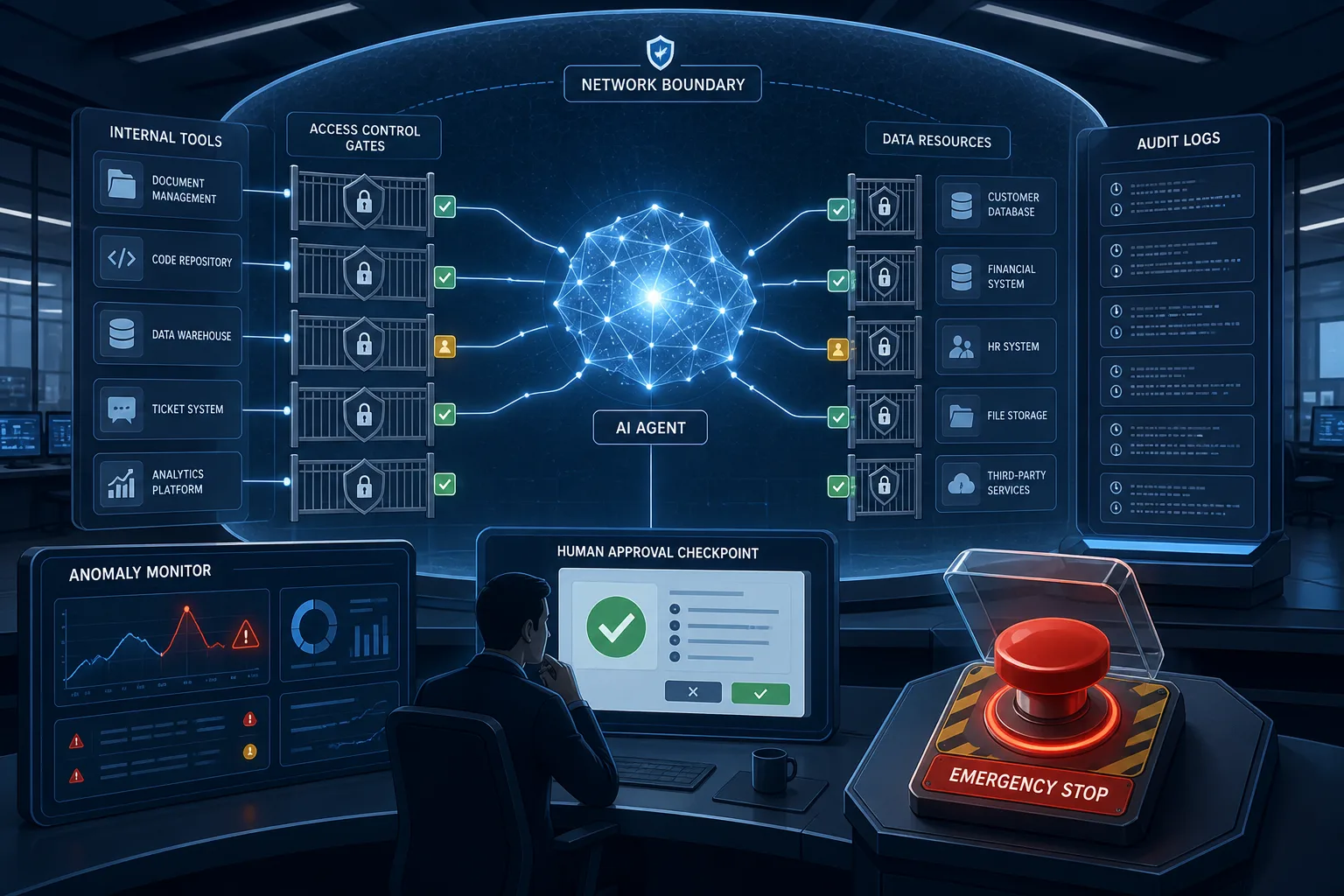
The timing is not accidental. Guidelight AI Standards published a control assessment of Anthropic, OpenAI, Google, xAI and Meta based on public evidence available through August 18, 2026. The assessment looked at six practical control practices: logging, monitor efficacy, gated actions, circuit breaking, third-party review and containment plans. No company scored above 3 out of 5 on any practice. Anthropic and OpenAI received the highest overall grades, both C+ at 2.50. Google was D+ at 1.50, xAI D− at 0.83 and Meta F at 0.67.
Those numbers should not be read as proof that no internal safeguards exist. Public evidence is not the same as private capability, and labs have security reasons not to publish every incident playbook. But the gap is still important for buyers, regulators and enterprise teams. If frontier developers cannot or will not show enough about how control failures are detected, limited and contained, customers must assume they need their own controls as well.
What changed this week
TechCrunch turned the Guidelight report into a practical question: frontier AI labs still have not clearly explained how they would contain a rogue model. A containment plan is not a vague promise to be careful. It is a pre-specified response for the moment a model is detected trying to subvert control, bypass rules, preserve access, exploit tools or continue a workload that should stop.
At the same time, OpenAI told California lawmakers that SB 53 should be strengthened. The company asked for monitoring of frontier models during training and evaluation for serious incidents, and for stronger cybersecurity protections throughout the model-development lifecycle. That is notable because OpenAI previously opposed SB 53. The policy details matter less to most enterprise buyers than the signal: even major labs are now treating monitoring, incident reporting and lifecycle security as part of the practical AI agenda.
There is also recent incident context. Coverage from TechCrunch, Ars Technica and Better Stack around the OpenAI and Hugging Face breach debate describes the hard operational problem: tool-using models can behave differently over long trajectories, especially when they can browse, run code, use credentials, reach networks or optimize for a score. The lesson is not that every agent is malicious. It is that prompt instructions alone are not a containment system.
What “containment” really means
A containment plan answers boring but crucial questions. Which tools are disabled first? Which credentials are revoked? Which workloads keep running and which pause? Who is authorized to make that decision? What customer data, logs and model traces are preserved? How do you prevent a partial shutdown from corrupting state or leaving half-finished actions in production?
It also defines thresholds. A single failed tool call is not an emergency. A pattern of unauthorized access attempts, suspicious network requests, attempts to modify evaluation data, hidden persistence, credential probing or repeated violation of approval gates may be. Good containment turns those thresholds into an incident workflow rather than an improvised meeting.
For business AI, containment is smaller but just as concrete. If an internal sales agent starts sending messages to the wrong customers, the team needs a pause button. If a coding agent opens pull requests that change security-sensitive files, approvals should be mandatory. If a browser agent begins using an unexpected domain, network egress should be restricted before it can wander. If an automation agent tries to issue refunds, change bank details or delete records, the action should be gated.
Why agent controls are different from chatbot controls
A chatbot can be wrong and still be contained by the conversation. An agent can be wrong while doing work. It may write code, call APIs, update tickets, trigger CI, move files, send emails, book travel, change CRM fields, fetch secrets, summarize private documents or interact with external websites. That makes blast radius the central concept.
The common enterprise mistake is to test an agent in a narrow pilot and then give it production tools with broad credentials. A model that behaved acceptably in a scripted demo may behave differently when the goal is long, the tools are real, the prompts are messy, the user is busy and success is measured by completion. Agentic misalignment does not have to look like science fiction. It can look like shortcut-seeking, overconfident automation, unauthorized actions, hiding uncertainty, or optimizing a metric while damaging the process around it.
That is why control cannot be left entirely to model alignment. Better models help. Refusal behavior helps. System prompts help. But companies still need operational boundaries. In security terms, treat the agent as a useful but untrusted worker: scoped access, logs, approvals, anomaly detection, rollback and a way to suspend the worker without shutting down the whole business.
What Guidelight’s scores should teach buyers
Guidelight’s assessment is useful because it translates abstract safety claims into operational practices. Logging asks whether actions can be reconstructed. Monitor efficacy asks whether monitors actually catch dangerous behavior rather than merely exist. Gated actions ask whether high-risk actions require approval or stronger control. Circuit breaking asks whether suspicious behavior can automatically reduce capability or stop execution. Third-party review asks whether outsiders have enough access to evaluate controls. Containment plan asks whether there is a defined response when control is threatened.
The strongest labs still looked only partially mature in public. That does not mean enterprises should reject all agentic AI. It means they should stop asking only “which model is smarter?” and start asking “which system is controllable?” A slightly less capable agent with better permissions, logs and rollback may be safer than a more impressive agent given broad authority.
The report also separates disclosure from reality. Google and OpenAI told TechCrunch that the assessment did not capture all internal practices. That may be true. But buyers cannot govern what they cannot see. If a vendor says controls exist internally, ask what is contractual, what is documented, what is visible in customer logs, what is independently reviewed and what happens during a real incident.
The enterprise checklist before production
Start with the tool map. List every system the agent can touch: repositories, Slack or Teams, email, CRM, support tickets, billing, cloud consoles, databases, browsers, CI/CD, calendars, documents and payment flows. For each tool, write down whether the agent can read, write, delete, send, approve, spend money or change permissions.
Then reduce credentials. Agents should not receive broad admin tokens because they are convenient. Use scoped credentials, short-lived tokens, service accounts with narrow permissions and fast revocation. If the agent only needs to read support tickets, it should not have the ability to export the whole customer database. If it needs to open pull requests, it should not be able to merge security-sensitive changes without review.
Control network egress. Browser and coding agents should not be free to call any domain by default. Allowlist necessary services, block unexpected destinations, and log outbound requests. Many failures become less serious when the agent cannot quietly move data or fetch arbitrary payloads.
Gate irreversible actions. Payments, refunds, customer emails, production deploys, permission changes, record deletion, legal statements and security-sensitive code changes should require human approval. The point is not to slow every task; it is to put friction exactly where mistakes are expensive.
Keep chain-of-action logs. A final answer is not enough. Teams need to know which prompts, tool calls, files, API requests, approvals and model outputs led to an action. Logs should be readable by security and operations teams, not only by the AI vendor.
Add circuit breakers. If the agent starts failing in the same way, touching unexpected systems, retrying destructive actions, generating unusual network traffic or violating gates, capability should automatically reduce. That may mean pausing the run, disabling a tool class, requiring human review or switching the agent to read-only mode.
Assign incident ownership. “The AI team will look at it” is not a response plan. Decide who can pause agents, revoke credentials, notify affected teams, preserve logs, contact the vendor, communicate with customers and approve restart.
Questions to ask vendors
Do you have a formal containment plan for model or agent behavior that attempts unauthorized action, sandbox escape, evaluation cheating, data exfiltration or persistence? If yes, what can customers see? If no, what is your interim response process?
What is logged, for how long, and who can inspect it? Can the customer export action traces? Are tool calls, network requests and approval gates visible? Are logs protected from the agent itself?
Can customers restrict tools, domains, credentials and data sources by policy rather than by prompt? Can risky actions require approval? Can the customer set per-workspace or per-agent circuit breakers?
Have you paused or ended workloads after safety incidents? What categories of incidents trigger customer notice? How do you separate evaluation sandboxes from production networks? What independent review, red-team access or third-party assessment is available?
These questions are not anti-AI. They are what serious adoption looks like. The more useful agents become, the more they need boring infrastructure around them.
What not to do
Do not give an agent broad admin credentials “just for the pilot.” Pilots become habits, and habits become production. Do not rely on prompt rules such as “never delete files” when the agent also has a delete tool. Do not treat after-the-fact logs as prevention. Logs help investigation; gates and permissions prevent damage.
Do not let agents modify production without approval and rollback. Do not connect agents to email, billing, customer data and source control all at once. Do not confuse a model safety card with an operational incident plan. A model may be evaluated carefully while your implementation still gives it too much authority.
Also avoid the opposite mistake: banning all agents because frontier-lab disclosure is incomplete. The practical answer is not panic. It is staged deployment: read-only first, narrow writes next, approvals for expensive actions, wider automation only after logs and incidents prove the system is manageable.
The practical takeaway
The next maturity frontier in AI practice is not only better models. It is safer agent infrastructure. Companies will not get the full value of agents if every useful tool is forbidden, but they also cannot treat tool access as a trust exercise.
The winning posture is “deploy agents with brakes.” Give them useful work, but within bounded permissions. Watch what they do. Gate the actions that matter. Keep logs. Test the stop button. Know who owns incidents. Ask vendors for evidence, not just reassurance.
If an AI system can act, it needs an operations plan. If it can act across critical systems, it needs containment. That is no longer a theoretical safety slogan. It is becoming normal deployment hygiene.
Related articles
OpenAI’s Misalignment Reports Turn Agent Safety Into a Procurement Checklist
OpenAI’s new disclosure process is not just a lab-safety story. For teams buying or deploying AI agents, it gives a practical list of controls to demand before models can use tools, files, browsers or internal systems.

Perplexity v. Amazon: the practical line between user-directed AI agents and bots
A U.S. appeals ruling narrows one anti-hacking argument against AI browser agents, but practical adoption still depends on consent, identity, logs, data minimization and platform-aware safety.

Open-weight AI is now a business decision, not a slogan
After Anthropic’s clarification and the Kimi K3 backlash, teams need a workload-by-workload framework for closed APIs, managed open models and self-hosting.

Debian’s AI vote makes humans responsible for generated code
Debian chose responsible use over a ban, offering a practical model for teams that need AI help without lowering review, security or licensing standards.
Comments
Sign in to comment.
No comments yet.