Open-weight AI is now a business decision, not a slogan
After Anthropic’s clarification and the Kimi K3 backlash, teams need a workload-by-workload framework for closed APIs, managed open models and self-hosting.

The open-weight AI argument has reached the point where “open versus closed” is no longer a useful business question. The better question is simpler and harder: which workloads should your company run on closed APIs, which should move to open-weight models, and what controls must exist before that switch is responsible?

That question became unavoidable on July 27 and 28. Anthropic’s Dario Amodei published “Our position on open-weights models” after criticism that the company wanted open-weight models banned. Hacker News pushed the post into a huge argument; the Firebase API showed 914 points and 1,332 comments when checked. The debate landed in the same week as Kimi K3’s open-weight release, letters from startups and large tech companies against broad restrictions, and a wave of developer posts arguing that open models now feel practical, not merely ideological.
Anthropic’s actual position is narrower than the social-media version. Amodei wrote that “Anthropic has never advocated for a ban on open-weights models.” He also wrote that open-weight models without dangerous capabilities are a public good because they provide value to businesses, developers and researchers once someone has the compute to run them. The company’s concern is not ordinary business use of every open model. Its stated concerns are powerful models in the hands of authoritarian governments, cyber or biological misuse, alignment failures, industrial-scale distillation, and released weights that cannot be pulled back.
The proposed remedies are also specific: stronger chip controls, action against smuggling and workarounds, crackdowns on industrial-scale distillation, and mandatory safety testing for sufficiently capable models, open or closed. You can agree or disagree with that policy package, but it is not the same as saying every open-weight model should disappear from enterprise use.
The backlash was predictable because open weights solve real problems for builders. Closed frontier APIs are easy to start with, but teams quickly run into cost, data routing, latency, rate limits, vendor policy and product dependency. A managed open-weight endpoint can be cheaper or more flexible. A self-hosted model can keep data inside a chosen environment. A fine-tuned small model can beat a frontier API on a narrow workflow if the task has clear scoring and enough examples. Those wins are not theoretical anymore; developers are posting ordinary, practical accounts of using open models in coding tools, internal automation and workflow-specific classifiers.
But open weights are not magic, and they are not free. They change where the work sits. With a closed API, the provider handles most serving, abuse monitoring, safety filters, updates and incident response. With open weights, especially self-hosted ones, more of that becomes your problem: GPUs, quantization, serving stack, logging, evaluation, context windows, prompt routing, data controls, security patches, model provenance and fallback. The invoice may move from API usage to infrastructure and engineering time.
That is why procurement teams should stop asking whether open-weight AI is “good” or “bad.” Ask which operating model fits the workload.
Closed APIs still make sense for broad reasoning, general assistants, low-volume experiments, workloads that benefit from managed safety controls, and regulated processes where a major vendor’s terms, audit posture and incident response matter. They also make sense when quality is the top constraint and the cost is acceptable.
Managed open-weight inference fits a different shape: cost-sensitive products, workloads where customization matters, teams that want model portability without running GPUs, and cases where data can leave the organization but vendor lock-in is still a concern. This is often the practical middle path. You get access to open models without immediately becoming an AI infrastructure company.
Self-hosting should clear a higher bar. It can be right when data residency, latency, privacy, air-gapped operation, routing control or total cost of ownership justify the MLOps burden. It is not right just because the weights are downloadable. If your team cannot monitor failures, patch serving software, secure prompts and outputs, control access, benchmark quality and maintain a fallback model, self-hosting may create more risk than it removes.
Fine-tuning or training a specialist model is the fourth path. It works best when the task is bounded and measurable: document classification, catalog review, extraction from known formats, support triage, compliance tagging, internal search ranking, code review checks with clear labels. It works badly when the team cannot define success, cannot collect examples, or secretly wants a cheap clone of a broad frontier assistant.
The governance checklist is not glamorous, but it decides whether open-weight adoption survives contact with reality. Start with provenance and license: where did the model come from, what rights does the license grant, what usage restrictions exist, and are you using an official release or an untrusted quantization? Then evaluate on your own tasks, not only public benchmarks. Measure quality, refusal behavior, hallucination rate, latency, cost, security behavior and failure modes.
Next, handle data. What data may be sent to the model? Where does inference run? Are prompts and outputs logged? Can logs contain customer data? Who can read them? How long are they retained? Do you need a regional provider, a private endpoint or self-hosting for certain workloads? These questions matter more than whether a model has an exciting leaderboard score.
Security and abuse monitoring also need a plan. If an open-weight model is used in coding, customer support, cyber workflows or autonomous agents, teams need red-team tests, output review rules, rate limits, anomaly monitoring and a kill switch. If the model is reachable through a product, assume people will probe it. If it can call tools, assume mistakes can trigger real side effects.
Policy risk is now part of architecture. A company using a Chinese open-weight model, a U.S. closed API and a European managed inference provider may face different customer concerns, procurement reviews and future restrictions. The answer is not to avoid everything. It is to design for substitution: model abstraction, routing rules, internal evals that compare candidates, and contracts that do not trap the product on one provider.
The Anthropic post matters because it shows how the AI market is splitting into three overlapping debates. One debate is business competition: open weights keep closed labs honest on price and control. Another is safety: powerful released weights are harder to monitor or withdraw. The third is geopolitics: chips, frontier capability, Chinese models, distillation claims and national-security policy. Enterprises cannot resolve all three. They can avoid pretending the debates are the same.
For product teams, the next-quarter plan should be practical. Pick two or three workloads where open models plausibly help. Run an evaluation against the current closed API baseline. Include cost, latency, quality, support burden and risk review. Try managed inference before self-hosting unless data rules force your hand. Keep a closed API fallback for broad or high-risk cases. Do not move customer-facing automation just because a demo looked good on Friday.
Developers should keep experimenting. Procurement should keep asking boring questions. Risk teams should avoid reflexive bans and reflexive approval. The useful middle is workload-by-workload adoption with evidence.
Open-weight AI is not ideology anymore. It is procurement, architecture and operations. That is less exciting than the online fight, but much more useful.
Related articles
Nvidia’s reported Hugging Face talks turn model hubs into platform risk
The reported talks are not a confirmed acquisition, but they show why AI teams should treat model hubs as strategic dependencies, not neutral folders of weights.

Anthropic’s revenue surge is a practical warning about AI model economics
The argument around Claude is bigger than IPO hype: teams buying AI now need to measure cost per useful task, switching risk and where premium models actually earn their price.
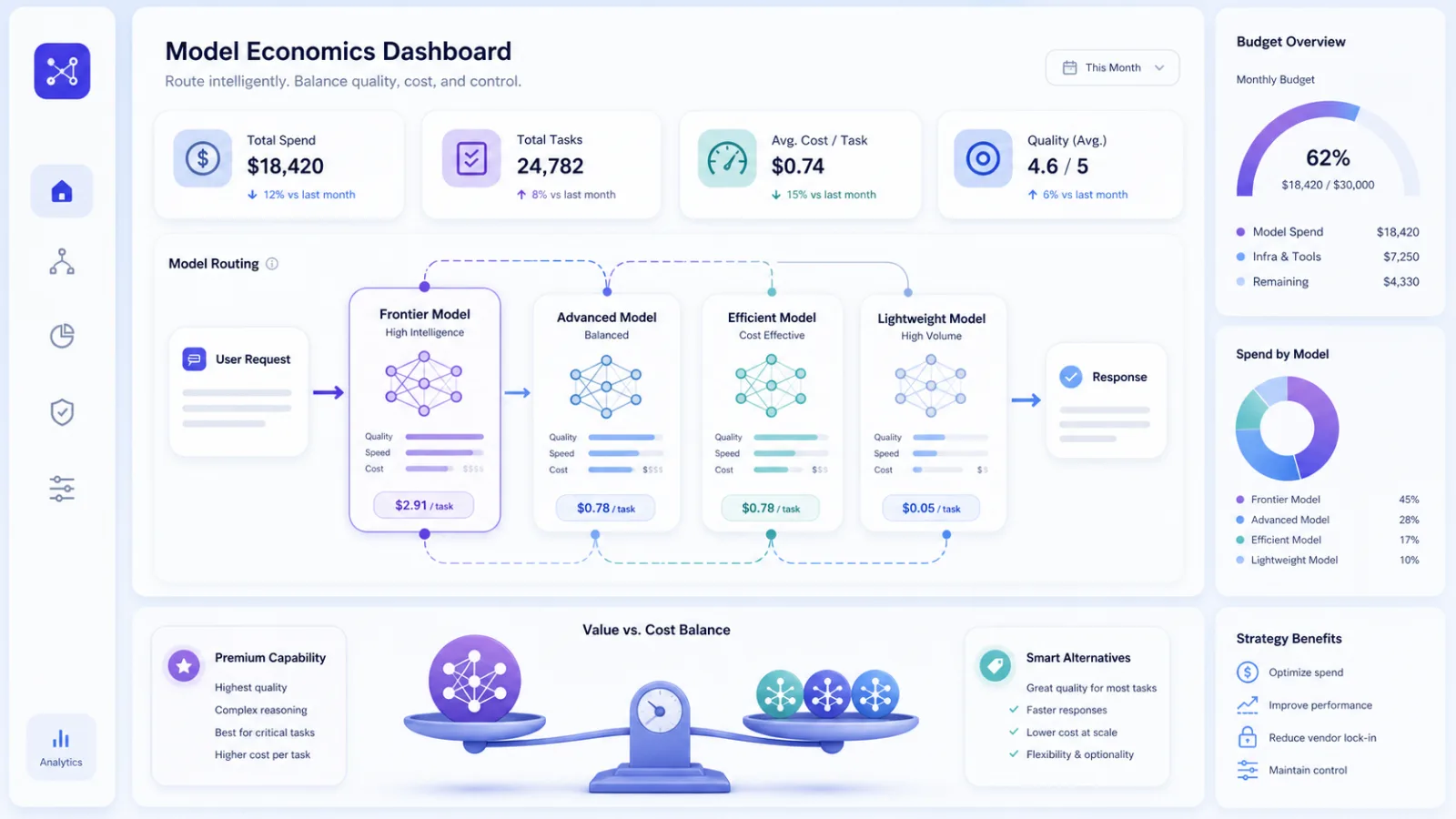
When basic AI becomes free: what ChatGPT’s new Luna and Sol split changes in practice
OpenAI’s wider free text access changes the buying question from model access to control, trust and workflow reliability.

The Automated Research Intern Has Arrived. The Bottleneck Is Now Evidence
OpenAI says its research teams are already using more agent effort than human labor in aggregate. The practical lesson for research and engineering leaders is not to hand over discovery, but to redesign how ideas are tested, recorded, and rejected.
Comments
Sign in to comment.
No comments yet.