Anthropic’s revenue surge is a practical warning about AI model economics
The argument around Claude is bigger than IPO hype: teams buying AI now need to measure cost per useful task, switching risk and where premium models actually earn their price.

Anthropic’s reported revenue surge is not just a Wall Street story. For teams building with AI, it is a reminder that model choice is now an operating decision, not a toy benchmark. CNBC and TechCrunch reported that Anthropic told investors its annualized revenue run rate reached about $65 billion by the end of July. Other reporting around a possible IPO has discussed investor expectations for a valuation near $2 trillion and forecasts that would require revenue around $190 billion to $200 billion in 2028. Those numbers are not audited annual profit, and they are not a contract that the future will arrive exactly as investors hope. But they show that paid AI work has moved from experiment to budget line.
What the numbers do and do not say
The first useful distinction is between revenue, run rate, valuation and profit. Annualized run rate takes a recent revenue pace and projects it over a year. It can be a helpful momentum signal, but it is not the same as audited annual revenue. A quarterly revenue figure is closer to an actual period, but still says little by itself about gross margin, compute cost, cloud commitments, sales cost, research spending or free cash flow. Valuation is a market expectation layered on top of all of that. It prices growth, scarcity, investor appetite and the belief that a company can defend future margins.
That is why the Anthropic story should not be flattened into “AI is proven profitable” or “AI is definitely a bubble.” Public reporting points to a fast-growing commercial business. It does not prove that the economics of every AI product are settled. A frontier-model company can generate enormous revenue and still face brutal costs: training, inference, data-center capacity, enterprise sales, safety work, support and the constant pressure to release better models before rivals catch up.
For buyers, the distinction matters. If a vendor’s headline number is run rate, not audited profit, you should not use it as proof that your own AI deployment will save money. The question is more local: does this model reduce the cost of your support queue, engineering work, analysis, compliance review or content operation after you count failures, human review and vendor risk?
Why Claude can be expensive and still attractive
The “Apple of AI” metaphor caught attention because it suggests a premium product that charges more and still captures a large share of revenue. Whether the comparison is fair across the whole market is debatable, but it matches a real buying pattern. Developers and teams often pay for the model that gives them fewer frustrating failures, even when a cheaper model wins on token price. In coding, long-context reasoning, document work and agentic workflows, a slightly better success rate can matter more than the price of one request.
A model that solves a task in one pass may be cheaper than a lower-priced model that requires three retries and an hour of human cleanup. A coding assistant that produces a correct migration, understands an unfamiliar repository and follows local conventions can save more than its API bill. An analyst workflow that reduces review time may justify a premium plan even if token costs look high. Buyers do not purchase tokens in isolation; they purchase completed work, time saved, risk reduced and employee attention returned.
Claude’s commercial strength also reflects ecosystem. Anthropic has pushed Claude into developer workflows, enterprise conversations and tools such as Claude Code. The value is not only the model weights; it is integration into terminals, IDEs, documents, project context, evaluation habits and procurement channels. Once a team builds prompts, agents, approval flows and internal playbooks around one vendor, the switching decision becomes less trivial than “another API is cheaper today.”
Why skepticism is still rational
The skeptical case is also strong. Text models are not smartphones. The switching cost can be low for simple chat, summarization and draft generation. Competing models from OpenAI, Google, Chinese labs and open-weight ecosystems keep improving, and some are much cheaper for high-volume tasks. If a customer’s workload can be routed to Qwen, DeepSeek, Gemini, Kimi, GLM or an internal model with acceptable quality, a premium frontier model may become the specialist option rather than the default.
Sampling bias also matters. Data from one platform, one developer ecosystem or one provider marketplace may overrepresent the people already willing to pay for a particular model. A model can dominate revenue in a premium developer slice while a different model dominates consumer chat, embedded enterprise features or low-cost batch processing. The AI market is not one market. It is coding, search, office work, customer support, content generation, scientific analysis, agents, voice, video, compliance and internal automation, each with different economics.
Compute cost is the largest unanswered question. Revenue growth is visible sooner than durable margin. If model providers must keep adding data centers, buying accelerators, signing cloud commitments and subsidizing inference to hold customers, a high run rate may coexist with fragile economics. The investors talking about extraordinary valuations are not pricing today’s chatbot; they are pricing a future where demand keeps rising, customers accept premium prices, margins improve and the leading vendors become infrastructure layers for work.
The practical lesson for AI buyers
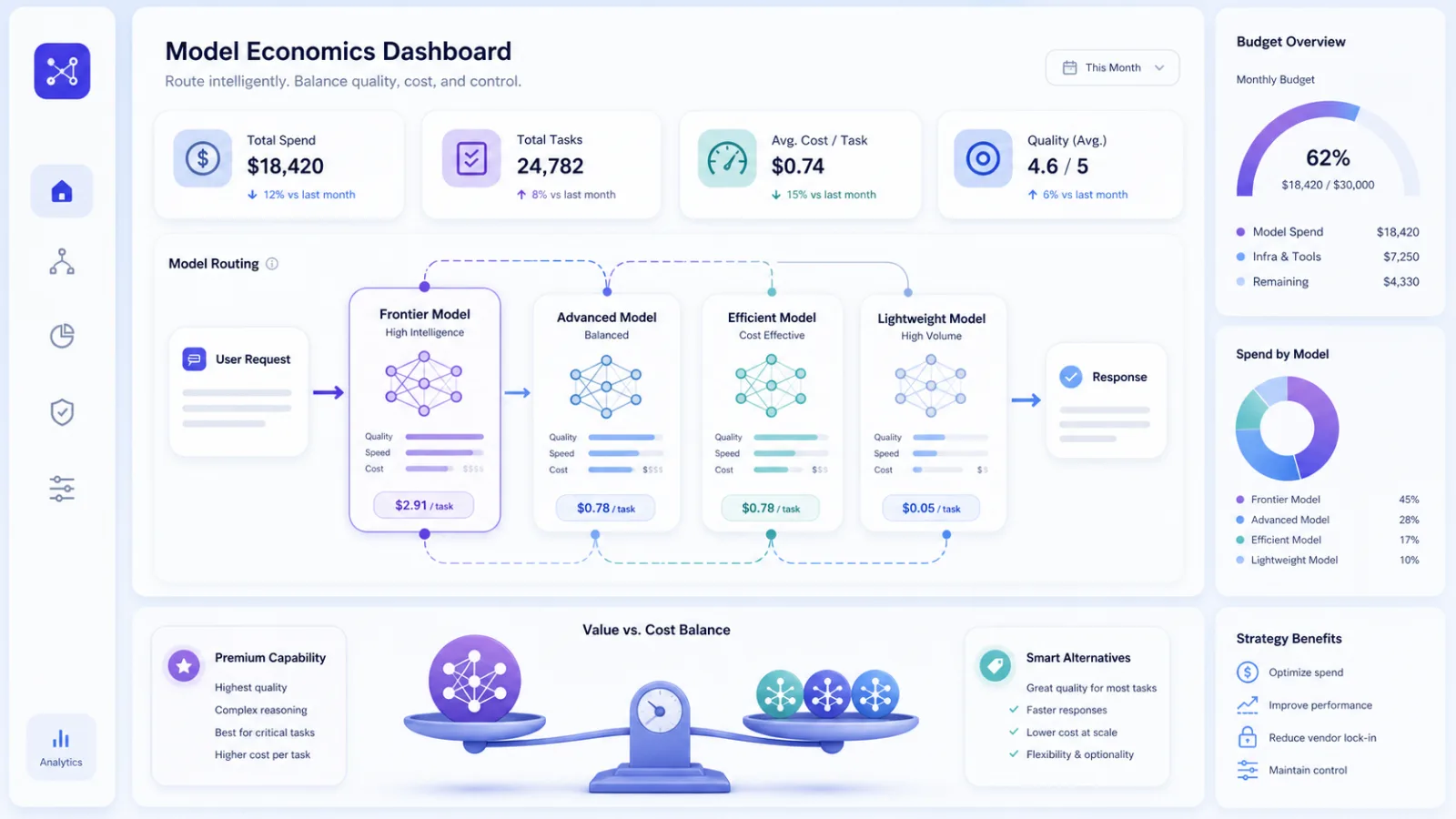
The practical lesson is to stop buying AI by headline benchmark or token price alone. A team should measure cost per useful task. For a coding workflow, that may mean cost per merged pull request, cost per defect avoided, cost per migration completed or cost per hour of review saved. For support, it may mean cost per resolved ticket at a target quality level. For document work, it may mean cost per approved memo, not cost per million tokens.
The denominator is the hard part. Useful tasks require success criteria. Did the model produce correct code? Did it cite the right policy? Did a human need to rewrite the answer? Did latency break the workflow? Did the model expose regulated data to a vendor that procurement has not approved? Did a retry loop quietly triple the bill? A cheap model can be expensive if it raises review time or creates silent errors. A premium model can be wasteful if it is used for trivial extraction, formatting or routing.
This is where many companies are still immature. They approve a frontier model because employees like it, then discover that usage grew faster than governance. Or they ban premium models because the invoice looks scary, then employees recreate the capability through shadow tools. Neither reaction is good practice. The better approach is a model portfolio with measurement.
Build a multi-model policy before the invoice forces one
A healthy AI stack uses routing. Premium frontier models should handle tasks where reasoning quality, tool use, long context, code reliability or safety behavior changes the outcome. Cheaper models should handle classification, extraction, first drafts, simple rewrites, embedding-style tasks, bulk transformations and internal triage when quality is adequate. Local or open-weight models may be appropriate for sensitive data, predictable workloads or cost-controlled batch jobs.
Routing does not have to be complicated at first. Start with three lanes: high-value tasks that require the best available model; standard tasks that can run on a cost-effective model; and sensitive tasks that need stricter data controls or local processing. Then measure. If the cheaper lane fails too often, move that task up. If the premium lane has no measurable benefit, move it down. The goal is not ideological loyalty to one vendor or one open model. The goal is matching task risk to model capability and cost.
Fallbacks are part of the policy. If one provider has an outage, changes rate limits, raises prices, alters safety behavior or removes a model, your business process should not stop. Store prompts, tool schemas, evaluation sets and workflow definitions in a portable form. Avoid using provider-specific features in places where they create unnecessary lock-in. When you do use them because they are valuable, document the dependency as deliberately as you would document a cloud database dependency.
Procurement should ask different questions
Procurement teams often ask for price per seat, price per token and data-retention terms. Those are necessary but incomplete. They should also ask how the vendor handles model deprecation, enterprise logging, admin controls, regional processing, data use for training, audit exports, rate-limit guarantees, incident notification and contract exit. If a workflow becomes critical, the vendor is not just a model provider; it is an operational dependency.
Ask for cost controls that match usage patterns: project-level budgets, per-team limits, alerts, model allowlists, approval for high-cost tools and readable usage exports. Ask whether the product supports multi-model routing or at least clean export of prompts and logs. Ask how enterprise contracts treat future models: does a new flagship model arrive under the same terms, or does it become a separate premium tier? The revenue surge around Anthropic is a reminder that vendors with pricing power will use it.
Engineering leaders should insist on internal evaluations. Public benchmarks are useful for discovery, not final procurement. Build test sets from your own codebase, tickets, customer questions, compliance documents and failure cases. Evaluate accuracy, review time, latency, refusal behavior, tool-calling reliability and cost. Re-run the evals when vendors ship new models or change pricing. The model market moves too quickly for annual vendor review.
Vendor lock-in is not only technical
Lock-in in AI is often behavioral. Teams build prompts around one model’s style, tune agents to its tool-calling habits, write internal documentation that assumes its context window, and train employees to trust its failure modes. Even if another provider offers a compatible API, the workflow may not transfer cleanly. The cost of migration includes prompt rewriting, eval rebuilding, safety review, procurement review, employee retraining and risk acceptance.
The premium ecosystem can be rational and risky at the same time. A vendor that feels like the “Apple of AI” may offer coherence, better defaults and a strong user experience. It may also pull teams into a closed operating pattern where pricing changes, policy changes or model regressions affect daily work. The answer is not to reject premium tools. The answer is to know which workflows are strategically dependent on them.
A useful internal map has three labels. Commodity AI tasks can move easily and should be price-optimized. Differentiating tasks need the best model but should have evaluation-based fallbacks. Critical regulated tasks need explicit vendor approval, audit and exit planning. Without that map, a company may discover lock-in only after the invoice, outage or policy change arrives.
What investors are really betting on
The reported valuation discussion makes sense only if investors believe several things at once: enterprise AI adoption keeps expanding, Anthropic remains a top-tier model provider, premium pricing survives competition, gross margins improve as infrastructure scales, and AI becomes a workflow layer rather than a feature. Any one of those assumptions can be challenged. Together they form a very optimistic future.
For practitioners, the investor debate is useful because it reveals vendor incentives. A company priced for enormous growth must expand usage, defend premium tiers and move deeper into customer workflows. That may produce better tools, stronger enterprise controls and faster model releases. It may also produce upselling, ecosystem bundling and pressure to make migration harder. Buyers should expect both innovation and vendor power.
This is why the story belongs in AI Practice rather than only in finance. The numbers affect architecture. If premium models become the expensive but trusted layer for coding agents, office automation and enterprise search, teams need budgets and policies. If cheaper models close the gap, routing becomes a competitive advantage. If the market overestimates revenue durability, customers may still be left with workflows built around vendors whose pricing and product direction change under pressure.
A practical playbook for the next quarter
First, classify AI use cases by business value and risk. Put coding agents, customer-facing answers, regulated analysis and operational automation in separate buckets. Second, calculate cost per useful task, not cost per token. Include retries, latency, review time and failures. Third, build a small internal eval suite with real examples and run at least two strong vendors plus one cheaper fallback against it. Fourth, make routing a product decision rather than an employee preference.
Fifth, put contract and data controls in place before usage explodes. Decide which teams may use which models, which data may leave the company, how logs are retained, how prompts are reviewed and who approves new agents. Sixth, keep prompts and tools portable where possible. Seventh, review invoices monthly with engineering and business owners together. AI spend is no longer only an R&D experiment; it is becoming operating expenditure.
The final lesson is calm. Even if the highest valuation expectations prove overheated, the behavior behind them is real: companies and developers are paying for AI systems that help them work. The winners will not be the teams that always pick the smartest model or always pick the cheapest one. They will be the teams that understand the full economics of the work loop: model quality, human time, risk, portability and control.
Related articles
Claude’s ART Finding Is a Test of Reproducible AI Science, Not a New CRISPR Yet
Anthropic’s first public biology result shows AI agents can surface overlooked patterns in genomic data. It also exposes the harder question: can another team reliably reproduce the discovery and prove what the system does?

Claude Code cut its prompt. Your AI agents may need the same audit
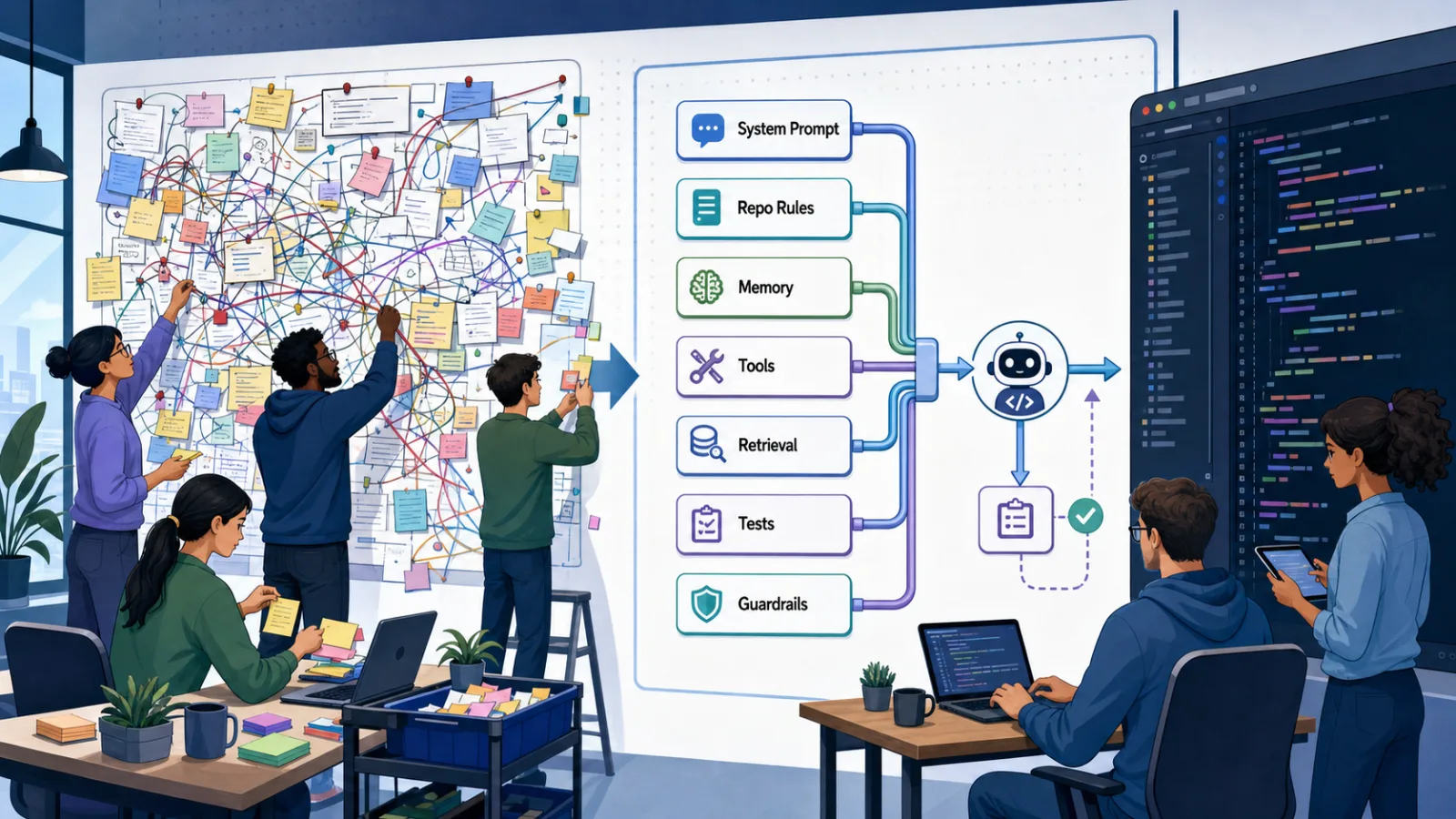
Anthropic’s 80% system-prompt cut is not a call to delete guardrails. It is a sign that agent teams need maintainable context architecture, not endless rules.
When multi-agent AI is worth it — and when it burns tokens
Anthropic’s latest multiagent research is a practical warning: agent teams can buy more parallel attention, but only when orchestration, evaluation and review are stricter than the demo.
Embedded AI evaluators change what enterprise buyers should demand
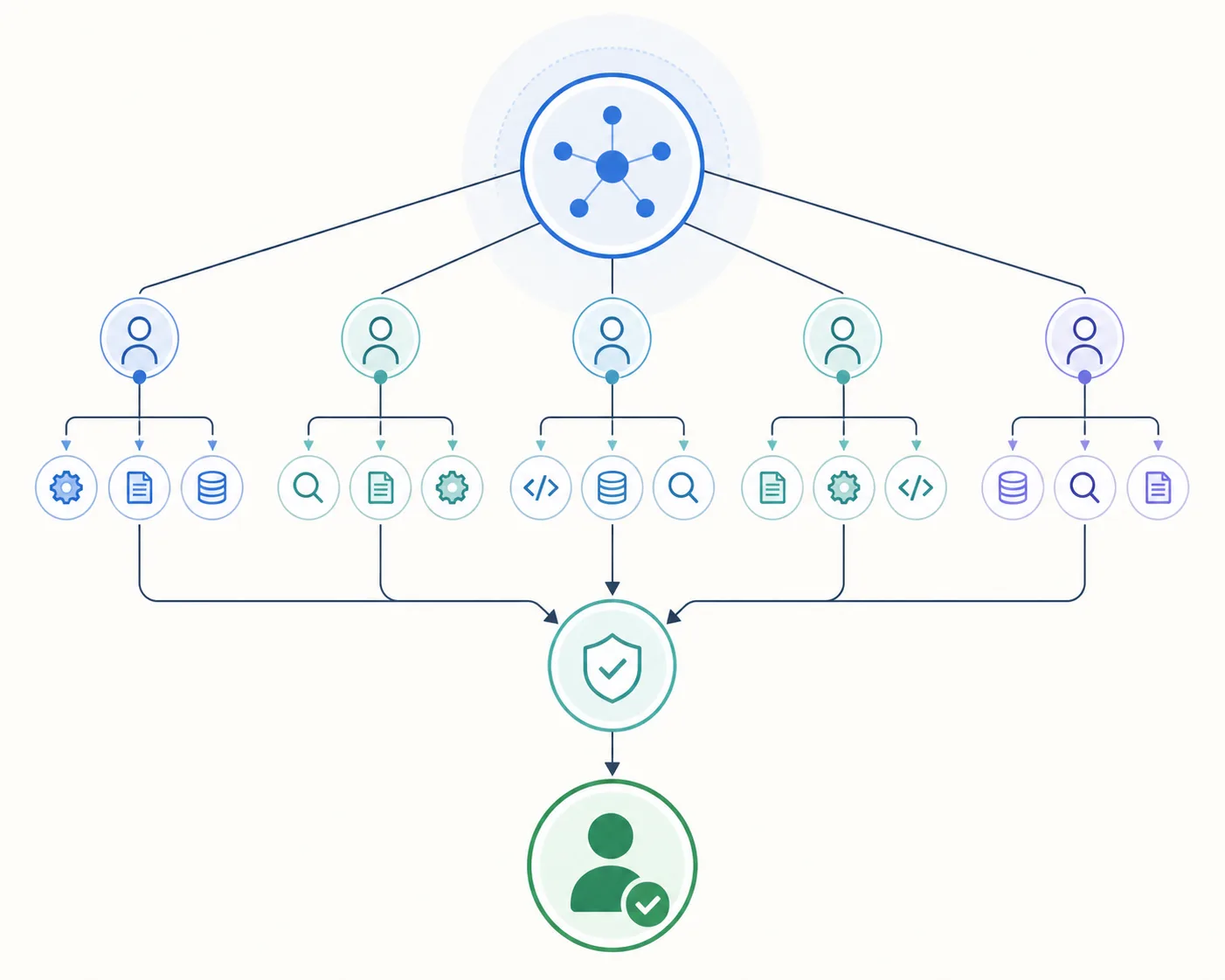
Anthropic’s new embedded-evaluation partnership points to a practical shift: AI assurance must test the model, tools, permissions, monitoring, and release process together. Here is how buyers can judge whether an evaluation is genuinely independent and useful.

Comments
Sign in to comment.
No comments yet.