GoAhead TLS Backend Flaws Turn Embedded Device Patching Into a Manufacturer-Tracking Problem
Three GoAhead TLS integration flaws affect different libraries and configurations. The upstream fix is available, but many operators still need to identify which device vendors have incorporated it into firmware.

What the GoAhead disclosure actually covers
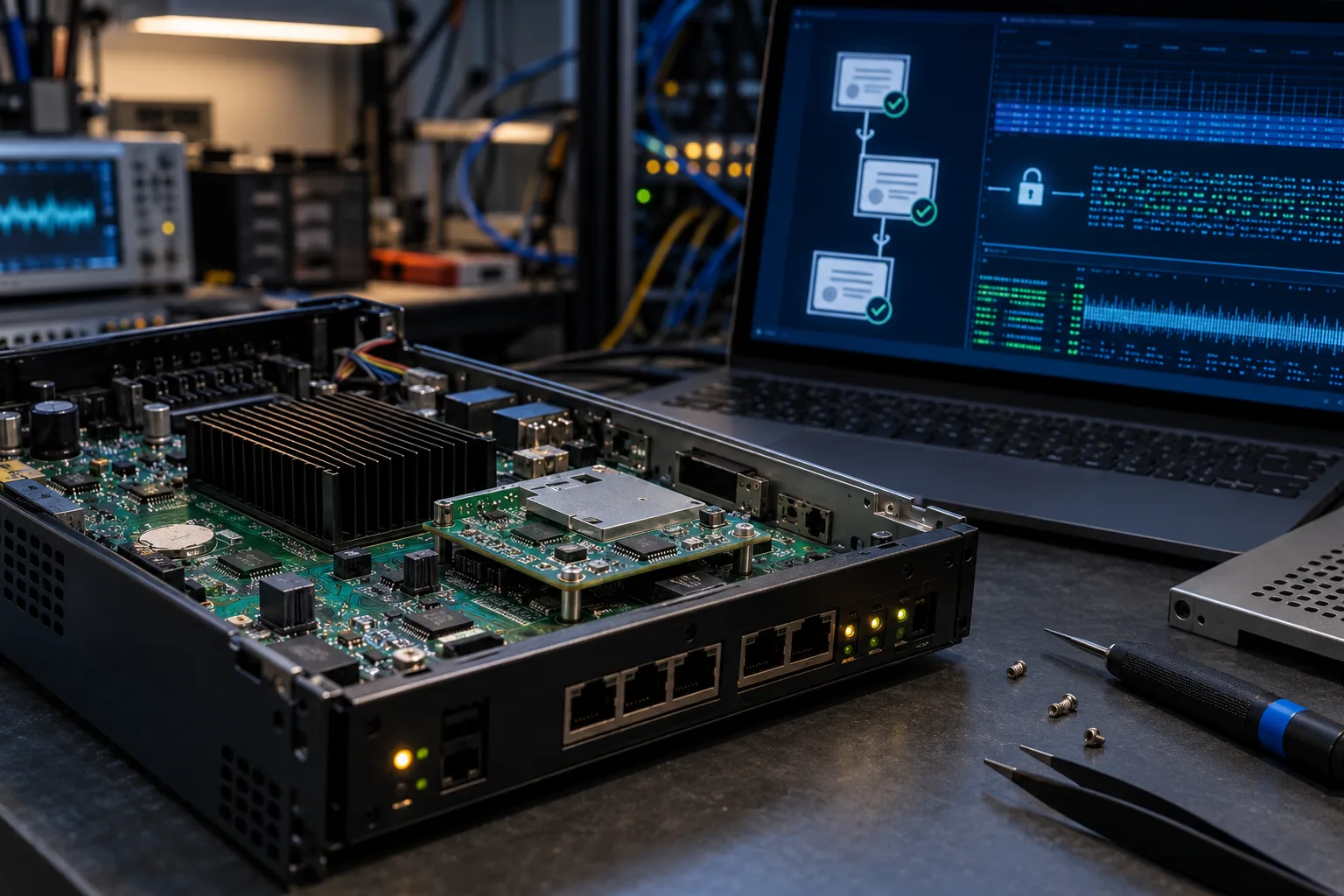
The GoAhead disclosure is easy to misread as a single vulnerability affecting every product that contains the web server. The published material describes three separate TLS integration defects, each tied to a particular cryptographic backend or verification path. CERT-In reported the issue on October 28, while EmbedThis advisories and FoxIO’s technical analysis distinguish the failures and connect their remediation to GoAhead 6.1.1. That distinction matters because the practical question for a device owner is not simply whether a product name appears in a vulnerability list. It is whether the device contains an affected GoAhead build, uses the relevant TLS backend, and enables the configuration or protocol path in which the defect can matter.
GoAhead is commonly used as an embedded HTTP or HTTPS management server rather than as a standalone web platform administered directly by an operating-system team. It can therefore sit inside products whose manufacturers control the firmware, build options, certificate policy, and update process. A router, camera, industrial appliance, network controller, or other embedded product may expose a GoAhead-powered management interface without exposing every defect described in the advisories. Conversely, a vendor may advertise only the product firmware version and omit the embedded GoAhead version or TLS library, leaving operators unable to determine exposure from ordinary asset records alone.
The affected code was fixed upstream in GoAhead 6.1.1. The release is the clearest reference point for remediation, but it does not automatically answer whether a particular device has been corrected. Manufacturers can backport a patch, change the TLS backend, disable a feature, or ship a firmware release that incorporates the fix without updating the component version in an obvious way. They can also continue distributing an older GoAhead branch in a product that is no longer maintained. For that reason, “GoAhead present” and “GoAhead vulnerable” should remain separate inventory states until the firmware contents or a vendor security notice establishes the build and configuration.
The first defect concerns OpenSSL-compatible builds and certificate revocation. The EmbedThis advisory for CVE-2026-115881 says that a configured certificate revocation list could be loaded but not enforced. In a deployment that relies on mutual TLS, this can mean that a client certificate expected to be rejected after revocation remains acceptable. The issue is therefore closely tied to how the device uses client authentication and revocation checking; it is not a generic statement that every HTTPS connection made by GoAhead is broken.
The second defect is associated with LibreSSL’s legacy verifier path. The advisory for CVE-2026-115884 describes a certificate-chain depth bypass under specific settings, involving an over-depth client chain. That wording is important for triage: the relevant exposure depends on the verifier path and the certificate-policy configuration, so a product that uses LibreSSL is not enough by itself to establish that the bypass is reachable. The third issue affects the Mbed TLS path and concerns malformed finite-field Diffie–Hellman parameters in some TLS 1.2 sessions, with the research describing a possibility of passive decryption under the applicable conditions.
These backend distinctions turn the disclosure into a software-supply-chain and device-maintenance problem as much as a library-patching problem. The upstream release provides a concrete fix, but operators still need the manufacturer to identify the embedded component, select the applicable mitigation, and deliver it through firmware. Until that evidence is available, product-name searches and broad claims about devices using GoAhead can indicate where to investigate, but they cannot prove that a particular installation is affected.
The three backend-specific failure modes
The disclosure is best understood as three separate defects whose reach depends on the TLS library selected when GoAhead is built. That distinction matters because “a product uses GoAhead” is not enough to identify the behavior at issue: the same embedded web server can be compiled against different cryptographic backends, and the vulnerable code paths are not interchangeable. The OpenSSL-compatible case concerns client-certificate revocation, the LibreSSL case concerns certificate-chain depth, and the Mbed TLS case concerns finite-field Diffie–Hellman parameters. Each therefore requires a different exposure question and a different reading of the device’s security configuration.
In the OpenSSL-compatible build, GoAhead could load a configured certificate revocation list (CRL) without enforcing it during client authentication. In a deployment using mutual TLS, that creates a gap between the administrator’s apparent policy and the check actually performed: a certificate listed as revoked could still be accepted because the CRL was present but not applied as a rejection rule. The defect affects GoAhead OpenSSL-backend versions from 3.4.5 through 6.1.0, while Mbed TLS builds use a separate CRL path and are not exposed to this specific flaw. The condition also depends on the endpoint using mutual TLS with a CRL configured; it does not mean that every OpenSSL-backed GoAhead endpoint accepts revoked certificates. The practical question is whether the device both supports that policy and actually rejects a revoked test identity after the relevant configuration is applied.
The LibreSSL issue follows a different path. It appears only on builds using the LibreSSL legacy X.509 verifier, including the specified LibreSSL 3.2.x and 3.3.2–3.3.6 branches. Under the affected configuration, GoAhead requires a client certificate but does not check issuer trust: VERIFY_PEER=1 is enabled while VERIFY_ISSUER=0 is disabled. In that situation, the verifier’s earlier error state can cause the depth guard to be skipped, allowing an over-depth client certificate chain to pass. Certificate-chain depth is intended to constrain how many subordinate certificates can sit between the client certificate and a trusted authority. If that limit is bypassed, a server may accept a chain longer than the administrator intended, weakening a policy that was supposed to restrict which issuing structures are valid.
This is not the same as a general failure of certificate validation, nor does LibreSSL by itself establish that the bypass is reachable. OpenSSL builds are not affected by this particular defect, and the advisory also distinguishes other backend and LibreSSL versions from the legacy-verifier path. For operators, the important combination is therefore not simply “LibreSSL present,” but the library release, the GoAhead build, the requirement for client certificates, and whether issuer verification is disabled. A device with issuer verification enabled and a trusted CA bundle is in a materially different configuration from one that only requires a peer certificate.
The Mbed TLS defect affects the cryptographic negotiation rather than certificate revocation or chain policy. In the affected GoAhead versions, the Mbed TLS backend passes the wrong length for the finite-field Diffie–Hellman prime. As a result, a TLS 1.2 DHE-RSA exchange can transmit a one-byte modulus instead of the intended larger parameter. When a client accepts those broken parameters, the resulting session can be recovered by a passive observer, defeating the forward-secrecy protection expected from that exchange. The issue is specific to the Mbed TLS path and the affected finite-field DHE negotiation; OpenSSL builds are not exposed to this implementation error.
The scope of that last finding is consequently narrower than the phrase “Mbed TLS vulnerability” might suggest. It does not establish that all TLS traffic from an Mbed TLS GoAhead device can be decrypted, or that every TLS 1.2 connection is exposed. The relevant questions are whether the endpoint permits the affected DHE-RSA exchange, whether a client accepts the malformed parameters, and whether the session matches the vulnerable conditions. Avoiding finite-field DHE removes the negotiation in which the malformed parameters matter, but it does not change the status of sessions that were already recorded before the configuration or firmware was corrected.
These differences explain why a single generic mitigation can be misleading. Revocation enforcement addresses the OpenSSL-compatible failure, while issuer and chain-verification settings are the relevant control surface for the LibreSSL path where those options are supported. For the Mbed TLS case, cipher-suite policy can prevent finite-field DHE from being negotiated. All three defects were addressed upstream in GoAhead 6.1.1, but that release number is not itself a firmware status for an embedded product. A vendor may have incorporated the corrected library, backported the relevant changes, or left the device on an older integration while changing surrounding configuration. The backend, version, authentication policy, and negotiated key exchange must therefore be considered together before an endpoint is classified as affected or remediated.
How to establish exposure without guessing
Treat the word “GoAhead” as the start of an investigation, not as proof that a device is affected. GoAhead is used as an embedded web and management server, but its presence in a product does not establish the exact library version, TLS backend, build options, or certificate-validation settings used by that product. The practical question is not whether a vendor has ever shipped GoAhead, but whether a particular firmware image contains a vulnerable GoAhead release and reaches one of the affected code paths.
Start with an inventory that ties each product to a model, hardware revision, firmware version, management interface, and update channel. Search product documentation, firmware release notes, SBOMs, package manifests, and vendor security advisories for GoAhead or EmbedThis references. If the vendor publishes a downloadable image, preserve the exact file and its release metadata; a product family name alone is too coarse to establish exposure. The CERT-In notice and the EmbedThis advisories describe the affected GoAhead versions and backend-specific conditions, while the GoAhead 6.1.1 release is the relevant upstream remediation point. That evidence should be matched against the firmware actually deployed, not against a vendor-name list or an unverified claim that a product “uses GoAhead.” CERT-In’s advisory and the GoAhead 6.1.1 release notes provide the baseline for that comparison.
The next step is to identify the TLS backend. The three defects do not apply uniformly to every GoAhead build: the reported conditions differ between OpenSSL-compatible, LibreSSL, and Mbed TLS integrations. A firmware image may reveal linked libraries, package names, build scripts, or symbols, although stripped binaries and vendor modifications can make that inconclusive. Where documentation is available, record whether the device uses OpenSSL, LibreSSL, or Mbed TLS and whether the relevant legacy or compatibility verification path is enabled. When documentation is incomplete, treat the backend as unknown rather than assuming the most common option. A confirmed backend, version, and configuration combination is substantially stronger evidence than a generic product search result.
Configuration review is equally important. For the OpenSSL-related flaw, determine whether the device uses certificate revocation lists as part of mutual TLS authentication and whether those lists are merely loaded or actually enforced during certificate verification. For the LibreSSL condition, examine whether client certificate chains are checked through the affected legacy-verifier path and whether a chain-depth limit is configured. For Mbed TLS deployments, establish whether TLS 1.2 can negotiate finite-field Diffie-Hellman exchange and whether DHE is enabled for the management service. These questions narrow the assessment to the circumstances described by the advisories; they do not justify declaring every device with the same vendor, product line, or web server affected. The corresponding OpenSSL advisory, LibreSSL advisory, and Mbed TLS advisory should be used as the configuration checklist.
Network observation can provide supporting evidence, but it should not be treated as a substitute for firmware attribution. For an exposed management endpoint, record the negotiated protocol version, certificate-authentication behavior, and the TLS fingerprint or cipher-suite profile where those observations are available and permitted. A profile may help distinguish an OpenSSL-style deployment from another implementation, or show whether finite-field DHE is offered, but it normally cannot prove the exact embedded GoAhead release. Likewise, seeing mutual TLS does not prove that a revocation list is configured or that the OpenSSL defect is reachable. Use these observations to prioritize devices for owner confirmation and controlled testing, then retain the raw results with the asset record.
A useful triage record separates three outcomes: confirmed exposure, plausible exposure, and unconfirmed association. Confirmed exposure requires evidence linking the deployed firmware to an affected GoAhead version, backend, and triggering configuration or protocol path. Plausible exposure means one or more of those elements is still unknown—for example, a vendor acknowledges GoAhead but has not identified the bundled version or TLS library. Unconfirmed association covers cases where the only evidence is a product or manufacturer name appearing in a public list. That distinction prevents a broad software footprint from becoming an inaccurate vulnerability declaration and gives manufacturers a precise request to answer.
Finally, record exploitation status separately from exposure. The cited research and discussion describe the defects and their affected conditions, but do not report confirmed exploitation of these flaws in the wild. That is not a reason to defer verification: internet-facing management services and certificate-authentication weaknesses still warrant prompt ownership and remediation checks. It does mean that incident teams should avoid presenting an unverified vendor match as evidence of compromise. Preserve relevant logs and certificate-authentication records, ask the manufacturer to identify the GoAhead version and TLS backend in the affected firmware, and update the assessment when that evidence arrives.
Patch ownership, compensating controls, and response
The durable fix is to move the device to firmware that contains GoAhead 6.1.1 or a later release. The upstream security release addresses the three backend-specific TLS defects, but an embedded product generally does not expose GoAhead as an independently maintained package. In practice, the relevant update is therefore the vendor’s firmware release, not simply the existence of a corrected version in the upstream project. Operators should record the product model, hardware revision, installed firmware, and the date of the latest vendor advisory, then compare that information with the manufacturer’s stated remediation. A vendor name appearing in a list of products that use GoAhead is not confirmation that a particular unit is affected, and the absence of a public notice is not confirmation that it is safe.
Where the manufacturer has not published a fix, ask for a specific remediation timeline and for the GoAhead version and TLS backend included in the planned firmware. The question should be precise: does the build use OpenSSL, LibreSSL, or Mbed TLS; which release of GoAhead is included; and have the relevant certificate-validation or key-exchange settings been changed? This helps separate a genuine patch commitment from a general statement that the product is “not affected.” It also gives defenders a basis for prioritising devices that expose management interfaces beyond trusted networks, use mutual TLS, or protect sensitive administrative sessions.
Compensating controls depend on the backend and the feature in use. For an OpenSSL-compatible build, administrators should verify whether certificate revocation lists are configured and whether issuer or chain verification is enabled in a way that prevents a revoked client identity from being accepted. The defect described in the advisory concerns a configured CRL being loaded but not enforced, so merely confirming that a CRL file exists is insufficient. Until patched, environments that rely on client-certificate authentication should review whether they can strengthen issuer verification or temporarily restrict the affected management service to trusted networks and approved source systems.
For LibreSSL deployments, the relevant exposure depends on the legacy verifier path and the settings that permit the certificate-chain depth condition. The practical response is to confirm the verification policy used by the product and to avoid assuming that a configured chain-depth limit alone provides the intended protection. For Mbed TLS builds, the advisory’s mitigation is more direct: where supported by the product, disable finite-field DHE and prefer an available alternative that does not depend on the affected parameter handling. This is a temporary control, not a substitute for firmware remediation, and it should be validated against the product’s supported TLS configuration before deployment.
After an update or configuration change, verification should cover both the software and the security policy. Confirm the reported firmware version, check that the management interface is still using the intended certificate and trust configuration, and test revoked or otherwise disallowed client identities where mutual TLS is part of the design. Review the negotiated TLS behaviour, including whether finite-field DHE remains enabled on an Mbed TLS device, when the product provides a way to inspect it. Also reassess which management interfaces are reachable, whether administrative access is limited to the expected networks, and whether any device has continued using an outdated firmware image after the maintenance cycle.
The response should also account for sessions and credentials handled before remediation. If a device accepted a certificate that should have been rejected, or if a sensitive TLS 1.2 session used the affected Mbed TLS key-exchange path, preserve relevant logs and consider the implications for identities, access decisions, and data exchanged during that period. The cited research reports no confirmed exploitation in the wild, so this is not evidence that every vulnerable device was compromised. It is, however, a reason to treat exposure as a patching and assurance problem: establish which builds and configurations were present, document the controls applied, and retain the manufacturer’s response.
Ultimately, responsibility is shared but not interchangeable. EmbedThis can provide the corrected GoAhead release, while the device manufacturer controls how that release is compiled, configured, signed, and delivered to customers. Device owners control inventory, network exposure, authentication policy, and the decision to retire or isolate unsupported hardware. A complete response therefore ends only when the firmware provenance is known, the backend-specific setting has been checked, the management surface has been reviewed, and the vendor has supplied a credible path for products that cannot be updated independently.
Comments
Sign in to comment.
No comments yet.