Digital-only consoles are turning gadget ownership into a trust problem
Sony's disc and digital-library stories are not just PlayStation news. They show why buyers need to judge modern devices by accounts, stores and licence rules, not only by hardware specs.

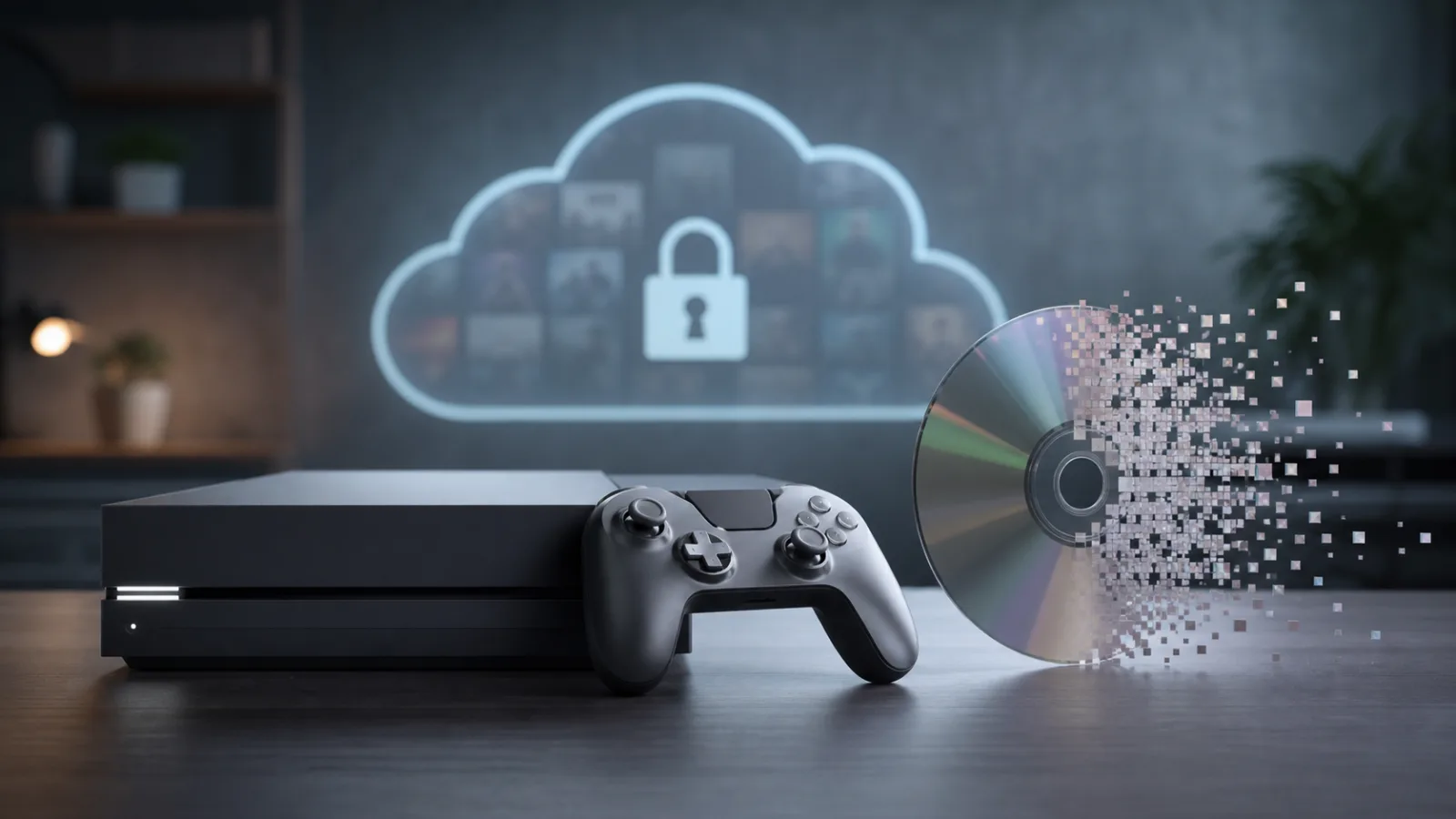
A console can look like a simple box under the TV. In 2026 it is more like a contract with a screen attached. The hardware still matters, but the store account, the licence terms, the download servers and the rights behind each film or game increasingly decide what the device is worth five years later.
That is why the latest Sony stories landed so hard. Ars Technica reported that some PlayStation users in the UK are losing access to previously bought StudioCanal video titles because the underlying rights have changed. The Verge separately reported that Sony plans to stop producing physical PlayStation game discs for new releases after January 2028, and then followed up with a report that Sony's disc plant in Thalgau, Austria, is already being repurposed for optical microlenses. Eurogamer, citing ORF Salzburg, described the same shift and reported that the plant's staff would be retrained rather than laid off.
None of this means that a disc you already own suddenly stops working tomorrow. It also does not prove that every future console will be useless without a server. But it does make one uncomfortable point very practical: the argument is no longer only about discs versus downloads. It is about whether a consumer device keeps its value when the manufacturer, the store or the rights holder changes the rules.
The disc was annoying, but it gave buyers leverage
Physical media was never perfect. Discs scratch. They take space. Modern games often need huge patches before they are worth playing. Some retail boxes already contain little more than a launcher, a partial build or a download code. Pretending that plastic automatically equals preservation would be dishonest.
Still, the disc did several jobs that digital stores rarely replace. It could be resold. It could be lent to a friend. It could sit on a shelf without depending on a login. In many cases it provided at least a starting point for installation when a store was slow, broken or gone. It also made the terms of the deal easier to understand. You paid money and received an object. That object might not guarantee every online feature, but it existed outside the seller's account system.
Digital purchases changed the deal. They gave users convenience, instant delivery and less clutter, but they also moved the centre of ownership from the living room to a database. The user interface may still say "buy". The legal and technical reality often looks more like permission to access a licensed copy while the platform can provide it.
That gap is what makes the StudioCanal case sting. The affected users did not wake up angry because streaming services rotate catalogues. Everyone understands that a subscription is temporary. They were angry because the purchase language suggested permanence, while the practical result felt temporary.
Sony is the case study, not the whole story
The Sony angle matters because PlayStation is a mass-market gadget, not a niche experiment. If a mainstream console ecosystem can move away from physical media while also showing how fragile digital libraries can be, the lesson applies far beyond games.
Smart TVs lose apps when vendors stop supporting old software. E-readers can depend on account policies and regional stores. Media boxes are only as good as the services they can still authenticate with. Cars increasingly ship with functions tied to subscriptions. Mobile apps disappear from stores. VR headsets, smart speakers and connected fitness devices can become worse products when a cloud service changes direction.
The pattern is familiar: the device is sold as hardware, but the experience is rented through software. That is not always bad. Connected devices can improve after purchase, receive security fixes and add features. The problem starts when buyers cannot tell which parts of the product they actually control.
The same question is now circling Xbox. Reports about Microsoft's next console plans have discussed a possible disc-free future and a way to digitize physical games, but those reports should be treated as reports rather than settled fact. What matters for buyers is the direction of travel. Console makers, film stores and app platforms all have incentives to reduce physical distribution and keep transactions inside their own storefronts.
Why the discussion is so heated
The reaction on Hacker News, Reddit and tech sites is not just nostalgia. Some people do miss shelves of games and Blu-rays, but the bigger concern is practical. Digital-only systems remove the user's fallback options.
If a store delists a title, a new buyer may lose access forever. If a rights deal ends, an old buyer may discover that "purchase" did not mean what it sounded like. If an account is banned, compromised or region-locked, the library may be trapped. If a platform shuts down, the question becomes whether the company offers refunds, migration, offline installers or nothing at all.
This is also why preservation groups care. Games and films are not only products. They are cultural objects. A disc is not a perfect archive, especially for always-online games, but it is at least a copy that can be catalogued, traded, dumped, studied and preserved. A licence entry in a private account database is harder to rescue.
Consumers care for a simpler reason: they paid. If a store uses the emotional language of buying, buyers expect some of the rights that buying usually brings. They expect access, transferability or at least a clear warning when those rights are absent.
The honest case for digital-only
There is a reason people keep choosing downloads. Digital games are convenient. There is no disc noise, no broken drive, no lost box. A cheaper digital-only console can make sense for a household that never resells games. Downloads also reduce some physical logistics and can make small independent releases easier to distribute.
For many users, that trade is fine. A parent who buys a few games a year in the same store may care more about convenience than resale value. A player with fast internet may prefer preloading a release at midnight. Someone who already lives inside Game Pass, PlayStation Plus or another subscription may not feel much attachment to individual purchases.
The trouble is that the market has not given digital buyers a clean replacement for the rights they lost. If a platform wants people to accept digital-only hardware, it should offer stronger guarantees: clear minimum access terms, simple refunds when content is revoked, offline access where technically possible, family sharing that does not feel punitive, account recovery that does not destroy a library, and end-of-life plans for stores and servers.
What to check before buying the next device
The spec sheet is no longer enough. Before buying a digital-only console, media box, e-reader or connected gadget, ask a few dull questions. They are dull until something disappears.
Can the device work offline for the things you care about? Does a physical version exist, and does the disc actually contain a playable build or only a licence key? Can you download a local copy? Can you back it up? What happens if your account is banned or you move countries? Does the store offer refunds when content is removed? Can family members use the library without your account being permanently signed in? Is there a resale path, or are you locked into one storefront forever?
For films, books and music, the strongest answer is still DRM-free when available. For games, the answer is messier because updates, online services and anti-cheat systems are part of the product. Even so, there is a difference between a game that remains playable offline after installation and one that turns into a receipt when the server goes away.
Buyers should also stop treating "digital" as a single category. A DRM-free download from a store that lets you keep an installer is not the same thing as a console purchase tied to one account and one region. A subscription is not the same thing as a purchased licence. A disc with a complete build is not the same thing as a box with a code.
The wording needs to catch up
Some regulators have started to notice the problem. California's AB 2426, for example, pushed sellers of digital goods toward clearer disclosure when a transaction is really a licence rather than unrestricted ownership. The details vary by jurisdiction, and no single law fixes the broader issue. But the direction is sensible: if companies want to sell access, they should not dress it up as ownership without explaining the limits.
Labels would help. "Licence, not ownership" is blunt, but at least it is honest. Better still would be a short consumer-facing summary: can this be removed, can it be downloaded, can it be transferred, can it be refunded if rights change, and what happens if the service closes?
The industry may hate that because plain language makes the trade-off visible. That is exactly why buyers need it.
A digital future still needs ownership habits
Physical discs are probably not coming back as the default. The economics point the other way, and many buyers already prefer downloads. The question is whether the digital replacement becomes more trustworthy or whether every purchase quietly turns into a fragile access token.
Sony's current headlines are a warning because they put both halves of the transition on the table at once. The physical fallback is shrinking, while digital libraries are reminding users that rights can move underneath them.
The next time a gadget looks cheaper because it has no drive, no local storage path or no independent media option, that missing part should count as part of the price. You are not only buying hardware. You are buying into a store, an account system and a promise. The important question is how much of that promise survives when the company changes its mind.
Related articles
Nintendo Switch 2 Game-Key Cards make physical games less physical
Game-Key Cards keep the box and resale, but not the full game on the card. Buyers need to check downloads, storage and long-term value before paying.

Should You Buy a Smart TV in 2026 — or a Dumb Screen With a Box?
A practical buyer’s guide to smart TVs, privacy, ads, external streamers, monitors and the trade-offs behind today’s cheap big screens.


Perplexity v. Amazon: the practical line between user-directed AI agents and bots
A U.S. appeals ruling narrows one anti-hacking argument against AI browser agents, but practical adoption still depends on consent, identity, logs, data minimization and platform-aware safety.

Google Play Age Signals turns age checks into a platform API
Google is rolling out an Android age-signal interface for Play developers. The hard part is not the SDK; it is the new platform dependency around privacy, compliance and product design.
Comments
Sign in to comment.
No comments yet.