Ray-Ban Meta Audio Glasses Remove the Camera: What You Gain, What You Lose, and Who Should Buy Them
Meta’s new Ray-Ban Meta Audio glasses turn smart eyewear into an audio accessory by removing the camera. That makes them easier to wear around other people, but it also removes the feature that gives camera-equipped models their most distinctive uses.

Ray-Ban Meta Audio glasses are a quieter answer to a loud problem in wearable technology: people may like hands-free audio and voice assistants, but they do not necessarily want to wear a camera in public.
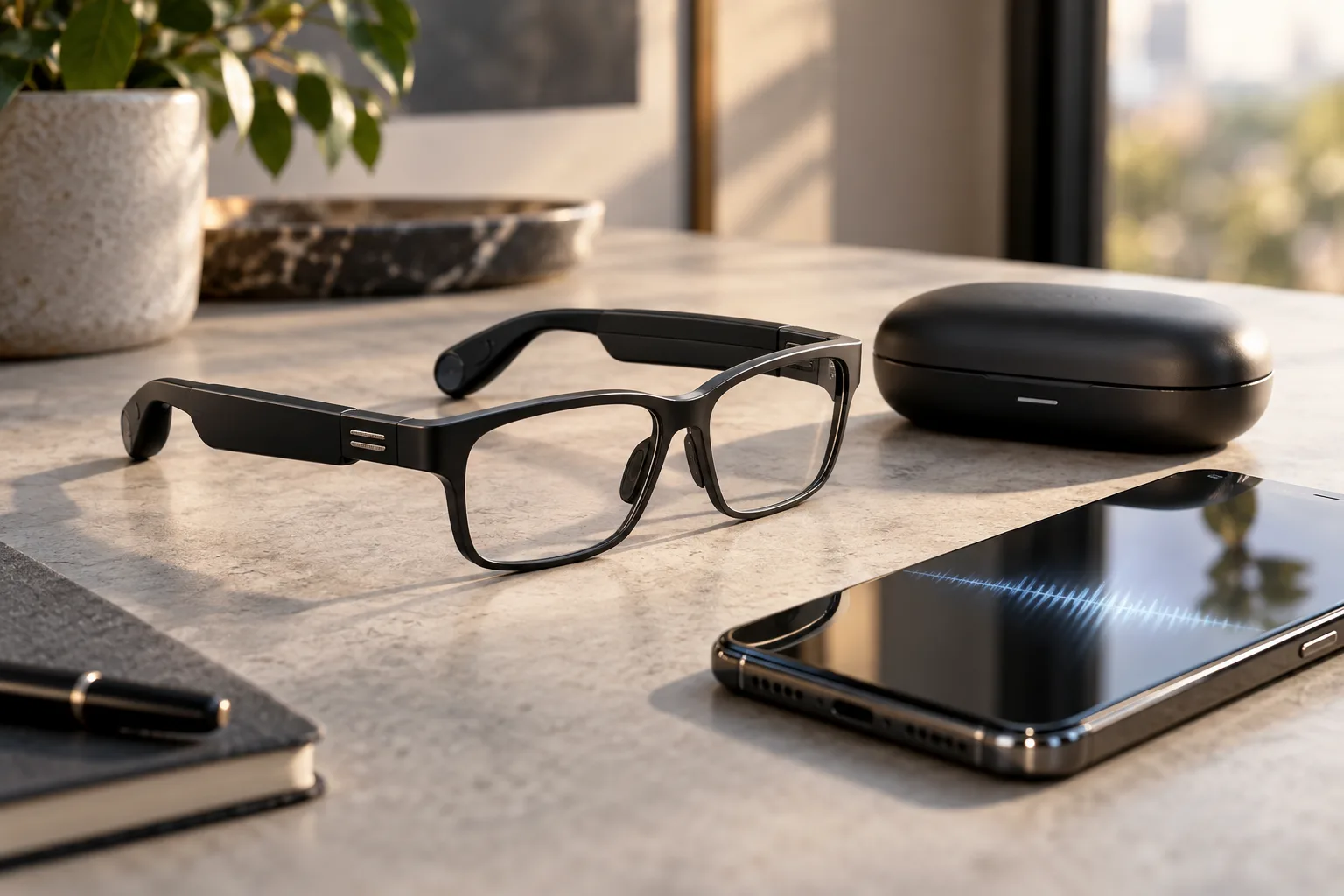
Meta’s new audio-only models keep the open-ear speakers, microphones, phone calls, messages, navigation prompts, translation and Meta AI access found across the Ray-Ban line. They remove the camera entirely. That single change affects the product’s social acceptability, battery expectations, privacy profile and usefulness in ways that matter more than the frame styling.
The glasses start at $349 in the United States and are offered in Clubmaster and Burbank shapes, with 23 colour and lens combinations according to Meta. They weigh 43 grams, support prescription options, and are rated by Meta for up to 12 hours of use, with up to 48 additional hours from the charging case. Ray-Ban’s product information lists Bluetooth 5.3, Wi-Fi 6 and IPX4 water resistance.
The important question is not whether these are the most advanced smart glasses. They are not designed to be. The question is whether removing the camera solves a problem you actually have, while leaving enough useful audio capability to justify paying more than you would for ordinary open-ear headphones.
What changed when Meta removed the camera
The Ray-Ban Meta Audio glasses are not a camera model with a disabled recording mode. They are a different hardware configuration. Ray-Ban lists no camera, no image memory and no multimodal AI features that depend on seeing the world through the wearer’s frame. That means no first-person photos, no videos, no livestreaming, and no asking Meta AI to identify a sign, object, dish or landmark from the glasses’ point of view.
In return, the design is simpler. There is no outward-facing camera lens, no camera storage to manage and no recording indicator whose meaning has to be explained to everyone nearby. A person seeing the glasses still cannot know everything about what the wearer is doing, but the most obvious concern—whether the frame is pointed at them and recording—is removed at the hardware level.
That distinction matters because the privacy problem with camera glasses is not limited to actual recording. In a school pickup area, a family gathering, a workplace meeting or a shop counter, other people cannot normally tell whether the camera is active. Even when a manufacturer adds an indicator light, the wearer’s intentions and the device’s current state remain difficult for bystanders to verify.
The Audio model changes that social calculation. It does not make Meta’s data practices irrelevant, and it does not make microphones disappear. It does make the glasses much easier to describe honestly: they are glasses with speakers and microphones, not glasses that can silently capture a visual record of the room.
That is a meaningful product decision, not merely a missing specification.
What the Audio model can still do
The everyday feature set is broader than the name suggests. Meta and Ray-Ban position the glasses as a hands-free audio and assistant device. With a phone connection, they can play music and podcasts, handle calls, send voice messages, read or respond to messages through supported services, and deliver spoken navigation. Meta also lists live translation among the available capabilities, although language support and regional availability should be checked before buying.
The open-ear design leaves outside sound audible. That is useful when walking, cycling at a responsible level of attention, running errands or listening for a child while audio is playing. It is also the reason these should not be judged as a replacement for noise-isolating earbuds. In a busy street, on public transport or beside machinery, external noise will compete with the speakers. The trade-off is awareness, not silence.
Meta AI is the other major reason to consider them. You can use a voice command to ask a question, control playback, start a timer, set a reminder or interact with supported phone functions without pulling out the phone. Ray-Ban’s product pages also list calendar and translation features across the wider Meta glasses range. The Audio model can use language-based assistance, but it cannot use the visual capabilities that depend on a camera.
That limitation is easy to underestimate in a product demonstration. A camera-equipped pair can answer a question about something the wearer is looking at. Audio-only glasses can answer a general question or repeat information supplied by the connected phone, but they cannot inspect a menu, read a street sign or identify a product sitting on a shelf.
The practical dividing line is simple:
- If your main use is listening, calling, messaging, reminders and spoken assistance, the Audio model covers the core task.
- If your main use is capturing moments or asking an assistant about things in front of you, the camera-equipped model is the necessary version.
The first group is larger than the marketing around smart glasses sometimes suggests. The second group is also real, and it is where the Audio model stops being an alternative and becomes a different product.
Battery life: a claim with a plausible reason behind it
Meta claims up to 12 hours of use on a single charge and up to 48 additional hours from the included case. Ray-Ban’s current product comparison gives the Audio model the same headline figures. Those numbers should be read as manufacturer targets, not a promise that every owner will get twelve hours of continuous listening in every situation.
Battery life varies with volume, phone calls, assistant requests, microphone activity, wireless conditions and the mix of services being used. A long call or repeated voice interaction can consume power differently from low-volume podcast playback. The charging case also adds weight and another device to carry, even if it is less cumbersome than carrying a separate pair of glasses and earbuds.
There is, however, a technical reason to expect the Audio version to have an advantage over a camera model in ordinary use. It does not need to power image capture, video processing, flash storage or the wireless transfer of photos and video. Meta lists up to nine hours for its Ray-Ban Meta Gen 3 camera glasses, compared with up to twelve hours for the Audio model. That is not a laboratory comparison of identical workloads, but it shows the direction of the trade-off.
The better way to judge the battery is by routine rather than by the advertised maximum. If you want glasses that can cover a commute, a workday of intermittent calls and a walk home, the Audio model is aimed at that pattern. If you expect continuous music at high volume, long calls and frequent assistant use from morning to night, you should still plan to charge them.
A second battery question is replacement. These are electronics built into prescription or sunglass frames, not disposable earbuds that can be replaced without changing the eyewear. Before buying, check the local warranty, return period, prescription-lens process and repair route. A longer claimed runtime improves daily convenience, but it does not remove the long-term ownership question.
The phone and account requirement is still there
Removing the camera does not make the glasses independent. Ray-Ban says the product requires a compatible smartphone, a Meta account, the Meta AI app and wireless internet access. The listed phone requirements are Android 10 or later with location services enabled, or iOS 14.4 or later. A USB-C charging plug is also needed if the case is charged from a wall outlet rather than directly from a USB port.
That setup requirement changes the value calculation. You are not buying a self-contained pair of intelligent glasses. You are buying a wearable interface for a phone, cloud services and a Meta account. The glasses can make common actions less awkward, but they do not remove the dependency on the phone ecosystem behind them.
The supported app list is narrower than the full list associated with camera-equipped Meta glasses. Ray-Ban currently lists WhatsApp and Spotify for the Audio model. That does not mean other Bluetooth audio sources cannot work, but it does mean you should distinguish ordinary Bluetooth playback from deeper, officially integrated controls.
Compatibility also has a social and practical dimension. If you use an iPhone, Android phone, work-managed device or a phone with strict background-app restrictions, check how the Meta AI app behaves before committing to the glasses. A feature that works in a demonstration may depend on permissions for Bluetooth, notifications, location, contacts or background activity.
The useful pre-purchase test is not “Does the phone connect?” It is “Can the phone and app stay connected through the situations in which I want to use the glasses?” Try calls, navigation, audio playback and assistant access. Those are the features that determine whether the glasses become a daily tool or spend most of their time in the case.
Privacy improves, but the microphone question remains
The absence of a camera is the strongest privacy argument for the Audio model, but it should not be treated as a complete privacy guarantee.
The glasses still contain microphones for calls, voice commands and audio capture. They still connect to a phone and Meta’s services. Voice requests may be processed to provide an answer, and the companion app remains part of the product. The exact handling of recordings, transcripts, retention and settings can change with software updates and regional policy, so buyers should read the current Meta AI privacy information rather than assuming that “audio only” means “offline.”
There is also a difference between privacy for bystanders and privacy for the wearer. Bystanders benefit from the absence of a visual camera. The wearer still needs to decide whether they are comfortable with a connected microphone and cloud-based assistant near private conversations.
The sensible social rules are straightforward:
- Tell people when you are using the assistant in a setting where a voice request may be recorded or processed.
- Do not use voice commands during confidential meetings, medical appointments or conversations where a phone would normally be put away.
- Turn the glasses off when you need a clear boundary rather than relying only on an app setting.
- Keep the Meta AI app and the glasses’ firmware updated, because security and privacy controls can depend on software.
- Treat the microphone as a microphone even though the product has no camera.
The Audio model removes one category of concern. It does not eliminate the responsibility that comes with wearing a networked listening and speaking device.
Who benefits most from the camera-free design
The strongest candidates are people who want open-ear audio but have avoided smart glasses because of the camera. That includes people who spend time around children, work with customers, attend frequent social events or simply do not want to explain a visible recording device every time they wear it.
They may also suit people who already like the shape and fit of Ray-Ban frames and want a single object that handles sunglasses or prescription lenses, calls and audio. The combination is more convenient than carrying normal glasses, earbuds and a phone for every short trip. Convenience is the actual selling point; the AI is an additional layer.
Drivers may find spoken navigation and calls useful, but the glasses should not be treated as a permission to interact with an assistant while attention is needed on the road. Open-ear audio can make directions audible, yet any device that encourages repeated voice interaction can also become a distraction. Use the same restraint you would apply to a phone’s voice assistant.
The Audio model could also work for someone who is interested in AI wearables but wants a lower-commitment entry point. Without a camera, there is less pressure to justify why the device needs to be worn in public. The trade-off is that the glasses are less demonstrably “smart.” They do not show off the most futuristic feature because their best feature is that they fade into the background.
Who should buy the camera-equipped model instead
Choose a camera-equipped Ray-Ban Meta if first-person capture is part of the reason you want smart glasses. The current Gen 3 model has a 12-megapixel camera, 3K video recording and a six-microphone array according to Meta. It also supports visual AI functions that the Audio model cannot provide.
That is the right choice for hands-free photos, short clips, visual questions, live sharing and situations where holding a phone is genuinely inconvenient. A parent documenting a walk, a cyclist recording a route or a creator needing a point-of-view camera may value those abilities more than the privacy advantage of the Audio model.
The cost is not only the camera. You also accept the social friction of wearing a camera in public, a more complicated privacy conversation, more storage and transfer considerations, and a greater chance that the glasses will be treated as a recording device even when they are only playing music.
For some buyers, that is a fair trade. For others, it defeats the reason to buy glasses instead of earbuds. The choice should be made from the task you expect to perform, not from the most impressive product demonstration.
How the Audio glasses compare with ordinary headphones
The obvious alternative is a pair of open-ear headphones or earbuds. Those products can provide better audio control, more familiar Bluetooth behaviour and, depending on the model, stronger water resistance or easier replacement. They can also be used with any glasses you already own.
Ray-Ban Meta Audio glasses answer a different problem: reducing the number of objects on your face and in your pockets. They combine eyewear, speakers, microphones, controls and an assistant in one frame. If you already need prescription glasses or sunglasses, that integration can be worthwhile. If you do not, the premium is harder to defend.
A good comparison should include the full cost of the configuration you need. Prescription lenses can increase the price. Transitions lenses may make the glasses more flexible across indoor and outdoor use, but they are not identical to dedicated sunglasses in every lighting condition. A spare pair of ordinary glasses may still be necessary.
Also consider failure modes. If the electronics stop working, you may still have usable frames, but you may need a repair or replacement process that is more complicated than replacing headphones. If the glasses are left charging, you may be without both your audio device and your preferred eyewear. The more functions a wearable combines, the more useful it can be—and the more inconvenient one failure becomes.
Price and value: pay for the combination, not the novelty
At a starting price of $349, Ray-Ban Meta Audio is positioned above many open-ear headphones and around the price of a premium pair of everyday glasses before prescription upgrades. The product makes sense when you value several functions together: open-ear audio, calls, voice control, assistant access and a familiar frame.
It is poor value if you only want music. In that case, ordinary headphones are likely to deliver the same basic result with fewer account requirements and less risk that a broken battery affects your eyewear.
It is also poor value if your primary reason for considering smart glasses is visual AI. The Audio model cannot see what you see. Paying for it and then discovering that the feature you wanted was the camera would be an avoidable mistake.
The strongest value case is therefore narrow but credible: you want the form of glasses, you will wear them often, you need hands-free audio and calls, and you prefer not to carry a camera on your face. If those conditions are not true, the product is mostly a stylish experiment.
A practical checklist before ordering
Before placing an order, check the following details against your own use rather than the product page’s headline claims.
- Your main task: Is it audio, calls and spoken assistance, or do you need photos and visual AI?
- Your phone: Is it running a supported Android or iOS version, and can it keep the Meta AI app active with the necessary permissions?
- Your services: Are your music, messaging and navigation apps supported in your region and on your phone?
- Your lens needs: Do you need prescription, clear, sun or Transitions lenses, and what will the final configured price be?
- Your environment: Will open-ear audio be loud enough where you plan to use it, and can you safely hear the surrounding world?
- Your privacy boundary: Are you comfortable with microphones and a connected assistant even though there is no camera?
- Your charging routine: Can you charge the glasses and case regularly, and what happens if the battery is depleted during the day?
- Your ownership plan: What is the return process, warranty coverage and repair route in your country?
- Your social context: Will you wear them around people who may be uncomfortable with connected eyewear, and can you explain clearly that this model has no camera?
- Your fallback: If the electronics fail, do you still have another usable pair of glasses and an audio device?
Those questions expose the real trade-offs faster than a feature list. They also prevent a common mistake with new wearables: buying the most interesting version first and only later discovering that the daily inconvenience is not the feature you expected.
The verdict
Ray-Ban Meta Audio is a focused redesign of the smart-glasses idea. It does not make the category more spectacular. It makes the category easier to live with.
Removing the camera gives up the most distinctive capability of Meta’s glasses, including photos, video and visual AI. In exchange, the Audio model is lighter, has a longer claimed battery life, avoids camera-related social suspicion and concentrates on functions many people already use every day: listening, calling, messaging, navigation and voice assistance.
That makes it a better fit for buyers who want smart eyewear to disappear into ordinary life. It is not the right fit for anyone whose main reason for buying is seeing through the glasses, recording hands-free video or asking an assistant about the physical world.
The best advice is to decide whether the camera is a feature you would use or a liability you would rather not own. If it is a liability, Ray-Ban Meta Audio is one of the clearest attempts yet to make smart glasses socially ordinary. If it is a feature, spend the money on the camera-equipped model—or keep using headphones and a phone until the right wearable arrives.
Related articles
Snap Specs Put a Standalone AR Computer on Your Face. What the $2,195 Glasses Actually Change
Snap’s new Specs are a serious standalone augmented-reality computer, not a cheaper pair of camera glasses. Their value depends on whether you need hands-free spatial tools often enough to justify the price, weight, battery limits, and still-forming software ecosystem.
Smart glasses have a people problem, not just a privacy problem
Meta, Snap and Google can make camera glasses look normal. The harder question is whether bystanders will accept them.
People are buying smart-glasses detectors. That is the real warning for face-worn AI gadgets
Antizuck is not a perfect way to find camera glasses, but its popularity shows that smart glasses now have to win the trust of bystanders, venues and buyers alike.

Should You Buy Meta’s Muse Charm? Wait for the Price, Privacy Terms, and a Reason to Carry Another Device
Meta’s Muse Charm is a keychain-sized voice device for its new personal AI agent, shipping in December with no price announced. The buying decision is less about the gadget’s novelty than whether it earns a permanent place beside your phone.
Comments
Sign in to comment.
No comments yet.