Before Autumn Rain: A Practical Apple-Tree Check for Scab, Rot and Next Year’s Crop
A wet spell can turn a minor apple-tree problem into next spring’s disease reservoir. Use this late-season checklist to sort harvestable fruit, remove infection sources and prepare a realistic prevention plan without spraying blindly.

September is when a backyard apple tree can look healthy from a distance while quietly storing next year’s disease problem. Leaves may show only a few olive spots. A handful of apples may have rough patches or begin rotting around an injury. Windfalls sit under the canopy, and the first sustained autumn rain is on the forecast. None of those signs automatically means the tree is doomed, but together they are a reason to inspect it before wet weather does more of the work for fungal diseases.
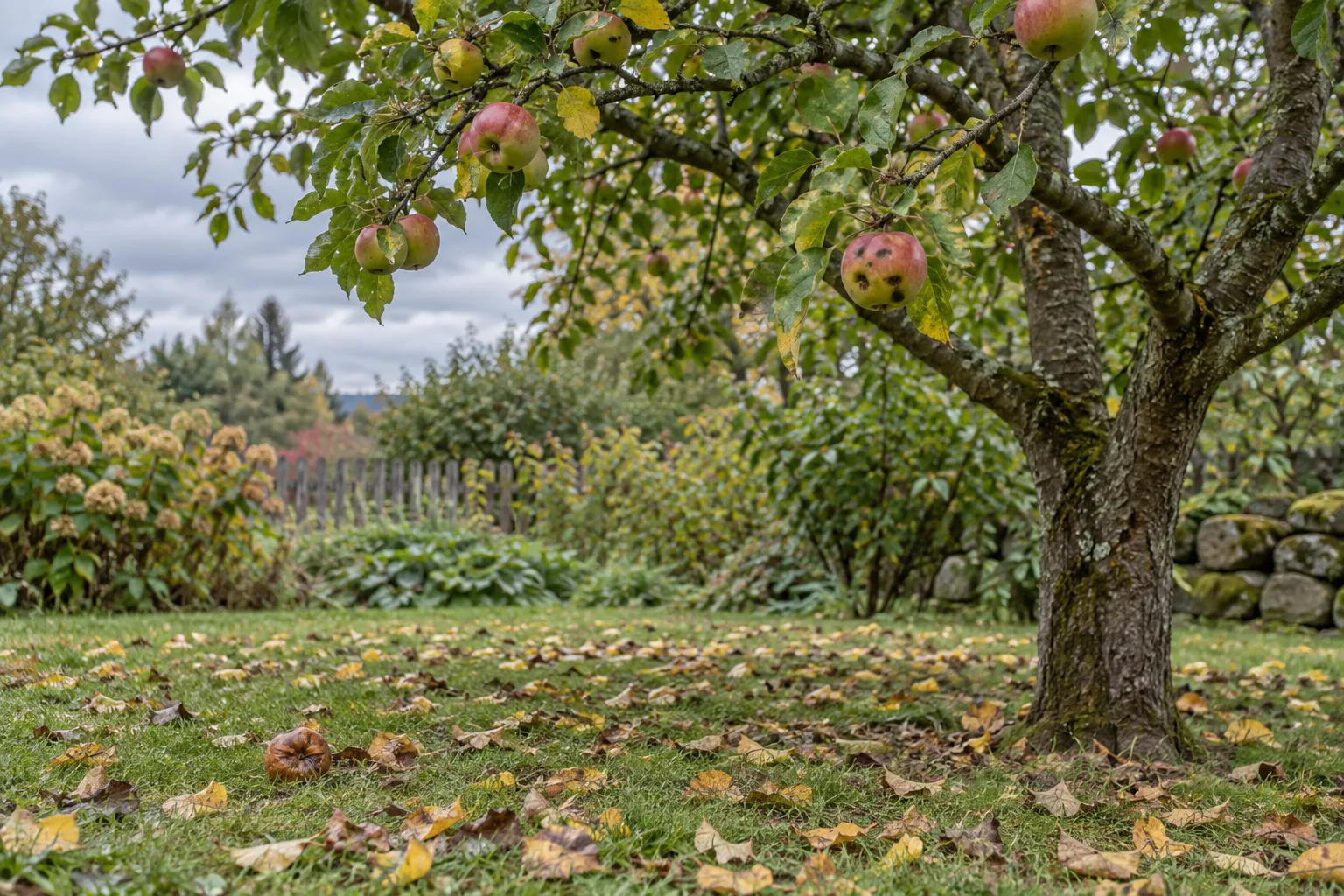
The most useful late-season job is not an emergency spray. It is a short audit: identify what is happening, harvest or discard fruit sensibly, remove infected material, improve airflow where pruning is safe, and record what the tree looked like before dormancy. That information makes spring decisions far more precise.
This plan is especially relevant in regions where September brings cooler nights, repeated rain and long periods of leaf wetness. Timing differs by climate. In warm or dry areas, the same tasks may belong later in autumn; in places with an early freeze, sanitation should be completed as soon as practical after leaf fall.
Why the next wet spell matters
Apple scab is caused by the fungus Venturia inaequalis. It is not the only reason an apple tree can lose fruit, but it is one of the most common explanations for olive-green to brown, corky lesions on apples and leaves. The fungus survives in fallen infected leaves. In spring, moisture helps those leaves release spores, which can be carried into the canopy by wind and splashing rain.
The disease cycle is therefore partly decided months before the first spring spot appears. The University of Minnesota’s apple-scab guide explains that spores can be spread by rain, irrigation and wind, while wet foliage gives new infections the conditions they need to begin. A tree with a dense canopy dries slowly after rain, so the same storm can be less damaging in an open, well-ventilated tree than in a crowded one.
A forecast of rain does not mean every apple tree needs treatment. It does mean that fruit, leaves and branches should be checked before they are hidden under a layer of wet debris. The goal is to reduce the amount of infected material that remains on the property and to avoid confusing prevention with cure.
Start with a ten-minute inspection
Choose a dry period if possible. Take a bucket, gloves, hand pruners, a phone or notebook, and a small ladder only if it can be placed securely on level ground. Do not climb a tree or stretch from an unstable ladder to reach fruit. If the canopy is tall, mark the inaccessible area for a professional or leave it alone until winter pruning can be planned safely.
Walk around the tree rather than looking from one side. Check four zones:
- the upper and lower surfaces of leaves;
- fruit still hanging in the canopy;
- apples that have fallen or are pressed against one another;
- dead, cracked, broken or obviously diseased twigs.
Scab often begins as dull olive or dark spots. On fruit, older lesions can become rough and cork-like, and severe infections may lead to cracking or distortion. Other problems can look similar. Sooty marks, insect feeding, bruised fruit, storage rot and fire blight do not all require the same response. A close photograph of a leaf and fruit lesion, together with the tree variety and your region, is more useful to an extension diagnostic service than the phrase “my apples are diseased.”
Do not diagnose from one damaged apple. Look for a pattern. If only windfalls are brown where they hit the ground, physical damage may be the main issue. If many leaves have similar olive spots and are dropping early, scab becomes more plausible. If individual fruit have a soft expanding brown rot and small spore-producing areas, remove them promptly, but do not assume that rot alone identifies the pathogen.
Sort the fruit before the rain
Harvest fruit that is mature enough for your variety and local conditions. Apples do not all ripen at the same time, and color alone is a poor test. A gentle lift-and-twist that releases the fruit, firm flesh, developed seeds and the variety’s normal flavor are better clues than a red cheek. Local extension guidance is useful because harvest timing varies by cultivar and climate.
Separate the harvest into three groups:
- Sound fruit. Handle it gently, keep it cool and dry, and inspect it again before storage. One damaged apple can spread rot in a box when fruit are packed tightly.
- Blemished but usable fruit. Small scab marks do not necessarily make an apple unsafe to eat. Cut away damaged tissue and use the fruit promptly for cooking, sauce or another household use. Do not store it with perfect fruit.
- Soft, leaking, badly rotted or mummified fruit. Remove it from the tree and ground. Do not leave it as wildlife feed directly beneath the canopy, where it remains a source of spores and attracts insects.
Avoid placing questionable apples in an open compost pile unless your compost system reliably reaches and maintains conditions that break down diseased plant material. Advice differs by pathogen and composting system. When in doubt, use your local waste rules or an enclosed, managed composting method rather than returning visibly diseased fruit to the orchard. The Oregon State University home-orchard guide specifically recommends removing fallen and mummified fruit as part of apple disease management.
Clean the ground after leaf fall
The most important sanitation window begins when leaves drop. Do not strip green leaves early just because a few spots are visible; premature defoliation can stress a tree. Instead, plan to remove or thoroughly process fallen leaves after natural leaf fall, especially if the tree had scab this year.
For a small tree, rake leaves from beneath the canopy and from nearby beds where they have collected. Bagging and municipal yard-waste disposal may be the simplest option. Burning is restricted or prohibited in many places, so check local rules before considering it.
Another option is to mow or shred the leaves repeatedly with a mulching mower, reducing them to small pieces that decompose more quickly. The University of Minnesota notes that chopped leaves can break down faster, while Pennsylvania State University’s 2026 disease-management guidance emphasizes reducing leaf litter as a key part of limiting the next season’s scab pressure. A mower is useful only when it actually shreds the material; simply blowing whole leaves into another corner of the yard does not solve the problem.
Keep fallen fruit out of the same cleanup loop. Pick up windfalls every few days while fruit are dropping. Remove apples caught in branch forks and any dry “mummies” that remain on the tree. These jobs are repetitive, but they cost little and reduce the amount of infected material left in the orchard.
Do not spread diseased apple leaves as a thick mulch directly under the tree. Clean leaves from other parts of the yard may be valuable mulch, but material from a tree with a serious disease history deserves more cautious handling.
Prune for air, but do not panic-prune
A dense canopy stays wet longer. Winter pruning can improve light penetration and airflow, which supports faster drying and makes future disease management easier. It is not a reason to remove every branch in September.
During the late-season inspection, limit yourself to clear hazards and obvious dead or broken wood if local conditions permit pruning. Save structural decisions for the appropriate dormant-pruning window in your region. Removing large limbs immediately before a wet period, making rough cuts, or opening the canopy too aggressively can create new problems.
When pruning is appropriate:
- remove dead, damaged or crossing wood with clean, sharp tools;
- keep cuts outside the branch collar rather than leaving long stubs;
- disinfect tools when moving between trees with suspicious disease symptoms;
- avoid pruning during rain or when branches are visibly wet;
- remove prunings from the orchard instead of leaving them under the tree.
The OSU home-orchard guidance links apple-scab management with an open canopy, removal of diseased branches, fallen leaves and mummified fruit. Airflow is a useful cultural control, but it cannot erase an established infection in the current season.
If you see blackened shoots, sunken cankers or a shepherd’s-crook shape, do not treat every symptom as scab. Fire blight and other bacterial or fungal problems require a different diagnosis. Photograph the symptoms and consult a local extension office before making major cuts, especially on a valuable mature tree.
What to do about spraying
Late September is a poor time to improvise a spray program based on a single damaged apple. Fungicides used for scab are generally preventive: they protect new tissue before infection or during a defined infection period. They do not turn spotted leaves back into healthy leaves. The University of Minnesota explains that once scab lesions are present, fungicides will not control the disease already established in that tissue.
That distinction matters because a homeowner may see a problem after a rainy spell, buy a product, and spray too late. The result can be expense, unnecessary exposure and disappointment without addressing the source of next year’s spores. Product registrations and permitted uses also vary by country, state and crop. A product label is a legal document, not a general suggestion.
For a tree with a repeated history of serious scab, make a spring plan with local guidance. The important questions are:
- Is the variety known to be susceptible?
- Did the tree lose a large portion of its leaves early?
- Were nearby crabapples or apples also infected?
- Can the canopy be reached safely and covered according to the label?
- Is the expected harvest valuable enough to justify the work?
The Penn State home-fruit guidance recommends cultural controls and scab-resistant varieties, with pesticides considered only when other strategies are insufficient. If you use any pesticide, verify that it is registered for apples in your jurisdiction, wear the label-required protective equipment, observe the pre-harvest interval, protect children and pets, and never spray during bloom when pollinators are actively visiting.
A backyard tree does not automatically need a full commercial spray schedule. For some households, accepting cosmetic blemishes while improving sanitation is the most sensible choice. For others, a resistant replacement tree is more practical than repeatedly treating a large, highly susceptible tree that produces little usable fruit.
Decide whether the tree is worth keeping
A difficult year does not by itself justify removing an apple tree. Consider the pattern over several seasons. A tree may still be worthwhile if it has a good site, strong growth, reliable flowering and fruit that can be used despite surface blemishes. It may need better thinning, better harvest timing or a cleanup plan rather than replacement.
Replacement becomes more reasonable when several problems persist together: severe annual defoliation, poor fruit quality, structural weakness, a variety badly mismatched to the local climate, or a canopy that cannot be managed safely. Disease resistance is not absolute, and local performance matters, but resistant cultivars can reduce the burden. OSU lists examples such as Liberty, Prima, Akane and Chehalis as scab-resistant apples, while also warning that suitability depends on climate and regional conditions.
Do not buy a new tree solely because a catalog calls it “disease resistant.” Check which disease the rating refers to, whether a compatible pollinizer is needed, the mature size of the rootstock, winter hardiness, chilling requirements and local availability. A resistant variety planted in a wet, crowded site can still struggle.
A low-cost late-season kit
Most homeowners do not need specialized orchard equipment for this inspection. A practical kit contains:
- gloves and a sturdy bucket;
- a rake or mulching mower;
- sharp bypass pruners for small dead branches;
- disinfectant appropriate for tools and used according to its label;
- paper bags or approved yard-waste bags;
- a phone for close photographs;
- a notebook or simple digital record.
Costs vary widely by location. If you already own a rake and mower, the cleanup may cost only disposal fees or bags. A new pair of quality pruners can be a modest purchase, while professional pruning or diagnosis costs more but may be safer for a tall tree. Do not buy a ladder, chainsaw or pesticide simply to complete a seasonal checklist. A dangerous access problem is a reason to hire a qualified arborist, not to improvise.
Keep the workflow simple: harvest first, remove rotten fruit, clean the ground after leaf fall, record symptoms, and schedule any major pruning for the correct dormant season. A small job completed thoroughly is more useful than a large job started in a rush.
Common mistakes after a wet summer
Spraying after symptoms appear. This treats the calendar rather than the disease cycle. Record the problem now and plan preventive decisions before spring growth.
Raking leaves but leaving mummified fruit. Both leaves and fruit can preserve disease pressure. Inspect the canopy, branch forks and ground.
Blowing infected leaves under a hedge. Relocating leaf litter is not sanitation. Shred it thoroughly, dispose of it through an approved route or use a managed composting system.
Over-pruning in one afternoon. A tree needs leaves to make and store energy. Remove clear hazards and plan structural work carefully during dormancy.
Treating every mark as apple scab. Scab, rot, insect injury, sunscald and bacterial disease can overlap visually. Diagnosis is cheaper than repeated wrong treatments.
Ignoring nearby crabapples. Ornamental crabapples can share the apple-scab disease cycle. If a neighbor’s or your own crabapple loses spotted leaves every year, it belongs in the wider assessment.
Storing blemished fruit with clean fruit. Sort before storage and check boxes regularly. A fruit that is acceptable for immediate cooking may be a poor candidate for months of storage.
Using a general product without checking the apple label. Crop, disease, application timing, harvest interval and protective requirements all matter. If the label does not support the intended use, do not use the product that way.
A short plan for the next four weeks
This week: inspect the tree, photograph symptoms, harvest mature fruit, remove rotten apples and mark branches that may need dormant pruning. Check the local forecast, but do not interpret rain alone as proof that spraying is necessary.
During the next dry window: collect windfalls and mummies, improve access around the trunk, and remove only clearly dead or broken material that can be handled safely. Clean tools between questionable trees.
At leaf fall: rake or shred leaves from beneath the canopy, remove remaining fruit and dispose of diseased material through a suitable local route. Do not apply a fertilizer or disease product simply because autumn has arrived; use soil-test results and local recommendations.
In winter: review the photographs and notes. Decide whether the tree needs professional pruning, whether its variety and site are compatible, and whether a spring preventive program is justified. If planting a replacement, compare disease resistance with hardiness, mature size and pollination needs.
Before spring bud break: consult an extension service, orchard handbook or plant diagnostic clinic if the diagnosis remains uncertain. If a product is appropriate, read the current label and calculate timing from the tree’s growth stage rather than from a fixed date.
The practical lesson from a rainy late season is not that every apple tree needs more intervention. It is that sanitation, observation and timing do more for a backyard orchard than a hurried response after the leaves are already spotted. Remove what can carry the problem forward, preserve what is still usable, and make next year’s decision from evidence recorded this year.
Related articles
After a Hot, Dry Summer: A Practical Recovery Plan for Heat-Stressed Garden Plants
The first rain after a brutal dry spell is not a signal to prune, fertilize, and replant everything. Use a staged recovery check to decide what needs water, what needs time, and what should be replaced.
September Lawn Care: Seed Thin Turf or Prevent Winter Weeds?
Early autumn can favor both cool-season lawn repair and winter-weed prevention, but the two jobs may conflict. Use turf type, weed identity, local timing and the product label to choose the priority before spending seed, water or treatment.
Fall Planting After a Hot Summer: How to Establish Trees and Shrubs Without Wasting Water
Early fall can be a better planting window than spring, but only if the soil, root ball and watering plan are ready. This practical checklist covers what to plant, what to postpone, how to water, and which common shortcuts quietly kill new plants.
Empty Vegetable Beds in September Need a Cover Crop, Not Bare Soil
A practical September guide to choosing oats, rye, clover, radish or a simple mulch for empty vegetable beds, with timing, rates, watering and spring termination caveats.

Comments
Sign in to comment.
No comments yet.