After a Hot, Dry Summer: A Practical Recovery Plan for Heat-Stressed Garden Plants
The first rain after a brutal dry spell is not a signal to prune, fertilize, and replant everything. Use a staged recovery check to decide what needs water, what needs time, and what should be replaced.

The first proper rain after a hot, dry summer can make a garden look healthier overnight. Leaves lift, lawns begin to green and a shrub that seemed finished may produce fresh buds. It is also the moment when gardeners are most likely to do too much: cut every brown stem, spread fertilizer, soak the whole property and buy replacements before the original plants have had time to respond.
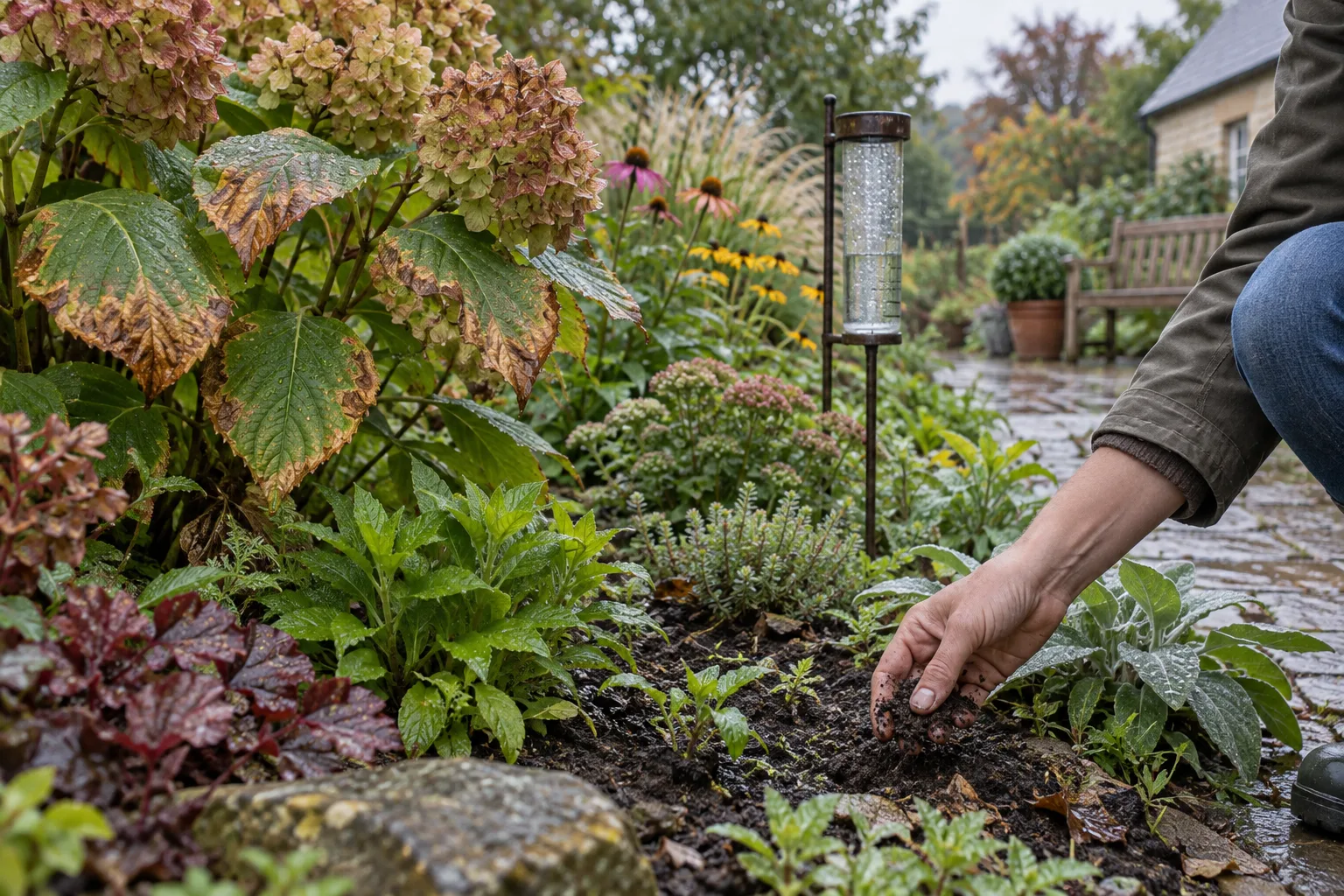
A better approach is to treat recovery as a diagnosis problem. Rain changes the conditions, but it does not instantly repair damaged roots, woody stems or compacted soil. Some plants are dormant rather than dead. Others have lost fine feeder roots and will need careful watering even after storms. A few are genuinely beyond recovery, but the evidence is usually clearer after several weeks than it is on the first cool morning.
This plan is designed for the transition from late summer into autumn in temperate gardens. The exact timing depends on local rainfall, soil, frost dates and plant type. In a Mediterranean or subtropical climate, “autumn recovery” may begin later or coincide with the start of the main growing season. In a region with an approaching freeze, protecting a living container plant may matter more than encouraging new growth.
What the recent dry spell may have done
Heat and drought do not affect every part of a plant at the same speed. Leaves may scorch or drop while buds and branches remain alive. Herbaceous perennials may retreat to crowns or underground storage organs. Cool-season turf may turn brown and wait for cooler, wetter conditions. Trees and shrubs can close leaf pores, reduce photosynthesis and shed fine feeder roots that normally absorb water.
That last point explains why a plant may not recover immediately when the soil is wet again. Colorado State University Extension notes that drought can kill fine feeder roots, slowing recovery even after irrigation resumes. Severe stress can also appear later as dieback, early autumn color, small leaves or increased insect and disease pressure. A green lawn after rain is not proof that every tree nearby has recovered.
The summer of 2026 has produced a useful warning from several regions. The University of New Hampshire has documented changing irrigation and planting strategies after a dry season, while the RHS has reported a sharp increase in questions about heat and drought damage to hydrangeas in Britain. Those reports point to the same practical lesson: recovery depends less on one dramatic watering session than on matching water, soil and pruning decisions to the plant’s actual condition.
The first 48 hours after rain
Start with observation, not a shopping list. Walk the garden when the leaves are dry enough to inspect and record what has changed. A phone photograph from the same angle can be more useful than memory, particularly for shrubs and small trees whose decline is gradual.
Check these areas first:
- Newly planted trees and shrubs. They remain a priority even after rain because the root ball may be dry while surrounding soil is wet, or the reverse.
- Containers and hanging baskets. A short storm may wet the surface without reaching the lower compost, while a saucer can leave roots standing in water.
- Plants beside walls, fences, paving and roof overhangs. Rainfall is often uneven in these rain-shadow locations.
- Slopes and compacted beds. Water may run off instead of entering the root zone. Look for crusting, channels, puddles and exposed roots.
- Lawns. Brown cool-season turf may be dormant; a newly seeded lawn has a different requirement and cannot be judged by the same rule.
Do not assume that a brown leaf is a brown branch. On a woody plant, use a clean fingernail or a disinfected knife to make a very small test on a young twig. Green, moist tissue just beneath the bark suggests life; dry brown tissue suggests dieback at that point. Move toward the base rather than making a large cut. This is only a rough field check, not a diagnosis of disease.
Avoid walking repeatedly on saturated soil. Wet soil compacts easily, especially clay, and compaction removes the air spaces roots need. If a storm has left water standing for more than a day or two in a bed that normally drains, investigate the drainage problem before adding more water. Penn State Extension makes the same distinction for rain gardens: persistent ponding after a storm is a drainage signal, not a reason to keep irrigating.
Water by the root zone, not by the calendar
The first rain may be enough for established plants, or it may be almost irrelevant if it was a brief shower. Test the soil before turning on irrigation. Push a finger into small beds, use a hand trowel around larger plants, or insert a narrow probe at several points around the root zone. Soil should be moist where roots are active, not merely dark at the surface.
For established borders, the RHS recommends watering the most stressed individual plants rather than following a blanket routine. Water slowly at the base and check whether moisture reaches roughly 15 centimetres, or 6 inches, in a perennial bed. Young trees and shrubs generally need moisture deeper in the root zone, often around 20–30 centimetres, or 8–12 inches, depending on their size and soil. These are useful inspection depths, not universal volumes: sandy soil drains quickly, clay accepts water slowly, and a raised bed behaves differently from compacted ground.
A practical sequence is:
- Clear mulch or loose debris from a small inspection spot without disturbing roots.
- Apply water slowly in several passes around the root area, not against the trunk or directly on the crown.
- Wait for the water to infiltrate rather than allowing it to run down a slope or across paving.
- Check below the surface later the same day and again before the next irrigation.
- Stop when the root zone is evenly moist and drainage remains normal.
Deep, occasional watering is usually more useful than a daily splash for established plants. Newly planted material is different: its root system is small and often confined to a container-shaped root ball, so it may need more frequent checks until it grows into surrounding soil. A plant sold as drought tolerant is not drought independent during its establishment period. Penn State Extension and Colorado State University both emphasize that root development determines how much drought resilience a plant can actually provide.
Water early in the day when possible. It reduces evaporation and gives foliage time to dry. Directing water at the soil also limits the disease risk associated with wet leaves. If local restrictions apply, follow them; a good recovery plan includes rainwater storage, prioritization of young plants and acceptance that some established lawns can remain dormant.
Do not prune every brown branch yet
Heat-damaged foliage is unattractive, but it may still shade living buds and stems. The RHS’s review of extreme-heat damage advises gardeners to resist pruning heavily immediately after heat and drought. Many plants retain live buds and leaf out again when conditions improve; cutting too soon can add stress and remove tissue that would have supported recovery.
That does not mean leaving everything untouched. Remove material that is clearly diseased, broken, hazardous or interfering with a path. On a tree, any hanging limb near a roof, play area or utility line deserves safety attention. For ordinary scorch and leaf loss, however, use restraint:
- Wait for a clear boundary between live and dead wood before making major cuts.
- Make small, clean cuts rather than shearing an entire shrub into a uniform shape.
- Do not top trees or remove large limbs as a cosmetic response to brown leaves.
- Disinfect tools between plants when disease is possible, and keep diseased material out of home compost unless the compost system reliably reaches pathogen-killing temperatures.
- Reassess woody plants after several weeks of moderate weather and again during the dormant season, when dead wood is easier to identify.
Perennials offer a different decision. A completely collapsed annual may be finished, while a perennial with a living crown can return from the base. Remove mushy or rotting material, but keep sound stems and seed heads where they provide habitat or food. If a plant is still making new growth, avoid turning a recovery effort into a late-season haircut.
Put fertilizer on hold until the plant is working again
Fertilizer is not a rescue treatment for drought. Nitrogen can encourage soft new growth at exactly the time when roots are still damaged and water supply is uncertain. That growth may demand more water and may be vulnerable to cold or another dry spell. Colorado State guidance for recently planted trees specifically warns that fertilizer can push new growth a stressed tree cannot support.
Wait until the plant shows sustained recovery, the soil is appropriately moist and the timing fits the local growing season. A soil test is more useful than guessing from leaf color, especially after a season in which heat, drought, salt, root damage and disease can all produce similar symptoms. Chicago Botanic Garden includes soil testing among its September checks, but the right laboratory and testing schedule depend on your region.
Compost and mulch are not interchangeable with fertilizer. A thin layer of mature organic matter can improve the surface over time, while mulch can reduce evaporation and moderate soil temperature. Neither should be piled against trunks or crowns. Keep a visible gap around woody stems, and do not use a thick, water-repellent layer that prevents rain from entering.
Avoid digging deeply around a stressed plant. Cutting already weakened roots creates another problem. If soil is compacted, improve access in paths and bare areas first, or use a carefully planned long-term approach rather than turning the root zone immediately after rain.
Triage plants into four groups
A simple classification prevents both waste and neglect. Mark plants with a label, stake or short note so that a busy household does not water everything equally.
Group 1: Recovering
These plants have flexible stems, live buds, a living crown or fresh growth. Give them stable conditions: moisture checks, a clear mulch layer, protection from competition and no major pruning or feeding. A recovering plant may look uneven for the rest of the season and still be viable.
Group 2: Alive but high priority
This group includes young trees, recent transplants, container plants and shrubs that have lost leaves but still show live tissue. Inspect them more often than established plants. Check the root ball itself, especially when the surrounding bed received rain. Move containers out of reflected heat, empty standing water and group plants according to their needs.
Group 3: Dormant or seasonally finished
A brown lawn, a spring ephemeral and some herbaceous perennials may be following their normal strategy rather than dying. Identify the species before watering or replacing it. Cool-season turf may green up with cooler weather; a warm-season turf may follow a different seasonal pattern. Local extension advice is more reliable than a generic calendar.
Group 4: Failed or unsafe
Replace a plant when the crown is dead, the root system has rotted, the container is beyond recovery or a woody limb presents a hazard. Before buying the same plant again, identify the failure: insufficient establishment, reflected heat, shallow soil, poor drainage, winter exposure, competition from tree roots or a mismatch between species and site. Replanting without correcting the site simply repeats the expense.
Lawns need a separate decision
Lawns often create the most pressure to act because brown turf looks like a visible failure. In many cases, established cool-season turf can enter dormancy during drought and recover when temperatures and moisture become favorable. The RHS explicitly advises that gardeners can let lawns go brown during heatwaves rather than spending water to maintain green color.
Do not apply that assumption to every lawn. Newly seeded areas, recently laid turf, heavily trafficked thin turf and lawns with disease or severe thatch may need different treatment. Pull gently on a few plants, inspect the crown and look for living roots. If you plan to overseed, wait until the soil temperature and local seasonal window suit the grass species. Seed that germinates just before a heat wave or hard freeze is a poor investment.
Mow higher during recovery if local conditions and grass type permit, keep blades sharp and avoid removing a large proportion of the leaf at once. Do not mow wet ground if it will create ruts or compact the soil. Fertilizer should follow a soil and seasonal plan, not the emotional urge to make a brown lawn green immediately.
Containers are the emergency department of the garden
Pots dry faster than ground beds because they have limited soil volume and exposed sides. At the same time, a storm can leave the bottom of a container waterlogged while the upper layer appears dry. Check below the surface and confirm that drainage holes are open. Do not leave a pot sitting in a full saucer for extended periods unless the plant is specifically adapted to wet conditions.
Remove dead flowers and badly damaged leaves only when doing so improves airflow or prevents rot. Shade a recovering container from harsh afternoon sun, but do not move it into a dark corner where it cannot rebuild. Plants under cover may need more attention because rain no longer reaches them. A greenhouse or porch can also become hot and stagnant after a storm; open vents when conditions allow and inspect for pests before bringing outdoor plants inside.
If a container plant is root-bound, transplanting immediately after severe stress may create another shock. Stabilize water and light first, then repot during a suitable local window unless roots are rotting or the container is unsafe.
Use the recovery period to fix the site
The most valuable autumn work may be outside the plant itself. Mark where water ran off, where soil stayed dry beneath a tree canopy and where puddles formed. These observations reveal the limits of the current design.
Useful low-risk improvements include:
- Redirecting downspouts into a suitable rain garden, storage tank or planted infiltration area where local rules and soil conditions allow.
- Replacing a uniform irrigation schedule with separate zones for containers, new plantings, lawn and established drought-tolerant beds.
- Adding a simple rain gauge and checking soil moisture rather than relying on a timer alone.
- Repairing leaking hose connections and clogged drip emitters.
- Extending mulch over exposed soil while keeping it away from stems and trunks.
- Grouping plants with similar water needs before the next planting season.
- Choosing replacement plants by mature size, sun, soil moisture and root-zone conditions rather than by a drought-tolerant label alone.
Automatic irrigation can save time, but it can also hide failure. A timer may run after a storm, a pressure change may leave one bed dry and an emitter may water a path. Inspect the system while it operates. For electrical pumps, controllers and outdoor outlets, use equipment rated for outdoor conditions, keep connections dry and follow local electrical requirements. Shut off power before servicing a pump or controller.
A region-aware replacement rule
The same brown symptom can have different meanings in different climates. In a cool maritime garden, a hydrangea may be reacting to heat and drought; in a hot humid region, the same leaf damage may coexist with root disease. In a dry western landscape, an established native shrub may need no replacement at all, while a newly planted tree may require targeted irrigation through the entire first season. In a place approaching frost, stimulating tender new growth can be counterproductive.
Before replacing a plant, ask five questions:
- Was the root system established, or was the plant still dependent on regular irrigation?
- Did water reach the root zone, or only the top layer of soil?
- Did heat reflect from paving, walls or windows onto the foliage?
- Was the plant exposed to salt, herbicide drift, pests or a drainage problem that mimicked drought?
- What is the next serious stress likely to be: frost, winter wet, another dry spell, wind or summer heat?
Use local extension services, botanical gardens, water authorities and plant labels for the final choice. A plant that survives in a regional trial is not automatically suited to every microclimate in that region.
A low-cost recovery schedule
You do not need a new irrigation system or a large plant order to begin. The first week can be handled with tools most gardeners already own: a hand trowel, hose or watering can, clean pruners, labels, a notebook and a rain gauge.
Day 1–2: map damage, inspect soil, check young plants and containers, clear hazards and confirm that water is draining.
Days 3–7: water only the root zones that remain dry, keep foot traffic off wet soil, add or refresh a sensible mulch layer and watch for new growth.
Weeks 2–4: reassess woody plants, adjust irrigation zones, repair emitters and decide which annuals or failed plants are truly finished. Avoid major feeding unless a local recommendation and soil test support it.
Later in the season: prune confirmed dead wood, review the plants that failed, collect information about sun and moisture patterns and plan replacements for the correct planting window. Protect newly established plants through their first dry period even if the species is marketed as waterwise.
Cost varies mainly with scale. A hand check and rain gauge cost little; replacing a timer, repairing a line or installing a water butt costs more; removing and replanting a mature shrub or tree is the expensive option. Delaying replacement until the evidence is clear is often the cheapest decision available.
Common recovery mistakes
Mistake: treating every brown plant as dead. Dormancy, leaf scorch and delayed recovery are common after prolonged stress. Check buds, crowns and stems before removing a plant.
Mistake: watering the whole garden equally. This wastes water and can keep already wet soil saturated. Prioritize young, newly planted and genuinely stressed plants.
Mistake: pruning for appearance immediately. Removing living buds and shade can increase stress. Cut hazards and confirmed dead wood; wait on cosmetic shaping.
Mistake: fertilizing to force a rebound. Nutrients do not replace damaged roots. Encourage recovery with stable moisture, suitable light and time.
Mistake: trusting a short storm. Measure moisture below the surface. Rainfall is often blocked by foliage, diverted by slopes or insufficient to wet the full root zone.
Mistake: repeating the same planting. A dead plant is evidence about the site. Change the plant, the location, the irrigation or the soil conditions instead of changing only the receipt.
Mistake: ignoring safety. Do not work beneath damaged limbs, handle outdoor electrical equipment with wet connections or use pesticides as a substitute for diagnosing drought. If a tree is large, split, leaning or close to infrastructure, consult a qualified arborist.
The useful signal is what happens next
A garden’s first response to rain is not the final verdict. New leaves, flexible stems, a living crown and steadily improving soil moisture all support continued care. Persistent dieback, soft roots, foul-smelling saturated soil or a lack of viable tissue point in another direction.
The practical goal is not to make every bed look perfect before autumn. It is to preserve plants that can recover, reduce stress on the ones that are vulnerable and learn where the garden’s design failed during the dry spell. Once the evidence is visible, pruning, replanting and irrigation changes become easier to justify—and much less likely to waste water, money or a plant that was still alive.
Related articles
Fall Planting After a Hot Summer: How to Establish Trees and Shrubs Without Wasting Water
Early fall can be a better planting window than spring, but only if the soil, root ball and watering plan are ready. This practical checklist covers what to plant, what to postpone, how to water, and which common shortcuts quietly kill new plants.
Your garden needs a water budget before the next heatwave
When drought rules limit outdoor watering, the safest garden plan is not watering everything. It is choosing what must survive first.
Microclover lawns can beat the heat. They can also be the wrong answer
A viral clover patch stayed green under drought limits, but the practical lesson is not “plant clover everywhere.” Start with region, species, water, traffic and rules.

The June yard reset: water less blindly, mulch better, and give pollinators a reason to stay
A practical summer garden plan for hot weeks: deeper watering, mulch, shade judgment, soil care and pollinator-friendly choices.
Comments
Sign in to comment.
No comments yet.