Bring Outdoor Houseplants Inside Without Importing Spider Mites
The October move indoors can turn a small pest problem into a whole-house infestation. A careful inspection, wash, quarantine period, and gentler winter routine protect the plants already on your windowsills.

When outdoor houseplants come back inside, the most expensive mistake is often made before the first pot crosses the threshold. A plant can look healthy from standing height while carrying spider mites beneath its leaves, scale in stem joints, aphids on new growth, or fungus gnat larvae in damp potting mix. Outside, rain, airflow and predators may keep those pests in check. Indoors, they can spread from one crowded windowsill to an entire collection.
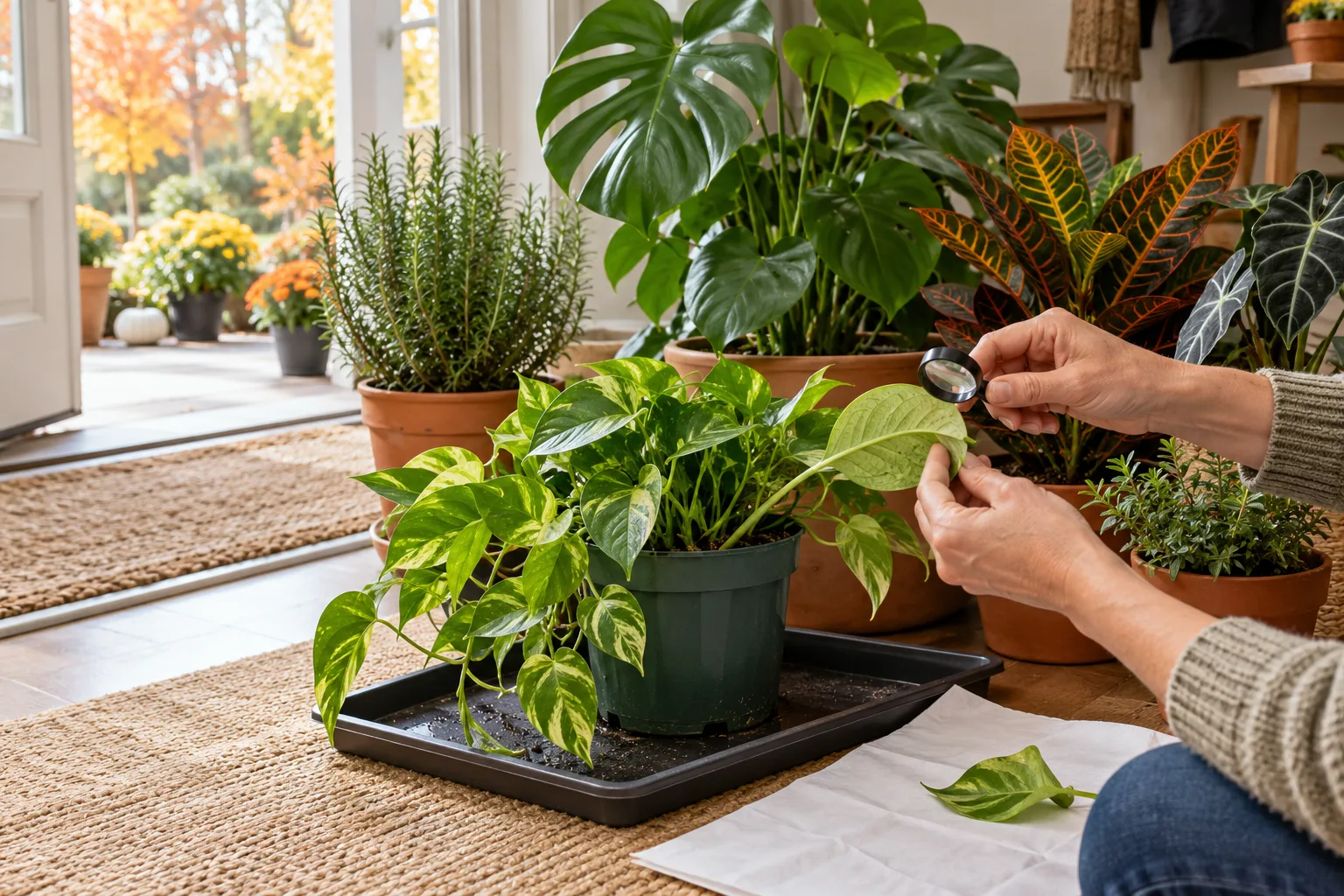
This is a different job from simply rescuing tender plants before frost. The useful question is not only “Which plants must come inside?” but also “Which plants have earned a place beside the healthy ones?” October is a good time to make that decision because many gardeners are moving containers, herbs, geraniums, citrus, tropicals and cuttings at once. A short inspection and quarantine routine now is far easier than treating every plant in the house later.
Start with the forecast, not the calendar
The safe temperature depends on the plant. Many common houseplants are tropical or subtropical and can be damaged when nights fall into the 40s or 50s Fahrenheit. University of Minnesota Extension recommends preparing most houseplants for indoor conditions before nighttime temperatures fall below about 50°F, while cold-sensitive plants may need to move earlier. Cacti, some succulents and cool-season annuals are exceptions, but they still need to be judged by species and local conditions.
Use the forecast for your actual yard rather than a regional average. A sheltered patio beside a warm wall may stay several degrees warmer than an exposed raised bed, while a pot on a windy balcony can chill quickly. Do not wait for the first frost if a plant is already showing cold stress. Cold injury can appear as limp foliage, darkened patches or sudden leaf drop, and a damaged plant is harder to inspect and recover.
Move plants in stages when possible. A week or two of slightly lower light outdoors, such as a bright porch instead of full afternoon sun, can reduce the shock of the indoor transition. The aim is not to keep the plant growing vigorously through winter. It is to help it adjust to less light, drier air and a slower watering schedule.
Make a holding area before you move anything
Choose a place that is separate from established houseplants: a bright bathroom, enclosed porch, mudroom, spare room or well-lit corner with a washable floor. The area does not need to be perfect. It needs enough space to keep pots from touching and enough light to inspect leaves.
Prepare a small inspection kit:
- a 10× hand lens or phone magnifier;
- a white sheet of paper for checking what falls from foliage;
- clean scissors or pruning snips;
- a bucket or hose with clean water;
- a soft cloth or sponge for sturdy leaves;
- yellow sticky cards for detecting flying pests;
- a tray or saucer that can be washed;
- labels for the plant, date inspected and any treatment used.
You do not need to buy a large “winter houseplant” kit. A magnifier and sticky cards are useful optional purchases; the rest can usually be assembled from items already used for potting and cleaning. Keep pruning tools and watering cans from an infested plant away from healthy plants until they have been washed.
Inspect the plant in four places
Begin with the newest leaves and growing tips. Aphids often cluster on soft new growth. Turn the pot slowly and inspect the undersides of leaves, where mites, whiteflies, thrips and eggs are easier to miss. Look for fine stippling, pale pinpricks, silvering, distorted leaves, sticky honeydew or delicate webbing.
Spider mites are especially easy to overlook. They are tiny arachnids, not insects, and may be difficult to see without magnification. UC Integrated Pest Management describes early damage as light-colored stippling that can progress to yellow or bronze leaves, premature leaf drop and webbing when numbers are high. Hot, dry, dusty conditions and water-stressed plants are more vulnerable, which helps explain why a problem can accelerate after a plant moves into a heated room.
Next, inspect stems and leaf joints. Scale may look like small brown or pale bumps that do not move. Mealybugs resemble bits of white cotton. Check the rim, drainage holes, saucer and the underside of the pot as well. Ants, springtails and fungus gnats may be associated with the soil rather than the foliage.
Finally, inspect the root zone without automatically repotting. Look for an unpleasant smell, persistently soggy mix, visible insects or roots circling a pot. Repotting every plant during the move adds stress and can spread contaminated soil. Do it when there is a clear reason, using a clean pot and fresh growing medium.
Wash before the plant enters the house
A thorough rinse is one of the lowest-risk first steps for many soft-bodied pests and mites. Take the plant outside or to a sink and use a firm but gentle stream of lukewarm water on the upper and lower leaf surfaces, stems and growing points. Hold the pot so loose mix does not wash out. Allow the plant to drain completely before placing it in the holding area.
For sturdy, smooth-leaved plants, wipe foliage with a damp cloth after rinsing. Delicate, hairy, waxy or easily damaged leaves may be better handled with water alone. Remove badly damaged leaves and stems with clean snips, then discard them in household waste if they carry pests or disease. Do not add clearly infested material to a home compost pile.
Some extension guidance suggests soaking the pot to the rim for a period to flush insects from the growing medium. That can be useful for suitable plants, but it is not appropriate for every species or every potting mix. Succulents, plants with poor drainage and plants already suffering root problems can be damaged by prolonged saturation. If you use a soak, let the container drain fully and do not place it in a decorative cachepot holding standing water.
Dish soap deserves caution. A homemade mixture can burn foliage if it is too concentrated or if the plant is sensitive. A product labeled as insecticidal soap is formulated for this purpose, but it still must be labeled for indoor use and for the plant and pest involved. Test any spray on a small section first, wait to check for injury, and follow the label. Never combine products casually, and do not spray a water-stressed plant.
Quarantine is the step people skip
Penn State Extension recommends isolating plants brought indoors for roughly three to four weeks; other extension guidance gives shorter periods for some situations. The exact length depends on the plant, pest pressure and how often you can inspect, but the principle is consistent: do not place a returning outdoor plant directly beside established houseplants.
Leave space between pots so leaves cannot touch. Check each plant every few days, especially after watering. Look at undersides of leaves, stems, pot rims and sticky cards. A single inspection can miss eggs or a small colony. Quarantine also gives the plant time to reveal whether yellow leaves are caused by pests, low light, cold injury, root trouble or the normal stress of changing environments.
If a plant shows mites or insects during quarantine, move it farther away from the others and mark the date. Wash it again if appropriate, prune heavily infested parts and monitor whether the problem is declining. If treatment is necessary, identify the pest first. A product effective against aphids may not control mites, and broad-spectrum insecticides can kill predators that help suppress spider mites outdoors. UC IPM specifically warns that some insecticides can trigger mite outbreaks by removing natural enemies without controlling the mites well.
For a severely infested, weak or diseased plant, discarding it may be the most responsible choice. That is not a failure of gardening. It protects plants that are healthy and avoids spending weeks applying treatments to a plant unlikely to recover.
Recognize the common indoor signals
Not every yellow leaf means spider mites. A move indoors changes light intensity, temperature, humidity and watering. Tropical plants such as hibiscus, ficus and citrus may drop leaves while adjusting. Soil that stays wet longer in a dim room can cause root problems. A plant placed beside a radiator may dry quickly at the foliage while the center of the pot remains wet.
Use symptoms as prompts for inspection rather than as a diagnosis:
- Fine pale speckles, bronzing and webbing suggest spider mites; check with a hand lens.
- Sticky leaves or nearby surfaces can indicate aphids, scale, whiteflies or mealybugs producing honeydew.
- Small black flies rising from the soil point toward fungus gnats; consistently wet mix encourages them.
- Distorted new growth, silver streaks or black specks may indicate thrips, but these symptoms can overlap with mechanical or environmental damage.
- Sudden leaf drop after a move may be temperature, light or watering stress rather than a pest outbreak.
When the signs are unclear, isolate first and change one variable at a time. Moving the plant repeatedly, overwatering it and spraying several products at once makes diagnosis harder and can create additional damage.
Set up the winter routine after quarantine
Once a plant has passed quarantine, place it according to its light needs rather than filling every bright window immediately. Clean windows allow more light to reach foliage, but direct exposure through glass can still scorch leaves that were moved abruptly from outdoor shade or filtered light. Rotate pots periodically if growth leans toward the window.
Water by checking the soil and the plant, not by repeating the summer schedule. Indoor light is usually weaker and evaporation slower, so a pot that needed frequent watering outdoors may stay wet much longer inside. At the same time, do not let a plant become severely drought-stressed; dry conditions can increase spider-mite damage. Empty saucers after watering, and keep pots away from heat vents and radiators.
Humidity is not a cure for an infestation. A humidifier can improve conditions for some plants, but it should not replace inspection, washing or correct watering. Avoid keeping foliage permanently wet, especially in cool rooms, because prolonged wetness can favor disease. Good airflow and clean leaves are more useful than a daily misting ritual that leaves water sitting in leaf axils.
Do not fertilize automatically just because a plant is indoors. Many houseplants slow down in late autumn and winter. Feeding a plant that has low light and limited growth can contribute to weak, stretched growth or salt buildup. Resume a normal feeding plan when the plant is actively growing and the light level supports it.
A practical October decision rule
For every outdoor container, make one of three decisions:
- Bring in after inspection: the plant is healthy, suitable for indoor conditions and worth the space.
- Treat and quarantine: the plant is valuable but has a manageable pest issue or needs closer observation.
- Leave outside or discard: the plant is not suited to indoor conditions, is severely infested, or would put the rest of the collection at unreasonable risk.
This rule prevents the common rush of carrying every pot inside on the same evening. It also separates sentimental value from practical risk. A cutting from a healthy plant may be easier to overwinter than a large, declining container. A plant that needs more light than your home can provide may be better replaced next season than kept alive in a dark room.
The October spider-mite warning is useful because it points to a timing problem, not a reason to panic. Plants move indoors just as heating begins, air dries and natural predators disappear. A rinse, a clean holding area and several weeks of observation cost little compared with treating an entire collection. Bring in fewer plants if necessary, but bring them in with a plan.
Related articles
The First-Frost Triage: What to Move, Cover, Clean, or Leave in the Garden This October
The first frost is not a single deadline for every plant. Use a short October triage to decide what belongs indoors, what can stay under a breathable cover, what needs greenhouse sanitation, and what is better left in the ground.
Your garden is not a carbon vacuum, but it can still fight heat, drought and wasted work
The useful climate yard is not sold as an offset. It is designed for shade, water, soil, habitat and less maintenance.

Battery-First Radio Planning for Outdoor Events: What a Mountain Bike Course Teaches Operators
A recent Maryland cycling event shows why reliable field communications begin with terrain, staffing, power and message discipline—not simply choosing a handheld. Here is a practical way to design and test a small event network.


Sub-GHz Thread Is Coming, but Your Smart Home Should Not Wait for It
Thread Group has started work on a Sub-GHz version of Thread. That matters for range, but it is not a buying signal for today’s door sensors, locks or outdoor devices yet.
Comments
Sign in to comment.
No comments yet.