Japanese beetles are back: why traps and a wet lawn can make July worse
A practical July plan for protecting roses, grapes, berries and lawns without turning traps or overwatering into part of the infestation.

Japanese beetles tend to arrive with terrible timing. In many northern U.S. gardens they show up around the Fourth of July, just when roses, grapes, raspberries, basil, beans and young fruit trees are doing the work you waited all spring to see. One day the leaves look fine. A few warm afternoons later they look like lace.
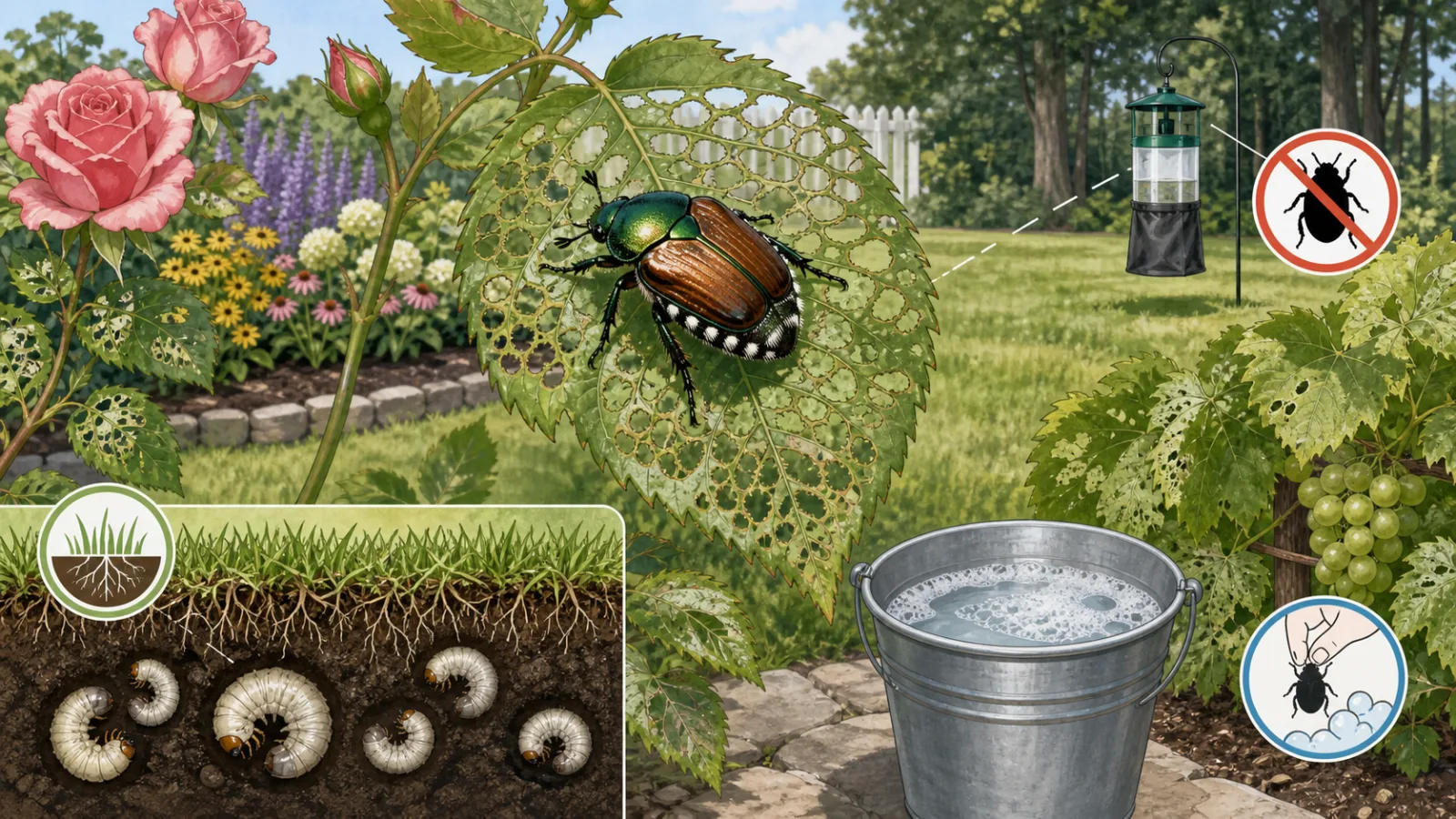
The tempting response is to buy the most visible product on the shelf: a pheromone trap with a bag underneath it. The second tempting response is to keep the lawn lush and wet, because brown turf feels like another failure. Both can backfire.
Japanese beetles are not only a leaf problem. They are a yard system problem. Adults feed in groups on leaves, flowers and fruit. Females lay eggs in soil, especially where turf or mulched ground stays moist enough for young grubs to survive. Those grubs then feed on grass roots. The rose damage and the weak patch of lawn can be two chapters of the same insect's year.
This does not mean panic-spraying the garden. It means acting early, removing the first beetles before they recruit more, protecting the plants that truly need protection, and managing the lawn so it does not become a comfortable nursery.
Why July is the moment to act
University extension guides in the Upper Midwest describe the usual adult emergence as late June or early July, with feeding pressure running through July and August. Wisconsin Horticulture notes that adults are most active on warm, sunny afternoons and can remain visible into September. Green Bay Press-Gazette reported on July 2, 2026 that Wisconsin gardeners were again seeing the seasonal emergence, with UW-Madison entomologist PJ Liesch pointing to the familiar Fourth of July timing and a northward shift in where the insects are being reported more regularly.
The exact calendar changes by region and weather. A gardener in a warmer area may see adults earlier. A cooler northern yard may lag. The practical rule is simpler: once you see the first metallic green and copper beetles on preferred plants, do not wait for the whole group to arrive.
That early window matters because damaged leaves can attract more adults. University of Minnesota Extension explains that beetles feed on leaves, flowers and fruit of more than 300 plant species, and Wisconsin Horticulture lists over 350 species across fruits, vegetables, ornamentals, field crops and weeds. Nobody needs to protect every plant. You need to identify the plants in your yard that matter most and keep the first feeding clusters from turning into a signal flare.
What damage looks like
Adult Japanese beetles are easy to recognize once you know the pattern: metallic green head and thorax, coppery wing covers, and small white hair patches along the sides of the abdomen. They often feed in groups. On thin leaves they eat the soft tissue between veins, leaving a skeletonized, lacy pattern. On flowers they can chew ragged petals. On fruit they may feed where the skin is already damaged or ripening.
Common targets include roses, grapes, raspberries, beans, basil, crabapple, birch, linden and many fruit trees. A healthy mature tree can often tolerate some cosmetic injury. A young tree, a stressed shrub, edible crops, blossoms and small fruit plantings deserve more attention.
The grub stage is less obvious. White, C-shaped larvae live under turf and feed on roots. If damage is heavy enough, grass can brown and lift like a loose carpet because the roots are gone. Skunks, raccoons and birds may dig for the grubs, making the lawn look worse. But brown lawn alone is not proof of Japanese beetles. Heat, drought, disease and other white grub species can look similar, so inspect before treating.
The trap problem
Japanese beetle traps are not fake. They catch beetles. That is part of the problem.
The lure can draw more beetles into the area than the bag actually captures. Wisconsin Horticulture is blunt: pheromone lure traps are not recommended for control because they can attract many more adults to the area, and the beetles that are not trapped can cause additional damage. The Old Farmer's Almanac gives the same practical warning for home gardens: traps may reduce the number inside the bag while making the garden around the bag more attractive.
There are limited situations where traps can be useful for monitoring, research, or a large property where they are placed far away from the plants you care about. They are a poor default next to roses, grapes, beans or a vegetable bed. If you already own one and want to use it, put it well away from the protected planting, not as decoration in the middle of the damage.
For a normal garden, the first tool is less glamorous: a cup or bucket of soapy water.
What to do today
Start with a slow morning or evening walk. Beetles are cooler and less quick then. Hold a container of soapy water under the leaf or flower, tap the plant, and let the beetles drop in. Do not spray dish soap all over the plant as a universal insecticide. The bucket is for captured beetles.
Do this daily when adults first appear. It sounds primitive, but it works surprisingly well in small landscapes because it removes the early groups before feeding damage becomes more attractive to other adults. The Almanac and extension-style garden guidance both emphasize hand-picking early, especially on valuable plants.
Prioritize. You do not have time to defend every leaf.
Protect:
- newly planted trees and shrubs;
- roses you actually care about;
- grapes, raspberries and small fruit;
- beans, basil and other edible crops taking heavy feeding;
- young or already stressed plants.
Ignore or tolerate:
- light cosmetic feeding on mature, otherwise healthy trees;
- plants that are already near the end of their crop cycle;
- established ornamentals that recover well;
- turf that does not show confirmed grub injury.
Remove heavily damaged leaves only when they are no longer useful to the plant or are concentrating beetles. Do not defoliate a stressed plant in the name of cleanliness.
Nets, covers and timing
Physical exclusion is underrated. Fine mesh netting can protect small fruit, young trees, roses or vegetable rows during peak adult feeding. The mesh must be fine enough to keep beetles out and secured at the edges. If the plant needs pollination, timing matters: do not trap pollinators outside during bloom and then wonder why fruit set is poor. Use covers after pollination where possible, or uncover briefly when pollinator access is needed.
For berries and grapes, netting often makes more sense than repeated sprays. It also avoids hitting bees and beneficial insects. Check the net regularly; a loose edge becomes an insect door.
The lawn connection: don't raise grubs by accident
The adult beetle on the rose and the grub under the lawn are the same pest at different stages. Females lay eggs in soil in summer. Wisconsin Horticulture notes that they burrow two to four inches down, favoring areas with higher soil moisture such as turf and mulched ground. Eggs hatch after about two weeks, and grubs begin feeding on turfgrass and ornamental roots.
That is why the Chicago Tribune's recent gardening angle, "don't overwater grass," is not just lawn austerity. Moist soil can help eggs and young grubs survive. Wisconsin Horticulture gives an even stronger seasonal warning: do not water turf from July to mid-August when Japanese beetles are most active if your goal is to discourage egg-laying and young larvae.
This advice needs nuance. Do not kill a new lawn, a newly planted tree, or a slope that will erode because you read one sentence about beetles. But for established turf, constant shallow irrigation during peak beetle egg-laying can work against you. Water only when the lawn actually needs it, and water deeply enough for turf health rather than misting it every day. Taller mowing and less stress can help the grass tolerate pests better than a short, pampered, constantly damp lawn.
If you suspect grubs, cut and lift a small section of turf and look. Healthy turf can tolerate some grubs. University of Minnesota guidance notes that treatment decisions depend on grub density and turf health; many extension programs use thresholds rather than treating every sighting as an emergency. If animals are tearing up the lawn or the turf lifts easily, then confirm the pest and choose a targeted treatment window with local extension guidance.
What not to do
Do not put traps beside the plants you are trying to save.
Do not assume vinegar, kitchen mixtures or random soap sprays are safe because they sound natural. Captured beetles in soapy water are one thing; coating edible crops or flowers with harsh homemade sprays is another.
Do not spray broad-spectrum insecticides onto open flowers. Japanese beetles often feed on blooms that also attract bees and other pollinators. If you use any pesticide, follow the label, check whether the plant is edible, avoid bloom-time exposure where the label requires it, and prefer targeted options over blanket spraying.
Do not fertilize a heat-stressed lawn or plant just because it looks bad. Feeding a stressed plant does not solve root loss, drought or insect pressure. It can push soft growth at the wrong time.
Do not confuse adult control with grub control. Killing adults on roses today does not automatically fix turf grubs. Treating grubs at the wrong time may do little for adult beetles that flew in from elsewhere.
When chemicals enter the conversation
Sometimes mechanical control and netting are not enough, especially on valuable fruit, nursery stock, or heavy infestations. That is when the boring phrase "read the label" matters. The label tells you where the product can be used, whether it can be used on edible crops, how long to wait before harvest, what pollinator precautions apply, and when the treatment actually works.
For adults, many contact products kill what they hit but do not prevent new beetles from flying in. For grubs, timing matters because young larvae near the surface are easier to control than older larvae deeper in the soil. Some reduced-risk or biological products may fit certain lawns or gardens, but availability, target species and timing vary by country and state. Local extension guidance is more useful than a generic internet recipe.
The goal is not to make the yard sterile. The goal is to reduce damage below the point where plants fail.
A useful July routine
For the next six weeks, treat Japanese beetles as a routine, not a one-time emergency.
Morning or evening:
- check roses, grapes, berries, beans, basil and young fruit trees;
- knock adults into soapy water;
- note which plants are becoming magnets;
- remove fallen or overripe fruit that attracts feeding;
- inspect netting and close gaps.
Once or twice a week:
- check whether damage is cosmetic or threatening the crop;
- inspect turf only if symptoms justify it;
- adjust lawn watering so soil is not kept constantly moist for no reason;
- move any trap away from valuable plants or stop using it.
Late summer:
- inspect suspicious brown turf for grubs before treating;
- record where adult feeding was worst;
- decide whether next year's plan needs resistant plant choices, netting, lawn changes, or a different irrigation schedule.
The small citizen-science twist
One odd detail in the Wisconsin coverage is worth mentioning. The Winsome fly, a parasitoid of Japanese beetles, lays white eggs on adult beetles, often visible behind the beetle's head. University of Minnesota FruitEdge has encouraged iNaturalist reporting to track this biocontrol agent.
This does not mean you should stop managing an outbreak. It does mean the ecosystem is more complicated than "bug equals kill." If you see beetles with obvious white eggs and you are in a region where the project applies, a photo report may help researchers understand where the parasitoid is spreading.
The practical bottom line
Japanese beetles are frustrating because every obvious fix is incomplete. A trap catches beetles but may invite more. A spray may kill adults but can hit pollinators and miss tomorrow's arrivals. A perfect green lawn may be exactly the moist egg-laying site the next generation needs.
The better plan is less dramatic: start early, hand-remove the first adults, protect the valuable plants, use traps only with distance and purpose, stop overwatering established turf during egg-laying season, and treat grubs only when inspection shows a real problem.
That plan will not erase Japanese beetles from the neighborhood. It can keep July from turning into six weeks of buying products that make the garden worse.
Related articles
Microclover lawns can beat the heat. They can also be the wrong answer
A viral clover patch stayed green under drought limits, but the practical lesson is not “plant clover everywhere.” Start with region, species, water, traffic and rules.

Box tree moth: what to do in the first 48 hours when boxwoods turn brown
A brown boxwood hedge is not always drought scorch. Check inside the plant, isolate clippings, follow local reporting rules and decide quickly whether to treat or replace.

Persimmon soap for body odor: what the tannin can do, what it cannot, and how to buy it on a budget
Persimmon soap is suddenly appearing in body-care feeds as a solution for musty body odor. The useful question is not whether the fruit is natural, but whether the formula contains meaningful persimmon tannin and suits your skin.

What is the correct way to publish in more than one language?
Learn how to publish one article in multiple languages without creating separate posts for every translation. Keep all language versions together, share one link, and let readers open the article in their preferred language with Publicasta.

Comments
Sign in to comment.
No comments yet.