September Lawn Care: Seed Thin Turf or Prevent Winter Weeds?
Early autumn can favor both cool-season lawn repair and winter-weed prevention, but the two jobs may conflict. Use turf type, weed identity, local timing and the product label to choose the priority before spending seed, water or treatment.

Early autumn can present two sensible lawn jobs at exactly the same time. A thin, cool-season lawn may be ready for seeding, while annual winter weeds are approaching the stage when a pre-emergent treatment would be useful. The problem is that those jobs can work against each other. A product designed to stop weed seedlings may also interfere with the grass seed you want to establish.
The right plan is therefore not to add both jobs to a September checklist. It is to decide which outcome matters most, confirm that the timing applies to your region and grass, and then give that job the conditions it needs to succeed.
This is a particularly timely choice in the central United States. In its September 1, 2026 horticulture newsletter, Kansas State University highlighted both September lawn seeding and early-September prevention of winter annual weeds. Those are Kansas timings, not dates to copy everywhere. They illustrate the conflict clearly: two valid recommendations can occupy the same seasonal window without being valid on the same patch of lawn.
Begin with the lawn, not the calendar
First identify whether the lawn is predominantly cool-season or warm-season turf. Bluegrasses and fescues are among the cool-season grasses for which autumn seeding or overseeding is often appropriate. As summer stress eases, conditions can become more favorable for establishment, although newly sown seed still depends on adequate moisture to germinate.
Warm-season lawns follow a different autumn rhythm. University of Georgia guidance for bermudagrass, centipedegrass and zoysiagrass focuses on preparing those grasses for dormancy and on a separate opportunity to prevent winter weeds. That is not the same as renovating the main lawn with cool-season grass seed in September. Georgia timings, like Kansas timings, belong to their region and named turf species; they are not universal rules.
If the grass type is uncertain, settle that question before buying seed or herbicide. Then assess what is actually wrong. A lawn with open soil, sparse cover or damaged areas may benefit most from repair. A reasonably dense lawn with a known history of annual winter weeds may have more to gain from prevention. An established perennial weed already growing in the turf presents a different problem altogether: a pre-emergent is not a universal way to remove mature perennial weeds.
Weed identification matters as much as turf identification. “Weeds” is not a useful treatment diagnosis. The plant’s life cycle and current growth stage determine whether prevention before emergence is even relevant. Local extension guidance can help match the species, turf and seasonal window without turning a regional recommendation into guesswork.
Why the two jobs can conflict
A pre-emergent herbicide acts before susceptible seedlings become established. That can be valuable when the target is an annual weed expected to germinate soon. But grass seed is seed too. Fall-applied pre-emergents used against annual winter weeds can affect newly sown turfgrass as well as the unwanted plants.
That does not mean every product makes every seeding plan impossible. Product behavior, permitted sites and waiting intervals vary. Illinois Extension, for example, identifies siduron as an exception in its discussion of pre-emergent annual-grass control. An exception is not permission to assume compatibility: the exact label must still support the intended turf, site, timing and use.
For a thin cool-season lawn, the practical decision is usually to choose the primary goal rather than automatically applying a pre-emergent and sowing seed together. If rebuilding turf is the priority, protect the establishment window. If preventing a recurring annual winter weed is more important, preserve the treatment’s effective window and postpone incompatible seeding until an allowed time.
When seeding is the better investment
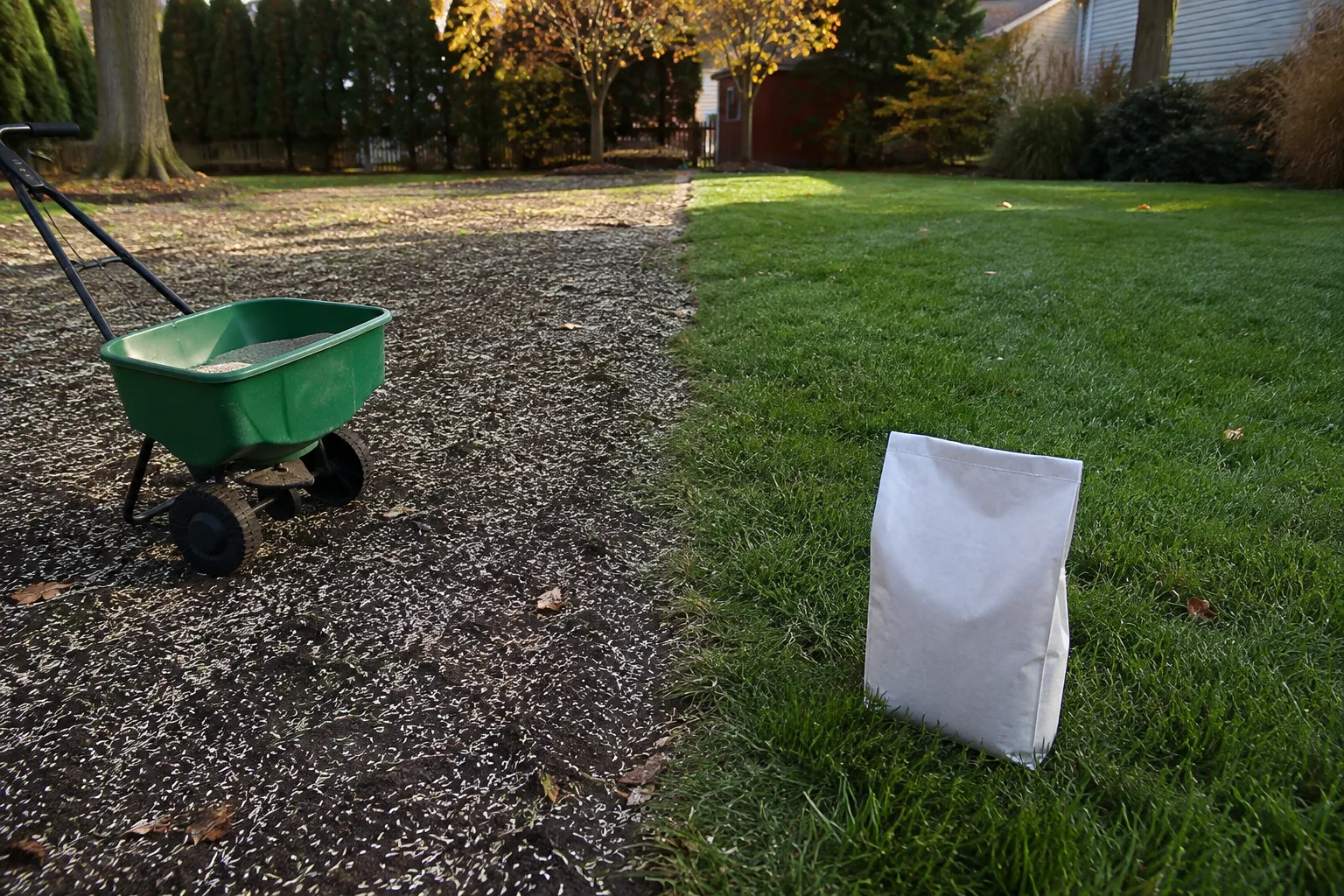
Favor seeding when the lawn is genuinely thin and the grass type, local season and weather outlook support establishment. The objective is not simply to scatter seed. It is to place viable seed where it can touch soil and remain moist during germination.
Start by inspecting the surface. Seed that rests on leaves, dense thatch or upright grass has a poorer opportunity to establish than seed that reaches exposed soil. Correcting that contact can involve preparing bare areas or overseeding after suitable cultivation, but more disturbance is not automatically better.
Core aeration can help where compaction is a real constraint. A core aerator removes plugs with hollow tines, opening routes for air and water and producing places where seed can meet soil. Illinois Extension suggests checking moist soil with a screwdriver at several points as a practical way to investigate compaction. The soil should be moist when aerated, but not saturated. Working waterlogged ground can cause damage rather than improve it.
Do not confuse hollow-tine aeration with punching holes using solid spikes. Spike tools can compress the soil around each hole, adding local compaction instead of removing a core. Nor does every lawn need aeration. A surface that already accepts water and allows easy penetration should not be cultivated merely because aeration appears on an autumn task list.
After sowing, moisture management becomes the central job. The surface of the seedbed needs to stay moist while the seed germinates. There is no responsible universal watering frequency: exposure, temperature, rain, soil texture, grass species, water restrictions and sprinkler performance all change the answer. Inspect the seeded area itself and adjust to current conditions. The aim is consistent surface moisture without puddling, runoff or prolonged saturation.
Before sowing, run the irrigation system and watch where the water lands. A schedule cannot compensate for a blocked nozzle, a misdirected head or an area outside the spray pattern. Hand watering may be needed for small repairs, but the same standard applies: keep the seed zone from drying out without washing seed away. Continue to base decisions on actual soil and plant conditions rather than an unattended timer.
This is also the moment to remove avoidable conflicts. Check every lawn product already applied or scheduled for use. A recent treatment may impose a seeding interval even if the bag of seed says autumn is suitable. Conversely, a future pre-emergent application may need to wait until the new grass has reached a stage specifically permitted by that product’s label. The label, not a generic seasonal checklist, controls that decision.
When weed prevention deserves priority
Pre-emergent treatment makes the stronger case when the turf is adequately dense, the target is a correctly identified annual winter weed, and local guidance indicates that its germination window is approaching. Prevention is most purposeful when it responds to a known pattern. It is less useful as an indiscriminate treatment for any plant that happens to be unwanted.
Look back at where and when the problem occurred. Recurring patches may justify a focused plan, but first consider whether the site conditions also favor weeds. Thin turf, irrigation faults and damaged ground can leave openings that chemistry alone does not correct. Preventing one cohort of seedlings will not rebuild the lawn or solve every underlying maintenance problem.
Timing must be based on local conditions and recommendations. K-State’s early-September prompt is useful for Kansas readers in 2026; it does not establish a fixed date for another state, country or climate. Likewise, guidance developed for Illinois, Missouri or Georgia should be applied within its stated regional and turf context. A local extension service or comparable official horticultural authority is the appropriate place to verify the window.
A treatment applied after the target has emerged may miss the purpose of pre-emergent control. At the other extreme, applying far ahead of the locally relevant period wastes the precision that makes the approach useful. Identify the weed, confirm its stage, and then follow the timing and application conditions on the selected product’s current label.
Do not infer that a product registered for one lawn is safe for another. Turf tolerance, application sites and restrictions differ. In the United States, a pesticide label is legally binding: it specifies where and how the product may be used, the permitted amount and frequency, and required precautions. Readers elsewhere need to check the official registration and label rules in their own jurisdiction. Advice from a neighbor, an old article or a retailer cannot override those instructions.
A practical decision sequence
A short inspection can prevent the cost of wasted seed, an ineffective treatment and weeks of watering the wrong project.
- Identify the turf. Determine whether it is cool-season or warm-season grass and, if possible, the species. Confirm that seeding is an appropriate autumn operation for that turf in your area.
- Define the main defect. Decide whether sparse cover is the immediate problem or whether a recurring annual winter weed is the better-documented risk. Do not treat an already established perennial weed as though it were a seed yet to emerge.
- Verify local timing. Use current advice for your region rather than adopting September dates from a different climate. Seasonal windows can shift with location, grass and conditions.
- Read the complete product label. If herbicide is under consideration, confirm the target, turf species, site, application timing, precautions and all restrictions related to seeding. Check the exact product, not merely the active purpose printed prominently on the package.
- Choose one primary outcome. Where the treatment and seed establishment conflict, either reserve the period for overseeding or reserve it for prevention. Do not compromise both jobs for the convenience of doing them on one weekend.
- Prepare for follow-through. A seeding choice requires soil contact and reliable moisture. A prevention choice requires correct timing and label-compliant use. If you cannot provide the necessary follow-up, postpone rather than perform a nominal treatment.
- Record what was done. Note the area, date, grass or weed identified, product if any, and relevant label interval. That record makes the next seeding or treatment decision safer and helps evaluate whether the work succeeded.
This sequence also reveals when neither job is ready. If the turf cannot be identified, the weed is unknown, heavy runoff occurs during irrigation, or no one can maintain seedbed moisture, buying materials is premature. Diagnosis and preparation are productive lawn care, even when they do not produce a same-day application.
Three common scenarios
A sparse cool-season lawn with no confirmed weed threat. If local guidance supports autumn establishment, direct effort toward seeding. Improve seed-to-soil contact where needed, investigate genuine compaction before aerating, and plan how the surface will be kept moist. Avoid scheduling an incompatible pre-emergent merely because early autumn is also associated with weed prevention.
A dense lawn with a repeated annual winter-weed problem. Confirm the weed and the local germination period. If the turf and site are listed and the label permits the intended use, pre-emergent prevention may offer more value than adding seed to an already adequate stand. Existing mature or perennial weeds still require a separate, correctly diagnosed approach.
A warm-season lawn entering dormancy. Do not import a cool-season September overseeding recommendation without checking its purpose and consequences. Guidance for bermudagrass, centipedegrass and zoysiagrass in Georgia treats autumn as preparation for dormancy and a potential winter-weed prevention period. Owners in other regions should obtain local guidance for their own warm-season turf and climate.
Make irrigation part of the decision
Water is often treated as a detail to arrange after seed has been spread. In reality, the ability to manage moisture should influence whether overseeding is selected at all. Germination depends on the upper surface staying moist, and autumn weather does not guarantee that outcome.
Test the system before committing the lawn to seed. Observe dry edges, blocked coverage and runoff rather than relying only on the controller display. Soil can dry at different rates across slopes, sunny margins and sheltered areas. Respond to those differences instead of increasing water everywhere. Excess water can move seed, carry material away from the intended area and leave soil overly wet; too little can interrupt germination. The useful target is neither a fixed number of daily cycles nor a one-size-fits-all duration, but stable moisture in the actual seedbed.
Where water restrictions apply, make sure the establishment plan complies before sowing. A smaller repair area that can be cared for properly may be more practical than treating the entire yard. If dependable moisture cannot be provided during the relevant period, delaying seeding may waste less seed, water and time.
Pre-emergent use also requires attention to irrigation and weather, but the applicable directions must come from the product label. Do not transfer watering instructions from one product to another or assume that a general online schedule is sufficient. Confirm that the equipment can apply the treatment as directed and that site conditions will not promote runoff.
What not to combine by habit
The central risk is not that two autumn tasks appear on the same list. It is acting as if sharing a month makes them compatible. Seeding advice concerns the successful germination and establishment of desirable grass. Pre-emergent advice concerns interrupting the establishment of a target weed. Unless a particular label and local recommendation reconcile those purposes, they point in opposite directions.
Avoid “just in case” treatment. It can sacrifice a valuable renovation window without addressing an identified weed. Equally, avoid overseeding by reflex where the lawn is already dense and a predictable winter annual has repeatedly caused trouble. Materials, labor and water should follow a diagnosis.
Also resist forcing all problem areas into one yard-wide choice. Conditions can differ from one section to another. A genuinely thin area may need repair, while a separate, established area has a documented weed history. Any area-specific plan still has to respect the label, including permitted sites and restrictions; physical separation does not erase application rules.
The most useful September job is a decision
For cool-season turf, early autumn can offer a valuable establishment period. For annual winter weeds, the same part of the year can bring a valuable prevention period. A good lawn plan recognizes both opportunities but does not pretend they are automatically compatible.
Choose from evidence on the ground: the turf species, density, compaction, weed identity and growth stage. Then place those observations in the correct regional calendar. If seeding wins, concentrate on soil contact and steady, non-saturating moisture. If prevention wins, work from the exact current label and an appropriate local window. If essential facts are missing, pause and identify them.
That deliberate choice is more efficient than an ambitious autumn checklist. It protects seed from a conflicting treatment, keeps pesticide use tied to a defined target, and directs irrigation toward work that can realistically succeed. In many yards, deciding what not to do this September is the step that saves the most time and produces the better lawn next season.
Related articles
After a Hot, Dry Summer: A Practical Recovery Plan for Heat-Stressed Garden Plants
The first rain after a brutal dry spell is not a signal to prune, fertilize, and replant everything. Use a staged recovery check to decide what needs water, what needs time, and what should be replaced.
The September Equinox Garden Audit: Test, Drain and Cover Tired Beds Before Winter
After a dry, demanding season, the most useful fall garden job may be an audit rather than a cleanup marathon. Check what the soil is telling you, correct drainage problems safely, and cover only the beds that can still support a useful autumn crop.
Japanese beetles are back: why traps and a wet lawn can make July worse
A practical July plan for protecting roses, grapes, berries and lawns without turning traps or overwatering into part of the infestation.

Empty Vegetable Beds in September Need a Cover Crop, Not Bare Soil
A practical September guide to choosing oats, rye, clover, radish or a simple mulch for empty vegetable beds, with timing, rates, watering and spring termination caveats.

Comments
Sign in to comment.
No comments yet.