AI did not find a miracle superconductor. It found something more useful
SuperC's new YRu3B2 and LuRu3B2 materials are not room-temperature breakthroughs, but they show how machine learning can make materials discovery less random.

Superconductor headlines are easy to ruin. Add the words "AI" and "room temperature" to the same sentence and the story starts to sound like another miracle claim waiting to collapse.
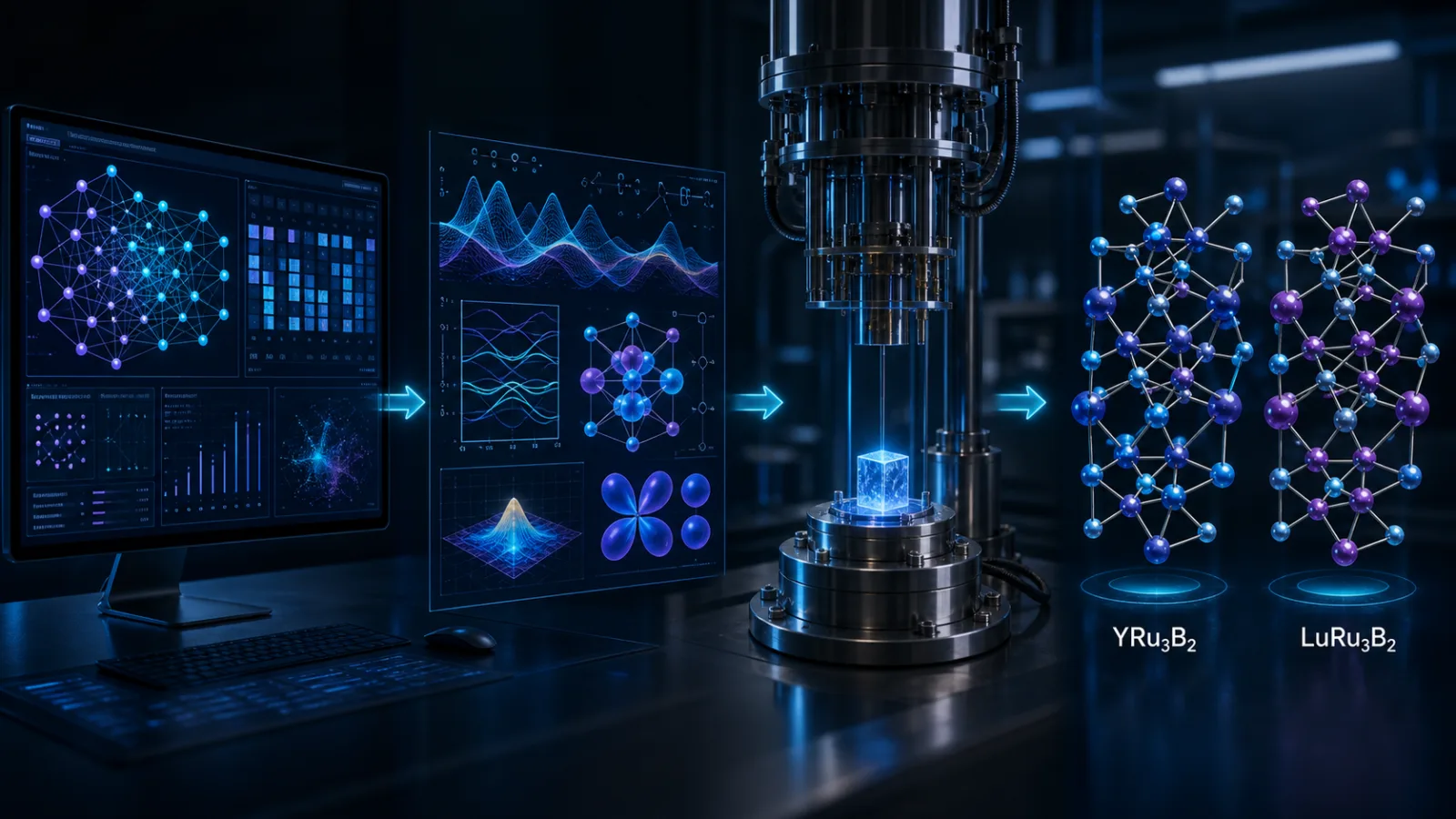
This one is more interesting because it is smaller than that. An international team working through the SuperC consortium, led from Aalto University with experimental work at Rice University, has reported two superconducting kagome compounds: YRu3B2 and LuRu3B2. The study appeared in Physical Review Research on June 17, 2026, and was picked up by ScienceDaily and other science outlets in early July.
The materials do not superconduct at room temperature. Their critical temperatures are low: 0.81 K for YRu3B2 and 0.95 K for LuRu3B2, according to the paper and the arXiv abstract. Nobody is wiring a data center with them next year.
The useful news is the method. The team used machine learning to narrow a huge search space, then used first-principles quantum calculations, then synthesized and tested the candidates in the lab. Magnetization, specific heat and transport measurements confirmed bulk superconductivity, with nearly 100% superconducting volume fractions reported for both compounds.
That is a better kind of good technology news: not a promise that physics has been conquered, but evidence that one hard part of materials discovery can become less random.
What was actually found
YRu3B2 and LuRu3B2 are kagome-lattice compounds. In this context, kagome refers to a hexagonal pattern, named after a Japanese basket-weaving motif, that can produce unusual electronic behavior. In these materials, ruthenium atoms form planar kagome networks. The researchers were looking for flat or quasi-flat electronic bands, which can raise the density of electronic states near the Fermi level and make superconductivity more likely in some settings.
The paper reports bulk superconductivity, not just a weak surface signal. That distinction matters. The authors confirmed the transition using more than one measurement channel and reported large superconducting volume fractions. The transition temperatures are below 1 kelvin, so the materials are scientifically useful rather than immediately practical.
There is also a correction to the simple press-release version. The story is not "AI discovered a room-temperature superconductor." It is closer to: a machine-learning-guided workflow found two low-temperature superconductors that were then checked with normal condensed-matter physics and laboratory measurements.
That is still a real result.
Why the search is so hard
A superconductor carries electric current without resistance. In principle, practical superconductors could cut energy losses, reduce heat, improve magnets, help quantum computing hardware, and change parts of medical imaging, fusion research, transport and power electronics. In practice, the useful materials are hard to find, hard to manufacture, or require extreme conditions.
Materials discovery is an unpleasant search problem. You can combine many elements in many ratios and crystal structures. Then you still have to ask whether the compound is stable, whether the electronic structure is promising, whether it can be synthesized, and whether the measured effect survives checks for impurities or artifacts.
For decades, many superconductors were found by a mix of theory, chemical intuition and luck. ScienceDaily's report says more than 7,000 superconductors have been recognized, while only a small fraction were theoretically predicted before discovery because the calculations are expensive. That number should not be read as a precise law of nature, but the basic point is right: brute-force search is a poor way to explore the space.
Machine learning helps if it makes the candidate list smaller before the expensive steps begin. It does not replace those steps. It filters.
The pipeline matters more than the two compounds
The SuperC work is useful because it connects four stages that are often discussed separately.
First, the model screened possible compounds and looked for patterns associated with promising kagome superconductors. Then quantum calculations tested the candidates more seriously. Then chemists and physicists synthesized the materials. Then experiments checked whether superconductivity was really present.
That sequence is why the result deserves attention. A model prediction alone would be interesting but fragile. A lab measurement without a scalable search method would be another isolated material. Together, they show a path that could be repeated.
The authors also compared the new compounds with LaRu3Si2, another kagome superconductor. Their analysis points to more dispersive ruthenium quasi-flat bands and a harder phonon spectrum in the new materials, which lowers electron-phonon coupling compared with the reference system. That is not headline material for a general audience, but it is exactly the kind of detail that separates a real paper from a miracle post.
Why skepticism is healthy here
Superconductivity has trained readers to be suspicious. LK-99 and other viral claims made the public conversation noisy: a preprint appears, social media declares a new era, and then the replication work starts removing the magic.
That skepticism is not cynicism. It is the right instinct. A serious superconductivity story has to answer boring questions: What is the transition temperature? Under what pressure and magnetic field? Is the signal bulk or local? Can other groups reproduce it? Is the material stable and scalable? Does it solve a practical engineering problem, or only a physics one?
For YRu3B2 and LuRu3B2, the answers are modest. The transition temperatures are far below room temperature. The work is early. The materials are not products. But the paper gives names, formulas, measurements, authors, institutions and a peer-reviewed venue. That is a very different category from a viral claim with no solid measurement trail.
What AI did and did not do
AI did not invent superconductivity, skip the lab or prove that low-loss electronics are around the corner. The model helped decide where to look.
That distinction matters because "AI for science" often gets sold as if software can replace the slow parts of research. In materials work, the slow parts are still there. Someone has to make the sample. Someone has to measure it. Someone has to explain why the signal appears and whether it survives cross-checks.
The good version of AI in science is less glamorous. It gives researchers a shorter shopping list. It notices patterns across databases and calculations. It reduces the number of dead ends. Then humans and instruments do the expensive work.
That is enough. If a workflow can turn a nearly impossible search into a smaller, testable set of candidates, it changes the odds.
Why it fits Good Tech News
Good technology news does not have to mean cheerful technology news. This story is positive because it improves the process, not because it promises instant abundance.
A practical room-temperature superconductor would be a huge event. It could make some electrical systems less wasteful and some scientific instruments easier to build. But that future depends on materials that work at accessible temperatures, tolerate realistic fields, can be made reliably, and fit into engineering systems.
This paper does not deliver that. It delivers a map-making improvement. It shows that machine learning, quantum theory and experiment can be chained together in a way that produces real materials, not just predictions. In a field where search is one of the bottlenecks, that is meaningful.
What to watch next
The next useful questions are not flashy. Can other labs reproduce the measurements? Can the workflow find materials with higher critical temperatures? Does it work outside this family of kagome compounds? Can it incorporate synthesis difficulty, toxicity, cost and stability, not only electronic promise?
If the answer is yes, the value may show up gradually: more candidate materials, fewer wasted experiments, better theories about which crystal geometries matter, and a clearer route toward useful superconductors.
That is not a revolution you can plug in. It is a better search engine for one of physics' most stubborn material problems. For now, that is the honest good news.
Related articles
Chrome’s AI security push is good news because it is boring engineering, not magic
Google says Chrome fixed 1,072 security bugs in two milestones. The real achievement is a bounded pipeline for discovery, triage, tests and faster releases.

Copilot for Word makes document trust an IT security problem
A new disclosure shows how hidden instructions in office files can cross from source material into AI-generated documents. Microsoft 365 rollouts now need a document trust model.


AI search has turned Reddit spam into a business risk
Reddit’s LLM-powered spam fight shows how answer engines are changing marketing: brands want AI recommendations, but fake community consensus can damage trust fast.


Open source needs a new spam filter for AI-generated pull requests
AI can help contributors, but it also makes low-effort PRs and security reports cheap. Maintainers need rules that protect attention without closing the door.

Comments
Sign in to comment.
No comments yet.